
In a recent post, I asked my readers to help me identify those catalysts that force the actions required to steer our future towards advancing our human development. Feel free to respond to the Poll. The number one response was the rapid pace of innovation. That response supports my own opinion that the pace will ultimately force stakeholders across multiple domains to take action. Much like the Domain Convergence that occurred during our most Transformative Period in History, convergence is required if we are to take the correct path towards human flourishing.
Three Trillion Reasons
I had the pleasure of delivering a dinner keynote at this weeks SAP Ariba Live event. I was very impressed with the event theme: 3 Trillion Reasons. That theme is a play on the nearly $3 trillion in commerce flowing through SAP Ariba annually. Although that number speaks to commerce, the theme spoke to purpose. As positioned on this Blog frequently, I expect a continued Shift to Purpose and Well-Being.
Systems Thinking: The Key to Thriving in a Complex Future
Our future is very complex. The sheer number of building blocks complicates not just our ability to see the future, but any chance we have to navigate it. As these building blocks combine in ever increasing ways, the challenges multiply. Leaders of tomorrow will move towards systemic leadership, having an ability to connect dots. Innovation will move from a myopic view of offerings to systems innovation.
To accomplish this, systems thinking must be embraced by leaders. Systems thinking is a holistic approach to analysis that focuses on the way that a system’s constituent parts interrelate and how systems work over time and within the context of larger systems. As leaders, we struggle with this holistic approach, choosing instead to focus on short term versus long term, and delivering immediate results versus positioning for the future. This focus is in direct conflict with where our complex future is taking us.
Self Driving Delivery
The hype around autonomous technology continues. The focus, investment and rapid advancement in this space has changed the way leaders Think about the Future. The science-fiction feel of a future-focused discussion has disappeared – replaced by the reality that the future is appearing faster than we think. Look no further than self-driving delivery.
Ecosystem Readiness
As the world continues its march towards platform-supported ecosystems, organizational readiness becomes a critical area of focus. Four facets of an organization contribute or detract from success in an ecosystem world:
- The mental models that drive an organization
- The lens in which an organization views value creation and capture
- The orientation of an organization – which in most cases is shareholder value
- The organization’s culture
The growth engine that ecosystems represent will serve as a forcing function, pushing Organizations to Mature across these key facets. For example, I firmly believe that over time, a transition occurs from shareholder value to stakeholder value. This transition places purpose at the center, with shared value at its core (Click on the Visual to expand).
The Catalysts that Drive Human Action
The conversation regarding catalysts that drive human action has been fascinating. This poll initially launched back in February has had a great response – with some great insight. Please take the poll if you have not already.
One of our Lessons from History was the presence of catalysts that drove actions that ultimately shaped our future. The major catalysts of the second revolution were astounding levels of innovation,
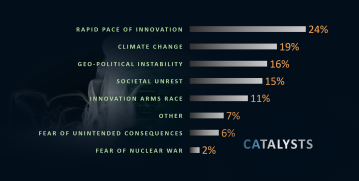
World War One, The Great Depression, World War Two, and the eventual democratization of innovation. What catalysts force stakeholder actions that ultimately shape our emerging future? Please help me build on this list and identify the most significant catalysts. Choose all catalysts that you feel will contribute – or add anything that I am missing. For a deeper description of catalysts, please see the lessons from history post.
Globalization 4.0
Within the context of the Fourth Industrial Revolution, the World Economic Forum is focused on Globalization 4.0. We are actually approaching Globalization’s Third Act. In a book titled The Great Convergence, Author Richard Baldwin describes the three constraints that have limited globalization: the cost of moving goods, the cost of moving ideas, and the cost of moving people. The first two acts of globalization occurred when the cost of moving goods and ideas dropped. While globalization raised the standard of living in several developing economies, the third constraint limited the breadth of impact.
In his closing chapter, Mr. Baldwin explores the possibility of a third act. This act is driven by dramatic advancements in areas that address the third constraint. If the cost of moving people were to drop, developing nations like South America, Africa, and others could be the beneficiaries of this third act. That aside, the World Economic Forum is looking at global risks and the need for global solutions. They identified Six Questions that must be addressed to make the next wave of Globalization work for all. They correctly state that facing future challenges requires dialog and input from all. Kudos to them for driving the dialog. The six questions are:
- How do we save the planet without killing economic growth?
- Can you be a patriot and a global citizen?
- What should work look like in the future?
- How do we make sure technology makes life better not worse?
- How do we create a fairer economy?
- How do we get countries working together better?
A very good set of questions. You can see how people responded to them by going Here.
Reimagining the Future
Future thinking has often focused on a three-horizon framework that allows for the continued advancement of core business, while planning for emerging opportunities. I believe the challenge these days is time compression associated with rapid advancement. When someone says to me: “I’m not worried about five years from now”, my reaction is always the same. What looks to be five years out is likely only 18 months away: A phenomenon I describe in this piece on Acceleration.
Possibilities
As I reflected on my Thoughts for 2019, three themes stood out. I’ve already written about Convergence and Acceleration, so this post will focus on possibilities. As described recently, I believe the world will experience a Burst of Possibilities enabled by the forces of convergence and acceleration. We should expect these possibilities to multiply in 2019, but realization depends upon multiple factors. One of these factors is a true focus on purpose, posing this question for humanity: how do we harness these possibilities to bring about a better world?
 In arguing the case for purpose-orientation and possibilities, I created this visual that maps future advancements to our areas of well-being (click on visuals to enlarge them). I could create a different one that shows how these same advancements can be used to diminish our well-being. That’s why convergence is the most critical theme among the three. An effective way to think about purpose and possibilities is via the United Nations Sustainable Development Goals. These are among the best-known and most frequently cited societal challenges. I believe we are entering a period of astounding innovation – advancements that have the potential to address these goals.
Acceleration
As I described in my Thoughts on 2019 post, acceleration is the second major theme for me in 2019. The pace of innovation and change is often cited as a key difference between the next revolution and prior ones. We even came up with a catchy phrase to describe it: exponential progression. How did we come upon the notion that we live in world that is now moving at an exponential versus linear pace? Some explain it with a story; we have entered the second half of the chess board. Ray Kurzweil an American author, inventor, futurist, and director of engineering at Google describes the second half of the chessboard as follows: once you reach the second half of the chessboard, changes are exponential. Each new square doubling that of the previous. Moore’s Law is said to have entered the second half of the chess board in 2013. A good description of this phenomenon can be found here.
This doubling accelerates the path to innovation. With an endless supply of building blocks fueling rapid value-creating combinations, this effect is amplified. While the window to realize value from innovation has shortened, there is a Rising Speed of Technological Adoption. Jeff Desjardins, Editor-in-Chief of Visual Capitalist, had this to say:
In the modern world, through increased connectivity, instant communication, and established infrastructure systems, new ideas and products can spread at speeds never seen before – and this enables a new product to get in the hands of consumers in the blink of an eye. Why do newer technologies get adopted so quickly? It seems partly because modern tech needs less infrastructure in contrast with the water pipes, cable lines, electricity grids, and telephone wires that had to be installed throughout the 20th century. However, it also says something else about today’s consumers – which is that they are connected, fast-acting, and not afraid to adopt the new technologies that can quickly impact their lives for the better.
Convergence
As I described in my Thoughts on 2019 post, convergence is one of the key dynamics I expect/hope to see more of this year. A century ago, a convergence across domains ushered in unprecedented advancements in human development. As Robert J. Gordon describes, the special century (1870 – 1970) that followed the Civil War was made possible by a unique clustering of what Mr. Gordon calls the great inventions. The great inventions of the second industrial revolution significantly improved our well-being. In his view, the economic revolution of 1870-1970 was unique in human history, unrepeatable because many of its achievements could only happen once. What makes this century so special, is that these inventions altered what until then, was a life lived in misery. I captured the advancements made during that period using an Innovation Wheel to map them to our areas of well-being (click on visuals in this post to open in a separate window).
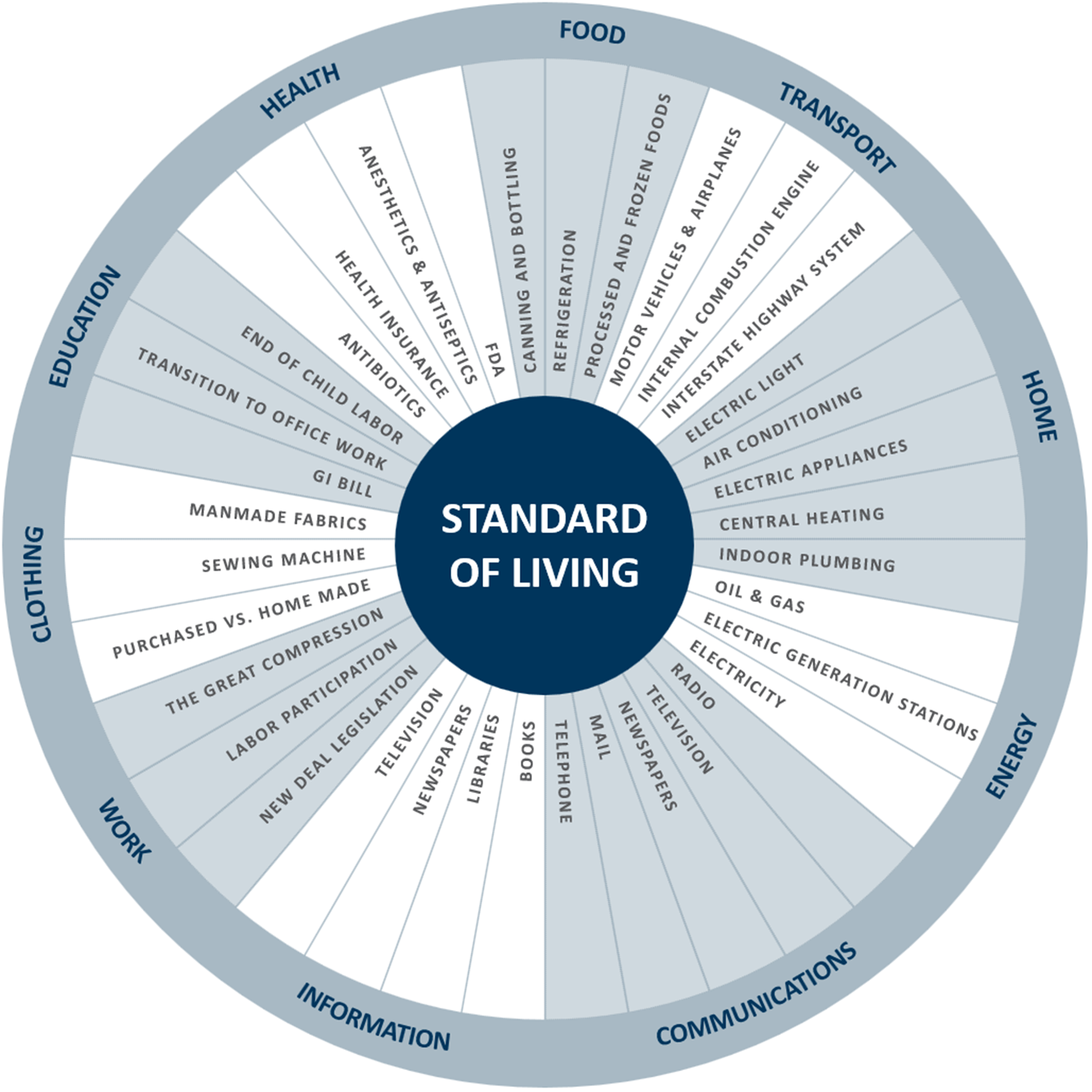
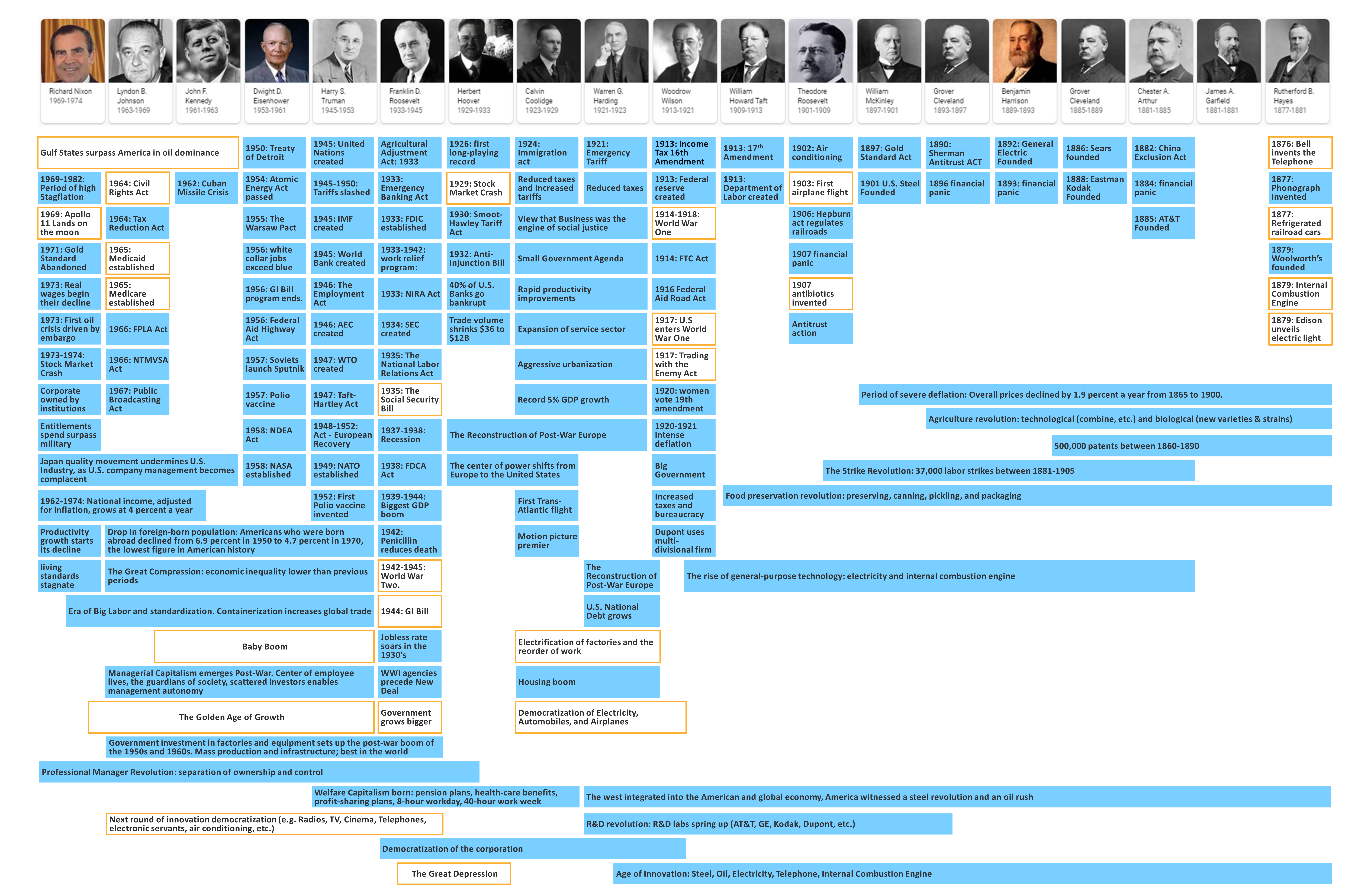
A look at history is very instructive, as several dynamics from that period have the potential to emerge once again – the biggest being the opportunity for convergence. In this context, convergence refers to a virtuous cycle where events in one domain spur action in another. The great inventions (electricity, telephone, and internal combustion engine) were clustered together at the end of the 19th century, forming a virtuous cycle that drove a period of astounding innovation. This innovation cycle continued well into the 20th century – a dynamic that could be emerging again. Yet, science and technology are simply two domains that converged during the special century. The others were the economy, business, politics, and a broader set of societal issues. What enabled this convergence and created the most dramatic improvement in human development? There were several key catalysts.
The Future of Retail
The National Retail Federation (NRF) kicked off it’s annual event this week, and with it comes an opportunity to consider the future of retail and the type of changes we might expect. Colleagues at Tata Consultancy Services (Kevin Mulcahy, Bill Quinn, and April Harris) pulled together their thoughts ahead of the event. You can explore the future of Retail via this Article, and/or the short video below.
What to Expect in 2019
With the start of a new year, the traditional focus on predictions has begun. Prognosticators do so at their own peril – as this New Yorker Article clearly articulates. It seems that in 1968, the Foreign Policy Association (formed in 1918 to promote the League of Nations), celebrated its fiftieth anniversary by publishing a book of predictions about what the world would look like in fifty years. Well, here we are fifty years later, and if history is any guide, futurists have very little credibility. Although predictions these days may be even more difficult given our complex systems are progressing and scaling at an unprecedented rate, a macro-level focus can provide an ability to scan beyond the horizon. So rather than attempt to predict, here are my 2019 thoughts on several macro-level forces.
Futurist Influence Ranking
Futurist Ross Dawson compiled a ranking that measures the web and social media influence of Futurists around the globe. The methodology and approach are outlined on his website where he presents his rankings of 219 Futurists. I am humbled by my inclusion. The influence ranking can be found Here.
A Moral Machine

This question underscores the need to proactively manage the path towards these possible futures – and the discussion surrounding ethics plays a critical role. Enter initiatives like Moral Machine from MIT. As described by their website, machine intelligence is supporting or entirely taking over ever more complex human activities at an ever increasing pace. The moral machine provides a platform for building a crowd-sourced picture of human opinion on how machines should make decisions when faced with moral dilemmas. Given the challenges of coding an ambiguous set of morals and ethics into machines, crowdsourcing makes great sense. So visit the Moral Machine platform and add your voice to the conversation.
AI Superpowers: China, Silicon Valley, and the New World Order – Summary
I just finished a fantastic book on artificial intelligence and the evolutionary path of China and the U.S.. Author Kai-Fu Lee inspires, as he focuses on the astounding capabilities of AI, and the one thing that only humans can provide; love. The journey includes the author’s own brush with mortality, and proposes a path forward: the synthesis on which we must build our shared future is AI’s ability to think, coupled with a human’s ability to love. He believes this synergy harnesses the undeniable power of artificial intelligence to generate prosperity, while also embracing our essential humanity. His hope for our future lies both in this new synergy between artificial intelligence and the human heart, and an AI-fueled age of abundance that fosters love and compassion in our societies.
I recommend reading this book from cover to cover. In the meantime, here is a summary organized by several key themes.
Techno-Philanthropists Drive Exponential Progression
A group of billionaires have pledged one billion dollars to fund radical new energy technologies. Breakthrough Energy Ventures (BEV) is an investment fund that aims to accelerate energy innovation and disrupt the energy industry. This Bill Gates brainchild managed to secure a host of high-profile investors, including Jeff Bezos, Richard Branson, Jack Ma, and Michael Bloomberg – and they’ve just announced their First Seven Investments.
The Growth of Knowledge
Knowledge is the engine that drives human development – and it has been throughout history. Knowledge expanded in the hunter-gatherer days with the invention of fire. In those days, a human obtained all its food by foraging. Although the source of food did not change, fire allowed humans to cook food and consume more calories. The human brain expanded with this caloric increase, and soon we invented language – the first in a series of innovations that drove the growth of knowledge.
Marriage, Alternative Living, Biometrics, and the Rise of Nationalism
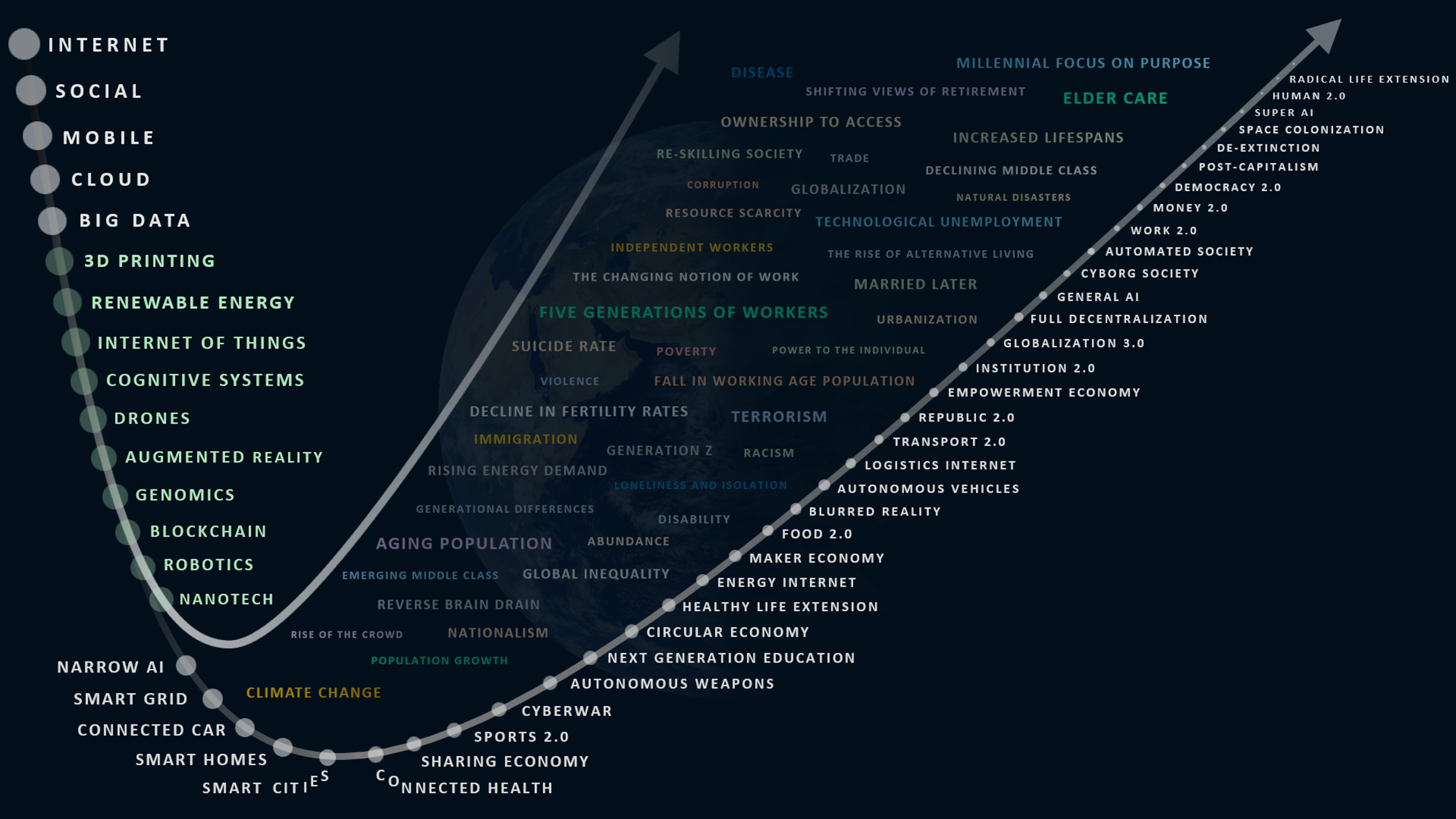
The visual below depicts aspects of our emerging future (Explained Here). I update it periodically to reflect impactful areas that affect the science and technology foundation, the future scenarios they spawn, and the wide array of societal factors that interact with both.
 Reimagining the Future