Beyond Human Scale: How AI Expands The Space Of Possible Futures

When AI takes knowledge beyond human scale, the number of plausible futures expands dramatically. This is not because the world becomes more random, but because more options become visible. As knowledge is continuously interpreted and synthesized across domains, new combinations, pathways, and secondary effects emerge faster than humans can naturally track. The future stops narrowing on its own.

Continue reading

A Post Pandemic Society

Updated December 16, 2025: Five Years Later

I am resurfacing this post because it captures a moment when convergence became impossible to ignore. Long before the pandemic, my work focused on how multiple domains — science, technology, society, economics, geopolitics, philosophy, and environment — were beginning to move together, creating conditions where change felt faster, more uneven, and harder to predict. COVID-19 did not initiate that convergence, but it revealed it in compressed form. The systemic change series builds on this longer arc of thinking, extending beyond the pandemic to examine how these forces continue to interact and reinforce one another today. This post remains relevant not as a historical artifact, but as an early, real-time glimpse into dynamics that are still unfolding.

Continue reading

Do We Shape The Future — Or Drift Into It?

This series began with a simple observation: something feels different about the world right now. Not just faster. Not just noisier. But more tightly connected, more reactive, and harder to stabilize using the assumptions we inherited from the last age. Over the course of these posts, we made that feeling legible. We explored how systems change, why pressure accumulates, and how societies move through periods of compression before reorganizing around new forms of order. We looked at history not to romanticize the past, but to recognize patterns that repeat when civilizations cross thresholds.

Continue reading

The Traits We Need For The Future We’re Entering

Over the last ten posts, we have been building a clearer picture of what it means to live in a world approaching a systemic turning point. We began by examining why today feels unusually active and uneven, then traced the deeper pattern behind major shifts in history. We explored how change accumulates, compresses, destabilizes, and eventually reorganizes life around new assumptions. We introduced the seven domains that shape every transition and showed why no single force ever moves a civilization forward on its own. We examined the three drivers that push societies across thresholds and built gauges that make systemic pressure legible. Using those gauges, we read four major transitions in the long arc of history: from hunter-gatherer life to agriculture, from agriculture to the Axial reorientation of ideas, from the Axial age to the Renaissance, and from the Renaissance into the Industrial world. We then applied the same lens to the present, showing why the 2020s feel dense, fast, and tightly connected. Most recently, we explored the possibility of another transition forming and the kind of governance required when intelligence itself becomes a shared utility. Together, these posts formed a simple arc: understand the moment, understand the mechanics, understand what may be forming next.

Continue reading

The Compressed Present

THE BIO-INTELLIGENT SIGNATURE: A LENS ON THE CURRENT AGE

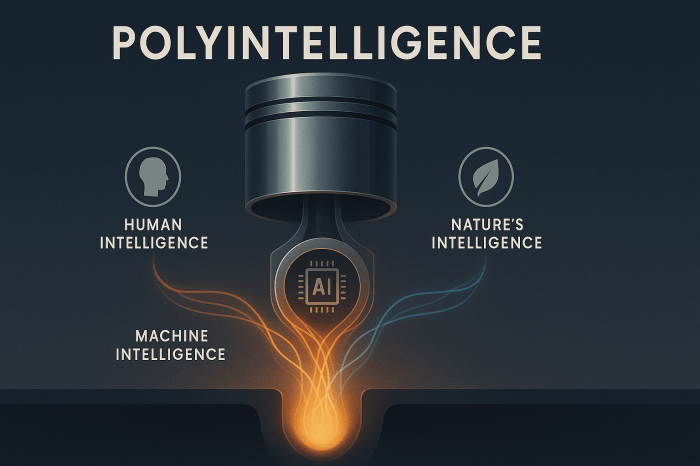
The present moment is shaped by three converging streams of intelligence: machine intelligence, biological intelligence, and planetary intelligence. These are the same sources that form what I have described elsewhere as polyintelligence — cognition distributed across humans, machines, and nature. Each stream is advancing on its own, but their deeper significance appears in how they now influence one another. Artificial intelligence extends cognition beyond the human mind. Synthetic biology brings design and computation into living systems. And the planet — long treated only as a resource base — is increasingly recognized as a source of insight. Through biomimetics, natural systems provide design principles refined through evolution: circularity instead of waste, resilience through diversity, and adaptation through constant sensing and feedback.

Continue reading

Crossing The Threshold

Civilization’s great shifts are the moments when continuity fails and a new order takes shape. Each historical age reached a point where the old logic could no longer hold, and pressures converged into a transformative release. By examining four major transitions – from Hunter–Gatherer to Agricultural, Agricultural to Axial, Axial to Renaissance, and Renaissance to Industrial – we can see how rising Total Systemic Domain Score (TSDS) and changing Activation Dispersion (AD) signaled that a threshold was near. Some transitions unfolded slowly over millennia, while others struck within a few centuries. In each case, the build-up of energy and imbalance hit a critical point, and society crossed into an irreversible new configuration that only in hindsight feels inevitable.

Continue reading

What The Gauges Reveal Across The Ages

Over the first seven posts, we explored the seven domains that shape civilization, the forces that move within them, the thresholds that mark major transitions, and the drivers that push systems toward those turning points. We also built two gauges that help make those movements visible. TSDS shows how much energy sits across the seven domains. AD shows how that energy is arranged. Together, they help us see the internal structure of an age: how active its domains were, how evenly that activity spread, and how tightly the system was coupled. With that groundwork in place, we can now use the gauges to trace the long arc of history and examine how pressure accumulated across major ages of civilization.

Continue reading

How The Gauges Were Built: Making Systemic Pressure Legible

Over the first six posts, I built the foundation needed to understand how civilizations change. I explored the seven domains that shape collective life, the forces that move within them, the thresholds that mark historical turning points, and the three drivers that push systems toward those moments. With that groundwork in place, I introduced a pair of gauges that make those movements easier to see. In this post, I describe the gauges in greater detail. TSDS reflects how much energy sits across the seven domains. AD shows how that energy is arranged. Before we apply these gauges to the long arc of history, we need to explain how they were built. Every measure rests on a set of choices. This post walks through those choices in a way that keeps the gauges intuitive while grounding them in the history they aim to describe.

Continue reading

Reading The Pulse Of A Civilization In Motion

The first five posts laid the foundation for understanding why the world feels dense, fast, and tightly connected. We explored the sense that something in the operating logic of civilzation is shifting. We looked at phase transitions, the four-stage pattern that repeats across history, and the seven domains that structure civilization. The last post introduced the three deep drivers that push civilizations across thresholds: growing convergence, system-shaping technologies, and the acceleration of knowledge. Taken together, they help explain why pressure builds, why systems couple, and why some ages move differently than others.

Continue reading

The Three Drivers That Push Civilizations Across Thresholds


The earlier posts introduced the sense that the world’s operating logic is beginning to shift, explored what compression feels like in daily life, and laid out the four-stage pattern that has shaped every major transition in history. Post Four explained why those transitions do not come from singular breakthroughs but from the interaction of multiple domains moving together. Before we can measure that interaction in today’s world, we need to understand the deeper forces that give convergence its power. These forces have shaped every civilizational transition across the long arc of history. They determine when pressure accumulates, how tightly systems couple, and what pushes society toward a threshold.

Continue reading

Why No Single Force Changes The World

RECAP FROM THE SERIES SO FAR

In the first post, I described the sense that the world’s operating logic is turning over. In the second, I explored what that feels like in daily life — the tightening, the pressure, the sense that everything is connected. The third post revealed the pattern beneath these moments: a four-stage rhythm of accumulation, compression, instability, and reordering that has shaped every major transition in history.

This post turns to a deeper question. If these shifts are so powerful, what triggers them? The answer is rarely what we expect.

Continue reading

How Big Shifts Unfold — And Where We Are Now

RECAP FROM THE SERIES SO FAR

In the first post, I explored why so many parts of life feel unsettled at the same time: all seven domains of civilization are active and amplifying one another. In the second post, I described the tightening that happens before major shifts — the compression that makes events feel more connected, faster, and harder to absorb. This post turns to the deeper structure beneath these shifts. When we look at history, we see a repeating pattern in how civilizations change shape.

Continue reading

Why Everything Feels Like It’s Changing At Once

Recap from Last Post

I opened this series by exploring why the world feels unsettled in ways that don’t fit the usual explanations. I introduced the idea of systemic change: moments when multiple parts of civilization become active at the same time, pushing and amplifying one another. I described today as a phase of compression, where pressures build across domains faster than old structures can absorb them. This post will bring that idea down to everyday experience. What do phase transitions feel like in normal life?

Continue reading

When Systems Turn Over

This post marks the beginning of a new series on systemic change — an exploration of how civilizations transform at the deepest level. Over the coming weeks, we’ll trace the rhythm of history, examine the forces that drive reordering, and explore why this moment may be the first time in history when every domain of human life is active at once. Each post will build on the last, revealing how science, technology, society, geopolitics, economics, philosophy, and the environment are converging toward a new operating logic for civilization.

Continue reading

The Evolution Of Political Order — And What Might Come Next

Every society invents new ways to organize power. Each system begins as an answer to the limits of the one before it – and eventually becomes the next problem to solve. As our world grows more interconnected, the frameworks that once defined legitimacy and belonging are starting to crack. Something new is forming in the spaces between.

Continue reading

The Ambient City: When Intelligence Becomes Infrastructure

Across every domain I have explored – from education and energy to health, governance, and human longevity – one pattern keeps reappearing whenever society encounters a General Purpose Technology. These are the rare breakthroughs that do not simply make us more efficient but fundamentally restructure how civilization operates. Language, writing, the printing press, the steam engine, and electricity each changed not only what we did, but who we became. Artificial intelligence may join that lineage.

Continue reading

Learning in the Age of AI

I recently wrote about the evolution of learning. A recent article takes this conversation further. Here is a short summary:

Continue reading

Book Review: How Countries Go Broke: The Big Cycle By Ray Dalio

Ray Dalio has long been a student of cycles – economic, financial, and societal. His latest book, How Countries Go Broke: The Big Cycle, is a sweeping examination of how nations rise, peak, and decline, often repeating the same mistakes across history. For anyone trying to make sense of today’s turbulent geopolitical and economic environment, Dalio’s work is both a warning and a guide.

Continue reading

Learning’s Next Phase, Captured On Video

Yesterday, I explored a powerful story: how human learning has evolved from vertical to horizontal, and now toward something even more transformative – ambient.

For most of history, learning was vertical, flowing down through families and traditions. The rise of schools, books, and digital platforms expanded it horizontally, allowing knowledge to move sideways across communities and institutions. But today, a new phase is emerging: ambient learning. In this model, knowledge doesn’t just pass down or across – it surrounds us. Supported by AI, sensors, and connected environments, learning becomes ever-present, context-aware, and seamlessly woven into daily life.

Continue reading

The Evolution Of Learning: From Vertical To Horizontal To Ambient

For most of human history, learning was vertical. Knowledge flowed downward, generation to generation, through families and traditions. A farmer taught his child the rhythms of the land, a craftsperson trained an apprentice at the workbench, a parent passed on rituals of faith and culture. The family was the classroom, and survival depended on what could be remembered and repeated.

Continue reading