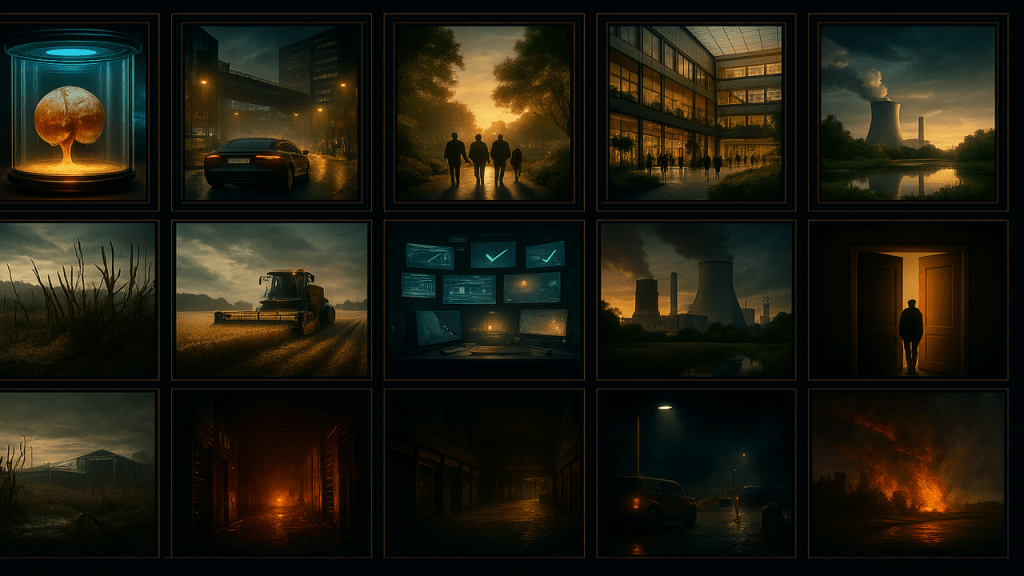
When AI takes knowledge beyond human scale, the number of plausible futures expands dramatically. This is not because the world becomes more random, but because more options become visible. As knowledge is continuously interpreted and synthesized across domains, new combinations, pathways, and secondary effects emerge faster than humans can naturally track. The future stops narrowing on its own.
Historically, human limits acted as a filter. We could only see so many possibilities, consider so many tradeoffs, and pursue so many paths at once. That constraint simplified decision-making, even if it also slowed progress. When that constraint weakens, the space of what could happen grows faster than our ability to reason about it intuitively.
This is where traditional planning and prediction begin to fail. When the possibility space explodes, asking “what will happen” becomes less useful than asking “what could happen next, and then next after that.” Understanding the future becomes a matter of mapping branching paths rather than projecting a single line forward.
Possibility Chains are a response to this condition. They are a way to make expanded possibility space navigable. Instead of collapsing complexity into a forecast, they lay out sequences of plausible developments, showing how one change creates conditions for the next. They allow leaders to rehearse futures rather than predict them.
In a world where AI expands knowledge beyond human scale, the role of humans is not to calculate every outcome. It is to choose which paths to prepare for, which risks to mitigate, and which opportunities to cultivate. Possibility Chains exist to support that work—turning overwhelming possibility into structured foresight and intentional choice.


Leave a Reply