How insurance connects climate risk to the future of home and community
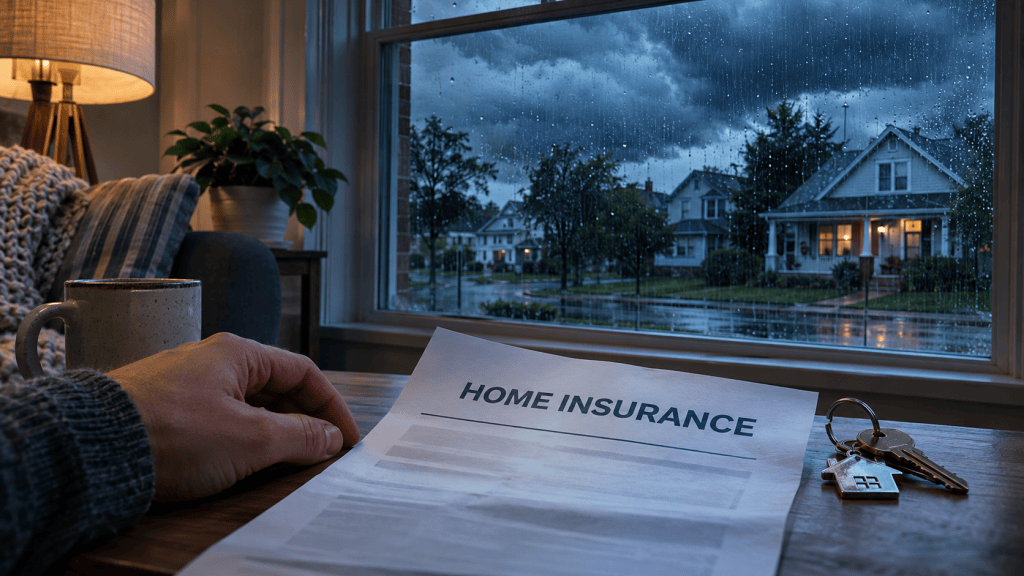
A home insurance renewal notice can seem like a routine part of household life. But when the cost of coverage rises sharply, or an insurer decides not to renew a policy, the consequences can reach beyond the premium. For many families, insurance is connected to a mortgage, the value of a home, and the ability to recover after a disaster. As risks and rebuilding costs change, those connections raise a larger question: what does it take to remain in the place you call home?
A Federal Reserve report on the economic well-being of U.S. households, published in 2026, found that 20 percent of insured homeowners surveyed in 2025 said they wanted more coverage but could not afford it. Fourteen percent said they struggled to afford their premiums. The survey does not establish how much of that strain is caused by climate change. It does show how many households are already weighing the protection they want against what they can afford.
Having a policy does not mean every kind of damage is covered. The Consumer Financial Protection Bureau notes that standard homeowners policies generally exclude flood damage, for which coverage is usually purchased separately. For some homes in designated high-risk flood areas, borrowers with mortgages from federally regulated lenders or backed by federal programs are required to carry flood insurance. A household may need to include that additional cost in its housing budget.
These financial decisions are taking place against a changing physical backdrop. The Fifth National Climate Assessment reports that climate change is affecting the frequency or severity of several kinds of extreme events. It also notes that growth in the number of people and buildings in exposed areas can contribute to disaster losses. The effect on a particular community, and on the cost of insuring a home there, depends on the hazards it faces and other local conditions.
The relationship between risk and insurance costs becomes clearer when we look at differences across places. In a 2025 analysis, the U.S. Treasury grouped ZIP codes by the share of building value expected to be lost each year to nine perils, including hurricanes, wind, and wildfires. Flooding was not included in that risk measure. Between 2018 and 2022, policies in the highest-risk fifth of ZIP codes had average premiums 82 percent higher than policies in the lowest-risk fifth. The comparison describes differences between places; it does not measure how much premiums rose over time or how much climate change contributed to an individual bill. Nonrenewal rates were also higher in the higher-risk group.
Insurance costs are not changing in the same way everywhere. The Government Accountability Office estimated that the average U.S. homeowners insurance premium rose about 27 percent between 2019 and 2024, or about 3 percent after adjusting for inflation. Some ZIP codes experienced increases of more than 25 percent even after inflation. The cost of rebuilding, local risks, insurance markets, and regulation all play a part in what households pay.
For a homeowner who pays insurance through an escrow account, a higher premium can increase the total monthly mortgage payment even when the interest rate on the loan is fixed. If required coverage lapses, a mortgage servicer may obtain a policy and charge the borrower. The Consumer Financial Protection Bureau explains that this coverage is usually more expensive and, in many instances, protects only the lender.
Risk and insurance costs can also enter decisions about a home’s value. In a 2026 working paper, Federal Reserve researchers examined about 465,000 mortgage-financed sales of single-family homes in Florida between 2012 and 2024. After accounting for location and other characteristics, they found that higher expected losses from non-flood weather hazards were associated with lower sale prices. Insurance premium rates, measured relative to coverage and deductibles, were also associated with lower prices, though the relationship was more modest. The researchers could not determine whether the association between weather risk and home values operated through insurance prices. The findings describe associations in one state; they cannot tell us what will happen to an individual home.
For a family whose savings are tied up in a home, a change in its value can have immediate consequences. A prospective buyer must weigh insurance alongside the mortgage and other costs of ownership. A current owner who wants to move may face a different calculation if buyers see greater risk in the property. The ability to leave can depend in part on what the home will sell for and what another place will cost.
The effects can reach beyond homeowners. Landlords facing higher insurance costs may try to recover some of the expense through rent, depending on leases and local market conditions. A community that loses residents or property value could face pressure on the resources available for schools, roads, and other services at the same time it needs to invest in protection. Whether those pressures develop will depend on local conditions and the decisions made there.
The options are not the same for every household. A family with savings may be able to absorb a higher premium or invest in improvements. Another may have to accept a larger deductible or less coverage. Moving can be difficult when work, family, schools, and community are tied to the place someone would leave. For people whose financial resources are already stretched, the range of available choices can narrow quickly.
There are ways to reduce exposure. Stronger buildings, better drainage, and measures that limit wildfire risk may reduce potential losses, although they require investment and do not guarantee an immediate reduction in an individual premium. Decisions about where and how to build can also influence the risks that households and communities face over time.
Some states have insurance plans intended for homeowners who cannot obtain coverage in the private market. The Government Accountability Office notes that these plans generally offer less coverage than private policies and that, in some cases, deficits can lead to assessments on certain private insurers in the state. Depending on state rules, insurers may be allowed to recover some of those assessment costs from other policyholders. These plans can help preserve access to coverage, while leaving important questions about how losses will be funded and how risks can be reduced.
To me, this brings us back to how we share the financial consequences of risk. Insurance helps spread those consequences, but when coverage becomes more expensive or harder to obtain, the underlying exposure remains unless it is reduced. More of the financial burden may be carried by households, lenders, other policyholders, or public institutions, depending on the circumstances. The way those costs are shared can influence the choices available to families and communities.
For the family opening a renewal notice, the immediate question may be how to afford another increase. For the community around that home, the question may be how to make protection available and keep the place viable for the people who live there. The decisions made now about reducing risk and sharing its costs will help shape how much choice those families have in the years ahead.


Leave a Reply