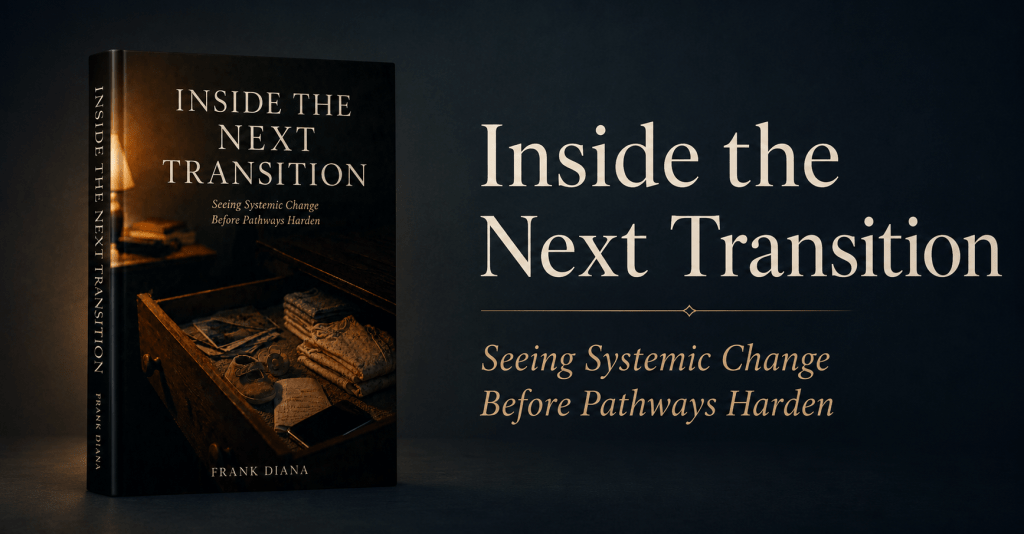
By Frank Diana, futurist, author, and keynote speaker
We are not waiting for the next transition. We are already living inside it. The pressure is visible in our institutions, workplaces, communities, and daily lives, but the larger pattern is often difficult to see. Inside the Next Transition helps readers understand how systemic change takes shape, how today’s strain becomes tomorrow’s operating condition, and where choices may still matter before new pathways harden.
FEATURED IN TIME
Can Studying Daily Life Help Us Envision the Future?
TIME published an adapted excerpt from Inside the Next Transition exploring how systemic change often becomes visible through the growing effort required to hold ordinary life together. The piece introduces one of the book’s central ideas: people frequently experience a transition before institutions have language for what is changing.
The Future Usually Arrives as Pressure First
Most conversations about the future move too quickly. They begin with a change we can already see, such as artificial intelligence, climate pressure, demographic decline, or institutional distrust, and then jump ahead to a transformed world. What often disappears is the movement between those two points.
That missing middle is where people actually experience change. It appears as more effort required to complete ordinary tasks, more responsibility shifting into homes and workplaces, more workarounds holding together systems that no longer function as smoothly as they once did, and a growing sense that familiar structures were built for conditions that are passing.
These pressures rarely arrive with a clear announcement. They build across different parts of life, interact with one another, and gradually change what people must do to keep work, care, learning, institutions, and communities functioning. By the time a new condition becomes obvious, many of the choices that shaped it may already have been made. Inside the Next Transition focuses on this formative period. It asks how pressure becomes visible, how people and institutions absorb it, and how today’s strain begins to harden into the operating conditions of tomorrow.
What the Book Is About
Inside the Next Transition explores how systemic change forms before it becomes fully visible. It begins with a simple idea: the future does not arrive all at once. It develops through pressure, adaptation, and a growing mismatch between the world people are living in and the structures they still rely on.
The book looks at why this moment feels different, how pressures across science, technology, society, economics, geopolitics, philosophy, the environment, and human capacity increasingly interact, and why older ways of organizing life begin to lose their ability to hold. It uses history to show that major transitions have never followed a single pattern and have never been driven by technology alone. They emerge when the operating logic of one age can no longer carry the conditions of the next.
At the center of the book is the missing middle: the period between visible strain and a new condition. This is where people compensate, institutions improvise, burdens shift, and early pathways begin to form. It is also where plausibility lives, because a future becomes easier to understand when we can trace how it might develop rather than simply describe what it may look like.
The book does not offer certainty about what comes next. It offers a way to see change earlier, understand where pressure is already landing, and recognize where choices may still shape the pathways ahead.
This Is Not Another Prediction Book
Many books about the future focus on trends, technologies, or forecasts about what may happen next. Inside the Next Transition takes a different approach. It does not try to predict a finished future or reduce systemic change to a list of developments. It asks how a new condition begins to form while people are still living inside the old one.
The book looks beyond technology as the sole driver of change. New capabilities matter, but they become transformative only when they interact with social expectations, economic pressures, political choices, environmental limits, scientific advances, and the beliefs people carry forward. The larger story emerges through the way these forces converge and place growing strain on structures built for earlier conditions.
The focus is therefore not simply on what may change, but on how change moves. The book follows the progression from early pressure to adaptation, from adaptation to institutional strain, and from strain to a new operating condition. It also pays attention to who carries that pressure before it appears in formal plans, public metrics, or organizational strategy.
This perspective does not eliminate uncertainty. It makes uncertainty more useful. By tracing how pathways form, readers can distinguish plausible movement from distant speculation and recognize where decisions may still influence what comes next.
Who This Book Is For
Inside the Next Transition is written for people who can feel that something larger is changing but do not find conventional predictions especially helpful. It is for readers who want to understand not only what may happen next, but how change moves, where pressure is already building, and why familiar systems are becoming harder to sustain.
The book will be especially useful to leaders, strategists, educators, policymakers, futurists, and others whose work requires them to make decisions before the full picture is clear. It is also written for thoughtful readers outside those roles who are trying to make sense of a world in which technology, institutions, economics, culture, the environment, and daily life are becoming more tightly connected.
No background in foresight is required. The ideas are explained through history, practical examples, and the lived experience of change. The aim is not to turn readers into forecasters. It is to help them recognize systemic pressure earlier, ask better questions, and see where choices may still matter before emerging pathways become difficult to alter.
What You Will See More Clearly
Inside the Next Transition helps readers recognize when separate pressures are becoming part of a larger systemic shift:
- Why familiar systems feel harder to navigate, and why more responsibility is moving onto individuals and families.
- Why many institutions continue operating on assumptions that no longer fit the world around them.
- How change develops between the first visible strain and the new condition that eventually follows.
- Why adaptation often begins through small workarounds and extra effort, long before institutions acknowledge that the system itself is changing.
- How plausible pathways can be traced through the pressures already forming in the present, rather than treating uncertainty as a reason to wait.
- Where decisions still have the potential to shape what comes next.
Above all, the book helps readers see that readiness is not the same as having a fixed plan. Readiness begins with understanding the forces already in motion, the conditions they are creating, and the choices that remain available before those conditions become difficult to change.
What Readers Are Saying
Early readers have described Inside the Next Transition as a timely and accessible way to understand the larger changes already taking shape around us.
The value of possibility is that it demands motion. Frank Diana’s Inside the Next Transition gives leaders the discipline behind that motion. Possibility Chains trace how today’s pressures become tomorrow’s conditions, helping leaders explore emerging change and make strategic decisions at the tempo the moment requires, not the tempo our planning cycles prefer. Diana shows us where choice still lives before pathways harden. That is the rarest thing a book about the future can offer.
Michael W. Wright
CEO, Intercepting Horizons
Executive Director, Biomimetics International
Author of The Exponential Era and The New Business Normal
We are living through an extraordinary period in human history, shaped by converging forces moving faster than our institutions, assumptions, and capacity to adapt. Frank Diana makes this systemic transition tangible by showing how it is already placing pressure on everyday life, reshaping judgment, trust, work, and human agency. “Inside the Next Transition” offers leaders an essential discipline: question the beliefs that made us successful, recognize emerging pathways before they harden, and act with humility even when certainty remains out of reach.
David Espindola
Founder, Brainyus
Frank Diana’s Inside the Next Transition offers something distinctive in futures thinking: rather than forecasting outcomes, it identifies what is becoming unsustainable, and for whom. His frameworks (the missing middle, Possibility Chains, and the seven-year arc) equip readers to recognize systemic change before the available paths narrow. Given how quickly these dynamics are evolving, Frank’s perspective is not optional reading but a necessary one for any leader navigating what comes next. The book combines analytical rigor with genuine moral seriousness. Congratulations, Frank, on a work that will shape how leaders and thinkers should approach both the present and the years ahead.
John H. Shannon
Professor, Stillman School of Business
Seton Hall University
Having had the privilege of knowing Frank Diana for many years, as a trusted friend, a member of Seton Hall University’ Buccino Leadership Institute Leadership Advisory Council, and one of the world’s foremost thought leaders on AI, I have long admired both the depth of his vision and the generosity with which he shares it. This remarkable book reflects both.
There are books that inform. There are books that inspire. And then there are those rare books that fundamentally change the way we see the world. Inside the Next Transition is one of those exceptional works. Frank Diana has written far more than a book about artificial intelligence or emerging technologies. He has given us a thoughtful, compelling framework for understanding how the future quietly takes shape around us, often long before we recognize it. His book truly paints a priceless and timeless mosaic template for understanding, adapting and creating our world of today and tomorrow.
What makes this book extraordinary is Frank’s remarkable ability to bridge technology, leadership, history, human behavior, and purpose into one coherent and deeply practical vision. Through rich stories, experiential learning, and penetrating questions, he invites us not simply to anticipate change, but to understand the forces already reshaping our world. His greatest insight is that the future is not waiting somewhere ahead of us, it is already forming within the present through the pressures, choices, adaptations, and beliefs that influence our daily lives. As Frank so powerfully reminds us, “The future is forming inside the present, through pressure, response, delay, adaptation, and choice, not waiting somewhere beyond it.”
More than an invitation to think differently, this book is a call to become differently. It challenges us to question assumptions, learn from history without being confined by it, recognize the subtle signals of emerging change, and develop the wisdom to shape the future before its pathways harden. Whether you are a leader, educator, policymaker, innovator, or simply someone seeking to better understand the world that is unfolding before us, Inside the Next Transition is an invaluable guide. Frank Diana has produced a timeless and visionary work—one that will continue to inform, challenge, and inspire readers for many years to come. I recommend it without hesitation.
Michael M. Reuter
Director Emeritus
Buccino Leadership Institute
Seton Hall University
As a professional futurist, Frank Diana has spent years thinking about how to see change before it’s obvious — and this book is his clearest articulation yet. His core insight, that ‘the future does not usually arrive as a finished condition, it forms in the middle,’ reframes how we should think about AI, and so much else besides. At a moment when we’re all trying to make sense of what AI actually means for our lives, this book couldn’t be more timely. I’m proud to call the author a friend, and even prouder of what he’s written.
Suresh Muthuswami
Former Chairman
TCS North America
It is indeed very difficult to understand change fully when we are part of that change. Recently, however, it is nearly impossible to ignore the overwhelming presence of catalytic events in the evolution of technology, geopolitical events, the employer/employee social contract, and the very nature of how we learn about what is going on in the world around us. It is difficult to argue that we ever completely finish responding to one change before the next one comes about and interrupts the response.
Frank Diana has been A dedicated and well-respected futurist for decades. His careful consideration of the environment, thoughtful and meaningful inclusion of conflicting ideas and concepts, and absolute clarity of communicating culminates in this wonderful book. He begins with a very credible and personal treatment of why these topics are important. laying out the present impact of change and the effect it has on organizations and people. He then presents a very strong case for organized approach to dealing with future disruption.
This book challenges us to take note of change, to be systematic about the possibilities of the future, to act with overt intentionality. As citizens of the disrupted today, it is our best and most promising course of action to lean into disruption and take thoughtful action.
Many thanks to Frank Diana for sharing this masterwork on responding to change.
Anthony Scriffignano
Distinguished Fellow, The Stimson Center
Loomis Innovation Council
Board Advisor, Author, Inventor
Frank Diana and I began collaborating over a decade ago, and it has been a privilege to learn, explore, and shape ideas about the future together.
This book beautifully reflects the methods and mindset Frank has developed along the way. As a former CTO and now a Board member, I deeply value its practical wisdom on sensing change, challenging assumptions, and rehearsing possible futures. Its message is powerful and personal: strategy should keep us learning and adapting.
Bravo, Frank!
Ananth Krishnan
Retired CTO of Tata Consultancy Services
Frank Diana has a unique ability in helping people understand how individual trends can impact broader systems. Through engaging storytelling and practical examples, Inside the Next Transition encourages us to question assumptions, stay curious, and think differently about what may lie ahead.
As a leadership educator, I found “When the Future Reaches Daily Life” particularly thought-provoking. It made me reflect on how we define learning in a world where technology produces increasingly polished and sophisticated outputs. It reinforces the importance of creating learning experiences that help people understand that meaningful learning is not just about the outcome, but about the thinking, questioning, judgment, decision-making, and growth that happen along the way.
Barbara Callahan
Undergraduate Director, Buccino Leadership Institute, Seton Hall University
Look Inside the Book
Inside the Next Transition takes readers from the feeling that something larger is changing to a clearer understanding of how systemic transitions form. The book begins by examining why this moment feels different and why familiar explanations often fail to capture the full pattern. It then turns to history, showing how earlier transitions emerged when the operating logic of one age could no longer carry the pressures of the next.
The middle of the book focuses on the part of change that is most often overlooked: the movement between today’s strain and tomorrow’s condition. It explores how pressure builds, how people absorb it through extra effort and workarounds, and how early pathways begin to take shape before institutions fully recognize what is happening.
The final chapters bring the discussion back to daily life. They examine how the future reaches people through work, care, learning, trust, burden, and choice, and why readiness begins with seeing these changes before they become fixed.
Chapter 5, “The Missing Middle,” explores the part most future conversations leave out: how pressure builds, how people absorb it, and how a new condition begins to form before it is fully visible.
The Story Behind the Book
Inside the Next Transition grew out of a question that stayed with me across years of writing, research, and conversations with leaders: how do we make the future useful before it becomes obvious? Too much discussion about the future begins with a visible development and ends with a distant outcome. We talk about artificial intelligence transforming work, demographic change reshaping society, or climate pressure altering markets, but we often skip the movement between those points. I kept returning to that missing middle because it is where people absorb change, institutions begin to strain, and early pathways start to form.
The ideas in this book developed through my work as a futurist, my study of earlier systemic transitions, and the creation of Possibility Chains as a way to trace how pressure can move toward different outcomes. They were also shaped by keynotes, workshops, executive discussions, and years of writing about the forces changing how we live, work, learn, govern, and relate to one another.
The Inside the Next Transition newsletter became an important part of that journey. Across its first eight editions, I explored many of the questions that sit at the heart of the book: why this moment feels different, how inherited structures lose their ability to hold, how human capacity is tested, and why readiness must begin before certainty arrives.
The book brings those questions together into one larger story. It is my attempt to help readers see the transition already forming around us and understand where pressure is leading before today’s choices become tomorrow’s fixed conditions.
About Frank Diana
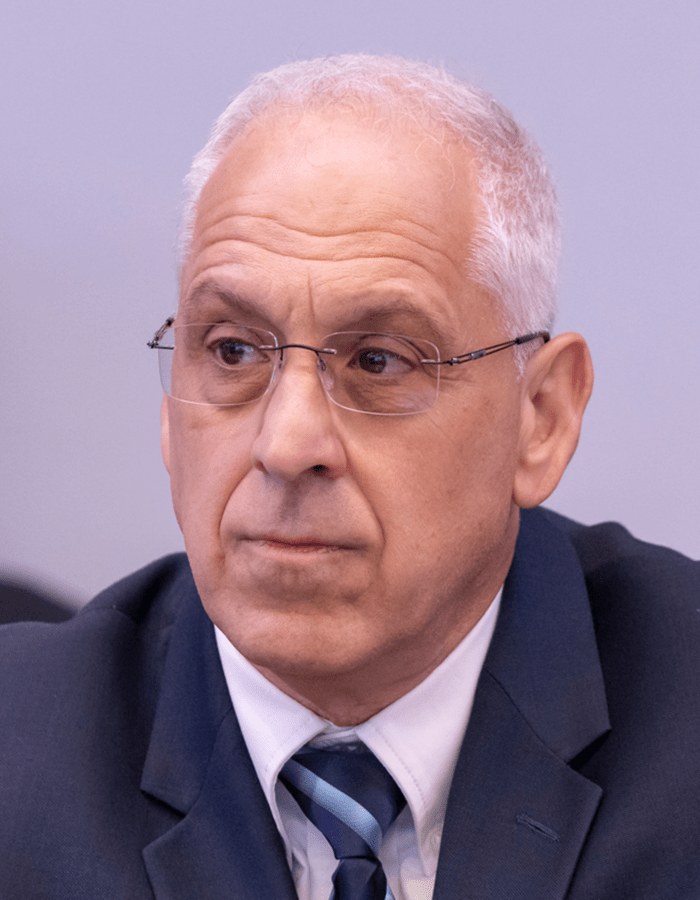
Frank Diana is a futurist, author, and keynote speaker who helps leaders understand how large-scale change forms before its full impact becomes visible. His work focuses on systemic transition, the convergence of forces across science, society, technology, economics, geopolitics, philosophy and the environment, and the ways those forces reshape everyday life.
Over the course of his career, Frank has worked with executives, strategists, educators, and organizations around the world to explore emerging change and its implications. His writing and speaking are grounded in a simple belief: the future becomes more useful when people can see how it is forming, not just imagine how it may eventually look.
Frank developed Possibility Chains as a way to trace the movement from present pressure to plausible future conditions. That work helped shape Inside the Next Transition, which brings together years of research, historical inquiry, writing, and conversations with leaders trying to make decisions amid growing uncertainty.
Buy the Book
We are already living inside the next transition. The challenge is learning to see how it is forming before today’s pressures become tomorrow’s fixed conditions. Inside the Next Transition: Seeing Systemic Change Before Pathways Harden is available in paperback and Kindle editions through Amazon.
Continue the Conversation
The publication of this book does not bring the conversation to an end. The Inside the Next Transition newsletter explores these developments as they unfold — looking beyond the immediate event to examine the larger pattern.
Subscribers can follow along at the newsletter’s own page. Subscribe on LinkedIn https://www.linkedin.com/build-relation/newsletter-follow?entityUrn=7463418554751832064
Using the book with a leadership team or discussion group?
Inside the Next Transition can be used as more than an individual read. Leadership teams, executive forums, professional associations, universities, and discussion groups can use the book to examine where pressure is already building, which inherited assumptions may be losing fit, and where meaningful decision space still remains.
The free Leadership Discussion Guide provides a structured 60-minute conversation built around six questions from the book.
Frequently Asked Questions
What formats are available?
Inside the Next Transition is available in paperback and Kindle editions through Amazon.
Is the book intended only for futurists?
No. The book is written for anyone trying to understand how large-scale change forms and why familiar systems are becoming harder to sustain. No background in foresight, strategy, or emerging technology is required.
Is a sample chapter available?
Yes. Visitors can read parts of Chapter 5, “The Missing Middle,” which introduces the central idea that distinguishes the book from conventional approaches to the future.
Can the book be used with leadership teams or book clubs?
Yes. The book is well suited to executive discussions, strategic planning sessions, leadership development, professional associations, classrooms, and book clubs. Its central ideas are designed to open conversation rather than prescribe a single answer.
Are bulk purchases available?
Organizations interested in purchasing copies for an event, team, or leadership group can contact Frank to discuss options.
Where can international readers purchase the book? The book can be ordered through the Amazon marketplace available in the reader’s country.
Follow Frank Diana on Goodreads for book recommendations, reader discussion, and questions about Inside the Next Transition.

