The Renaissance offers a useful way to think about AI, particularly through the relationship between inquiry, authority, and inherited knowledge. Renaissance humanists brought renewed scrutiny to influential texts, examining their language and comparing their claims. Their work sometimes challenged much more than an interpretation. It questioned the foundations on which established authority rested.
Part three of a three-part series on the changing architecture of coordination.
In Part One, I argued that AI is changing the economics of coordination. Some of the work that once had to be embedded permanently inside jobs, departments, and reporting relationships can increasingly be assembled around a need. Part Two looked at the other side of that shift. Those structures were carrying much more than the visible work. They were also carrying context, accountability, and the means by which people developed judgment.
Part two of a three-part series on the changing architecture of coordination.
In Part One, I described a small-business credit decision in which the numbers showed two quarters of weakening receivables. The person who knew the business also knew that its largest customer had temporarily extended payment terms during an acquisition while orders remained strong. The numbers were accurate, but they did not carry the full meaning of what was happening.
What the Industrial Organization Was Quietly Doing, and What Has to Replace It
A three-part series
CONTENTS
Part One: The Changing Economics of Coordination
Part Two: What the Boxes Were Carrying
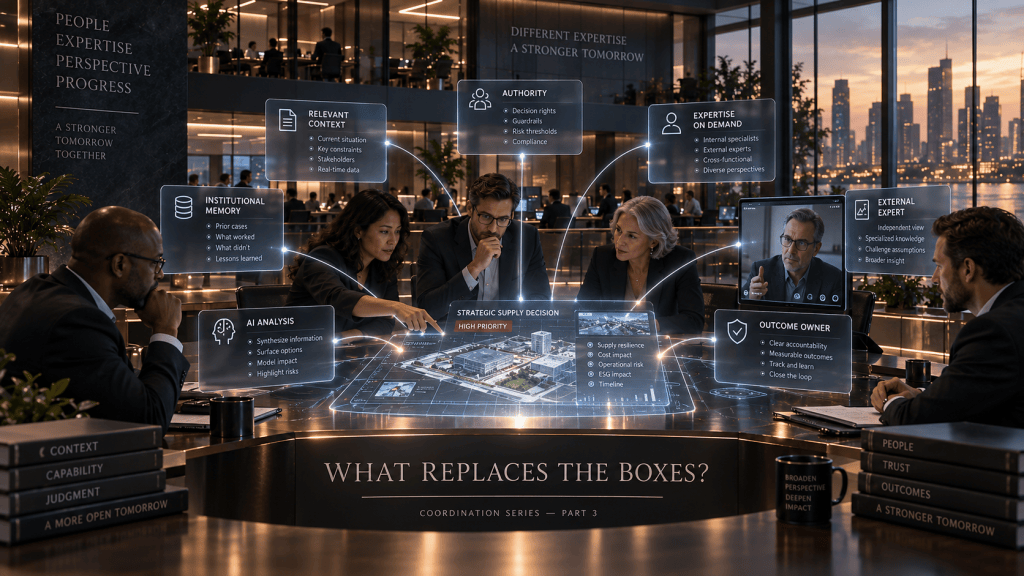
Part Three: What Replaces the Boxes?
Part One: The Changing Economics of Coordination
Part one of a three-part series on the changing architecture of coordination.
A small-business owner applies for credit after two quarters of weakening receivables. The numbers suggest deterioration. The person who has worked with the business for years knows the largest customer temporarily extended its payment terms during an acquisition while orders remained strong. That context changes the decision.
A woman’s mother has a fall. What begins as a medical event becomes, within a week, something considerably larger. There are appointments to arrange and a pharmacy to visit twice a month. Her own working hours change, which changes her income, which changes what she can comfortably cover this month. Transportation turns into a recurring problem rather than a one-time one. Her employer needs to know something about the situation, though not everything. Her insurer needs a different set of facts. The hospital needs a third. Meanwhile her son still has practice on Tuesdays and a school fee coming due.
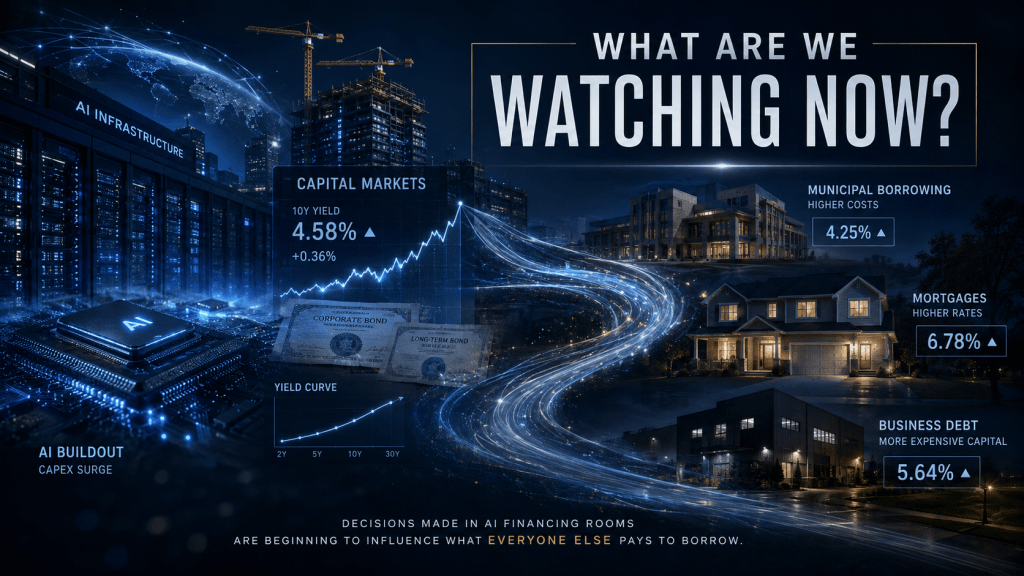
On August 13, the United States Treasury paid 5.22 percent to borrow for thirty years, the highest nominal cost at a thirty-year auction since 2001. Reuters reported the following day that inflation-adjusted borrowing costs across the major economies had reached their highest levels in more than a decade, with US thirty-year real yields near eighteen-year highs at around three percent, and British and German ten-year real yields at levels not seen in over ten years.
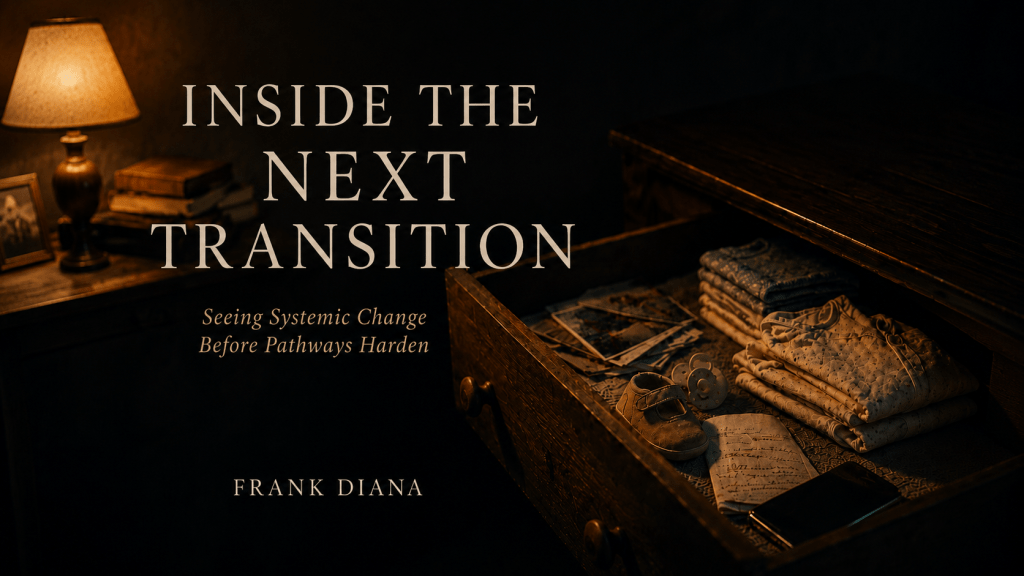
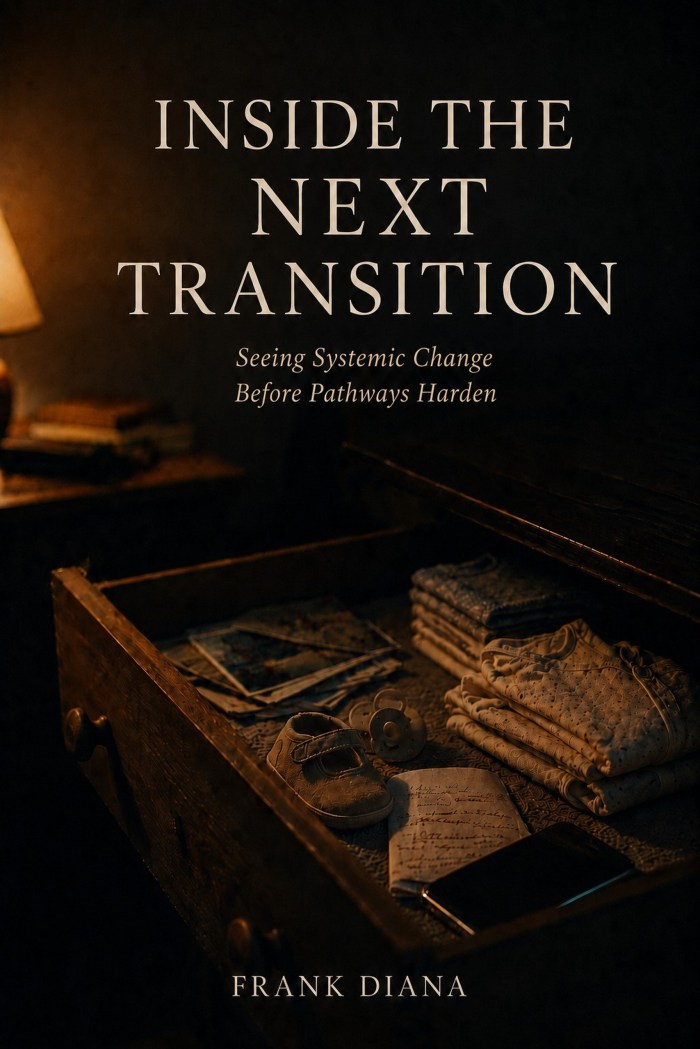
TIME recently published an adapted excerpt from my new book, Inside the Next Transition: Seeing Systemic Change Before Pathways Harden.
The excerpt begins with an ordinary family morning shaped by work, school, caregiving, money, and the small demands that keep accumulating. No single moment appears transformative, yet together they begin to narrow the room available for important choices, including whether to have another child.
The article explores one of the book’s central ideas: the future often becomes visible first as pressure inside daily life. Familiar systems may still appear to function, but only because people are absorbing more effort, coordination, and sacrifice to keep them working. That space between the pressure people already feel and the larger consequences that have not yet become obvious is what I call the missing middle.
I have been trying to understand why this moment feels different. The answer is not simply that technology is moving faster, although it is. What makes this period distinctive is that pressures — technological, demographic, environmental, geopolitical, institutional — are beginning to interact. They are crossing boundaries we have traditionally treated as separate, and colliding with systems built for a different set of assumptions.
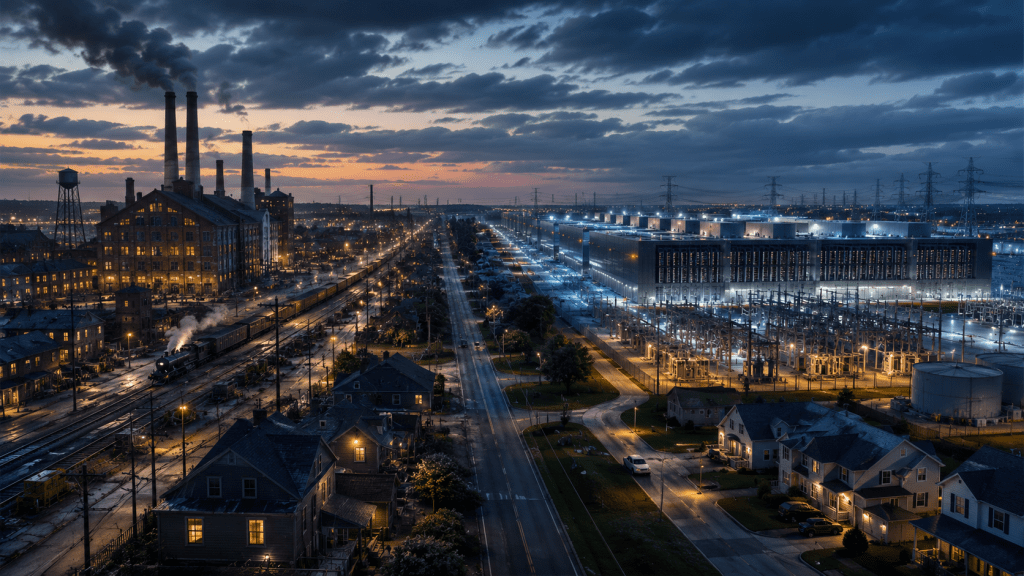
Last week I wrote that data centers may become the next factory towns of the AI age. The point was not that data centers look like the factory towns of the past. It was that they may begin to play a similar structural role. They gather power, water, land, capital, labor, and political attention around themselves. They reshape local decisions. They create dependencies. They force communities to ask what they are giving up, what they are gaining, and who gets to decide.
Since sharing this post, Annie Hardy shared a paper she wrote about Water Security in the Age of Hyperscale Data Centers. You can find that paper here.
For years, artificial intelligence has been described in language that makes it feel weightless. It lives in the cloud, answers through a screen, appears as a chatbot, a copilot, a search result, a synthetic image, or a quiet recommendation embedded inside a workflow. That language is useful, but it also hides something important. AI is not floating above the physical world. It depends on buildings, pipes, substations, transmission lines, cooling systems, backup generators, batteries, chips, water, land, tax agreements, zoning approvals, utility planning, and increasingly vocal communities. The more AI moves from novelty to infrastructure, the more visible those physical dependencies become. The data center is where the supposedly invisible future becomes visible. It is where the cloud touches land. It is where intelligence becomes an infrastructure question.
Over the last several weeks, I launched a new weekly LinkedIn newsletter called Inside the Next Transition. The response has been encouraging, and I wanted to share it here with my blog audience as well. This blog will remain my primary home for deeper reflections, research-driven pieces, and the broader body of work I have been developing around history, systemic change, convergence, and Possibility Chains. That will not change.
I recently joined colleague Kevin Benedict on FoBTV for a conversation about the ideas that sit at the center of my work: systemic change, convergence, pressure, possibility chains, pathways, and decision spaces. For long-time readers of this blog, these concepts will be familiar. But the conversation offered a useful opportunity to bring them together in one place and explain why they matter now.
In the last edition, I explored how we know when change becomes systemic. The answer is not found in the speed of one trend, but in the spread of pressure across domains. When science, technology, society, geopolitics, economics, philosophy, and the environment begin moving together, change stops behaving like a set of separate disruptions and begins to look like transition.
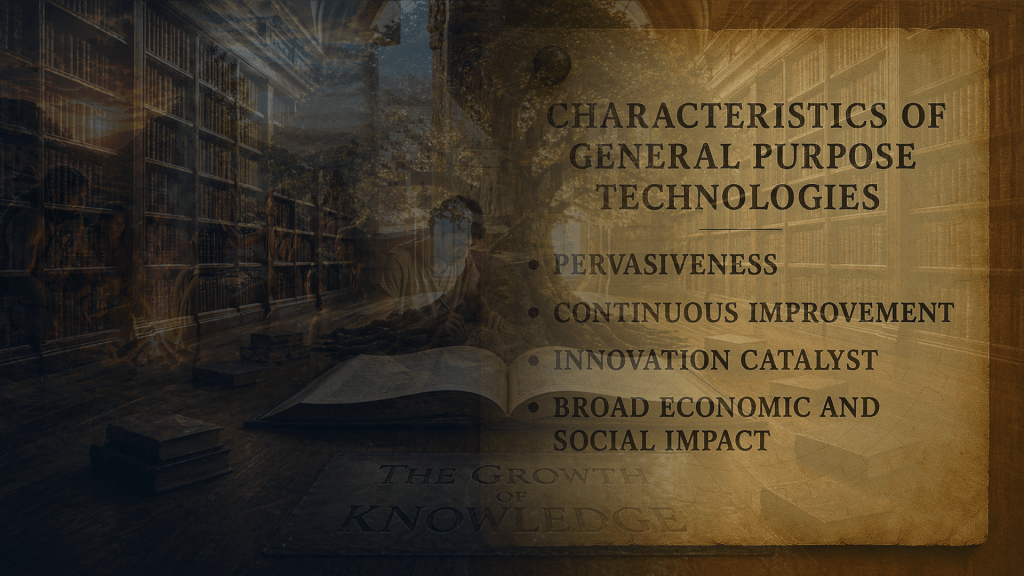
That raises the next question: what makes some technologies powerful enough to accelerate that kind of transition?
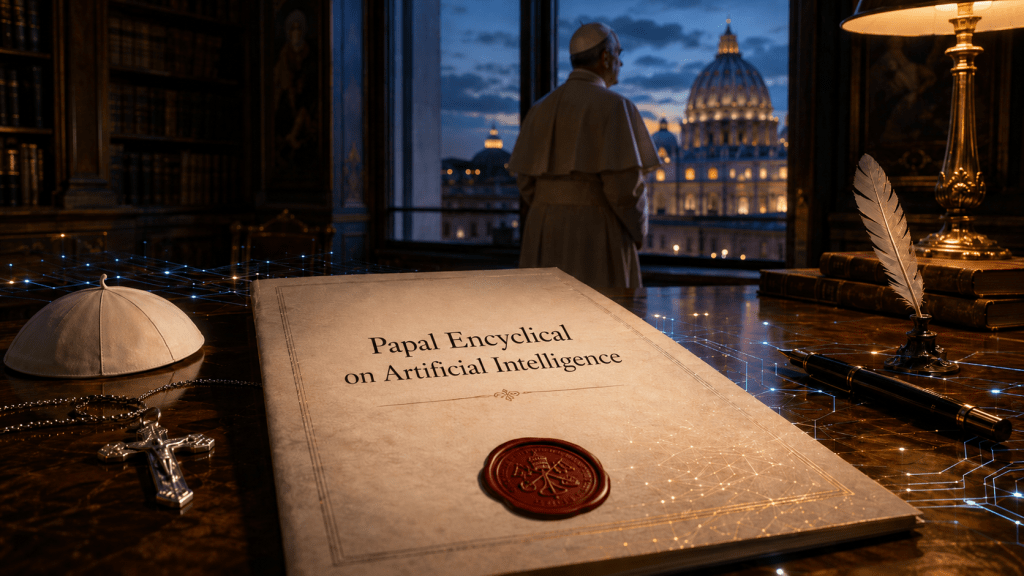
After my appearance on Chicago’s Morning Answer this week to discuss Pope Leo XIV’s new encyclical on artificial intelligence, I found myself returning to a question that sits at the center of my work on systemic change.
Can human beings get in front of a transition before catalysts force them to act? That question matters because the Pope’s encyclical is not really about whether artificial intelligence is good or bad. It is about whether human beings remain responsible for the systems they build. It is about whether a technology powerful enough to reshape work, learning, truth, war, institutions, and human identity will be guided by human dignity, or whether it will quietly inherit the priorities of speed, profit, power, and efficiency.
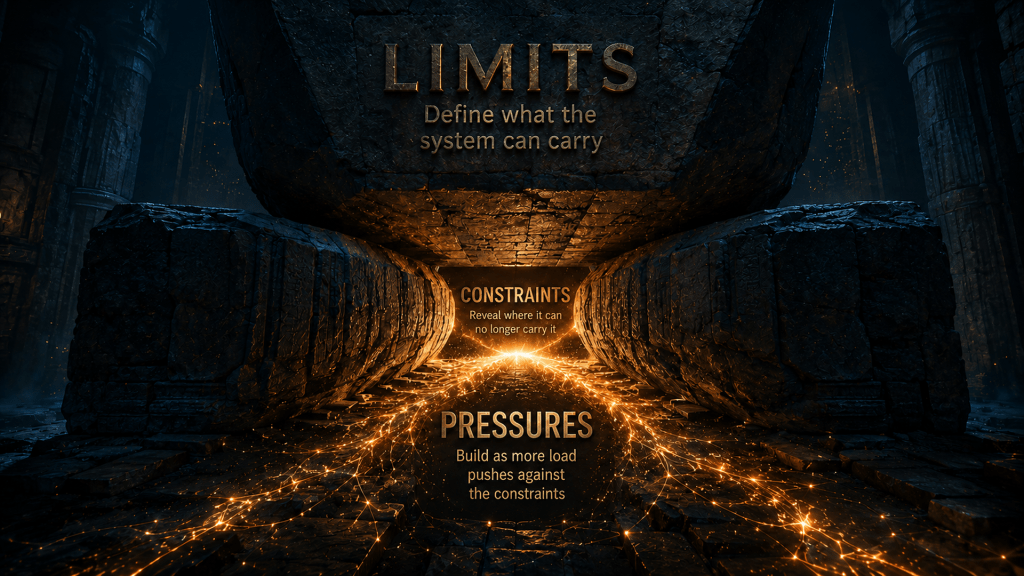
If history reveals one thing across major transitions, it is that systems do not change just because new possibilities appear. They change when old limits can no longer carry the load. Every age has limits. Some are physical. Some are social. Some are institutional. Some are moral. These limits define what a system can carry without breaking. They tell us how much complexity a society can absorb, how fast institutions can respond, how much trust people can maintain, how much strain the environment can take, and how much change humans can process before the old order begins to crack.
History does not matter because it repeats. It matters because it reveals patterns that are too large to see in one lifetime.
That is the central idea I bring to audiences in my keynote. We often talk about the future as if it is driven by isolated trends: artificial intelligence, climate pressure, demographic change, geopolitical instability, synthetic biology, institutional distrust, or economic disruption. Each matters. But the deeper story is not that these forces are happening at the same time. The deeper story is that they are beginning to interact. That interaction is what I mean by convergence.
I recently finished Odd Arne Westad’s The Coming Storm: Power, Conflict, and Warnings from History. Westad, the Elihu Professor of History and Global Affairs at Yale University, is one of the leading historians of modern international and global history, with deep expertise in China, Asia, and the long arc of global power shifts. His new book lands at a moment when history feels less like a subject we study and more like a force pressing against the present.
The central warning of the book is both simple and unsettling: the world may be moving into conditions that resemble the late nineteenth and early twentieth centuries, when great powers competed for position, nationalism intensified, new technologies altered the meaning of conflict, and leaders misread both their rivals and their own capacity to control events. Westad does not argue that history repeats itself in some mechanical way. That would be too easy and, frankly, too dangerous. His deeper point is that history reveals patterns. It shows us the conditions under which systems become brittle, leaders become reckless, publics become anxious, and events begin to move faster than institutions can absorb.
I’ve been exploring a simple idea with enormous implications: the human experience is being reordered.
That may sound broad, but it shows up in very ordinary ways. A parent is trying to get a child to school while answering work messages, managing an aging parent’s appointment, watching the weather, stretching the food budget, and keeping a phone nearby in case a service window opens. A worker is trying to remain useful while the tools of the job keep changing. A family is trying to celebrate a milestone, mourn a loss, care for someone at home, or simply get through the day without one missed step creating a chain reaction.
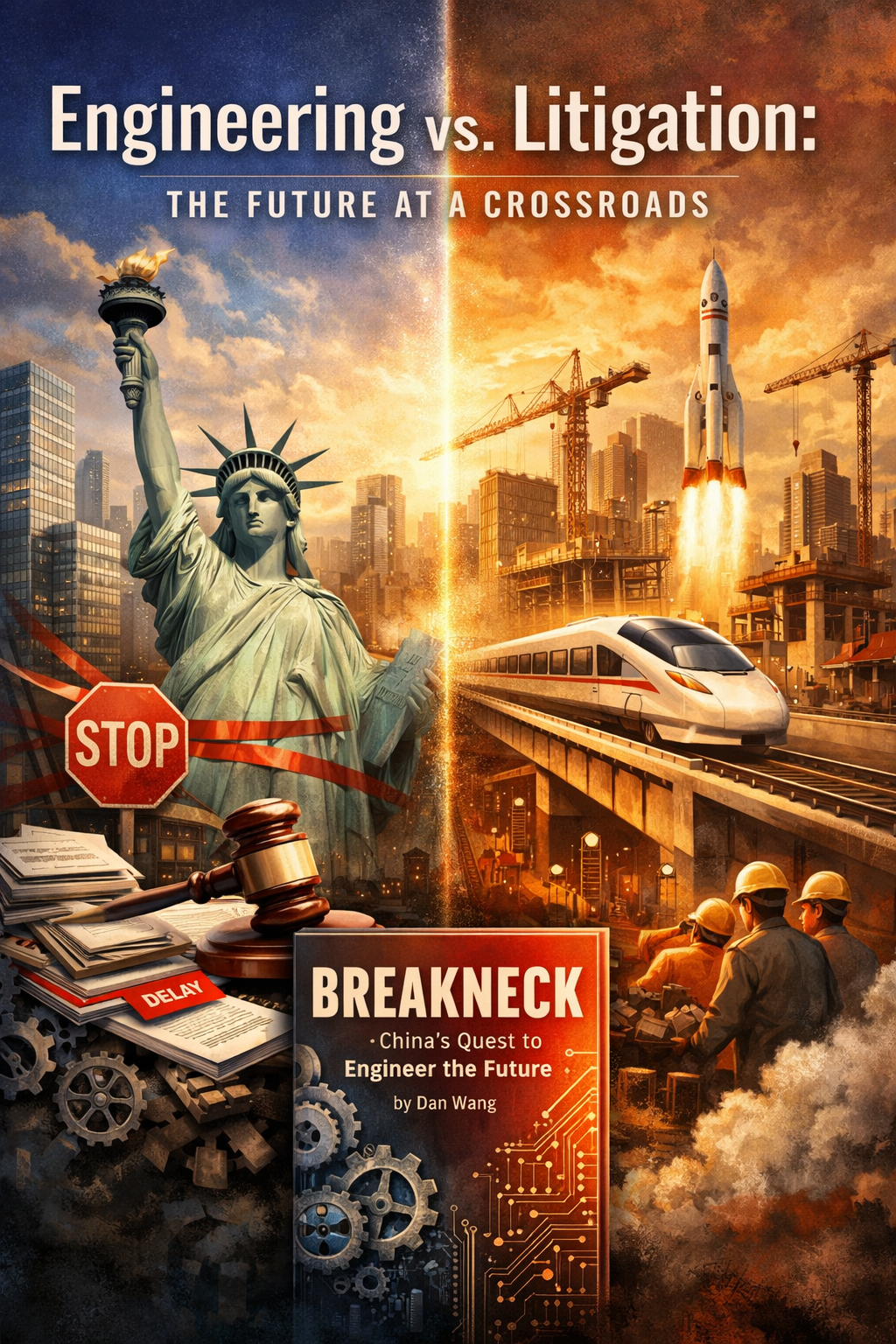
Dan Wang’s Breakneck: China’s Quest to Engineer the Future is not just a book about China. It is a book about what happens when a society decides that building matters more than debating, that execution matters more than process, and that national ambition should show up in steel, concrete, factories, power systems, and supply chains. Wang’s central argument is memorable because it is so simple: China operates as an engineering state, while the United States has drifted into what he calls a lawyerly society. In his framing, China’s governing class tends to think like builders, while America’s elite class increasingly thinks like litigators, gatekeepers, and procedural managers. The result is not merely a difference in politics. It is a difference in what each society can actually get done.
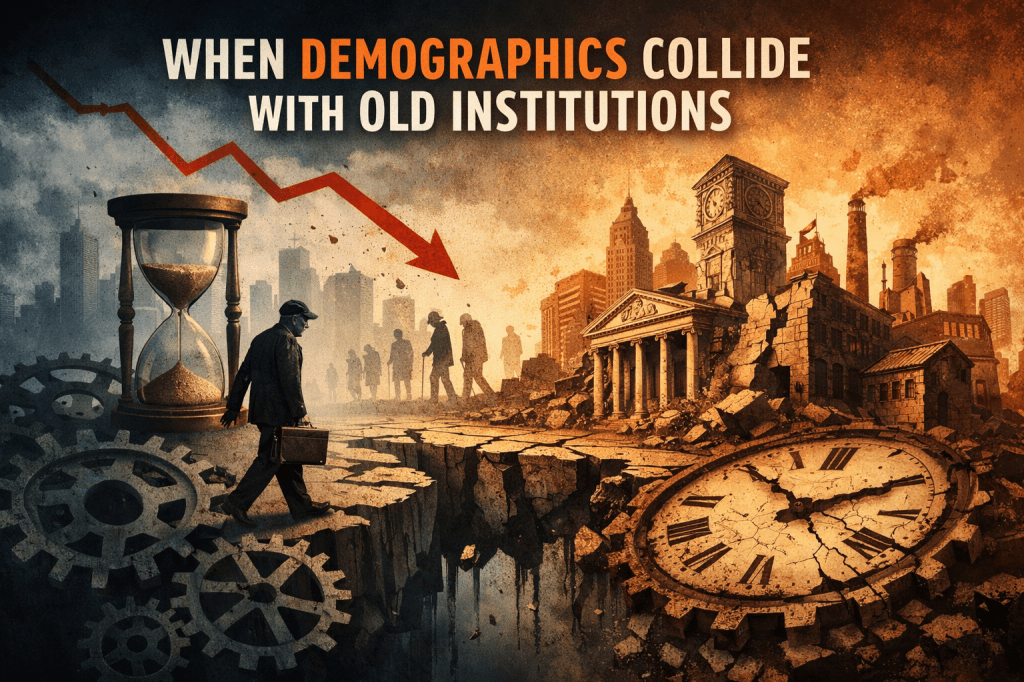
A recent article by Dan Pontefract uses Japan as a warning about demographic decline, pension strain, and government inaction. That framing is useful, but I believe the bigger story sits beneath it. Japan is not just a country in trouble. It is an early stress test for a much larger structural problem now moving across the developed world.
We often talk about demographics as if they were simply about aging, retirement, or falling birth rates. They are much more than that. Demographic change is a slow systems disruption. It gradually weakens the assumptions that modern economies were built on: a growing workforce, a stable ratio between workers and retirees, predictable career paths, and public systems designed for shorter lifespans and larger families. Once those assumptions begin to break, the pressure does not stay contained. It moves through the labor market, economic growth, healthcare systems, pension models, public finance, and the basic design of work itself.