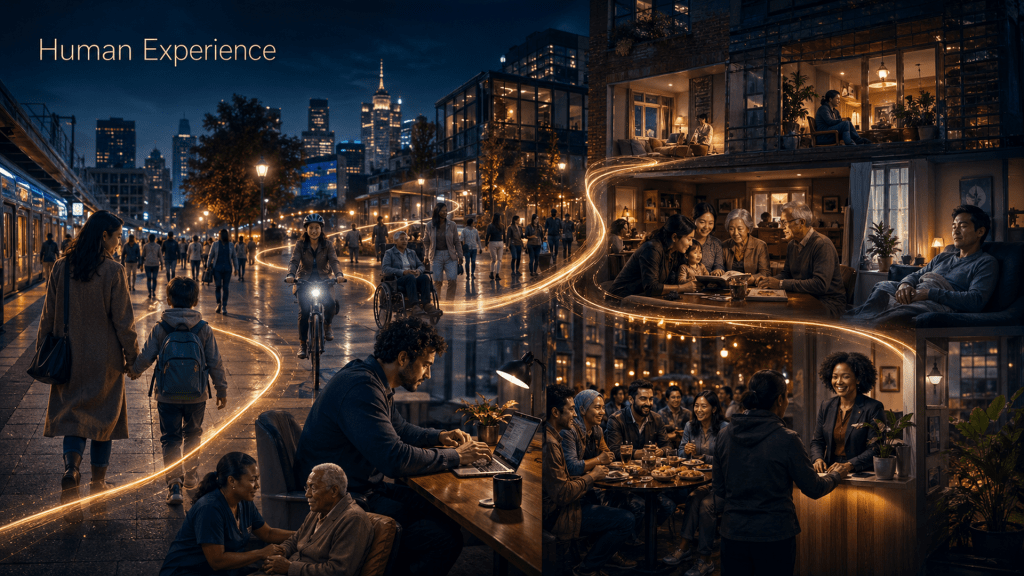
I’ve been exploring a simple idea with enormous implications: the human experience is being reordered.
That may sound broad, but it shows up in very ordinary ways. A parent is trying to get a child to school while answering work messages, managing an aging parent’s appointment, watching the weather, stretching the food budget, and keeping a phone nearby in case a service window opens. A worker is trying to remain useful while the tools of the job keep changing. A family is trying to celebrate a milestone, mourn a loss, care for someone at home, or simply get through the day without one missed step creating a chain reaction.
This is not just a story about consumers becoming more digital. It is not just a story about people expecting more convenience. It is a story about people carrying more of life themselves.
For much of industrial life, many people could assume that certain things would hold in the background. School would help children move through a broadly shared path of development. Work would provide a recognizable route into earning, usefulness, and adult standing. Home would be the place where rest, routine, caregiving, and recovery could be held together. Public systems could still be approached as human institutions. Movement usually reconnected people to work, care, family, and opportunity. Waiting was inconvenient, but it did not reorganize the day. Belonging often arrived through repeated participation in neighborhoods, workplaces, schools, faith communities, clubs, and family rituals.
That world was never perfect, and it was never equally available to everyone. But it did offer a powerful background assumption: life had a common floor. People still had hardship, but many of the systems around them absorbed enough strain that capability, legitimacy, mobility, trust, and meaning did not have to be rebuilt every day.
That floor is thinning.
The first place people feel it is in the shrinking room for error. Food, energy, housing, insurance, transport, school needs, medicine, care, and small comforts now compete inside the same household margin. Families are not simply asking what they prefer. They are asking what can still be carried without something else breaking. A birthday, a repair, a tutoring bill, a delivery fee, a doctor visit, or a missed shift can now change the shape of the week.
That changes how people experience value. Price still matters, but predictability matters more. People do not only want cheaper products or faster service. They want fewer surprises. They want bills they can understand, commitments that hold, flexible options when life slips, and experiences that do not punish them for having less margin.
The second change is that progress feels less secure. Children no longer arrive at later stages from the same starting line. Some have steady routines, early support, healthy sleep, adult attention, safe space, and strong developmental help. Others enter school and adolescence already carrying gaps that began before school had much chance to respond. At the same time, adults face a world where learning never really stops. Skills expire faster. Work roles keep changing. Past contribution does not always carry forward. People who have worked hard can still feel as if they are being asked to prove themselves again at every doorway.
For leaders, this creates a different expectation. People will value institutions and brands that help progress carry forward. A good experience will not make someone restart, re-enter, and re-prove what should already be known. It will preserve effort. It will carry history. It will recognize contribution. It will help people recover momentum instead of losing ground after every disruption.
The third change is that the home is carrying more than it was designed to hold. Home is no longer only a private refuge. It is a workplace, schoolroom, care setting, recovery space, storage hub, planning center, emotional shelter, and energy management system. Rooms do double duty. Family schedules collide. Privacy and rest are squeezed. Repairs linger. Power, cooling, connectivity, appliances, and indoor air become conditions for whether daily life can function.
This matters because home strain does not stay at home. It shapes how people show up as customers, workers, students, patients, citizens, and caregivers. A person who has slept poorly, juggled care, delayed a repair, watched an energy bill, and negotiated three schedules is not arriving in a service interaction as a clean slate. They are arriving already loaded.
The fourth change is that care and recovery are becoming active coordination work. Families are carrying more care for children, older adults, people with disabilities, people recovering from illness, and people dealing with mental strain or long-term conditions. Recovery itself is no longer a simple handoff from the clinic back to normal life. It requires time, rest, follow-up, transport, medication, meals, privacy, money, and emotional steadiness. Many people are trying to heal while still working, parenting, commuting, caregiving, and paying bills.
This is one of the most human shifts leaders need to understand. People do not only need services. They need life to fit around care. They need instructions that travel. They need handoffs that do not lose the person. They need employers, agencies, schools, health systems, retailers, insurers, and communities to understand that care is not an exception to daily life. For many households, it is the organizing reality.
The fifth change is that getting through systems is becoming a test of proof. More of life now asks people to prove who they are, where they live, what they qualify for, what they earn, who they care for, whether they are safe to admit, or why they deserve help. Digital identity, portals, screening tools, risk scores, eligibility filters, and automated rules may make systems faster in some cases, but they can also make people feel doubtful before they are heard.
This is where dignity becomes central. A person may have the right document, but not the right format. The right need, but not the right proof. The right story, but not the language a system accepts. The right case, but no path to correction when something goes wrong. Leaders often think about access as an efficiency challenge. People experience it as a question of whether they are seen as legitimate.
This has consequences for both government and business. A bad customer journey is no longer just irritating. It can become another place where people feel flattened, misread, or excluded. A wrong bill, a repeated error, an unresolved claim, a stale record, or a denial that follows someone across systems can affect rent, care, work, credit, mobility, and trust. The organizations that stand out will be those that make correction real. Not just a ticket number. Not just an apology. Real closure.
The sixth change is that the day itself is becoming tighter. Work, school, care, shopping, travel, appointments, service windows, meals, rest, and recovery now depend on each other more directly. One late bus can cost an appointment. One missed pickup can affect work. One missed form can delay benefits. One failed delivery can disrupt meals or care. The issue is not the single miss. It is how little space remains to contain it.
That changes the meaning of convenience. Convenience used to mean speed, ease, and fewer steps. Increasingly, it will mean recoverability. Can the appointment be held? Can the form be saved? Can the delivery be rerouted? Can the queue remember the person? Can the service recover after a missed step without forcing a full restart? Can the day stay intact when life does what life does?
For business leaders, this is a major shift in customer experience. The next frontier is not only personalization. It is protection of momentum. Customers will remember the organizations that keep a small disruption from becoming a bigger one.
The seventh change is that ordinary places are becoming more demanding. Heat, unsafe air, storms, outages, congestion, aging infrastructure, poor indoor conditions, and degraded public space make everyday settings feel less neutral. People check conditions, reroute, cool certain rooms, stock supplies, manage devices, avoid exposures, and plan around failure. Safety becomes something people actively perform rather than something they quietly receive.
That makes trust more local and more practical. People will ask whether a place, service, store, school, employer, transport system, or community setting lowers vigilance or adds to it. Does it feel usable under strain? Does it provide clear information? Does it offer backup? Does it account for heat, delay, disability, care burden, language, or limited time? Does it make people feel calmer, or does it add one more thing to manage?
The final change may be the most important: belonging, culture, and purpose no longer arrive by default. People still want friendship, shared meals, recreation, rituals, faith, memory, grief, celebration, usefulness, and moral grounding. But many of the recurring settings that once held those things are thinner. Local institutions are weaker in many places. Shared traditions cost more to maintain. Families are more dispersed. Work is less stable as a source of identity. Social feeds may connect people, but they can also narrow the worlds in which people find meaning.
As a result, shared life takes more work. Milestones need deliberate holding. Grief needs witnesses. Culture needs places. Purpose needs roles. Belonging needs repeated invitation. The people and organizations that create real welcome, repeated participation, and a sense of shared life will carry more emotional weight than they may realize.
This is where the leadership challenge becomes clear. Governments and businesses often organize around services, transactions, programs, products, channels, and segments. People organize around days, households, care responsibilities, hopes, fears, obligations, identity, and meaning. The gap between those two views is widening.
A government sees a benefits process. A person sees whether rent can be paid. A retailer sees a delivery window. A family sees dinner, medication, homework, and an elder check. An employer sees a learning module. A worker sees the strain of staying useful while holding the rest of life together. A bank sees a risk record. A customer sees whether one old mistake will keep following them. A platform sees engagement. A person may be searching for belonging, guidance, or proof that they still matter.
This is why the future customer is not simply more digital or more demanding. The future customer is carrying more interruption, more coordination load, and less background stability.
That should change how leaders think. The question is no longer only: how do we make this interaction faster, smarter, or more personalized? The better question is: what burden is this person already carrying, and does our experience reduce it or add to it?
For governments, this means designing public systems that are easier to enter, easier to correct, and more aware of real life. It means treating time, proof, language, disability, care burden, digital access, and appeal rights as part of fairness, not as side issues. It means recognizing that policy fails when it assumes households have infinite coordination capacity.
For businesses, it means designing for customers whose lives are more brittle than traditional segmentation suggests. It means fewer full restarts, more saved progress, clearer commitments, better handoffs, durable correction, flexible timing, trusted support, and offers that restore breathing room. It means recognizing that emotional loyalty will increasingly come from experiences that make people feel steadier, not merely served.
The opportunity is not to solve every social pressure through a product or a policy. That would be the wrong lesson. The opportunity is to see the person more completely.
People want progress that carries forward. They want home life with breathing room. They want care that does not depend on one exhausted family member remembering everything. They want systems that hear them before judging them. They want days that can recover after a small miss. They want places that feel safe enough to use. They want belonging, culture, and purpose that do not require heroic effort to sustain.
The organizations that understand this will design differently. They will see customer experience, citizen experience, employee experience, patient experience, and community experience as connected parts of the same human reality. They will stop treating friction as a minor inconvenience and start seeing it as one more weight added to lives that are already carrying too much.
That is the deeper shift. Human experience is not becoming more digital. It is becoming more loaded. The leaders who matter in the next decade will be those who help people carry less.


Leave a Reply