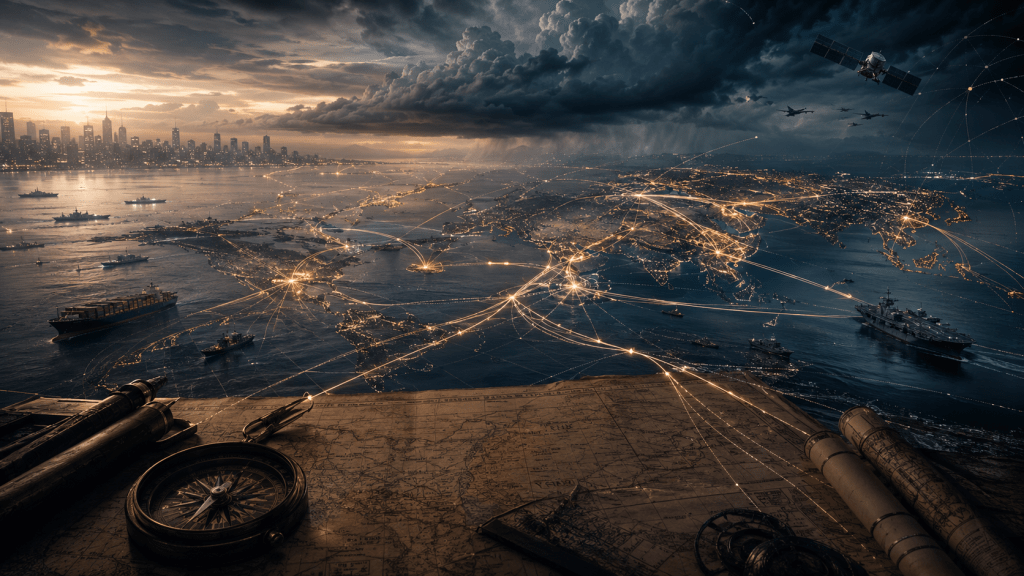
I recently finished Odd Arne Westad’s The Coming Storm: Power, Conflict, and Warnings from History. Westad, the Elihu Professor of History and Global Affairs at Yale University, is one of the leading historians of modern international and global history, with deep expertise in China, Asia, and the long arc of global power shifts. His new book lands at a moment when history feels less like a subject we study and more like a force pressing against the present.
The central warning of the book is both simple and unsettling: the world may be moving into conditions that resemble the late nineteenth and early twentieth centuries, when great powers competed for position, nationalism intensified, new technologies altered the meaning of conflict, and leaders misread both their rivals and their own capacity to control events. Westad does not argue that history repeats itself in some mechanical way. That would be too easy and, frankly, too dangerous. His deeper point is that history reveals patterns. It shows us the conditions under which systems become brittle, leaders become reckless, publics become anxious, and events begin to move faster than institutions can absorb.
That is what makes the book so timely. For most of our lives, many people lived inside a relatively stable global frame. It was not peaceful, and it was not just, but it was at least somewhat predictable. The Cold War had two superpowers. The post-Cold War period had one dominant superpower. Now, as Westad argues, we are moving into a world where multiple great powers are competing for regional influence and global position, making the system more fragile and combustible.
That shift matters because geopolitics is no longer a background condition. It is becoming one of the most powerful domains shaping the future. In much of my own work, I describe systemic change as the interaction of multiple domains: science, technology, society, geopolitics, economics, philosophy, and the environment. No single domain explains the whole transition. But some domains become more active in particular periods. Today, geopolitics is clearly one of them.
The evidence is visible everywhere. The United States and China are struggling over technology, trade, sea lanes, military posture, artificial intelligence, semiconductors, and influence across the Global South. Russia’s invasion of Ukraine has reopened questions about borders, sovereignty, deterrence, and the future of European security. Regional powers are asserting themselves more forcefully. Alliances are being tested. Supply chains have become strategic assets. Energy routes, rare earth minerals, undersea cables, space infrastructure, and digital platforms are no longer just economic systems. They are instruments of power.
Westad’s comparison to the period before World War I is powerful because it reminds us that catastrophe rarely begins with a single event. It usually emerges from accumulated pressures. A rising power wants recognition. An established power fears decline. Smaller conflicts become entangled with larger rivalries. Domestic politics harden foreign policy. Technology creates confidence without wisdom. Leaders assume escalation can be managed. Publics are mobilized through fear, pride, grievance, and resentment. Eventually, pathways narrow. Choices that once seemed avoidable begin to feel inevitable.
That is one of the most important lessons of history. Systems do not usually collapse because no one saw the pressures building. They collapse because leaders, institutions, and societies misread the pathways those pressures were creating.
This is where history and foresight belong together. History does not give us a script for the future. It gives us a way to recognize when familiar human behaviors are reappearing under new conditions. Foresight then asks a different question: if these pressures continue, what pathways could they spawn?
That question is critical. A great-power conflict does not have to begin as a declared war. It can begin through technology restrictions, cyberattacks, naval incidents, proxy conflicts, energy disruption, food insecurity, financial fragmentation, migration pressure, or the collapse of trust in international institutions. Each of these is a possible pathway. Each can interact with the others. Each can be amplified by artificial intelligence, climate stress, demographic strain, economic insecurity, and weakened public trust.
The danger is not simply that one country miscalculates. The danger is that many systems begin miscalculating at once.
Westad’s book also reinforces another point that I return to often: periods of systemic change are difficult because old assumptions continue to guide behavior long after the world has changed. Before World War I, leaders still believed they understood power, mobilization, deterrence, and empire. But industrialization, nationalism, mass politics, railways, new weapons, and alliance commitments had changed the operating environment. The mental models of the past could no longer hold the complexity of the present.
We face a similar challenge now. Many institutions still operate as if the twentieth-century world is intact. They assume that globalization can be repaired, that military deterrence will behave predictably, that technological interdependence will restrain conflict, that economic growth will stabilize societies, and that international institutions can absorb shocks as they have in the past. But the system around those assumptions is changing.
Artificial intelligence is altering knowledge, work, security, and decision-making. Climate change is altering geography, migration, food systems, and national vulnerability. Demographic change is altering labor markets, defense capacity, public spending, and social cohesion. Digital media is altering trust, identity, and political mobilization. At the same time, geopolitics is converting many of these forces into contests over control, advantage, legitimacy, and survival.
This is why exploring possibilities is not an intellectual luxury. It is a practical necessity.
The future rarely arrives as one big event. It arrives as a chain of pressures, choices, reactions, and unintended consequences. Some pathways lead toward fragmentation, coercion, and conflict. Others lead toward new forms of cooperation, resilience, and institutional redesign. The mix is not predetermined. But we cannot shape that mix if we do not first see the pathways forming.
That may be the deepest warning in The Coming Storm. The book is not simply about the possibility of great-power war. It is about the danger of sleepwalking through a systemic transition. The years before 1914 were filled with warnings. So is our own time. The question is whether we treat those warnings as background noise or as prompts to think differently.
For leaders, the lesson is clear. We need to stop asking only what is most likely. In unstable periods, the more important question may be: what becomes possible when pressure accumulates across domains?
That question changes the conversation. It moves us beyond prediction. It forces us to examine pathways. It asks how a technology dispute could become an economic rupture, how an energy shock could become a political crisis, how a regional conflict could become a global confrontation, how a trust failure could become an institutional legitimacy crisis, or how a climate event could become a geopolitical flashpoint.
History helps us see that these connections are not theoretical. They are how systemic change unfolds.
The Coming Storm is timely because it reminds us that the past is not behind us in the way we often imagine. The past lives in patterns of behavior, recurring illusions of control, repeated failures of imagination, and the human tendency to wait too long before changing course. But history also gives us something valuable: a chance to notice the storm before we are inside it.
That is why this book matters now. It is a warning, but not a sentence. It reminds us that the future is not a single road we are destined to travel. It is a possibility space shaped by choices, constraints, power, fear, imagination, and action.
The pathways are forming. The question is whether we are willing to see them early enough to shape where they lead. I highly recommend the book and have added it to my library.


Leave a Reply