History does not matter because it repeats. It matters because it reveals patterns that are too large to see in one lifetime.
That is the central idea I bring to audiences in my keynote. We often talk about the future as if it is driven by isolated trends: artificial intelligence, climate pressure, demographic change, geopolitical instability, synthetic biology, institutional distrust, or economic disruption. Each matters. But the deeper story is not that these forces are happening at the same time. The deeper story is that they are beginning to interact. That interaction is what I mean by convergence.
Across history, major periods of systemic change have rarely been caused by one force alone. They emerge when knowledge grows, general purpose technologies spread, institutions stretch, human capacity adapts, and multiple domains begin moving together. At first, the existing system can absorb the change. Then the load increases. Eventually, constraints appear. These constraints reveal the limits that were always built into the system.
That is why I begin the keynote by distinguishing limits, constraints, and pressures. Limits define what a system can carry. Constraints reveal where it can no longer carry it. Pressures build as more load pushes against those constraints. This is not just a language exercise. It is a way of understanding how civilizations change.
Every age begins with an operating logic that works. Its tools, institutions, habits, and beliefs are built for the world they help organize. For a time, that system carries its age. But the world does not stand still. Knowledge expands. Technologies spread. Cities grow. Markets widen. Institutions adapt. Human expectations rise. The load increases.
As that happens, old systems begin to strain. Coordination becomes harder. Trust becomes weaker. Reliability becomes more fragile. Institutions move too slowly. Ecological stress becomes harder to ignore. People are asked to absorb more complexity than they can comfortably carry. These are not random disruptions. They are constraints revealing limits.
The Industrial Age offers a useful example. Steam power, mechanization, electricity, factories, railways, ports, cities, and new institutions allowed civilization to scale production, movement, communication, and coordination in ways earlier ages could not. The Industrial Age was not a failure. It carried the world it helped create.
But its success increased the load. Scientific knowledge, general purpose technologies, energy systems, institutions, markets, and human organization began reinforcing one another. Civilization became larger, faster, more connected, and more demanding. The very systems that expanded human possibility also created new constraints around coordination, dependence, trust, institutional lag, ecological strain, and control.
That is the pattern I want audiences to see. Systemic change is not ordinary change at a larger scale. Ordinary change happens inside the existing operating logic. Systemic change begins when the operating logic itself becomes the constraint.
This is why the present moment matters.
We are now living through a period in which pressures are converging across many domains at once. Artificial intelligence is changing knowledge, work, creativity, and decision-making. Synthetic biology is expanding our ability to shape life itself. Climate instability is testing infrastructure, economics, migration, food systems, and governance. Demographic shifts are altering labor, care, consumption, and public finance. Geopolitical conflict is reshaping supply chains, alliances, security, and trust. Institutional legitimacy is under strain. Human attention, cognition, and meaning are being pulled into new environments.
Any one of these forces would matter. Together, they raise a larger question: can the structures we inherited still absorb the load?
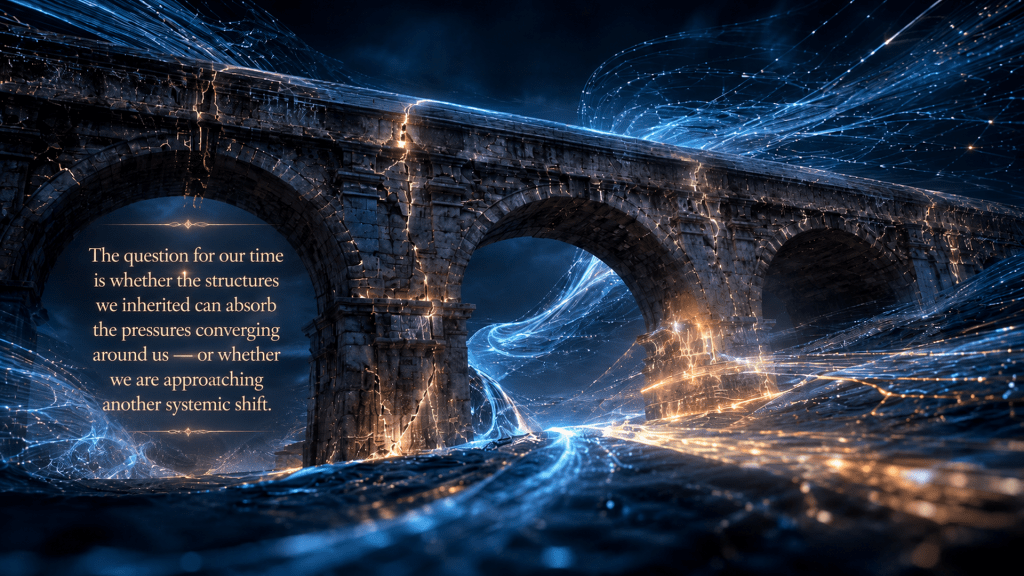
The closing image of the keynote is meant to leave the audience with that question.
It shows an old stone bridge standing under pressure. The bridge represents inherited structure: institutions, infrastructure, markets, knowledge systems, governance, culture, and the everyday habits that organize modern life. It is old, heavy, and still standing. That matters. These structures were not accidental. They were built over generations, and for a long time, they carried the world.
But around the bridge, luminous currents move faster than the structure itself. They represent the forces now converging around us: artificial intelligence, synthetic biology, climate instability, demographic change, geopolitical conflict, economic stress, institutional distrust, and rising human expectation. Each current has its own path, but together they form a field of pressure.
The bridge has cracks, but it has not collapsed. That is the tension. The point is not to predict failure. The point is to ask whether the inherited structures can still carry what is now being placed upon them.
Can they bend without breaking? Can they adapt without losing legitimacy? Can they coordinate a world that is becoming more intelligent, more biological, more networked, more interdependent, and more difficult for people to understand? Can they absorb the pressures now converging around us, or are we approaching another systemic shift?
That is where the keynote ends: not with certainty, but with a question history helps us ask more clearly.
Every age carries its world for a time. Then convergence increases the load. Constraints reveal the limits. Pressures build. And eventually, civilization must decide whether the old operating logic can still hold, or whether a new one is beginning to form.


Leave a Reply