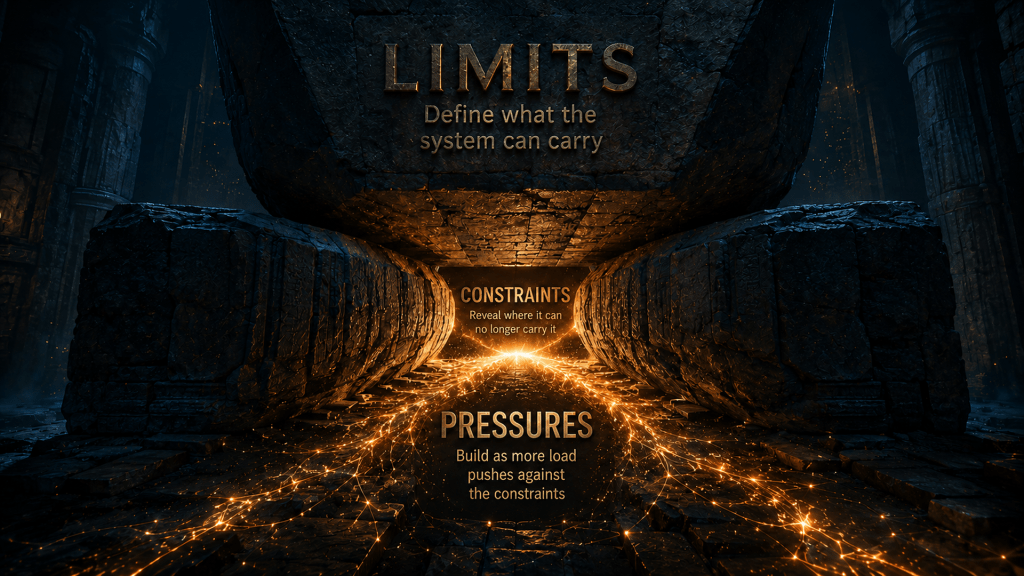
If history reveals one thing across major transitions, it is that systems do not change just because new possibilities appear. They change when old limits can no longer carry the load. Every age has limits. Some are physical. Some are social. Some are institutional. Some are moral. These limits define what a system can carry without breaking. They tell us how much complexity a society can absorb, how fast institutions can respond, how much trust people can maintain, how much strain the environment can take, and how much change humans can process before the old order begins to crack.
But limits are not always visible at first. When a system is working, we often mistake its limits for stability. We assume the way things are organized is natural, permanent, or inevitable. Then the load increases. That is where pressure enters the story.
Pressure builds when more demands are placed on a system than it was designed to handle. Population grows. Knowledge expands. New technologies arrive. Economic activity accelerates. Power shifts. Environmental stress rises. People ask new moral questions. Institutions face problems they were never built to solve. At first, the system adapts around the edges. It stretches. It absorbs. It makes small fixes. It adds rules, roles, tools, and processes. And for a while, that works.
But eventually, pressure finds the constraint. That distinction matters. Pressures are the forces pushing into the system. Constraints are the places where the system can no longer carry that pressure. They reveal the weak point. They show us where the old model stops working. A constraint is not just a problem. It is a message from the system. It tells us where redesign becomes necessary.
We can see this pattern across history. Agricultural societies created new stability, but eventually ran into constraints around land, hierarchy, taxation, and governance. The printing press expanded knowledge, but exposed constraints in religious authority, political control, and who had the right to interpret truth. The industrial age created enormous productive power, but eventually ran into constraints around labor, urban life, environment, inequality, and institutional scale.
In every case, the transition did not begin with a clean break. It began with pressure accumulating against limits the system could no longer hide. That is why this idea is so important for understanding the moment we are in now.
We are not just seeing a set of separate trends. We are seeing pressures building across the whole system. Artificial intelligence is changing what knowledge work means. Biotechnology is changing what life can become. Climate instability is changing what infrastructure and economics must absorb. Demographic shifts are changing the shape of care, labor, and growth. Trust is becoming harder to maintain. Institutions are being asked to act faster than they were designed to move. And people are being asked to process more change than any previous generation.
The question is not whether any one of these forces matters. The question is what happens when they press against the same system at the same time. That is systemic compression. Systemic compression is the moment when multiple pressures converge, the old limits become visible, and the constraints begin to glow. We start to see where our current systems cannot carry the next load.
We see it in education, where the old model of learning cannot keep up with changing capability needs. We see it in health, where care systems struggle with aging populations and chronic complexity. We see it in energy, where the grid must carry new demand, new volatility, and new climate risk. We see it in governance, where institutions built for slower change are being asked to respond to real-time crises.
These are not isolated failures. They are signs that inherited systems are being asked to carry loads they were not designed to absorb. That is the deeper lesson of history: limits do not simply block the future. They define the redesign challenge.
When pressure hits a constraint, societies have choices. They can deny the strain. They can patch the old system. They can protect the past. Or they can recognize that the constraint is showing them where the next system has to be built.
This is why studying history is not an exercise in nostalgia. It is a way of seeing the present more clearly. We are not just asking what happened before. We are asking where pressure built, where the system reached its limit, and what new form had to emerge because the old one could no longer carry the load.
That may be the most important question of our time. Not simply what is changing, but where are today’s pressures revealing tomorrow’s redesign? Because the future rarely begins as a clean invention. More often, it begins when the old system can no longer hide its limits.
 Inside the Next Transition
Leave a comment