I recently joined colleague Kevin Benedict on FoBTV for a conversation about the ideas that sit at the center of my work: systemic change, convergence, pressure, possibility chains, pathways, and decision spaces. For long-time readers of this blog, these concepts will be familiar. But the conversation offered a useful opportunity to bring them together in one place and explain why they matter now.
(more…)Tag: Pressure
-
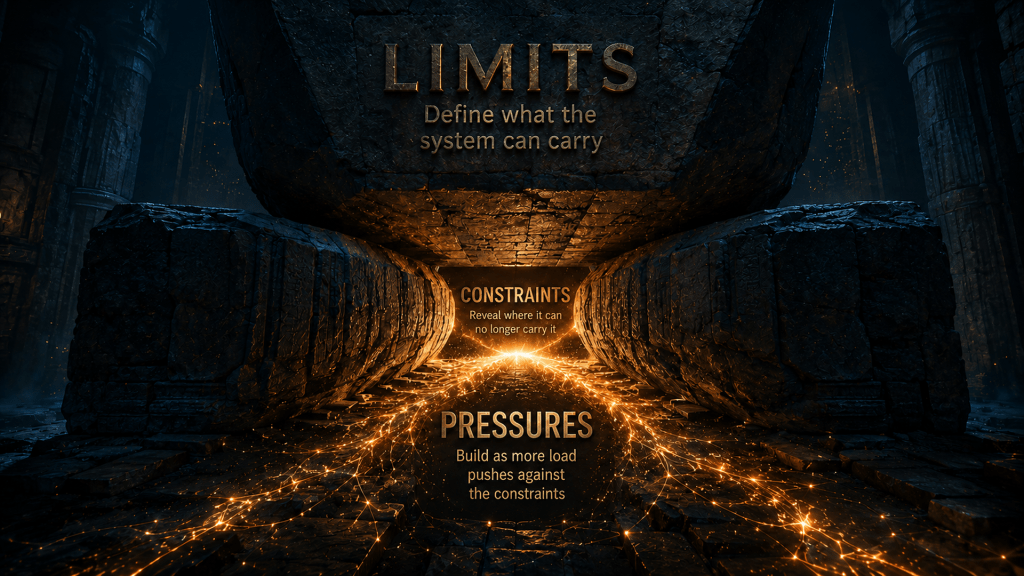
When Old Limits Can No Longer Carry The Load
If history reveals one thing across major transitions, it is that systems do not change just because new possibilities appear. They change when old limits can no longer carry the load. Every age has limits. Some are physical. Some are social. Some are institutional. Some are moral. These limits define what a system can carry without breaking. They tell us how much complexity a society can absorb, how fast institutions can respond, how much trust people can maintain, how much strain the environment can take, and how much change humans can process before the old order begins to crack.
(more…) -
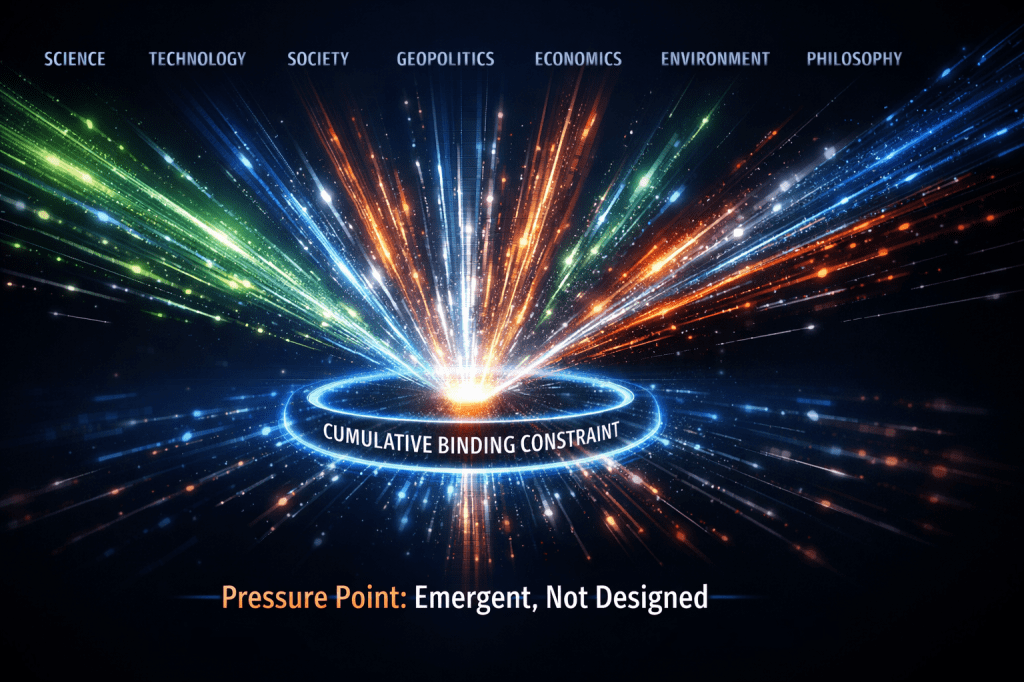
Moving One Layer Deeper – The Constraints That Drive Our Future
When I first described pressure points and catalysts, the goal was to explain why large-scale change rarely arrives without warning. History does not shift randomly. It shifts when accumulating pressures reach limits that systems can no longer absorb. That framing remains. We now move one layer deeper — from pressure as a visible signal to constraint as the underlying mechanic.
A pressure point is not simply stress in the abstract. It is a constraint that reduces flexibility. It is a limit that narrows optionality. It appears when decisions become harder to reverse, when response time shrinks, when coordination becomes more expensive, and when substitution becomes necessary rather than optional. Pressure points mark where systems are approaching or crossing limits.
(more…) -

A World Of Expanding Possibilities – And Accelerating Pressure
The world feels unfamiliar – more volatile, more complex, and harder to navigate than at any point in recent memory. That sense is not misplaced. It reflects the reality of a system under strain.
Across seven domains – science, technology, society, geopolitics, economy, philosophy, and environment – more than 1,700 convergent forces have been identified and mapped between 2025 and 2030, with the list continuing to grow. These forces are directional, accelerating, and deeply entangled. Together, they are expanding the possibility space – the set of plausible futures – faster than most institutions can observe, let alone act.
(more…)
 Inside the Next Transition