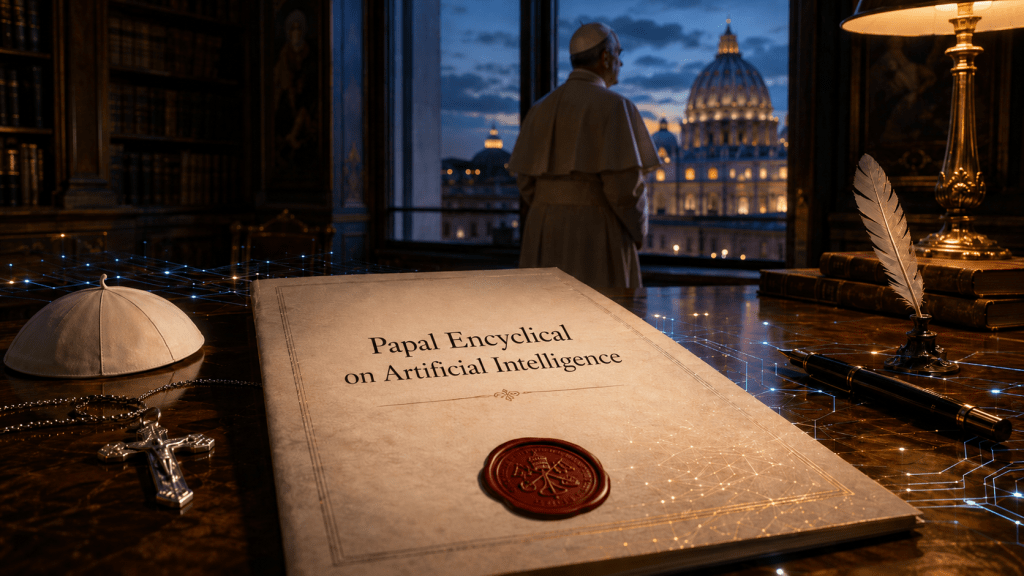
After my appearance on Chicago’s Morning Answer this week to discuss Pope Leo XIV’s new encyclical on artificial intelligence, I found myself returning to a question that sits at the center of my work on systemic change.
Can human beings get in front of a transition before catalysts force them to act? That question matters because the Pope’s encyclical is not really about whether artificial intelligence is good or bad. It is about whether human beings remain responsible for the systems they build. It is about whether a technology powerful enough to reshape work, learning, truth, war, institutions, and human identity will be guided by human dignity, or whether it will quietly inherit the priorities of speed, profit, power, and efficiency.
Pope Leo XIV signed his encyclical on the 135th anniversary of Rerum Novarum, the 1891 encyclical issued by Pope Leo XIII during the industrial age. That older document became one of the foundations of modern Catholic social teaching. It addressed the condition of workers, the responsibilities of capital, the dangers of exploitation, and the need to protect the human person in a world being reorganized by machines, factories, capital, and labor.
The parallel is not subtle. Leo XIII looked at the industrial age and said the worker cannot be reduced to a tool of production. Leo XIV looks at the AI age and says the human being cannot be reduced to data, function, prediction, or performance. That is a powerful moral echo. But the timing is the part that should make us pause.
Rerum Novarum did not arrive at the beginning of industrial disruption. It arrived long after the machine age had already changed labor, cities, family life, class identity, and political conflict. The Luddite moment had erupted decades earlier. Factory work had already reorganized the rhythm of daily life. Child labor, unsafe working conditions, urban poverty, and labor unrest were already visible. By 1891, the old world had not merely been pressured. It had already been broken open.
That does not mean Rerum Novarum had no impact. It had deep long-term influence. It helped shape Catholic social teaching, labor thought, Christian democracy, and the moral vocabulary through which millions of people understood industrial capitalism. But it did not get society ahead of industrial disruption. It gave language to a crisis already underway. That distinction matters because a warning can be historically important without being early enough to prevent harm.
That is the pattern I see across history. Human beings rarely reorganize institutions simply because a better argument appears. We usually wait until the old system can no longer carry the load. We wait until the pressure becomes visible enough, painful enough, or embarrassing enough that delay is no longer cheaper than change. Labor protections followed exploitation and unrest. New economic structures followed collapse. International institutions followed war. Environmental rules followed visible damage. Public health systems often hardened after disease exposed institutional weakness.
In other words, we do not usually act because we see the future clearly. We act because catalysts force the future into the present. That is the real challenge facing Pope Leo XIV’s encyclical.
In one sense, this new document is more proactive than its industrial predecessor. It arrives much earlier in the life of artificial intelligence than Rerum Novarum arrived in the life of industrial capitalism. AI has not yet fully reorganized labor markets, education systems, legal systems, warfare, childhood, elder care, public truth, and institutional authority. We can see the pressure forming, but many of the deepest consequences have not yet hardened into daily life.
That creates a rare opening. It gives us a chance to rehearse the future before the full crisis arrives. But that opening is fragile because early action always faces a dilemma. When a technology is still young, we can still shape it, but we do not fully know what it will become. Once the harms are obvious, the technology is usually embedded in business models, infrastructure, consumer habits, national strategy, and institutional routines. At that point, changing course becomes much harder.
That is the pacing problem of technological change. Early enough to shape often means too early to prove. Late enough to prove often means too late to shape. This is why artificial intelligence creates such a difficult moment. We can already see enough to know that the stakes are not narrow. AI is not simply a better software tool. It is evolving toward a general purpose technology that may alter how societies produce knowledge, distribute work, educate children, fight wars, make decisions, assign risk, and understand human value. But many leaders will still treat it as a productivity race. That is the danger.
If AI is absorbed into the current system without deeper reflection, it will not arrive as a neutral force. It will enter institutions that already have incentives, blind spots, inequalities, and power structures. It will enter schools already struggling with attention, trust, staffing, and purpose. It will enter workplaces already under pressure to do more with less. It will enter media systems already fragmenting shared reality. It will enter governments already facing public mistrust. It will enter militaries already shaped by competition, deterrence, and speed.
The technology may be new. The systems absorbing it are not. That is why the encyclical’s focus on the human person matters. The Pope is not warning against intelligence. He is warning against reduction. A human being is not only a worker, a consumer, a voter, a patient, a student, a soldier, a data profile, or a risk category. A human life includes dignity, memory, relationship, judgment, responsibility, weakness, care, and meaning.
Those qualities do not always show up well inside a system optimized for efficiency. That is the connection to my work on human experience. The future of AI will not be decided only in labs, boardrooms, or legislatures. It will be experienced in the ordinary places where people live: a child using an AI tutor, a worker being evaluated by an unseen system, a patient receiving a machine-shaped diagnosis, a family navigating digital companionship, a citizen trying to know what is true, a soldier operating at the edge of automated force, a customer trying to appeal a decision no human seems able to explain.
The question is not whether AI can perform tasks. Of course it can. The question is whether people will still be able to understand, question, contest, and shape the systems acting on their lives.
That is why I often come back to the idea of decision space. A society under pressure needs room to choose. It needs visibility into the pathways forming ahead of it. It needs to see where inherited systems are likely to strain before those strains become collapse. It needs to ask not only what a technology can do, but what kind of world its adoption begins to normalize.
Pope Leo’s encyclical creates moral decision space. It says: do not let the future be governed by inevitability. Do not let speed become the measure of wisdom. Do not let technical capability become moral permission. Do not hand irreversible decisions to systems no one can question. Do not allow human beings to become functions inside machines built by a small number of powerful actors. That is a necessary warning. But history tells us it may not be sufficient.
The harder question is what kind of catalyst will make avoidance impossible if we fail to act. History suggests it is rarely one isolated failure. It is usually an accumulation of stresses that eventually breaks through as something larger: war, economic collapse, mass unrest, institutional failure, or a legitimacy crisis deep enough that the old system can no longer explain itself. In the AI age, the early fractures may appear in labor markets, childhood, public truth, automated decision systems, or military automation. But those are not the true catalysts. They are the warning cracks. The larger catalyst would come when several of them converge, when citizens, workers, parents, governments, and institutions all recognize that the systems shaping daily life have moved beyond human understanding, accountability, and control.
That is why the Leo XIII and Leo XIV comparison matters. In 1891, the papacy gave moral language to an industrial crisis that had already taken shape. In 2026, the papacy is trying to name the AI crisis before it fully hardens. That is the opportunity. But it is also the test.
Can a society act on a warning before the harm becomes undeniable? Human beings are not naturally proactive at the scale of systems. We are more likely to protect what already works, defend familiar institutions, and postpone hard choices until pressure leaves us no alternative. That is not cynicism. It is pattern recognition. But pattern recognition is not fatalism.
The lesson of history is not that we are doomed to repeat every mistake. The lesson is that we should be honest about how change usually happens. We should not pretend that moral clarity automatically produces institutional readiness. We should not confuse speeches, principles, frameworks, or values statements with the harder work of redesigning systems.
The real work is practical. Can workers appeal automated decisions? Can parents understand how AI is shaping childhood? Can schools protect judgment, attention, and relationship while using intelligent tools? Can companies explain what their systems optimize for? Can governments prevent lethal decisions from drifting into machines? Can citizens know when they are interacting with synthetic media? Can institutions preserve human responsibility when decisions become faster, more complex, and more automated?
Those are not abstract questions. They are the early architecture of the AI age. Pope Leo XIV has offered a warning before the catalyst has fully arrived. That is rare. The challenge now is whether leaders, institutions, companies, communities, and citizens can turn that warning into preparation. Because if we do not create decision space now, crisis will create it for us. And history tells us that when crisis creates the decision space, it usually chooses the terms.


Leave a Reply