Since sharing this post, Annie Hardy shared a paper she wrote about Water Security in the Age of Hyperscale Data Centers. You can find that paper here.
For years, artificial intelligence has been described in language that makes it feel weightless. It lives in the cloud, answers through a screen, appears as a chatbot, a copilot, a search result, a synthetic image, or a quiet recommendation embedded inside a workflow. That language is useful, but it also hides something important. AI is not floating above the physical world. It depends on buildings, pipes, substations, transmission lines, cooling systems, backup generators, batteries, chips, water, land, tax agreements, zoning approvals, utility planning, and increasingly vocal communities. The more AI moves from novelty to infrastructure, the more visible those physical dependencies become. The data center is where the supposedly invisible future becomes visible. It is where the cloud touches land. It is where intelligence becomes an infrastructure question.
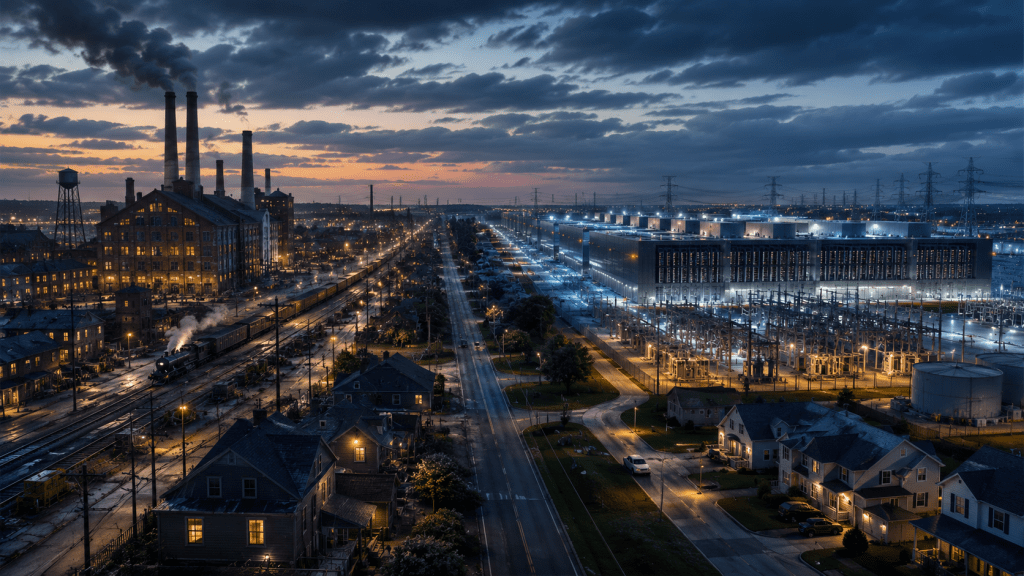
That is why the data center may be emerging as the new factory town. The comparison is not exact, and the difference matters. The old factory town concentrated labor. The new data-center town concentrates power, water, land, capital, and local permission. A textile mill, steel plant, or automobile factory brought workers, payrolls, housing, suppliers, stores, schools, pollution, labor conflict, and civic identity. A modern data center may bring large investment and tax revenue, but it does not usually bring the same long-term employment base or surrounding supplier ecosystem. It may employ far more machines than people once construction ends. Yet the structural resemblance is hard to ignore. Factories were never just buildings where things were made. They reorganized towns around the needs of production, changed the value of land, redirected water and energy, shaped local politics, and made the surrounding community part of the industrial machine. Data centers are beginning to play a similar role in the age of computation.
A data center is not simply a building where information is stored or processed. It is an industrial site for the production of computation. It turns electricity, chips, software, cooling, and data into prediction, automation, language, image, decision support, and synthetic intelligence. That industrial footprint is becoming harder to ignore. In the United States, data centers consumed about 4.4% of national electricity in 2023 and could consume between 6.7% and 12% by 2028, according to analysis from the U.S. Department of Energy and Lawrence Berkeley National Laboratory. Globally, the International Energy Agency expects data-center electricity use to roughly double by 2030. Public resistance is rising alongside that build-out. Gallup reported in May 2026 that seven in ten Americans oppose an AI data center being built in their local area. The pushback is no longer theoretical. It is showing up in zoning fights, moratoriums, lawsuits, tax debates, water-reporting bills, and delayed projects.
History gives us a useful lens. When electricity first emerged, the light bulb was the visible marvel. But the light bulb did not change society by itself. It required power plants, wires, substations, meters, safety rules, financing models, skilled labor, standards, and eventually a massive public and private infrastructure build-out. The deeper transformation came when electricity moved from novelty to system. Factories had to be redesigned around electric motors. Cities had to be rewired. Rural communities had to be connected. Institutions had to learn how to govern a new essential utility. That process took decades, and it required far more than technical progress. It required new forms of coordination among companies, governments, households, workers, regulators, and communities. Electricity became transformative only when society built the physical and institutional arrangements that allowed it to scale.
The same pattern is now appearing around AI. The public sees the chatbot. Businesses see the productivity promise. Investors see the platform opportunity. But underneath all of that is a physical build-out that looks less like a software upgrade and more like an industrial transition. AI does not scale on inspiration alone. It scales through compute. Compute scales through energy. Energy scales through infrastructure. Infrastructure lands somewhere, and that somewhere is changing. For years, the American data-center map was dominated by places like Northern Virginia, where fiber, power, cloud infrastructure, land, customers, and tax policy clustered into what became known as Data Center Alley. As mature hubs face power constraints, permitting fights, rising costs, and community resistance, development is spreading into rural counties, secondary markets, former industrial areas, energy-rich states, and places that did not expect to become part of the AI supply chain. That makes the factory-town analogy more powerful. The next AI infrastructure fight may not happen in Silicon Valley. It may happen in a town whose residents never thought of themselves as hosts of the digital economy.
That is where the resistance begins. Communities are pushing back against data centers for practical reasons, and electricity is usually the first. A large facility behaves like a major industrial load arriving faster than many local planning systems, utility processes, and public consent mechanisms were built to handle. It needs reliable power all day, every day. That raises questions about whether the local grid can support the demand, whether new generation will be needed, whether transmission lines must be expanded, and whether ordinary customers will eventually bear part of the cost through higher rates or delayed upgrades elsewhere. The issue is not simply that data centers use electricity. It is that they can change the priorities of an entire local energy system. When AI demand begins to shape what gets built, what gets delayed, who pays, and who receives reliable service, the data center becomes more than a customer of the grid. It becomes a force acting on the grid.
Water is another flashpoint, but the issue is not as simple as saying that data centers use too much water. Cooling choices vary widely. Some facilities rely heavily on evaporative cooling, which can reduce electricity use because water removes heat efficiently. Others use air-based or closed-loop systems that reduce direct water use but may require more electricity for fans, chillers, and other equipment. This is the resource tug-of-war communities are beginning to see more clearly. Saving water can increase power demand, while saving power can increase water demand. The real question is not whether one resource matters more than the other. It is whether the total burden on electricity, water, heat, cost, climate, and local tolerance is visible before the deal is approved. In regions already worried about drought, growth, heat, or long-term water security, a facility built to serve global digital demand can feel like a local sacrifice for a distant benefit.
The resistance also becomes personal through noise, land use, air quality, and the everyday experience of living near industrial-scale infrastructure. Residents may not care about AI strategy, model training, or national competitiveness when they hear the steady low-frequency sound of cooling systems or backup equipment near their homes. Noise changes the feeling of a backyard, a bedroom, a street, or a neighborhood that once felt quiet. Air pollution and climate impact sit inside the same debate, but they require precision. Backup generators are common because data centers are designed for extreme reliability, yet they usually run only during outages or required testing. The larger ongoing question is often the power behind the facility: whether the electricity comes from renewable generation, nuclear power, gas-fired plants, coal-heavy grids, or new on-site generation built to serve the data center directly. When these facilities are proposed near communities already worried about air quality, noise, industrial concentration, or rising utility costs, the question is no longer just about technology. It becomes a question of environmental fairness and local trust.
Land use adds another layer because data centers are large, secure, and often visually disconnected from the communities around them. They can replace farmland, woods, or other potential uses with windowless industrial buildings. They may not create the street life, local commerce, or dense employment that residents associate with economic development. To a community, that can feel like giving up land for a use that serves someone else’s future. The tax question sharpens the concern. Many data-center deals are built around incentives, abatements, exemptions, or negotiated local benefits. Supporters argue that these facilities bring investment and revenue. Critics ask whether the public is giving away too much for too little, especially when the number of permanent jobs may be modest relative to the size of the facility and the value of the company behind it. Industrial towns often learned that a dominant employer could shape local priorities. Today, communities worry that dominant technology companies may shape local infrastructure, tax policy, land use, and energy choices without enough public say.
This is where the factory-town analogy both works and breaks. The old factory town concentrated labor. It brought workers, suppliers, housing, payrolls, and a visible civic bargain. The data-center town concentrates infrastructure. It brings power demand, water questions, land conversion, tax negotiation, noise, security, and long-term dependence on a facility that may employ dozens or low hundreds of people once construction ends. That difference does not weaken the analogy. It updates it. The new industrial bargain is no longer primarily about labor. It is about whether communities hosting the infrastructure of intelligence receive enough value, protection, and voice in return. Not all data centers have the same footprint. A hyperscale AI campus, a cloud region, a colocation facility, and a small edge site can differ sharply in energy demand, water use, employment, land requirements, and community impact. But the larger pattern still holds: the more AI becomes embedded in the economy, the more its physical infrastructure becomes a public issue.
A further shift is now beginning. Some technology companies and data-center developers are no longer simply asking utilities for power. They are looking for ways to secure power directly through co-located generation, private power agreements, gas-backed microgrids, nuclear purchase agreements, and future small modular reactor plans. This changes the public conversation again. The question is no longer only whether the grid can support AI. It is whether AI will begin reshaping the grid, the energy market, and local energy choices around its own needs. That shift matters because it moves AI from being a digital service riding on top of existing infrastructure to being a major actor in the future of infrastructure itself. When the demand for computation begins to influence generation decisions, transmission planning, land use, utility investment, and local energy politics, the AI conversation moves beyond software. It becomes a question of system design.
The search for new locations is already producing more speculative answers. Some developers are exploring underwater modules, floating platforms, repurposed ships, offshore sites, and even orbital data centers as ways to reduce land conflict, improve cooling, access renewable energy, or bypass some local constraints. These ideas should not be dismissed, but they should not be treated as escape routes from the underlying problem. Underwater facilities still raise questions about maintenance, marine impact, subsea cabling, permitting, and long-term reliability. Floating or ship-based facilities still need power, network access, coastal infrastructure, security, and jurisdictional clarity. Space-based data centers remain more moonshot than near-term relief, with unresolved challenges around launch cost, communications, hardware replacement, radiation, and heat management. The deeper point is that AI infrastructure cannot avoid place. It can only change what kind of place it occupies and which public questions follow it there.
There is also something deeper beneath the practical concerns. Data centers have become a stand-in for anxiety about AI itself. People may not know how to influence the direction of artificial intelligence. They may not have a vote on model design, labor automation, synthetic media, surveillance, or the future of knowledge. But they do have a voice at a zoning meeting. They can oppose a permit, demand water reporting, ask who is paying for the substation, challenge a tax break, and insist that promised benefits be made specific. They can fight the building because the larger system feels unreachable. That is why the data-center debate is not simply a local planning issue. It is a democratic pressure point in the AI transition.
Every general-purpose technology eventually becomes a question of social settlement because it does not remain inside the domain where it first appeared. Electricity began as invention, but it became transformative only when it moved through power generation, wiring standards, household adoption, factory redesign, public utility governance, rural access, safety rules, and new patterns of economic life. Automobiles began as machines, but they became a system of roads, insurance, traffic law, suburbs, oil supply chains, policing, logistics, and personal freedom. The internet began as a network, but it became a platform economy, advertising model, public square, security problem, knowledge system, cultural force, and source of institutional strain. This is the convergence story that every major transition eventually reveals. A powerful technology does not change the world alone. It changes the world when it activates other systems and forces them to reorganize around it.
AI is now moving through that same passage. The early story was capability: what models could generate, predict, summarize, automate, and decide. The next story is infrastructure: where the compute lives, how much power it needs, how much water it uses, what land it occupies, which communities host it, which utilities support it, and who pays for the build-out. The deeper story will be governance, because the data center forces the AI conversation out of abstraction and into the physical and institutional world. It asks whether our grids are ready, whether our water systems are ready, whether local governments have the expertise and authority to negotiate with global technology firms, whether communities hosting the infrastructure of the intelligence age receive a fair share of its value, and whether speed should outrun consent. That is why the data center matters. It is not just the back end of AI. It is one of the first visible places where AI becomes a convergence story.
That does not mean data centers are bad. It means they are serious. A society that wants AI will need places for AI to live. It will need computation, storage, networking, electricity, cooling, and resilience. The question is not whether infrastructure is necessary. The question is whether it will be built through extraction or reciprocity. Extraction says the future needs this, so the community must accept it. Reciprocity says that if a community is asked to host critical infrastructure for the AI age, it deserves transparent information, enforceable standards, meaningful tax benefits, water accountability, noise protections, grid investment, environmental safeguards, and a real voice in how the project fits into local life. Some communities are beginning to push for that bargain directly. Instead of accepting broad promises about innovation and tax revenue, they are asking for specific commitments: water caps, low-noise cooling, generator-testing limits, clean-energy requirements, public reporting, emergency-response support, and community benefit agreements. That shift matters because resistance is not always opposition to technology. Sometimes it is a demand that the terms of hosting the future be made visible, measurable, and enforceable.
The old factory town carried the promise and pain of industrialization. It brought jobs, production, identity, and growth. It also brought smoke, control, labor conflict, inequality, and dependence on decisions made far from the people most affected. The data-center town carries a different version of the same tension. It may not bring thousands of workers through the gate each morning, but it brings industrial-scale demand into local systems. It brings the future physically into the neighborhood. This is why resistance should not be dismissed as anti-technology. In many cases, it is a rational response to a transition that has not yet built the civic arrangements needed to carry it. AI leaders often say we are building the future. Communities are asking a more grounded question: whose future, built where, powered by what, governed by whom, and paid for by whom?
That may be the real story of the data center. It is not merely the back end of AI. It is the place where the AI age becomes a public negotiation. It is where technological ambition meets physical limits, where national strategy meets local trust, and where the invisible cloud becomes a building down the road. The factory town taught us that infrastructure does not just support a new economy. It changes the terms of community life. The data center is teaching us the same lesson again. AI may be digital, but its future is being built in very real places.


Leave a Reply