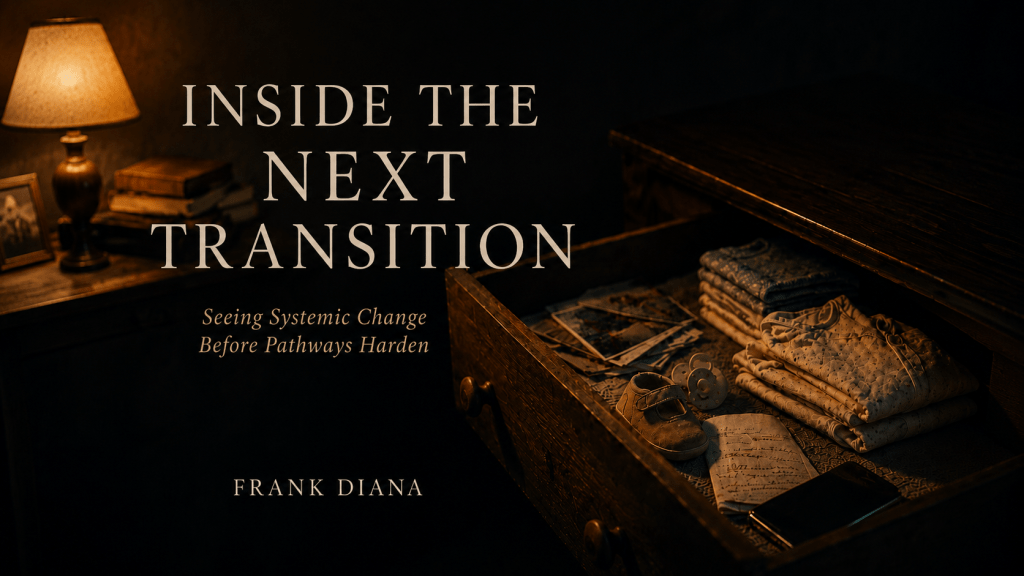
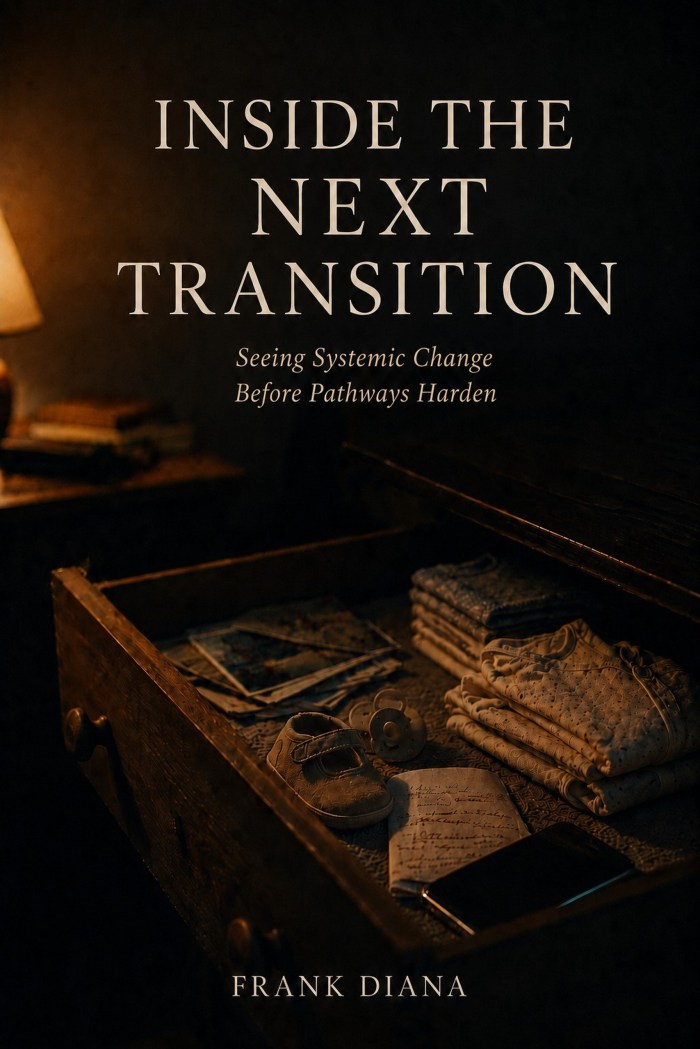
For years, many of you have encouraged me to write a book. Today, I am pleased to share that Inside the Next Transition: Seeing Systemic Change Before Pathways Harden is now available in paperback and eBook formats.
I have been trying to understand why this moment feels different. The answer is not simply that technology is moving faster, although it is. What makes this period distinctive is that pressures — technological, demographic, environmental, geopolitical, institutional — are beginning to interact. They are crossing boundaries we have traditionally treated as separate, and colliding with systems built for a different set of assumptions.
We can feel the effects in ordinary life. Work requires new forms of adaptation. Families absorb responsibilities that once belonged to institutions. People spend more time navigating systems that promise convenience but require additional effort.
Most conversations about the future acknowledge these developments, but they move too quickly. They begin with a change we can already see and jump ahead to the world that may follow. AI will transform work. Climate pressure will reshape markets. Those claims may contain truth, but they leave out the part where transitions actually happen.
That movement between present strain and future condition is what I call the missing middle.
It is where people compensate for systems that no longer work as smoothly as they once did. It is where workarounds become normal, responsibilities shift without being acknowledged, and early decisions begin steering us toward one pathway rather than another.
That concern led me to write Inside the Next Transition: Seeing Systemic Change Before Pathways Harden.
Where the Book Begins
The book opens with stories like this one — the kind of ordinary moment where a transition becomes real long before anyone names it:
The school record said Mateo was present, connected, and prepared. It did not show what his family carried to get him there — the moved shift, the delayed payment, the borrowed ride. The system appeared to work because someone kept holding it up.
That is how the future usually arrives: not as an announcement, but as pressure. Someone is already carrying it before institutions have language for it. The book is built around stories like Anna and Mateo’s, because systemic change is never only about technologies, markets, or institutions. It is experienced through work, care, learning, trust, time, and burden.
We Are Already Inside the Transition
The central argument of the book is straightforward: we are not waiting for the next transition. We are already living inside it. Transitions do not begin on the day a new age is officially named. They begin earlier, while people are still trying to preserve familiar ways of working, governing, learning, and caring. The pressure appears before the new condition becomes visible.
History shows the pattern. Agriculture did not merely produce more food — surplus reorganized settlement, authority, and labor. The printing press changed who could create knowledge and how authority could be challenged. These transitions never followed a single pattern, and they were never driven by technology alone. They formed when pressures converged and the operating logic of one age could no longer carry the conditions of the next.
I believe we are living through a similar period now — AI embedding itself in decisions and work, demographics reshaping labor and care, climate influencing infrastructure and migration, geopolitical fragmentation altering supply chains. The book explores what happens when these pressures no longer remain separate.
Not a Prediction Book
I do not claim to know exactly what happens next, and I do not believe the future becomes more useful simply because we make a more confident forecast. The book focuses on pressure – not prediction.
Pressure tells us where the current system is beginning to strain — who is compensating, which assumptions no longer fit, and where temporary responses are quietly becoming permanent conditions. My work with Possibility Chains grew from this idea: tracing the movement from current pressure to plausible futures, so that leaders and communities can ask better questions before the pathway becomes difficult to change.
Instead of asking only what the future may look like, we can ask what people are already doing to compensate for strain — like Anna moving a shift so Mateo could show up. That will not give us certainty. It may give us something more useful: the ability to recognize movement before the outcome hardens.
The Conversation Continues
The first eight editions of my LinkedIn newsletter, also titled Inside the Next Transition, opened many of the questions that came together in this book. The newsletter will continue exploring how systemic change is forming. The book does not close that conversation — it gives it a stronger foundation.
Inside the Next Transition: Seeing Systemic Change Before Pathways Harden is now available in paperback and eBook formats.
I am grateful to everyone who has followed, challenged, and contributed to this work over the years. I look forward to hearing what the book helps you see — and where you believe the next transition is already becoming visible.


Leave a Reply