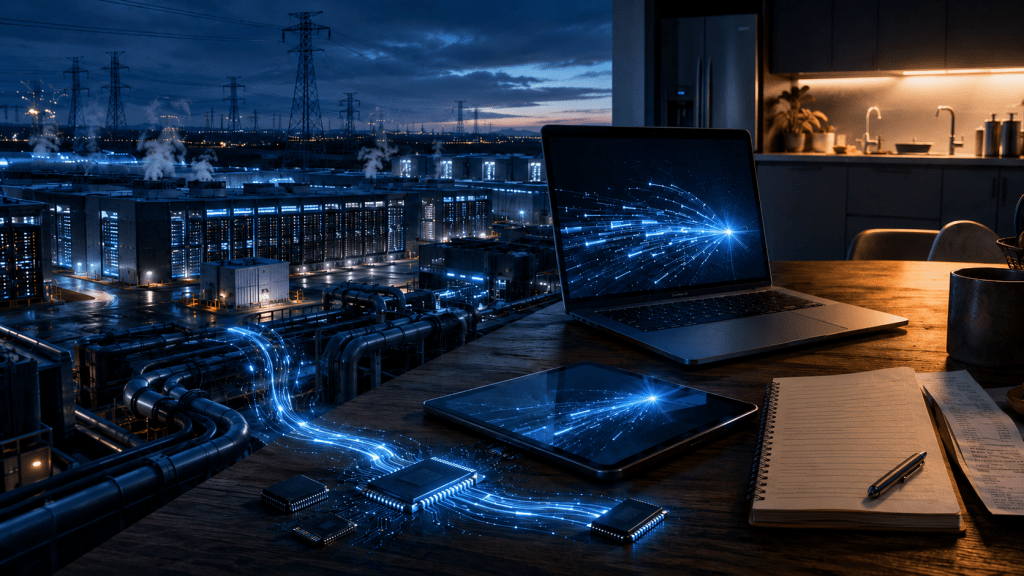
Last week I wrote that data centers may become the next factory towns of the AI age. The point was not that data centers look like the factory towns of the past. It was that they may begin to play a similar structural role. They gather power, water, land, capital, labor, and political attention around themselves. They reshape local decisions. They create dependencies. They force communities to ask what they are giving up, what they are gaining, and who gets to decide.
Now Apple has given us another reason to take that frame seriously. Reports that Apple is raising prices on Macs and iPads because of memory and storage shortages tied to the AI boom show how quickly the pressure is moving beyond the walls of the data center. What begins as infrastructure demand does not stay infrastructure demand. It moves into semiconductor markets. It moves into device supply chains. It moves into schools, households, small businesses, and consumers trying to replace a laptop or buy a tablet.
That is the factory town pattern in a new form. The old factory town reorganized life around industrial production. It shaped where people lived, how they worked, what local governments prioritized, and which costs were treated as the price of progress. The data center town may reorganize life through a different set of pressures: electricity demand, water use, grid expansion, land conflict, chip allocation, memory shortages, and rising prices for the everyday tools people depend on.
This is why the Apple story matters. It is not simply a story about Apple. It is a glimpse of AI infrastructure becoming a broader social and economic force. The laptop on a kitchen table, the tablet in a classroom, the workstation in a small business, and the server rack inside a hyperscale facility are now connected through the same constrained supply base. As AI systems demand more of that supply, others feel the pressure.
The intelligence age will not be built in the cloud alone. It will be built through physical systems, scarce resources, strained communities, and public choices. The question is whether we recognize those choices early enough to make them visible. Because once the costs become embedded in prices, bills, zoning fights, water access, grid upgrades, and household budgets, they stop looking like choices. They start looking like the normal cost of living in an AI-shaped world.


Leave a Reply