
On August 13, the United States Treasury paid 5.22 percent to borrow for thirty years, the highest nominal cost at a thirty-year auction since 2001. Reuters reported the following day that inflation-adjusted borrowing costs across the major economies had reached their highest levels in more than a decade, with US thirty-year real yields near eighteen-year highs at around three percent, and British and German ten-year real yields at levels not seen in over ten years.
(more…)Tag: Data Centers
-

The AI Factory Town Just Reached Your Laptop
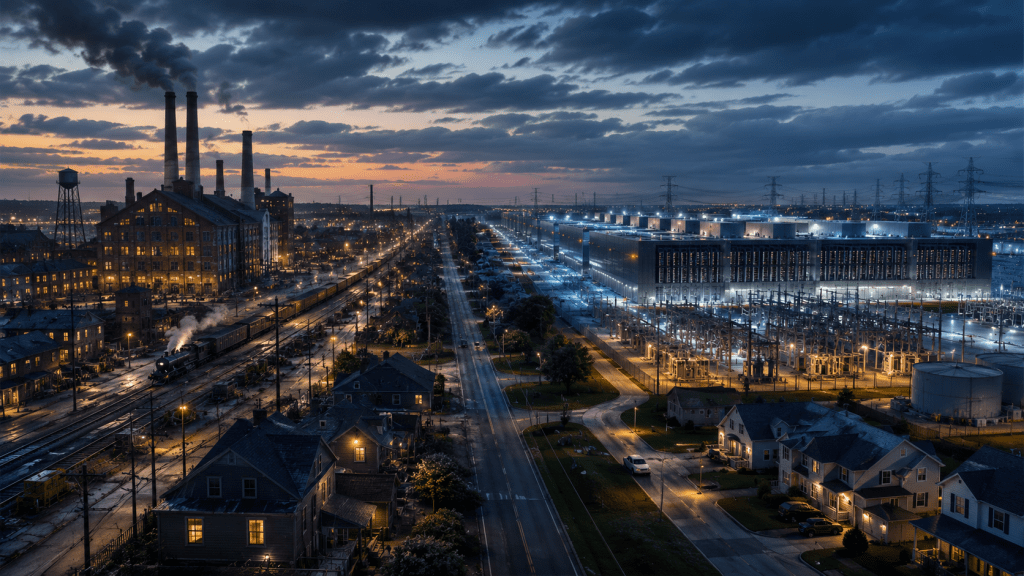
Last week I wrote that data centers may become the next factory towns of the AI age. The point was not that data centers look like the factory towns of the past. It was that they may begin to play a similar structural role. They gather power, water, land, capital, labor, and political attention around themselves. They reshape local decisions. They create dependencies. They force communities to ask what they are giving up, what they are gaining, and who gets to decide.
(more…) -
The Data Center Is The New Factory Town
Since sharing this post, Annie Hardy shared a paper she wrote about Water Security in the Age of Hyperscale Data Centers. You can find that paper here.
For years, artificial intelligence has been described in language that makes it feel weightless. It lives in the cloud, answers through a screen, appears as a chatbot, a copilot, a search result, a synthetic image, or a quiet recommendation embedded inside a workflow. That language is useful, but it also hides something important. AI is not floating above the physical world. It depends on buildings, pipes, substations, transmission lines, cooling systems, backup generators, batteries, chips, water, land, tax agreements, zoning approvals, utility planning, and increasingly vocal communities. The more AI moves from novelty to infrastructure, the more visible those physical dependencies become. The data center is where the supposedly invisible future becomes visible. It is where the cloud touches land. It is where intelligence becomes an infrastructure question.
(more…)

