In the last edition, I explored how we know when change becomes systemic. The answer is not found in the speed of one trend, but in the spread of pressure across domains. When science, technology, society, geopolitics, economics, philosophy, and the environment begin moving together, change stops behaving like a set of separate disruptions and begins to look like transition.
That raises the next question: what makes some technologies powerful enough to accelerate that kind of transition?
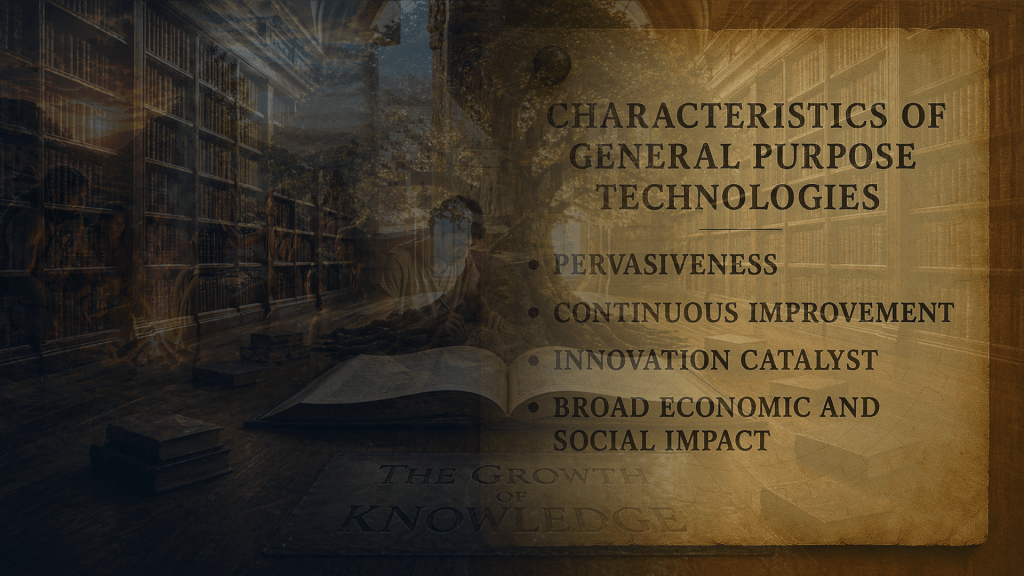
History offers one useful category: general purpose technologies. These are not ordinary tools. They do not simply improve one task, one market, or one industry. They become part of the operating structure of society. They reshape how people work, how institutions coordinate, how value is created, how knowledge moves, and how daily life is organized.
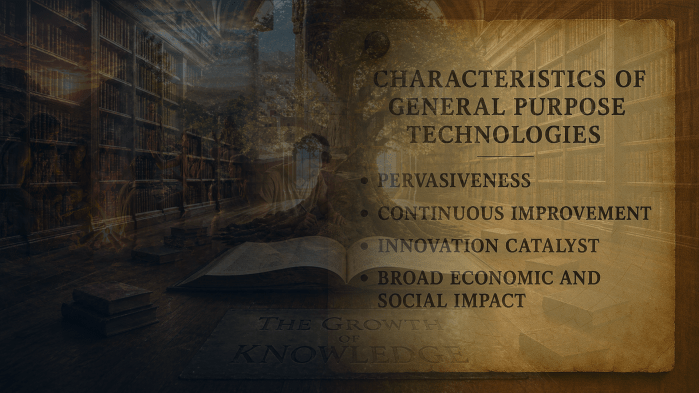
Fire, language, writing, printing, steam power, and electricity, all carried this quality in different ways. They mattered not only because they gave people new capabilities, but because other systems began reorganizing around them. Writing changed memory, law, administration, trade, religion, and authority. Printing changed access to knowledge, religious life, scientific exchange, education, politics, and public debate. Steam and electricity changed production, transportation, cities, labor, time, communication, and the scale of economic life.
That is what makes a general purpose technology different from a powerful invention. A powerful invention can solve a problem. A general purpose technology changes the environment in which many problems are understood and solved. It becomes a platform for further change.
This is why artificial intelligence is often compared to electricity. The comparison is useful, but it is incomplete. Electricity transformed the world by changing what human systems could do. It made power more flexible, distributed, and adaptable. Over time, factories, homes, cities, appliances, communications, entertainment, medicine, transportation, and daily routines reorganized around it. The deepest effect of electricity was not the replacement of one machine with another. It was the redesign of the surrounding system.
AI may follow a similar path, but it also introduces something different. It is not only a capability engine. It is also a knowledge engine.
That distinction matters. A capability engine changes what people and institutions can do. A knowledge engine changes how people discover, generate, interpret, validate, distribute, and act on knowledge. AI appears to do both. It can automate tasks, assist workers, write code, generate content, analyze data, and support decisions. But it can also change how science is conducted, how students learn, how professionals search for answers, how organizations reason, how citizens encounter information, and how institutions define expertise.
This is why AI cannot be understood only as another wave of automation. Automation changes labor. AI may change the conditions of knowledge itself.
Across history, the growth of knowledge has been one of the great engines behind systemic transitions. Human beings discovered how to domesticate plants and animals. They learned to write, count, measure, classify, navigate, experiment, print, mechanize, electrify, compute, and network. Each expansion of knowledge changed what societies could imagine and organize. Knowledge did not merely accumulate in libraries or laboratories. It altered institutions, beliefs, markets, tools, professions, and power.
But knowledge usually grew through human limits. It moved at the speed of observation, teaching, travel, debate, experiment, publication, and institutional acceptance. Even when breakthroughs occurred, they had to pass through human systems of interpretation and application. The growth of knowledge was powerful, but it was constrained by human attention, human expertise, human coordination, and human time.
AI changes that equation. It gives more people access to forms of analysis, synthesis, translation, pattern recognition, simulation, and content generation that were once limited by expertise, training, or institutional position. It can help a scientist explore hypotheses, a student learn a difficult concept, a doctor review information, a worker navigate a complex task, a leader scan a changing environment, or a citizen ask questions that would once require access to specialists. At the same time, it can produce confusion, false confidence, misinformation, dependency, and new forms of manipulation. That is the dual nature of a knowledge engine. It expands access to insight while also increasing the burden of judgment.
This is where AI begins to look historically unusual. It may be a general purpose technology because it can reorganize work, institutions, markets, education, science, media, and governance. But it may also be a knowledge engine because it changes how those systems know what they know. Electricity did not answer questions. Steam power did not summarize legal arguments. Printing spread knowledge, but it did not generate new explanations in real time. Digital computing processed information, but AI increasingly participates in the production, interpretation, and application of knowledge itself.
That combination gives AI a different kind of reach. If AI were only a productivity tool, the transition would be important but more bounded. Organizations would use it to reduce cost, improve speed, and automate selected tasks. Many early applications still fit that pattern. AI helps write emails, summarize documents, generate images, assist coding, support customer service, and improve workflows. These uses matter, but they are still largely point solutions. They apply a new capability to existing structures.
The deeper shift begins when those structures start changing around AI. Education is a clear example. If AI is used only to help students draft essays or teachers create lesson plans, it remains a tool inside the old model. But if AI changes what it means to learn, assess capability, personalize support, verify understanding, guide lifelong development, and define the role of teachers, then the system itself begins to move. The issue is no longer whether students should use AI. The issue becomes what learning is for when knowledge is instantly accessible, generated, and mediated by intelligent systems.
Science offers another example. If AI is used only to search literature or automate administrative work, it improves existing research routines. But if AI helps generate hypotheses, model complex systems, accelerate discovery, design molecules, interpret biological data, and connect findings across fields, then knowledge production itself changes. The scientific process does not disappear, but parts of it may become faster, more distributed, and more computationally assisted.
Institutions face a similar shift. If AI is used only to process forms, summarize meetings, or improve service interactions, it remains a layer of efficiency. But if AI begins shaping decisions about eligibility, risk, trust, enforcement, care, credit, employment, identity, or public information, then institutions must rethink accountability, transparency, legitimacy, and recourse. The question becomes not only whether AI improves performance, but whether people can understand, challenge, and trust the systems that affect their lives.
This is why the electricity analogy should be used carefully. Electricity became transformative when the world reorganized around electric power. AI may become transformative when the world reorganizes around machine-mediated knowledge and intelligence. That is a more intimate shift because knowledge sits close to human agency. It shapes what people believe, what institutions justify, what societies value, and what choices appear possible.
The growth of knowledge has always expanded human possibility, but it has also strained human capacity. Every major knowledge expansion forced people to adapt their institutions, beliefs, education systems, ethical frameworks, and social arrangements. The printing press helped spread learning, but it also destabilized authority. Scientific knowledge expanded human control over nature, but it also challenged inherited worldviews. Industrial knowledge increased production, but it also created new forms of exploitation and environmental strain. Digital knowledge connected the world, but it also overwhelmed attention and weakened shared reality.
AI extends this pattern, but with greater speed and reach. That is why the question is not simply whether AI will become a general purpose technology. The deeper question is whether AI becomes a general purpose technology and a knowledge engine at the same time. If it does, then its impact will not be limited to automation or productivity. It will reach into how societies learn, decide, govern, create, compete, care, remember, and make meaning.
This has direct implications for how we think about the next transition. If AI is treated only as a tool, leaders will ask how to deploy it. If AI is treated as a general purpose technology, leaders will ask how business models, institutions, infrastructure, labor, and governance may reorganize around it. If AI is also treated as a knowledge engine, leaders must ask a deeper question: how will people and institutions maintain judgment, trust, agency, and wisdom when knowledge itself becomes faster, more abundant, more synthetic, and more mediated?
That may be the harder challenge. The future will not be shaped only by what AI can produce. It will be shaped by what humans can understand, absorb, question, and govern. A world with more knowledge does not automatically become wiser. A world with more answers does not automatically develop better judgment. A world with more intelligence embedded in tools does not automatically protect human dignity, meaning, or responsibility.
This is where the four engines of transition begin to connect. The growth of knowledge expands what is possible. General purpose technologies turn possibility into new capabilities. Convergence spreads those capabilities across domains. Human capacity determines whether people and institutions can absorb the change without losing coherence, trust, or agency.
AI may be powerful because it activates more than one of those engines. It may be a general purpose technology, but it may also accelerate the growth and application of knowledge itself. That combination helps explain why the current moment feels different. The world is not only gaining a new tool. It may be gaining a new way of producing and distributing intelligence across the system.
So the question for this edition is not whether AI is impressive. It clearly is. The question is whether AI remains a tool inside the current system, or whether it becomes one of the forces around which the next system begins to organize.
If AI is only a tool, the old structures may absorb it. If AI is a general purpose technology, those structures may begin to change around it. If AI is also a knowledge engine, then the transition reaches deeper still, into the way people know, decide, trust, create, and understand the world.
That is why the next transition cannot be understood through technology alone. It must be understood through the interaction between knowledge, capability, convergence, and human capacity.
In the next edition, I will turn to that final engine: our ability as human beings to absorb change. Because even when knowledge grows and powerful technologies spread, the future still depends on whether people, institutions, and societies can keep up with what they have set in motion.


Leave a Reply