The Coming Storm: Why History Is Warning Us Again

I recently finished Odd Arne Westad’s The Coming Storm: Power, Conflict, and Warnings from History. Westad, the Elihu Professor of History and Global Affairs at Yale University, is one of the leading historians of modern international and global history, with deep expertise in China, Asia, and the long arc of global power shifts. His new book lands at a moment when history feels less like a subject we study and more like a force pressing against the present.

The central warning of the book is both simple and unsettling: the world may be moving into conditions that resemble the late nineteenth and early twentieth centuries, when great powers competed for position, nationalism intensified, new technologies altered the meaning of conflict, and leaders misread both their rivals and their own capacity to control events. Westad does not argue that history repeats itself in some mechanical way. That would be too easy and, frankly, too dangerous. His deeper point is that history reveals patterns. It shows us the conditions under which systems become brittle, leaders become reckless, publics become anxious, and events begin to move faster than institutions can absorb.

Continue reading

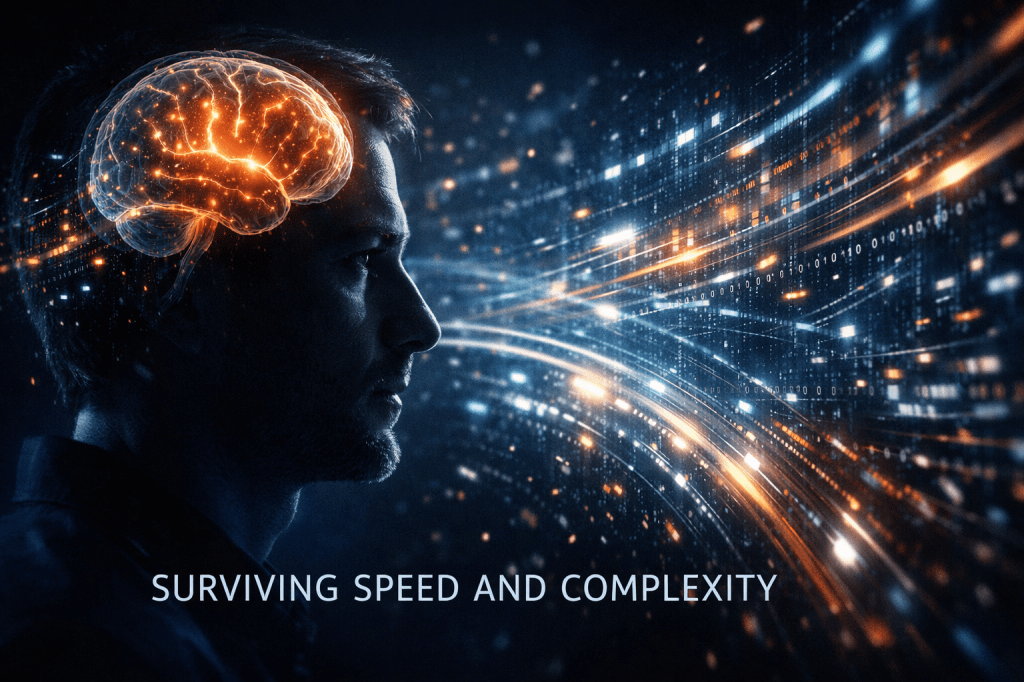
Guest Post: Surviving Speed And Complexity

Over the years, I’ve had the opportunity to work alongside leaders who think deeply about the structural forces shaping our future. Michael Wright is one of them. I had the pleasure of keynoting his Biomimetics conference in Minnesota — an event grounded in the idea that nature’s architectures still hold lessons for navigating modern complexity. That experience left me with a deep appreciation for Michael’s ability to connect technology, governance, human behavior, and leadership into a single systemic frame.

In my recent systemic change series, I explored how convergence across foundational domains — science, technology, economics, geopolitics, society, environment, and philosophy — is creating new forms of acceleration. We examined how tightening feedback loops, compressed response times, and institutional lag generate what I’ve described as coordination strain. The system is not just moving faster; it is reorganizing itself under pressure.

Continue reading

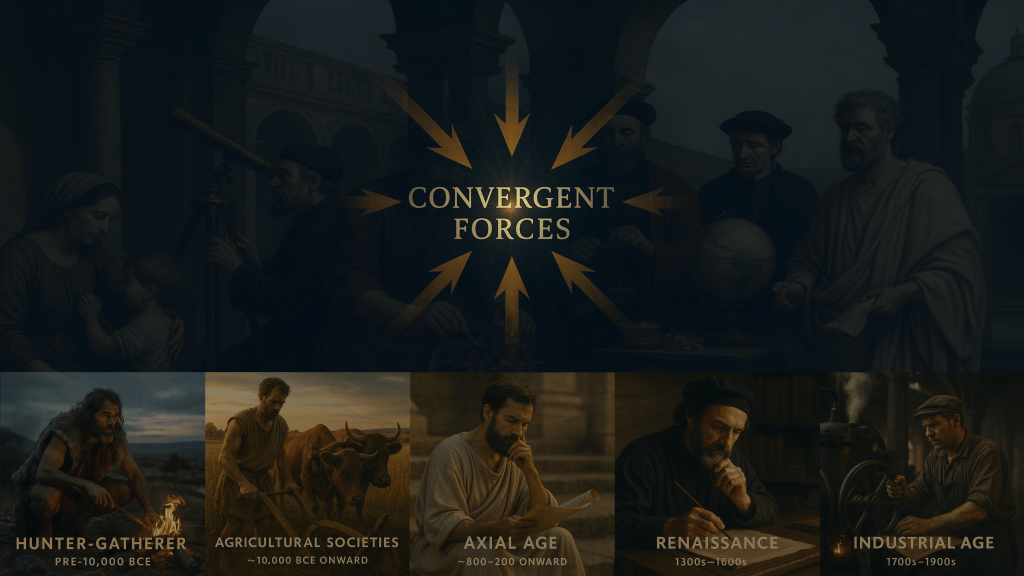
From Campfires To Code: The Systemic Shifts That Shaped Humanity

Human history has been anything but linear. While centuries can pass with relative stability, there are rare moments where everything changes—moments where converging forces across domains give rise to entirely new paradigms. These are not just periods of change. They are systemic transitions that reshape how we live, work, relate, and make sense of the world.

Continue reading