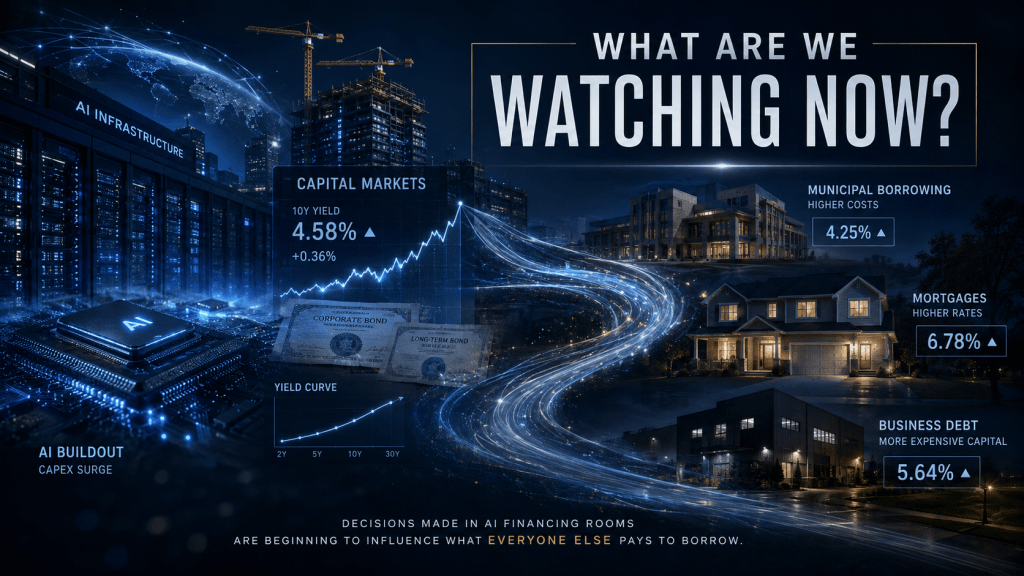
On August 13, the United States Treasury paid 5.22 percent to borrow for thirty years, the highest nominal cost at a thirty-year auction since 2001. Reuters reported the following day that inflation-adjusted borrowing costs across the major economies had reached their highest levels in more than a decade, with US thirty-year real yields near eighteen-year highs at around three percent, and British and German ten-year real yields at levels not seen in over ten years.
A real yield is what an investor demands above inflation, which makes it something close to the underlying price of money. It shapes what governments, companies, municipalities, and households pay to borrow, reaching fixed-rate mortgages, municipal bonds, and corporate credit, and it can move even when policy rates do not. Long real yields respond to inflation expectations, growth, the supply of debt, and what investors expect central banks to do, all at once.
One source of the pressure on yields is a wave of corporate borrowing. Using LSEG data, Reuters reports that Alphabet, Amazon, and Meta have issued close to $220 billion in bonds so far this year, against $108 billion across all of 2025. Investors asked to absorb that much new debt in a single year want more to keep buying it, and that higher price shows up in yields.
That borrowing sits at the visible end of a longer chain. Nvidia announced on August 10 that it had signed memorandums of understanding with Apollo, BlackRock, Blackstone, Brookfield, Goldman Sachs, and KKR to establish financing platforms intended to mobilize more than $500 billion of third-party capital for AI infrastructure over time. The figure is a capital-raising target rather than committed money, and the arrangement is designed to bring outside investors into the buildout rather than requiring Nvidia to finance the infrastructure directly. Further down the same chain, Foxconn reported in its second-quarter results that cloud and networking products, the division that builds AI servers, had reached 51 percent of quarterly revenue for the first time, passing the consumer electronics business that made the company’s name.
Taken as a sequence rather than as separate business stories, these developments describe a single route. Demand for compute became a hardware order, which became a construction program, which became a financing structure, which became bond supply, which became one of the pressures pushing on the price of money. The pressure did not stay inside the technology sector. It moved into capital markets and changed role as it moved.
There are other explanations for what is happening, and they matter. In the same Reuters analysis, Al Cattermole of Mirabaud Asset Management argued that in Europe, defense spending, energy security, and infrastructure investment are more important drivers than AI spending specifically. Max Kitson of Barclays pointed to growth in the United States running stronger than markets had expected, and to central banks having stopped buying bonds, a source of demand that previously helped hold yields down. That reading is about aggregate output rather than how conditions are being experienced, in a year when youth employment has weakened and layoff announcements have risen, but aggregate output is what bond investors price. Governments are also borrowing heavily on their own account. The Congressional Budget Office projects a US federal deficit of $1.9 trillion this year, close to six percent of output, while France runs near five percent and Britain near four.
What we have, then, is a clear correlation and an unclear cause. Several large forces are pulling in the same direction at once, and no one can yet say with confidence how much of the movement belongs to AI. That is the ordinary condition in which decisions have to be made, and there is little to gain from forcing an answer before the evidence supports one.
A more useful question is what we would need to believe in order to treat the current cost of capital as temporary. Roughly, we would need to believe that the borrowing decelerates rather than compounds, that the capacity being financed gets used at something close to the rate assumed, and that the revenue arrives on the schedule now being priced into these commitments.
That last assumption matters a great deal. Reuters reported on August 14 that Anthropic is projecting 2028 revenue of roughly $190 to $200 billion, against the $47 billion run rate the company disclosed in May, and that bankers weighing a public offering are applying revenue multiples to forecasts two years out, which the reporting describes as less typical practice. Whether that revenue arrives will not be known for years. What is already visible is that expectations of this kind are helping drive investment and issuance at a time when the cost of capital is rising. If the attribution holds, belief about 2028 is being paid for in 2026, partly by borrowers who were never asked.
The same reallocation is happening inside companies. Andy Challenger, of the outplacement firm that tracks US layoff announcements, put it plainly earlier this year: regardless of whether individual jobs are being replaced by AI, the money for those roles is. Companies are shifting more of their budgets toward compute and infrastructure, which means less money is available for other priorities. Challenger’s figures on the stated reasons for layoffs are based on voluntary and unverified employer reporting, so they should be treated with care.
That brings the question back to who is carrying this. At this point, much of the cost is being carried first by institutions rather than directly by individuals. School districts, water authorities, hospital systems, and mid-sized companies borrow into the same market as the hyperscalers, but they do not have the same credit ratings or diversified revenue that allow a large technology company to absorb a higher cost of capital or wait for a better window. The conditions have not been easy for them. SchoolBondFinder recorded 36 school bond propositions worth $1.6 billion failing on May 5 of this year against 43 worth $2 billion approved, a passage rate of 54 percent that lags historic national trends, and in February Representative Wesley Bell introduced legislation to restore a refinancing tool that would let districts reduce what they pay on debt they already hold.
I want to be careful here, because none of those developments has been attributed to AI borrowing by anyone reporting them, and I am not claiming that connection. What the pattern does show is where a rising cost of capital lands when an institution has to absorb it. It does not arrive as a bill anyone receives. It arrives as a smaller building than the one approved, a roof deferred another year, or a program that does not start. The people affected never see the transaction, which is what makes this kind of cost so easy to carry and so hard to notice.
Earlier editions traced that pattern through service desks and household schedules. It appears again here, one level up, where an institution absorbs the pressure and people experience the consequence as something that never happens rather than as a charge they can see.
Capital markets always allocate scarce funding among competing borrowers, so spillovers between them are ordinary. The scale and concentration are what make this different. A reallocation this large, arising from private decisions, eventually raises another question: whether an allocation of that size should be reaching institutions that had no standing in the decisions behind it, and who is positioned to ask that question on their behalf. I have not found a settled answer. It seems worth noticing that the question has become askable at all, because that is usually a sign that a pressure has traveled well beyond the domain where it began.
None of this predicts what happens next. What it offers is a set of things worth watching over the coming year: whether issuance stays elevated into 2027, whether the financed capacity actually gets contracted and used rather than merely announced, whether AI revenues develop quickly enough to support the assumptions now being priced, and whether the evidence strengthens or weakens the case that this borrowing is materially affecting what everyone else pays.
If those indicators keep pointing in the same direction, the question will eventually stop being whether the buildout works and become whether the conditions around capital have changed enough to treat this as the new normal rather than a cycle to wait out. That is a different decision, and it calls for different evidence. Organizations that have not been watching will meet it late.
An auction result is an easy thing to read past. This one may prove to be one of the places where decisions made in data center financing rooms began showing up in what everyone else pays to borrow. The connection is not established, and it may weaken rather than harden, but it is the kind of development worth following while there is still room to act on what it turns out to mean.
This newsletter continues to explore how pressure becomes visible, how it moves across domains, and how decision space changes as conditions evolve. My Book – Inside the Next Transition – brings that larger story together, showing why readiness depends on seeing change while meaningful choices still remain.


Leave a Reply