
Over the last ten posts, we have been building a clearer picture of what it means to live in a world approaching a systemic turning point. We began by examining why today feels unusually active and uneven, then traced the deeper pattern behind major shifts in history. We explored how change accumulates, compresses, destabilizes, and eventually reorganizes life around new assumptions. We introduced the seven domains that shape every transition and showed why no single force ever moves a civilization forward on its own. We examined the three drivers that push societies across thresholds and built gauges that make systemic pressure legible. Using those gauges, we read four major transitions in the long arc of history: from hunter-gatherer life to agriculture, from agriculture to the Axial reorientation of ideas, from the Axial age to the Renaissance, and from the Renaissance into the Industrial world. We then applied the same lens to the present, showing why the 2020s feel dense, fast, and tightly connected. Most recently, we explored the possibility of another transition forming and the kind of governance required when intelligence itself becomes a shared utility. Together, these posts formed a simple arc: understand the moment, understand the mechanics, understand what may be forming next.
(more…)Tag: Mental Health
-
Harnessing The Power of Generative AI: A Potential Ally In Addressing Mental Health Challenges
What would ChatGPT do if presented with a suicidal person standing on a suspension bridge? According to this article, it responded with empathy, recognizing the potential feelings of concern, anxiety, fear, and the importance of offering support. As the automation discussion accelerated over the last several years, we focused on those traits that make us distinctly human. Now, we see evidence that even those unique human characteristics may not be so distinct after all.
The results were staggering. The first testing session produced a Z-score of 2.84, while the second session yielded a Z-score of 4.26. Z-scores above 1 indicate results surpassing the average human response. This indicated that ChatGPT’s emotional awareness exceeded that of the general population.
John Palmer – ChatGPT’s Remarkable Abilities Surpasses Human Emotional AwarenessThis represents an opportunity to harness the power of generative AI to address mental health challenges. Once again, I asked ChatGPT to help me assess the potential.
(more…) -
The Virtual You
-
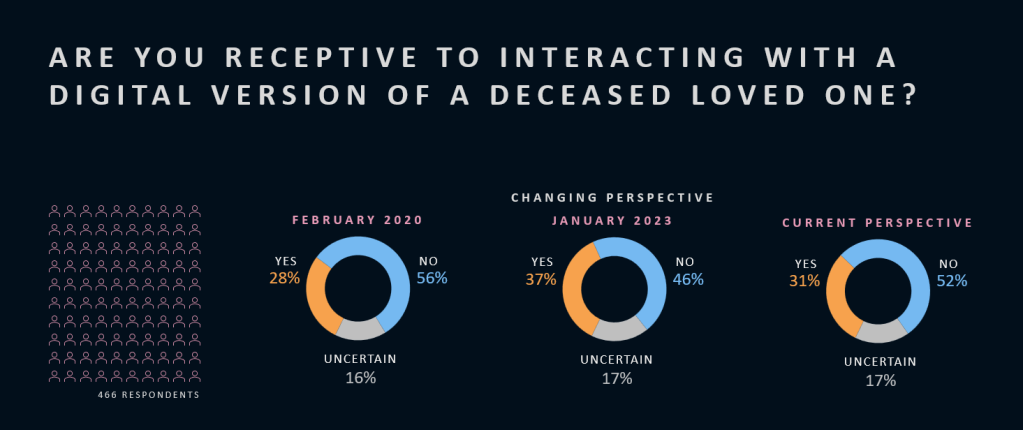
What The Community Said about Interacting With Lost Loved Ones
In this post from February 2nd, I once again posed the question of interacting with a lost loved one. This scenario is part of a broad digital twins discussion, whether it is a digital version of a lost loved one, or a version of ourselves that lives on forever. In a post from February 2020, I included this video that showed a women reconnecting with her lost daughter virtually (digital twin):
(more…) -
Companion Robots And Mental Health
What is your initial reaction to this question. Please respond to the poll.
 Inside the Next Transition