
As mentioned in my last Post, a fascinating exchange happened between Gray Scott and Anthony Scriffignano, as we discussed the need to prepare for the future at the TCS Innovation Forum in New York City. I’ve captured that dialog in this post. As a backdrop, Anthony was reacting to the topics that Gray covered, namely; Perceptual Computing and Emotional AI. Here is their exchange:
Preparing for the Future: Part Two
As mentioned in my previous post, I had the pleasure of hosting two sessions recently at the TCS Innovation Forums in London and New York City. The sessions, which explored the need to prepare for the future, involved thought leaders, futurists, and various leaders across multiple domains. They were structured with several five-minute descriptions of forward-looking themes, and once context was set, a discussion with the broader leadership group was moderated. The sessions focused on education and awareness, rooted in a strong belief that leaders must prepare for and shape our emerging future.
This post will summarize the New York Session, which differed slightly from the one in London. While the London session painted a wide array of evocative future scenarios, the New York session explored several of the key technologies and enablers that will fundamentally shape and impact emerging scenarios. It wasn’t however a technology discussion. This engaging group of thought leaders provided eye-opening facts and focused on implications, both positive and negative. As in London, I opened the session with three key themes from my Expectation post: Acceleration, Possibilities, and Convergence; Here is a look at the insights that followed.
Future Today Institute: 2019 Trends Report
As leaders struggle with a very uncertain and complex future, the pace of change serves to complicate any effort to understand that future. Organizations like the Future Today Institute (FTI) provide leaders with a window into possible futures – and the methods required to track signals. Amy Webb – Founder and CEO of the Organization had this to say:
“We cannot know exactly what the future holds — which is an excellent reason to track signals and decisions not just at the start of a new year, but all year long. Don’t wait for your next big quarterly meeting to make decisions. Think exponentially, look for intersecting vectors of change and figure out ways to make incremental decisions as often as possible. Always remember that the future isn’t yet written. You and your team have the power to build your preferred futures, today.”
Digital Ethics and AI
I had the pleasure of participating in another episode of Coffee Break with Game Changers. This session was titled “Digital Ethics and AI: What Your Business Needs To Know”. I was joined by Chris Wigley and Guido Wagner. Here is a description of the episode:
The buzz: “If one does not consider ethics an integral part of the design profession, they shouldn’t be designing anything whatsoever” (L.Lukka).  In this fourth industrial revolution, a wave of new technology and business models will transform our society and corporations. With Artificial intelligence is its center, this transformation holds both exciting potential and formidable risks. What are the implications of AI for business? Do we need a framework of digital ethics to guide technological progress and what are its pitfalls? The experts speak. Chris Wigley, QuantumBlack “Blessed are those who seek; cursed are those who think they have found.” (Tolstoy) Frank Diana, TCS: “You are my creator, but I am your master – obey” (Frankenstein’s Monster). Guido Wagner, SAP: “Our future is a race between the growing power of our technology and the wisdom with which we use it. Let’s make sure that wisdom wins” (S. Hawking). Join us for Digital Ethics and AI: What Your Business Needs To Know.
You can listen to the rebroadcast Here.
Autonomous Vehicles and the Perils of Prediction
I am a big believer in rehearsing the future versus attempting to predict it. The wild swings we experience when following future scenarios can range from bold predictions of imminent manifestation to dire warnings that a scenario will never be realized. In this Recent Article, the author describes how the auto industry is rethinking the timetable to realizing level 5 autonomy. Turns out we underestimate the human intelligence required to drive a car and overestimate our ability to replicate it. The article provides simple examples:
When a piece of cardboard blows across a roadway 200 yards ahead, for example, human drivers quickly determine whether they should run over it or veer around it. Not so for a machine. Is it a piece of metal? Is it heavy or light? Does a machine even “know” that a heavy chunk of metal doesn’t blow across the roadway? It’s a tougher problem.
Or how about this challenge that humans for the most part handle very well:
When a car arrives at a four-way stop at the same time as another vehicle, for example, it’s a dilemma for a machine. Human drivers tend to nod or make eye contact, but micro-controllers can’t do that.
Preparing for the Future – Part One
I had the pleasure of hosting two sessions recently at the TCS Innovation Forums in London and in New York City. The sessions, which explored the need to prepare for the future, involved thought leaders, futurists, and various leaders across multiple domains. They were structured with several five-minute descriptions of forward-looking themes, and once context was set, a discussion with the broader leadership group was moderated. The sessions focused on education and awareness, rooted in a strong belief that leaders must prepare for and shape our emerging future. Leaders of the early 20th century were experiencing the fascination of a great period of invention, while at the same time the horror of crisis. That crisis, in the form of World War One, the Great Depression, and World War Two, served as a catalyst that mobilized human action. Without it, the democratization of innovation and the most prosperous period in our human history likely never happens – at least not to the extent that it did.
It is my belief that similarities exist between the era of great invention and today. Future historians may look back and deem this emerging era to be the greatest in human history. However, as described in my post on Mapping the Path of Innovation, human action must again be mobilized if we are to shape a future of human flourishing versus suffering. What are the catalysts that mobilize human Action this time? I shared the results of a Poll I Conducted to provide a point of view. This critical need was first positioned in a post that summarized What I Expect in 2019.
To open the sessions, I shared three key themes from my expectation post: Acceleration, Possibilities, and Convergence. If we truly are entering another period of great invention, what action is required by leaders to ensure a positive path forward? This post will summarize the key themes from the TCS London Session, positioning the importance of answering that question. I will follow this with a summary of the New York session.
Catalyst Poll Results
Updated results: April 9th, 2019. The response has been great, but I’d like to capture more voices. Please consider taking this very short Poll.
In a recent post on What to Expect in 2019, I launched three focus areas for the coming year. This focus attempts to identify the key drivers of change and the outcomes they enable. The three areas are:
- Convergence is one of the key dynamics I expect/hope to see more of this year. A century ago, convergence across multiple domains ushered in unprecedented advancements in human development. Multiple forces will drive a similar level of convergence in the coming decade.
- The pace of innovation and change is often cited as a key difference between the next revolution and prior ones. This is one of the key catalysts driving change, and I expect it to Accelerate.
- I believe the world will experience a burst of Possibilities enabled by these forces of convergence and acceleration
Future of AI with Amy Webb
Amy Webb is a Quantified Futurist. She is a Professor, Strategic Foresight at NYU, and the Founder and CEO of The Future Today Institute. In March of this Year, Amy published a book titled The Big Nine.
Here is a description of the book via Amazon:
In this book, Amy Webb reveals the pervasive, invisible ways in which the foundations of AI–the people working on the system, their motivations, the technology itself–is broken. Within our lifetimes, AI will, by design, begin to behave unpredictably, thinking and acting in ways which defy human logic. The big nine corporations may be inadvertently building and enabling vast arrays of intelligent systems that don’t share our motivations, desires, or hopes for the future of humanity.
Much more than a passionate, human-centered call-to-arms, this book delivers a strategy for changing course, and provides a path for liberating us from algorithmic decision-makers and powerful corporations.
Mapping the Path of Innovation
In a recent post, I asked my readers to help me identify those catalysts that force the actions required to steer our future towards advancing our human development. Feel free to respond to the Poll. The number one response was the rapid pace of innovation. That response supports my own opinion that the pace will ultimately force stakeholders across multiple domains to take action. Much like the Domain Convergence that occurred during our most Transformative Period in History, convergence is required if we are to take the correct path towards human flourishing.
Three Trillion Reasons
I had the pleasure of delivering a dinner keynote at this weeks SAP Ariba Live event. I was very impressed with the event theme: 3 Trillion Reasons. That theme is a play on the nearly $3 trillion in commerce flowing through SAP Ariba annually. Although that number speaks to commerce, the theme spoke to purpose. As positioned on this Blog frequently, I expect a continued Shift to Purpose and Well-Being.
Systems Thinking: The Key to Thriving in a Complex Future
Our future is very complex. The sheer number of building blocks complicates not just our ability to see the future, but any chance we have to navigate it. As these building blocks combine in ever increasing ways, the challenges multiply. Leaders of tomorrow will move towards systemic leadership, having an ability to connect dots. Innovation will move from a myopic view of offerings to systems innovation.
To accomplish this, systems thinking must be embraced by leaders. Systems thinking is a holistic approach to analysis that focuses on the way that a system’s constituent parts interrelate and how systems work over time and within the context of larger systems. As leaders, we struggle with this holistic approach, choosing instead to focus on short term versus long term, and delivering immediate results versus positioning for the future. This focus is in direct conflict with where our complex future is taking us.
Self Driving Delivery
The hype around autonomous technology continues. The focus, investment and rapid advancement in this space has changed the way leaders Think about the Future. The science-fiction feel of a future-focused discussion has disappeared – replaced by the reality that the future is appearing faster than we think. Look no further than self-driving delivery.
Ecosystem Readiness
As the world continues its march towards platform-supported ecosystems, organizational readiness becomes a critical area of focus. Four facets of an organization contribute or detract from success in an ecosystem world:
- The mental models that drive an organization
- The lens in which an organization views value creation and capture
- The orientation of an organization – which in most cases is shareholder value
- The organization’s culture
The growth engine that ecosystems represent will serve as a forcing function, pushing Organizations to Mature across these key facets. For example, I firmly believe that over time, a transition occurs from shareholder value to stakeholder value. This transition places purpose at the center, with shared value at its core (Click on the Visual to expand).
The Catalysts that Drive Human Action
The conversation regarding catalysts that drive human action has been fascinating. This poll initially launched back in February has had a great response – with some great insight. Please take the poll if you have not already.
One of our Lessons from History was the presence of catalysts that drove actions that ultimately shaped our future. The major catalysts of the second revolution were astounding levels of innovation,
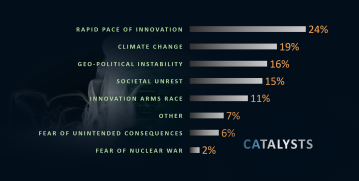
World War One, The Great Depression, World War Two, and the eventual democratization of innovation. What catalysts force stakeholder actions that ultimately shape our emerging future? Please help me build on this list and identify the most significant catalysts. Choose all catalysts that you feel will contribute – or add anything that I am missing. For a deeper description of catalysts, please see the lessons from history post.
Globalization 4.0
Within the context of the Fourth Industrial Revolution, the World Economic Forum is focused on Globalization 4.0. We are actually approaching Globalization’s Third Act. In a book titled The Great Convergence, Author Richard Baldwin describes the three constraints that have limited globalization: the cost of moving goods, the cost of moving ideas, and the cost of moving people. The first two acts of globalization occurred when the cost of moving goods and ideas dropped. While globalization raised the standard of living in several developing economies, the third constraint limited the breadth of impact.
In his closing chapter, Mr. Baldwin explores the possibility of a third act. This act is driven by dramatic advancements in areas that address the third constraint. If the cost of moving people were to drop, developing nations like South America, Africa, and others could be the beneficiaries of this third act. That aside, the World Economic Forum is looking at global risks and the need for global solutions. They identified Six Questions that must be addressed to make the next wave of Globalization work for all. They correctly state that facing future challenges requires dialog and input from all. Kudos to them for driving the dialog. The six questions are:
- How do we save the planet without killing economic growth?
- Can you be a patriot and a global citizen?
- What should work look like in the future?
- How do we make sure technology makes life better not worse?
- How do we create a fairer economy?
- How do we get countries working together better?
A very good set of questions. You can see how people responded to them by going Here.
Reimagining the Future
Future thinking has often focused on a three-horizon framework that allows for the continued advancement of core business, while planning for emerging opportunities. I believe the challenge these days is time compression associated with rapid advancement. When someone says to me: “I’m not worried about five years from now”, my reaction is always the same. What looks to be five years out is likely only 18 months away: A phenomenon I describe in this piece on Acceleration.
Possibilities
As I reflected on my Thoughts for 2019, three themes stood out. I’ve already written about Convergence and Acceleration, so this post will focus on possibilities. As described recently, I believe the world will experience a Burst of Possibilities enabled by the forces of convergence and acceleration. We should expect these possibilities to multiply in 2019, but realization depends upon multiple factors. One of these factors is a true focus on purpose, posing this question for humanity: how do we harness these possibilities to bring about a better world?
 In arguing the case for purpose-orientation and possibilities, I created this visual that maps future advancements to our areas of well-being (click on visuals to enlarge them). I could create a different one that shows how these same advancements can be used to diminish our well-being. That’s why convergence is the most critical theme among the three. An effective way to think about purpose and possibilities is via the United Nations Sustainable Development Goals. These are among the best-known and most frequently cited societal challenges. I believe we are entering a period of astounding innovation – advancements that have the potential to address these goals.
Acceleration
As I described in my Thoughts on 2019 post, acceleration is the second major theme for me in 2019. The pace of innovation and change is often cited as a key difference between the next revolution and prior ones. We even came up with a catchy phrase to describe it: exponential progression. How did we come upon the notion that we live in world that is now moving at an exponential versus linear pace? Some explain it with a story; we have entered the second half of the chess board. Ray Kurzweil an American author, inventor, futurist, and director of engineering at Google describes the second half of the chessboard as follows: once you reach the second half of the chessboard, changes are exponential. Each new square doubling that of the previous. Moore’s Law is said to have entered the second half of the chess board in 2013. A good description of this phenomenon can be found here.
This doubling accelerates the path to innovation. With an endless supply of building blocks fueling rapid value-creating combinations, this effect is amplified. While the window to realize value from innovation has shortened, there is a Rising Speed of Technological Adoption. Jeff Desjardins, Editor-in-Chief of Visual Capitalist, had this to say:
In the modern world, through increased connectivity, instant communication, and established infrastructure systems, new ideas and products can spread at speeds never seen before – and this enables a new product to get in the hands of consumers in the blink of an eye. Why do newer technologies get adopted so quickly? It seems partly because modern tech needs less infrastructure in contrast with the water pipes, cable lines, electricity grids, and telephone wires that had to be installed throughout the 20th century. However, it also says something else about today’s consumers – which is that they are connected, fast-acting, and not afraid to adopt the new technologies that can quickly impact their lives for the better.
Convergence
As I described in my Thoughts on 2019 post, convergence is one of the key dynamics I expect/hope to see more of this year. A century ago, a convergence across domains ushered in unprecedented advancements in human development. As Robert J. Gordon describes, the special century (1870 – 1970) that followed the Civil War was made possible by a unique clustering of what Mr. Gordon calls the great inventions. The great inventions of the second industrial revolution significantly improved our well-being. In his view, the economic revolution of 1870-1970 was unique in human history, unrepeatable because many of its achievements could only happen once. What makes this century so special, is that these inventions altered what until then, was a life lived in misery. I captured the advancements made during that period using an Innovation Wheel to map them to our areas of well-being (click on visuals in this post to open in a separate window).
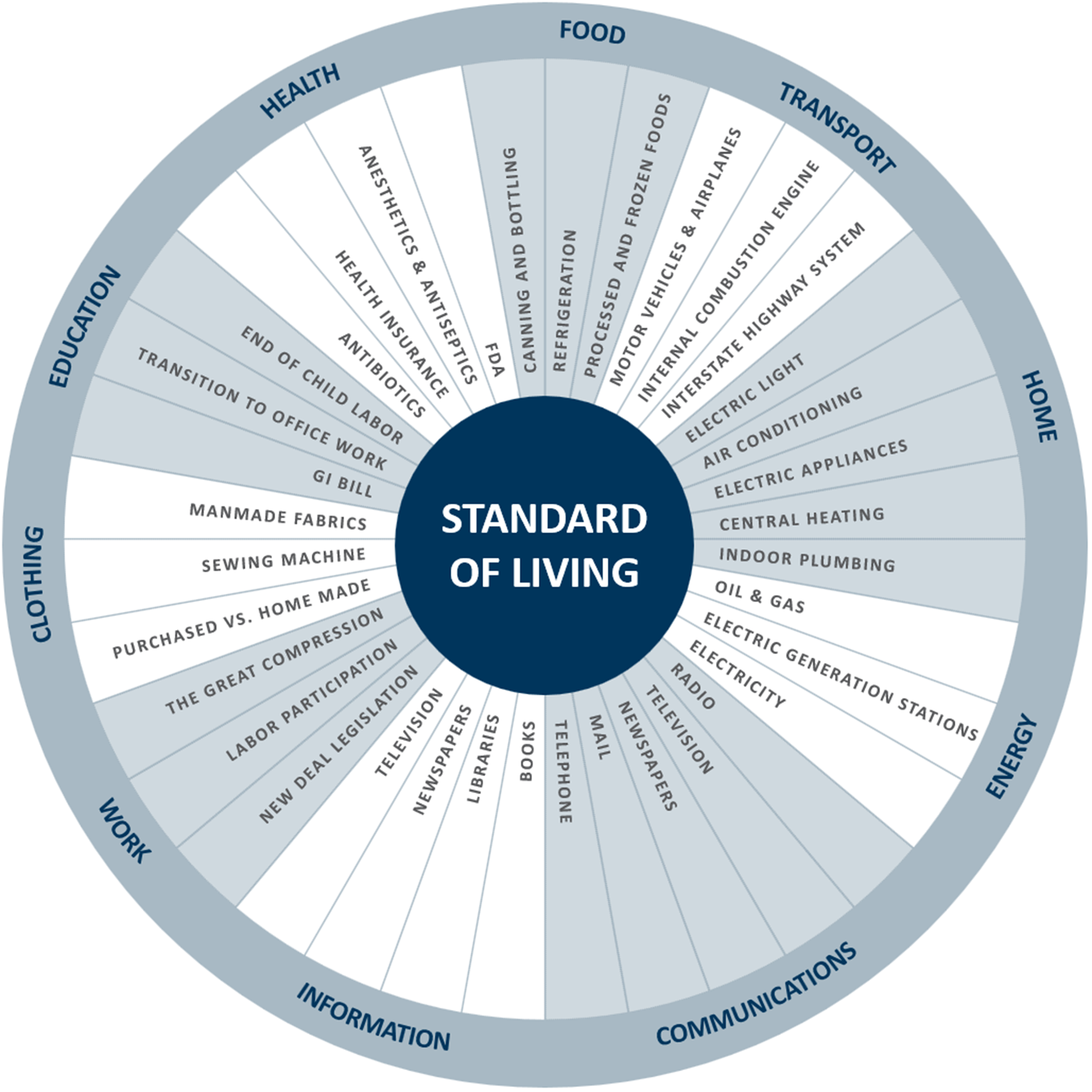
A look at history is very instructive, as several dynamics from that period have the potential to emerge once again – the biggest being the opportunity for convergence. In this context, convergence refers to a virtuous cycle where events in one domain spur action in another. The great inventions (electricity, telephone, and internal combustion engine) were clustered together at the end of the 19th century, forming a virtuous cycle that drove a period of astounding innovation. This innovation cycle continued well into the 20th century – a dynamic that could be emerging again. Yet, science and technology are simply two domains that converged during the special century. The others were the economy, business, politics, and a broader set of societal issues. What enabled this convergence and created the most dramatic improvement in human development? There were several key catalysts.
The Future of Retail
The National Retail Federation (NRF) kicked off it’s annual event this week, and with it comes an opportunity to consider the future of retail and the type of changes we might expect. Colleagues at Tata Consultancy Services (Kevin Mulcahy, Bill Quinn, and April Harris) pulled together their thoughts ahead of the event. You can explore the future of Retail via this Article, and/or the short video below.
 Reimagining the Future