“There are decades when nothing happens and weeks when decades happen.” – Vladimir Lenin
That quote is highlighted in a new book by best-selling author Fareed Zakaria. In “Ten Lessons for a Post- Pandemic World”, Mr. Zakaria helps readers to understand the nature of a world that emerges after the pandemic: the political, social, technological, and economic consequences that may take years to unfold. He does this by focusing on ten lessons:
We owe so much to the frontline heroes that serve society in critical times. The pandemic has shown us just how important and under-appreciated these individuals are. We owe them a debt of gratitude. Healthcare is one of those areas where we see both heroics and exposure. The lack of digital progress has been exposed across sectors by the virus. That is the bad news. The good news is that extreme events like this can serve as accelerants. This recent Article describes the turning point that COVID-19 likely represents for healthcare. Rethinking healthcare for the digital age should be a top priority (as it should across all industries).
A recent Study found that the number of students enrolling in college immediately after high school plunged nearly 22% this past fall over last year. The future of education is a big discussion topic, as the pandemic is threatening the viability of education organizations and models. Key findings include:
Last week, I participated in the Mass Participation World Conference 2020. The theme of the event was “Changing the Narrative: Solutions to help us move from Surviving to Thriving”. We shared the results of a recent survey of runners. The TCS This Run Tech Survey reveals that technology is powering runners through the pandemic. The survey was geared towards uncovering running technology trends amid COVID-19 and helping shape how TCS can best support runners and races in the future. TCS sponsors marathons around the world, including the NYC Marathon.
As a follow up to my presentation on the Future of Sports, this Article envisions the future of athletics and society. Reimagine the future of sports along with us – I’d be interested in your thoughts.
I just finished another book and added it to my Library. Pandemic, Inc. explores eight trends that are amplified by the current pandemic. Author Patrick Schwerdtfeger believes we will see more change in the next 12 months then we saw in the last 12 years. He views the current crisis through an optimistic lens, seeing a time of incredible change, but also opportunity.
Back in April and May, there was a lot of crystal ball gazing going on. Will COVID-19 change our world forever? This Post, among others I wrote in the early days of the pandemic, explored the various ways the world may change. In the post, I reflected on a key warning sign: most predictions of a post-crisis world have historically been wrong. I pointed to an Article authored by Rob Walker, where he stresses that thoughtful speculation about the future helps us cope with the present and identify potential challenges and opportunities. He adds however that history tells us that most predictions will be wrong. In looking back at predictions post 9/11 and the great recession, Mr. Walker provides supporting evidence for this statement.
I had the pleasure of joining RegalixTV recently for a session focused on education. Host Dheeraj Prasad and I discussed the importance of education in transformative eras, how digital learning experiences are evolving, why there needs to be a shift in focus with respect to skill sets and a whole lot more on Knowledge-Centered Growth.
Tune in to watch the full Interview. I have focused a great deal on education recently. You got explore the topic via my earlier posts.
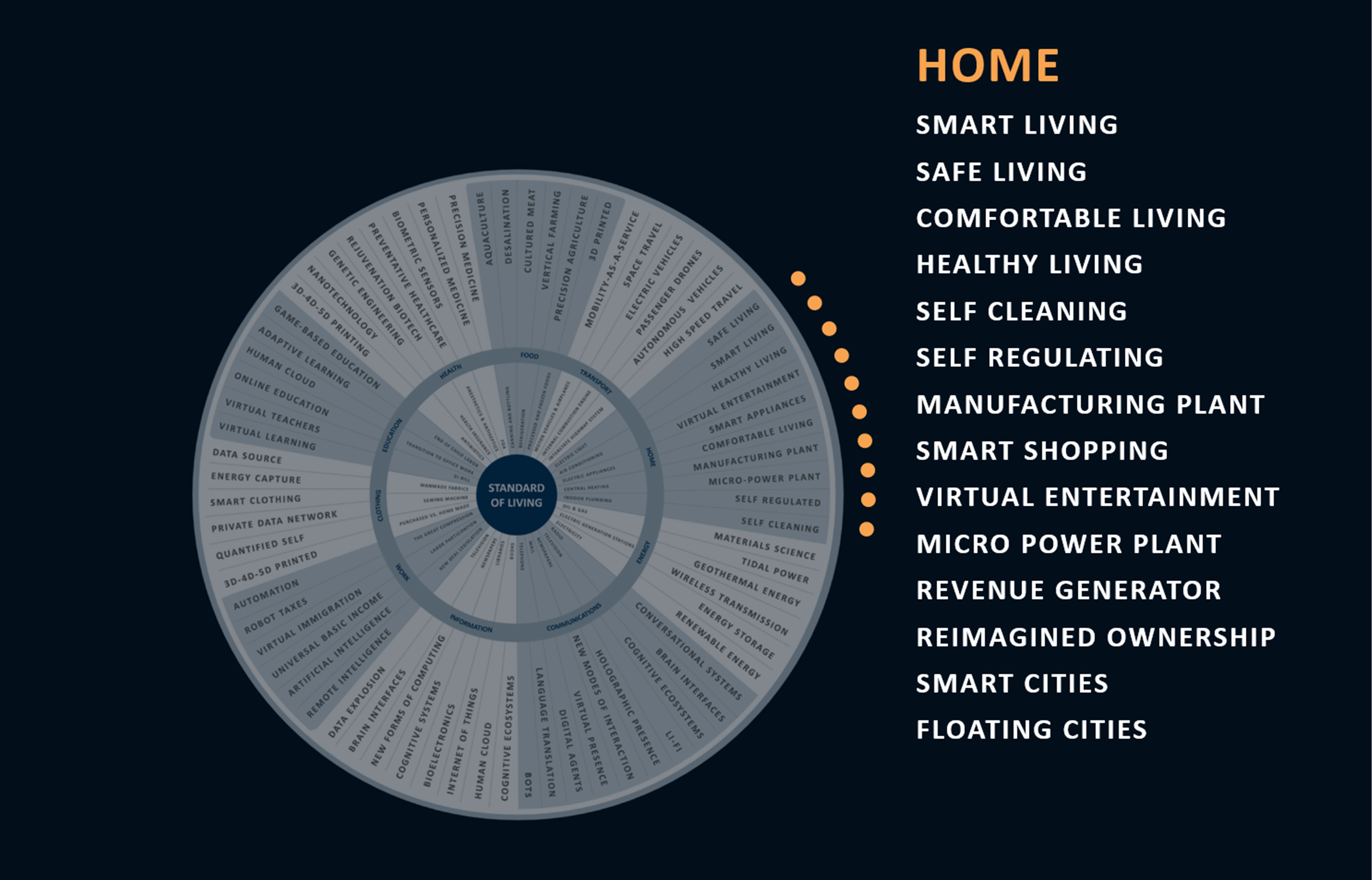
When I talk about this emerging era of great invention advancing the various areas of our well-being, I always include changes to the home. The home has remained quite static since great inventions of the second revolution (running water, sanitation, heating, air conditioning, etc.) established our modern-day home. For the first time since that period, the home is likely to see another shift. This was true prior to the pandemic, as the visual I use to describe this part of the innovation story describes.
An event like a pandemic triggers a chain reaction. Like one domino setting the others in motion, COVID-19 is shaping a different future. The links in the chain represent multiple domains, and the reaction spans them all. Our challenge is to understand the Implications of these reactions and the way the World may Respond. I looked at this implication/response Framework in the early days of the pandemic. Now, we see signals that may provide more clarity as to possible paths. One domain where signals are emerging is work.
I mentioned last week that I would spend time on education and our critical need to rethink it. To start that journey, fellow Futurist Alexandra Whittington joins our future of business show with host Kevin Benedict. Listen in to their wide ranging conversation about futurism and the rethinking of higher education.
Data gathered by LinkedIn, Coursera and the World Economic Forum was captured in a Future of Jobs Report recently published by The World Economic forum (WEF). A good summary is provided by senior writer Kate Whiting in her recent Article on the WEF website. Report content is showing up in varied places, with key finding.
The acceleration of automation is not a direct outcome of the pandemic – it is simply more visible now. That visibility is one of the few bright spots in an otherwise horrible several months. The inequities that exist in the world are now more visible. The lack of preparation for a digital future has exposed those who did not see the need. In the case of automation, it was going to accelerate for a number of reasons, but the pandemic will Accelerate the Acceleration. One clear reason that this decade will see a massive investment in automation is the fall in Working Age population. Said another way, it is getting increasingly difficult to find skilled resources.
I just finished another very good book and added it to my Book Library. COVID-19: The Great Reset was authored by Klaus Schwab and Thierry Malleret. Professor Klaus Schwab is the Founder and Executive Chairman of the World Economic Forum. He has argued that a company must serve not only shareholders but all stakeholders to achieve long-term growth and prosperity. To promote the stakeholder concept (something gaining considerable traction today), he founded the World Economic Forum. Thierry is the co-founder and main author of the Monthly Barometer, a succinct predictive analysis exclusively provided to private investors and some of today’s most influential opinion and decision-makers.
As artificial intelligence continues to both dominate the news and stimulate our imagination, many questions remain. One such question was explored in a recent Article. As the authors describe, artificial intelligence still needs to bridge the gap between mastering cerebral games like chess and Go and translating that impact to the physical world. The latter remains a bigger challenge.
Shopping malls are an example of the lasting impact that the global pandemic is likely to have on real estate. If the surge in online shopping represents a new normal, then what is to become of all those malls? In a recent Article, author Parija Kavilanz explores that question. According to data from research firm (REIS) Moody’s Analytics, the rate of mall vacancies is at a historic high of 9.8% in early September, exceeding the previous peak of 9.3% in 2011.
In early 2019, I described the Three Focus Themes for the year. They were Acceleration, Convergence, and Possibilities. Little did I know that one of those themes would factor so prominently in 2020. In a recent Presentation, Mehlman, Castagnetti, Rosen & Thomas – a full-service, bipartisan government relations firm – describes 2020 as the year where forces already in play experience a great acceleration. One of those forces is mixed reality.
There was a lot going on in the world of travel prior to the pandemic. The emerging Mobility Ecosystem built on a foundation of innovation promises to disrupt this space as the decade progresses. The visual describes some of what lies ahead (click to view in a separate window).
As we have seen over the last several months. COVID-19 is impacting multiple domains. I had explored the Possible Implications across these domains in a post earlier this year. The visual below reflects some of that work (click to enlarge). Now months later, we see indications of potential paths or responses.
As I mentioned in a recent Post, the global pandemic has altered how we think about our world. However, one thing is constant if not amplified by it: society needs to act if we hope to shape a future that advances human development. The rapid pace of innovation – riding on antiquated institutions – required our attention pre-pandemic. In a post-pandemic world, both of those factors are amplified. The inadequacies of our institutions are more visible now than ever; and innovation that may have unfolded over years is realized in months.
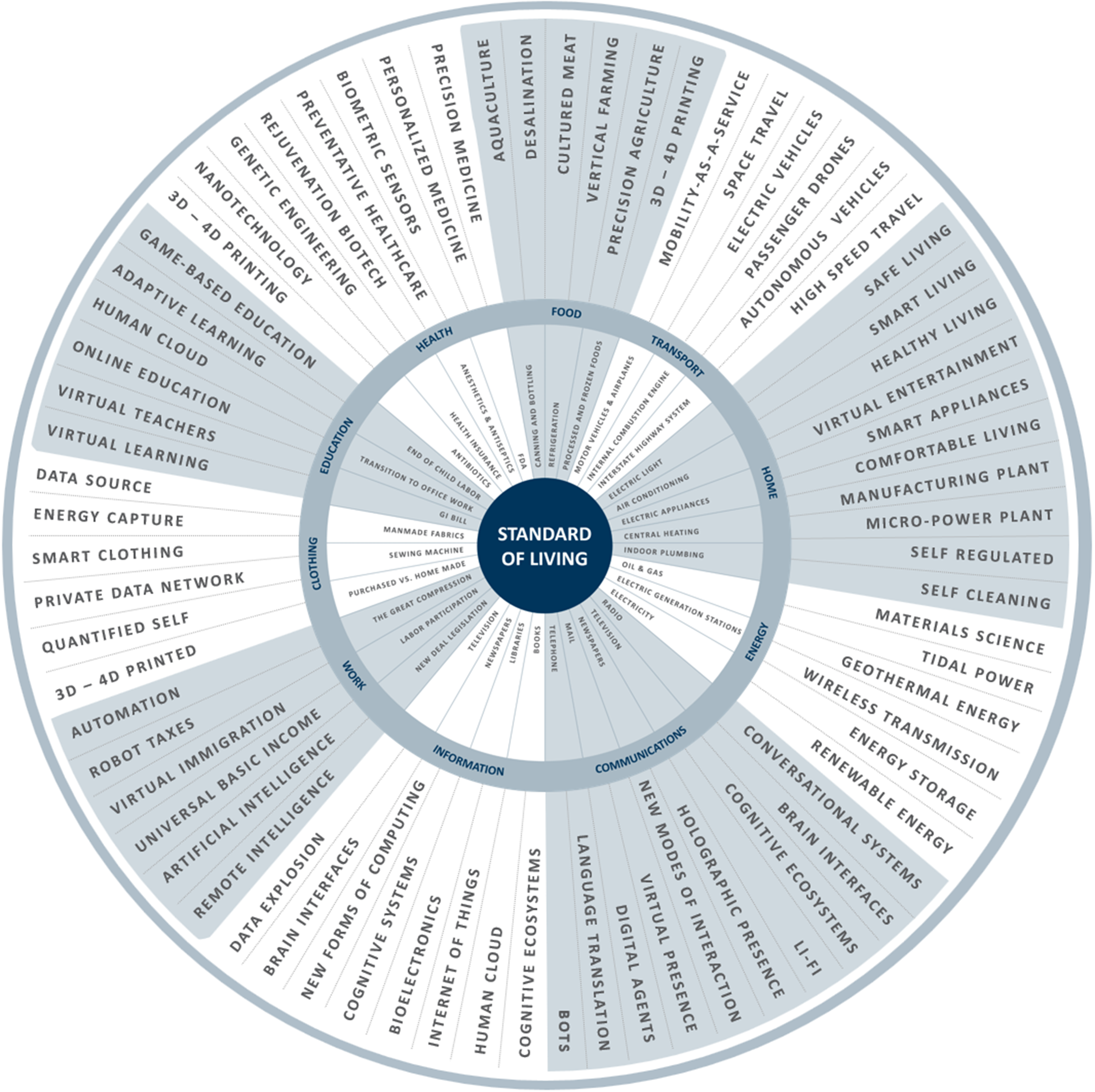
Human development has advanced considerably since the start of the industrial revolution. Economist Robert J. Gordon describes this Human Development Journey and concludes that, as far as standard of living is concerned, we have journeyed as far as we can. While thinking about that assessment, I set out to consider this new age of great invention and its impact on human development. The result was the development of this innovation wheel (click to enlarge).

 Reimagining the Future