
Data gathered by LinkedIn, Coursera and the World Economic Forum was captured in a Future of Jobs Report recently published by The World Economic forum (WEF). A good summary is provided by senior writer Kate Whiting in her recent Article on the WEF website. Report content is showing up in varied places, with key finding.
Continue readingThe Next Generation Of Farming
As we Rethink Humanity, we appreciate that the next decade represents what is likely the fastest, deepest, most consequential disruption in history. By 2030, much of what we know could be completely reimagined. Something as basic as food and farming could look quite different, as the possibilities cover a wide spectrum. In the short term, we find different ways to farm, optimizing yield and improving our environment. In the long term, we likely witness the complete transformation of farming.
Continue readingAccelerating Towards Automation
The acceleration of automation is not a direct outcome of the pandemic – it is simply more visible now. That visibility is one of the few bright spots in an otherwise horrible several months. The inequities that exist in the world are now more visible. The lack of preparation for a digital future has exposed those who did not see the need. In the case of automation, it was going to accelerate for a number of reasons, but the pandemic will Accelerate the Acceleration. One clear reason that this decade will see a massive investment in automation is the fall in Working Age population. Said another way, it is getting increasingly difficult to find skilled resources.
Continue readingThe Workforce of 2025
“According to experts, remote work is here to stay and even when the health crisis ends, a good portion of the workforce will remain working from home”
That’s the sentiment from a recent Article that looks at the workforce of 2025. Author Lori Ioannou explores the challenges of keeping employees connected, innovating and collaborating in a world of virtual organizations. Evidence that remote work is likely to continue keeps mounting. Microsoft told employees that they can Work From Home Permanently. Dropbox recently did the same, announcing on Tuesday that they will stop asking employees to come into its offices and instead make Remote Work The Standard Practice. For employees that need to meet or work together in person, the company is setting up “Dropbox Studios” when it’s safe to do so. In the meantime, the company extended its mandatory work from home policy through June 2021.
Continue readingThe Autonomous Vehicle Has Arrived
“Those who say it cannot be done should not interrupt those who are doing it.” – Thomas Alva Edison
That is a quote from a recent Article on Waymo’s announcement of a Completely Driverless Service for the general public in Chandler, Tempe and Mesa Arizona. The quote addresses all the skepticism that has surrounded the move towards autonomous vehicles. Author Enrique Dans describes the emerging service and has a message for the naysayers:
Continue readingRethinking Humanity
Last week, I Reacted to an article exploring something that is rapidly approaching: likely the fastest, deepest, most consequential disruption in history. The Article was authored by Tony Seba and James Arbib, founders of RethinkX, an independent think tank that analyzes and forecasts the speed and scale of technology-driven disruption and its implications across society. In the article, they describe a world where our most intractable problems are solved. A book was referenced by the authors titled Rethinking Humanity – which I just finished and added to my Book Library. As an aside, I found two other books while researching their organization: Rethinking Food and Agriculture and Rethinking Transportation. These books are next on my list.
Continue readingRobots Are Constructing a Dam in Japan. Are Buildings Next?
Here is a scenario I expect to see play out increasingly over time:
To address Japan’s rapidly aging workforce and labor shortage, contractor Obayashi Corporation has turned to automation by constructing a dam almost entirely with robots
Continue readingThe Fastest, Deepest, Most Consequential Disruption In History
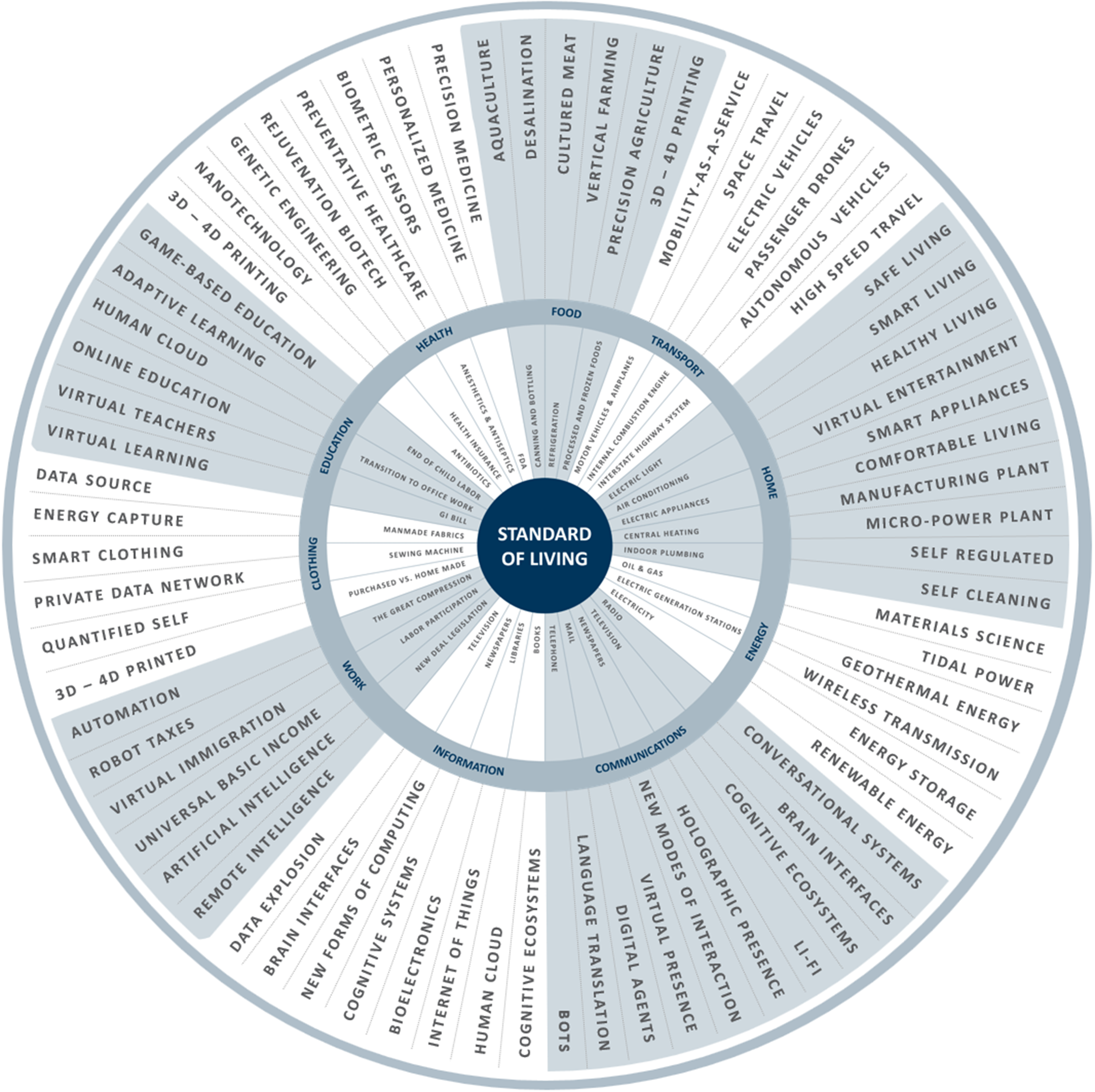
That is quite the title. It is the title of a recent Article authored by Tony Seba and James Arbib. In it, they describe a world where our most intractable problems are solved. I have described that same story using my innovation wheel, and in so doing, I draw many of the same conclusions positioned by the article.
Continue readingCurrent Poll Results: Catalysts of Change
By now, readers of my Blog know that I have been researching the catalysts of human action for over 18 months. I have used a poll to gather insights from the community. I posted Results a while back, and am providing an update via this post. As a reminder of the topic, here is an excerpt from a Post back in April 2019:
Continue readingCOVID-19: The Great Reset
I just finished another very good book and added it to my Book Library. COVID-19: The Great Reset was authored by Klaus Schwab and Thierry Malleret. Professor Klaus Schwab is the Founder and Executive Chairman of the World Economic Forum. He has argued that a company must serve not only shareholders but all stakeholders to achieve long-term growth and prosperity. To promote the stakeholder concept (something gaining considerable traction today), he founded the World Economic Forum. Thierry is the co-founder and main author of the Monthly Barometer, a succinct predictive analysis exclusively provided to private investors and some of today’s most influential opinion and decision-makers.
Continue readingDealing With Loneliness And Isolation
At a Milken Institute Health Summit in 2017, I participated in a panel discussion that focused on effective methods for healthier aging on a vast scale. One of the key discussion points was how Loneliness and Isolation were a leading cause of death among the elderly. Here in 2020, that concern has been amplified by the pandemic. During that panel discussion, I mentioned the use of companion robots to deal with this growing crisis. As society continues to age, the problem of isolation and loneliness grows more acute.
Continue readingArtificial Intelligence And The Cerebral-Physical Gap
As artificial intelligence continues to both dominate the news and stimulate our imagination, many questions remain. One such question was explored in a recent Article. As the authors describe, artificial intelligence still needs to bridge the gap between mastering cerebral games like chess and Go and translating that impact to the physical world. The latter remains a bigger challenge.
Continue readingEdge Computing And The Need To Sense And Respond
Back in 2013, I wrote about the critical need to Sense and Respond in a climate of uncertainty, interdependency, complexity, and velocity. In that post, I said this:
As our world experiences continued Acceleration and the amount of data flowing through company ecosystems expands, the need to sense stimuli and enable a real time response intensifies. Fortunately, rapid advancements in the price and performance of technology make realizing this sense and respond paradigm achievable and economical for a wide range of use cases – but this is arguably one of the most difficult components of transformation road maps.
Continue readingGeopolitics: A Complex Area Of Convergence
The critical need to understand the rapidly approaching future relies upon our understanding of various domains that are Converging. It is difficult enough to stay abreast of rapid advancements in science and technology, but Introduce societal factors, geopolitical, economic, and environmental considerations, and the task gets harder. Yet a high-level appreciation for these domains is necessary if we hope to understand the future and steer it in constructive directions.
Continue readingCovid-19 Leaves Its Mark on Real Estate
Shopping malls are an example of the lasting impact that the global pandemic is likely to have on real estate. If the surge in online shopping represents a new normal, then what is to become of all those malls? In a recent Article, author Parija Kavilanz explores that question. According to data from research firm (REIS) Moody’s Analytics, the rate of mall vacancies is at a historic high of 9.8% in early September, exceeding the previous peak of 9.3% in 2011.
Continue readingPhilosophy Complicates The Convergence Story
In a post from last year, I focused on the Convergence story. This story has one foot in the past, and another in the future. The realization of great advancements in human development during the late 19th and early 20th centuries is a convergence story. A period of great invention converged with other domains to enable our modern society. As we stand at the threshold of another period of great invention, the convergence story is more complicated. This time, complexity is added by the introduction of two new domains: philosophy and environment.
Continue readingIs The Future Of Work A Return To The Past?
For those of us alive today, our core beliefs, the way we live, and our notion of work are rooted in the way it has been for the last 250 years. To us, it has always been this way. When a transformative era emerges, we struggle to imagine a different way of doing things – even when the emerging future is begging us to think differently. One great example lies in the future of work. As we struggle to envision a world where work is no longer required, we fail to realize that History is very Instructive.
Continue readingIs The Shareholder Doctrine Dead?
Fifty years ago, Milton Friedman announced that the social responsibility of a business was to increase profits. So was born the shareholder value era. Friedman was pushing back on dominant movements of the day: the new deal and European models of social democracy. Global inequality issues trace back to this rise of shareholder value. A recent Article explores the topic and the resulting power of the stock market. The authors suggest that while the market and the wealthy soared, consideration of the interests of workers, the environment, and consumers declined.
Continue readingThe Next Generation Of Artificial Intelligence
Two recent articles caught my eye this week. One article focused on the Fourth Generation of artificial intelligence, calling it artificial intuition. The other article explores the shift from artificial narrow intelligence to Artificial General Intelligence. In the case of artificial intuition, author Mark Gazit describes how helpful AI has become, and its ongoing limitations. Machine learning is still fully dependent on historic data. New and unknown scenarios leave data scientists helpless. Mr. Gazit suggests that in order to have true artificial intelligence, we need machines that can think on their own.
Continue readingAdvancing Human Development: The Catalysts Of Change
More votes have come in since I last reported on my poll. The question based on history is this: what catalysts drive human action in the future? It took two world wars and a great depression to drive humans to act in ways that prevented reoccurrence and advanced human development. In a world that looks eerily similar to that era, we once again wonder about catalysts. Here are the current results.
Continue reading Reimagining the Future