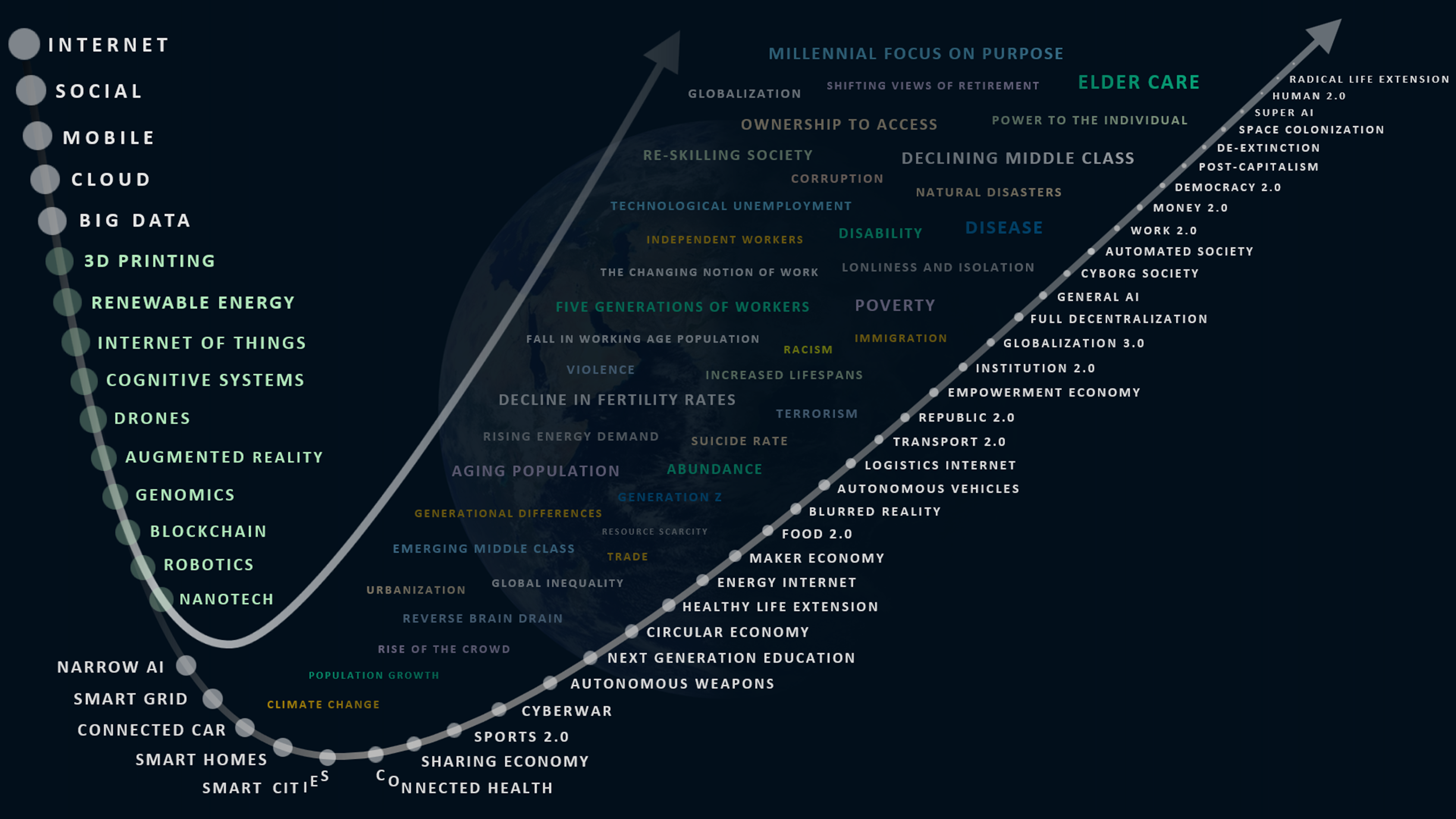
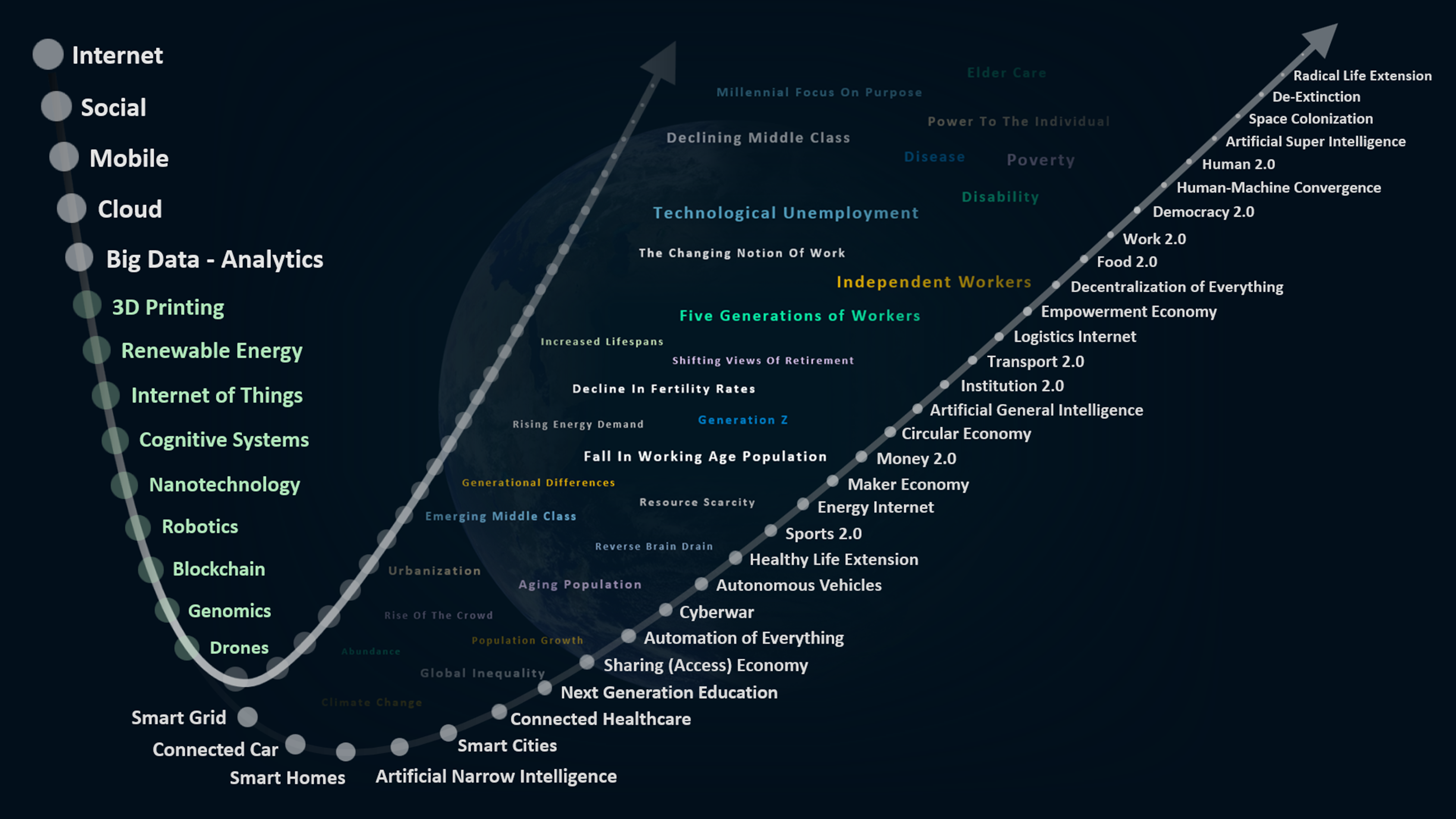
The brain is clearly one of the next great frontiers. In this World Economic Forum Article on reading minds, we get a glimpse into the exponential progression of brain science. The author cites research published by AI experts in China, the US and Japan showing that computers can replicate what people are thinking by using functional magnetic resonance imaging (fMRI) machines that measure brain activity – linked to deep neural networks that replicate human brain functions.
Future Scenarios
Unlearning May be our Biggest Challenge
The illiterate of the 21st century will not be those that can’t read or write, but those who cannot learn, unlearn, and relearn – Alvin Tofler, Rethinking the Future.
As we all become life long learners, unlearning could be our biggest challenge. Our mental models prevent us from seeing the need for change. We are creatures of the only world we have individually known. Even if you are one hundred years old, the mental models established after humanities second Tipping Point dominate your thinking. They form our intuitions and belief systems.
The Future of AI – Predicting, Preparing, and Thriving in our Changing Future
I had the pleasure of recording a Podcast with AJ Goldstein on a wide ranging set of topics. The central theme was artificial intelligence. We took a journey to the future and explored several possible paths for artificial intelligence. AJ had the following kind words to say as he shared the Podcast in various channels:
Last month I had the opportunity to sit down with one of the world’s leading futurists, Frank Diana, to discuss the future of artificial intelligence.
Today the episode has been released, and it’s one of the most meaningful conversations I’ve had on the podcast.
Rather than provide a subjective one-sided view, with every question that I asked about the future of AI, Frank responded with presenting both sides. He helped me understand “what does the optimist say?”, “what does the pessimist say?”, “what is the utopian view?”, “what’s the dystopian view?”… and in this way it quickly became one of the most balanced conversations I’ve had the chance to be a part of.
With over 30+ years of experience to pull from, Frank provided so many fascinating lenses through which to view our changing future… all the while outlining an insightful playbook of what we can do as individuals, communities, and societies to prepare for the inevitable change that’s going to come.
AJ drove the discussion on the following topics:
- Addressing the two tipping points that have occurred thus far in humanity and changed what it means to be human– and the coming third tipping point.
- Addressing some of the common fears that people have about the implications of advanced AI and robotics on the future.
- How the shift to an automated society might cause initial elimination of jobs, but ultimately will allow more time for pursuit of creative, entrepreneurial endeavors.
- A discussion on the characteristics needed to succeed in a world of change, and what you personally should do to prepare for it.
Enjoy the show!
Are we all Designers?
Yesterday on Coffee Break with Game Changers, Bonnie D. Graham hosted a show focused on designing the future of humanity. You can listen to the rebroadcast here. The session abstract is included below. The show participants included: Bonnie, Masha Krol, Ian Gertler, Maricel Cabahug and myself.
In her opening monologue, Bonnie said:
The first impact of AI will be that more and more non-designers develop their creativity and social intelligence skills to bolster their employability – in the future, everyone will be a designer
With all the talk of AI and its potential negative impact on humanity, we lose sight of the positive. As an engine for augmentation, artificial intelligence is likely to advance our human potential. The effectiveness of what we do stands to improve – whether its creativity and design, or oriented in analytics. Some would prefer to call it “Augmented Intelligence” versus artificial intelligence. If we view the progression of AI on a spectrum, we could indeed reach the place of augmentation and never approach the other end of the spectrum. This lies at the heart of the artificial intelligence debate.
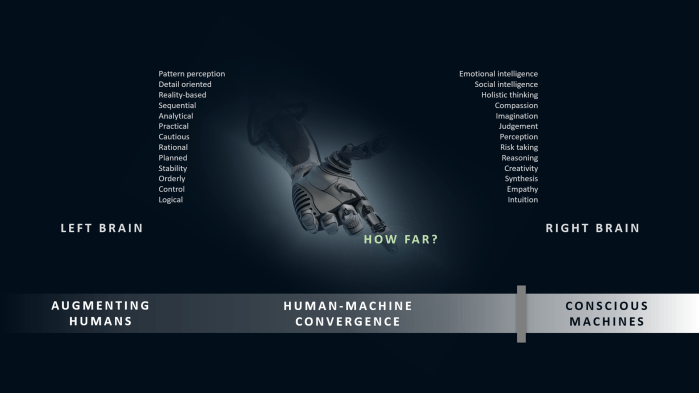
Republic 2.0 Added to Emerging Future Visual
In a recent book titled The Future of Work, author Darrell M. West describes the Work 2.0 scenario on this emerging future visual. In exploring possible implications of a shifting work paradigm, he gets prescriptive about possible responses. This implication-response exercise sits at the heart of Future Thinking.
No one can predict this complex and uncertain future – but exercises like this help us see possible futures. In seeing them, we position ourselves to proactively shape them. In the context of work, Mr. West explores several possible responses, including another future scenario which he calls Republic 2.0. How this scenario plays out has a direct impact on the path of other scenarios. The scenario speaks to a new kind of politics. Mr. West states:
Life 3.0: Being Human in the Age of Artificial Intelligence
I just added another very good book to the Book Library: Life 3.0: Being Human in the Age of Artificial Intelligence – A New York Times Best Seller. Author Max Tegmark takes a fascinating journey through possible AI futures. His physics oriented perspective provides an interesting point of view, as humanity wrestles with the ultimate path of artificial intelligence.
Mr. Tegmark tackles the discussion around how much machines will encroach on human domains, by illustrating a metaphor from Hans Moravec:
The Journey Continues
It’s been over a year since launching an Online Course focused on a complex and uncertain future. The course takes a Journey through the Looking Glass – a metaphorical expression that means: on the strange side, in the twilight zone, in a strange parallel world. It comes from the Alice and Wonderland literary work of Lewis Carroll, where he explores the strange and mysterious world Alice finds when she steps through a mirror. I have always found this to be a perfect metaphor for our times.
Every time the looking glass has appeared, the world has experienced a Tipping Point. While I firmly believe a tipping point is coming, the impact is likely a question of severity. Some believe that we have survived similar economic transitions in the past, while others disagree:
Game Changers: Can We Teach Machines to Predict?
Today on Coffee Break with Game Changers, Bonnie D. Graham hosted a show focused on the future of prediction. You can listen to the rebroadcast here. The session abstract is included below, as well as a Twitter stream that provides insight into the topic and our discussion. The show participants included: Bonnie, Gray Scott, and myself
Episode Description
The buzz: “Those who have knowledge, don’t predict. Those who predict, don’t have knowledge.” (Lao Tzu)
Given the uncertainty, pace, and unexpected nature of today’s world, there are too many unknowns for us to effectively predict the future. Reality check: A convergence across science, technology, politics, society, economics, the environment, and growing ethics discussion, has created a complex web that requires the type of system thinking that may exceed our human capacity. Do machines hold the answer? Can they predict the path of an overwhelming number of possible futures?
The experts speak. Frank Diana, TCS: “We have a duty to think hard about what may be, so as to better prepare society for the changes that may come” (Richard Baldwin). Gray Scott, Futurist: “Prediction is not just one of the things your brain does. It is the primary function of the neo-cortex, and the foundation of intelligence” (Jeff Hawkins). Join us for Tech Magic or Hype: Can We Teach Machines to Predict?
Find out where you Stand on Artificial Intelligence
Technology is giving life the potential to flourish like never before, or to self-destruct – The Future of Life Institute.
I stumbled upon this organization while reading Life 3.0: Being Human in the Age of Artificial Intelligence by author Max Tegmark. Their mission is to catalyze and support research and initiatives for safeguarding life and developing optimistic visions of the future, including positive ways for humanity to steer its own course considering new technologies and challenges. They are a charity and outreach organization working to ensure that tomorrow’s most powerful technologies are beneficial for humanity – and the list of members is a whose who of the science and technology community.
In their view, technology is to thank for all the ways in which today is better than the stone age, and technology is likely to keep improving at an accelerating pace. From their website: with less powerful technologies such as fire, we learned to minimize risks largely by learning from mistakes. With more powerful technologies such as nuclear weapons, synthetic biology and future strong artificial intelligence, planning ahead is a better strategy than learning from mistakes.
They support research and other efforts aimed at proactively avoiding problems with a current focus on artificial intelligence. The book referenced above looks at the advance of AI and how it will impact life, exploring a broad spectrum of views on what will/should happen. Now, the organization is looking to expand the conversation to include as many voices as possible. Here is a look at the results of their Super Intelligence Survey. You can add your own voice by taking the survey here.
Higher Education in the Age of Artificial Intelligence
In a recent book titled, Robot-Proof: Higher Education in the Age of Artificial Intelligence, Northeastern University president Joseph Aoun proposes a way to educate the next generation of college students, supporting society in ways that artificial intelligence cannot. His underlying premise is that the existing model of higher education has yet to adapt to the seismic shifts rattling the foundations of the global economy – I firmly agree. It was Alvin Tofler that said: The illiterate of the 21st century will not be those that can’t read or write, but those who cannot learn, unlearn, and relearn.
Continue readingThe Fourth Age
Byron Reese recently authored a book titled The Fourth Age. I thoroughly enjoyed this fascinating look at history, and the focus on possible futures. In looking at the future, Mr. Reese explores the reasons that experts disagree on the path of these possible futures. He asks: why do Elon Musk, Stephen Hawking, and Bill Gates fear artificial intelligence (AI) and express concern that it may be a threat to humanity’s survival; and yet, why do an equally illustrious group, including Mark Zuckerberg, Andrew Ng, and Pedro Domingos, find this viewpoint so far-fetched as to be hardly even worth a rebuttal? The answer as described by the author lies not in what we know – but what we individually belief. This theme throughout the book is an interesting piece of self-reflection. See how you would answer the questions posed by the author.
Globalization’s Third Act
Globalization could be entering its third act. In a book titled The Great Convergence, Author Richard Baldwin describes the three constraints that have limited globalization: the cost of moving goods, the cost of moving ideas, and the cost of moving people. The first two acts of globalization occurred when the cost of moving goods and ideas dropped. While globalization raised the standard of living in several developing economies, the third constraint limited the breadth of impact.
In his closing chapter, Mr. Baldwin explores the possibility of a third act. This act is driven by dramatic advancements in areas that address the third constraint. If the cost of moving people were to drop, developing nations like South America, Africa, and others could be the beneficiaries of this third act. How will the cost of moving people drop? What advancements enable this third act? In his closing chapter, Mr. Baldwin touches on enabling innovations and their fascinating potential. Here is a brief look at these innovations:
Healthy Life Extension
One of the paradigm shifts on the future scenarios curve is healthy life extension. When I mention to an audience that the first person to live to 200 has already been born – it gets quite the reaction. Extending our healthy lives has many implications to very long held beliefs. These challenges to our belief systems are the reason I believe humanity is heading towards another Tipping Point – that moment in time where intuitions and beliefs built over long periods experience a considerable shift. It is the reason I titled my presentation “A Journey through the Looking Glass”.
Through the looking glass is a metaphorical expression. It means: on the strange side, in the twilight zone, in a strange parallel world. It comes from the idea of Lewis Carol’s novel: “Through the Looking–Glass“, and the strange and mysterious world Alice finds when she steps through a mirror. I firmly believe we are stepping through the looking glass.
Healthy life extension is a great example of a scenario on the curve upending long standing institutions. As visualized below, multiple building blocks converge to deliver this scenario.

Blurred Reality
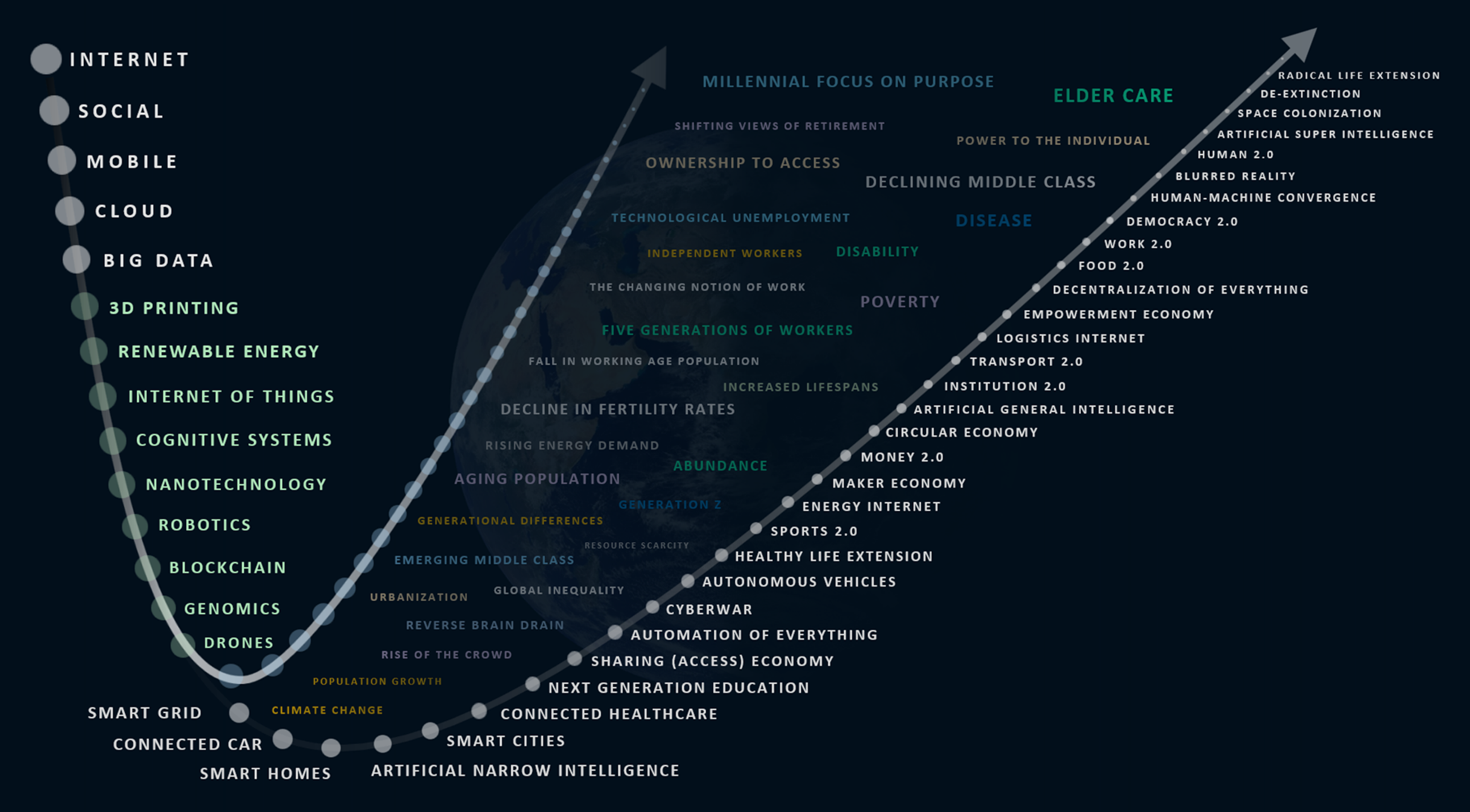
It is no longer a surprise to witness something progress exponentially. Add to that list virtual reality and its near term application in retail, games, sports, and other. As it progresses, the way we interact transforms slowly – and then suddenly. This is a great example of a building block on the science and technology curve spawning a scenario or shift on the future scenario curve – BLURRED REALITY.
MBA Education and Short Term Thinking
This recent Article focuses on the failure of MBA programs to prepare leaders and innovators to cope with a fast-changing world: leaders that can put the long-term health of their company and customers first. Here is the bottom line straight from the article:
Far from empowering business, MBA education has fostered the sort of short-term, balance-sheet-oriented thinking that is threatening the economic competitiveness of the country as a whole. If you wonder why most businesses still think of shareholders as their main priority or treat skilled labor as a cost rather than an asset – or why 80 percent of CEOs surveyed in one study said they’d pass up making an investment that would fuel a decade’s worth of innovation if it meant they’d miss a quarter of earnings results – it’s because that’s exactly what they are being educated to do
Artificial Intelligence and Jobs
This very good opinion piece addresses a subject that is gaining more attention and driving more dialog. Will artificial intelligence destroy jobs? Author Kai-Fu Lee has an opinion:
“It will soon be obvious that half of our job tasks can be done better at almost no cost by AI and robots. This will be the fastest transition humankind has experienced, and we’re not ready for it”
Shaping the Fourth Industrial Revolution

In a new book titled Shaping the Fourth Industrial Revolution, Klaus Schwab explores a future shaped by scientific and technological advances. The book builds on his earlier work where he describes the emerging Fourth Industrial Revolution. In this latest work, the author describes how rapid advancement in science and technology promise to disrupt the digital systems of our day, creating entirely new sources of value. He touches on a key point that I have articulated in my anchor visual; that the digital technologies that organizations are struggling to make sense of today, turn into the core infrastructure that business models will take for granted tomorrow. Said another way; digital is the foundation for the innovation that is emerging.
The Future of Energy on Game Changers Radio
Today on Coffee Break with Game Changers, Bonnie D. Graham hosted a show focused on the future of energy. You can listen to the rebroadcast here. The session abstract is included below, as well as a Twitter stream that provides insight into the topic and our discussion. The show participants included: Bonnie, Gray Scott, Tom Franklin, and myself. You can take a deeper dive on the topic via this Discussion with David Cohen.
Show Abstract
The Energy Internet is positioned to transform our lives – perhaps on a larger scale than the Internet before it. This dynamic, distributed, and multi-participant Enernet – as some are calling it – is built around clean energy generation, storage and delivery. With a long list of innovators emerging, the resulting innovation will drive massive change, including how we think about cities, municipal services, transportation, insurance, real estate, financial services, and more.
Future Capability Profile

This recent Article describes how Sergey Brin and Larry Page founded Google on the conviction that STEM expertise was the dominant piece of the capability profile – setting its hiring algorithms to look for computer science students with top grades from elite science universities. In 2013, they decided to test this hypothesis by analyzing the hiring, firing, and promotion data accumulated since their incorporation in 1998.
Social Robots
In this last segment from the Health Summit in D.C., I responded to a question regarding loneliness, isolation and the policies that might help address this societal issue. Is it strictly a policy question? Like everything else in this exponential world, are building blocks emerging to address such issues in different ways? Like say, social robots?
 Reimagining the Future