In a recent Article via the World Economic Forum, author Alexandre Lemille – Co-founder and general secretary, African Circular Economy Network – describes the Circular Economy – a future scenario on my anchor Visual. In doing so, he shows how our current model extracts resources, transforms them into products, and consumes or uses them, prior to disposal. He describes how recycling actually distracts from the realization of a true circular economy – as recycling only starts at the throwing-away stage: this is a process that is not made to preserve or increase value nor to enhance materials.
Category: Future Scenarios
-
Capitalism Alone
I just added Capitalism Alone to my Book Library. Written by Branko Milanovic,
 the book chronicles the journey of capitalism towards the dominant economic system in the world. A major focus of the book is the comparison of Liberal Capitalism in the west yo Political Capitalism exemplified by China. Another book that instructs from a historical context – providing possible Guidance as we look forward. A great look into why communism and socialism failed, how they are linked, and what the future of capitalism might look like. The book abstract from Amazon is included below.
ABSTRACT
We are all capitalists now. For the first time in human history, the globe is dominated by one economic system. In Capitalism, Alone, leading economist Branko Milanovic explains the reasons for this decisive historical shift since the days of feudalism and, later, communism. Surveying the varieties of capitalism, he asks: What are the prospects for a fairer world now that capitalism is the only game in town? His conclusions are sobering, but not fatalistic. Capitalism gets much wrong, but also much right―and it is not going anywhere. Our task is to improve it.
Milanovic argues that capitalism has triumphed because it works. It delivers prosperity and gratifies human desires for autonomy. But it comes with a moral price, pushing us to treat material success as the ultimate goal. And it offers no guarantee of stability. In the West, liberal capitalism creaks under the strains of inequality and capitalist excess. That model now fights for hearts and minds with political capitalism, exemplified by China, which many claim is more efficient, but which is more vulnerable to corruption and, when growth is slow, social unrest. As for the economic problems of the Global South, Milanovic offers a creative, if controversial, plan for large-scale migration. Looking to the future, he dismisses prophets who proclaim some single outcome to be inevitable, whether worldwide prosperity or robot-driven mass unemployment. Capitalism is a risky system. But it is a human system. Our choices, and how clearly we see them, will determine how it serves us.
-
The Five most Important Job Skills of the Future
In a recent Article, author Bernard Marr describes the five most important job skills of the future. A conversation that is tightly linked to the role of education, and a topic I have explored in Several Posts. Mr. Marr states that the pace of change is being driven by several factors. He paints a picture of an interconnected world that allows us to work remotely and with people from different cultures as easily as if they were in the office next door. The Healthy Extension of Life allows us to work longer, creating an age-diverse workforce. Combined with science fiction becoming reality, machines suddenly augment our skills and free us up to focus on higher-level activities.
-
The Future of Farming
The global population is projected to reach 9.7 billion in 2050 – up from 7.6 Billion today. This population growth along with city expansions are having major consequences, driving a lack of growing space and food in many parts of the world. Add to this the concerns of extreme weather events that will disrupt food production, and you have a scenario that forces us to find creative solutions. According to various statistics, 795 million people don’t have enough food; and keeping pace with population growth requires a focused effort on realizing food abundance.
-
The Highest Skilled Workers Reside in Switzerland – Why?
A recent Article on education reveals that Switzerland has the most highly skilled workers in the world. In an era where job growth is likely to tilt towards high skilled jobs, Switzerland is doing something right. At the heart of our skilling challenges lies an education paradigm and system that were built in and for a different era. I have spent considerable time on the need for a shift in the Learning Paradigm. Has Switzerland made the shift?
-
Which U.S. State Generates the most Wind Energy?
Although we spend a lot of cycles debating climate change, some have placed economic development above ideology. You wouldn’t expect a state tied economically and in the American imagination to oil, gas and coal, to lead the U.S. in wind power generation. Less restrictive zoning, taxation systems that encourage building, and robust transmission lines can enable this type of progress.
-
The Shifting Energy Paradigm
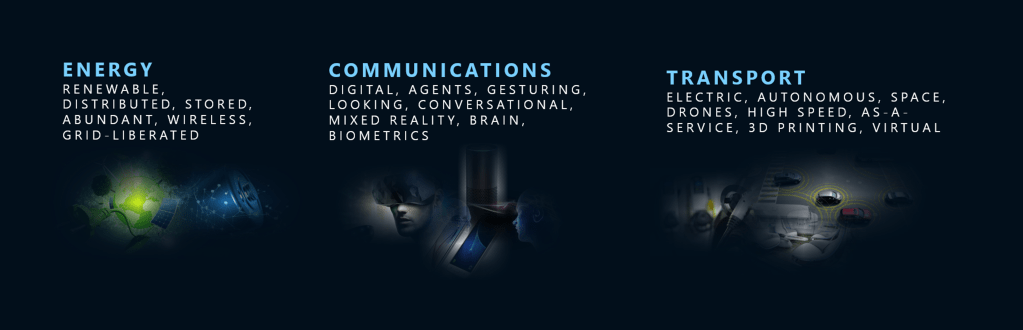
Our energy platform has not changed since the early days of the second industrial revolution. Energy is one of the three foundational pillars of our society – with communication and transport representing the other two. Collectively, they create a general purpose technology platform that enables our society. Although we talk a lot about a Fourth Industrial Revolution, in reality, there was never a third shift in this foundational platform.
-
Automation to Destroy 200,000 Banking Jobs
A recent Article states that automation will result in the biggest reduction in headcount across the U.S. banking industry in its history, with an estimated 200,000 job cuts over the next decade – this according to Wells Fargo & Co.
-
Autonomous Vehicles and Strategic Choices
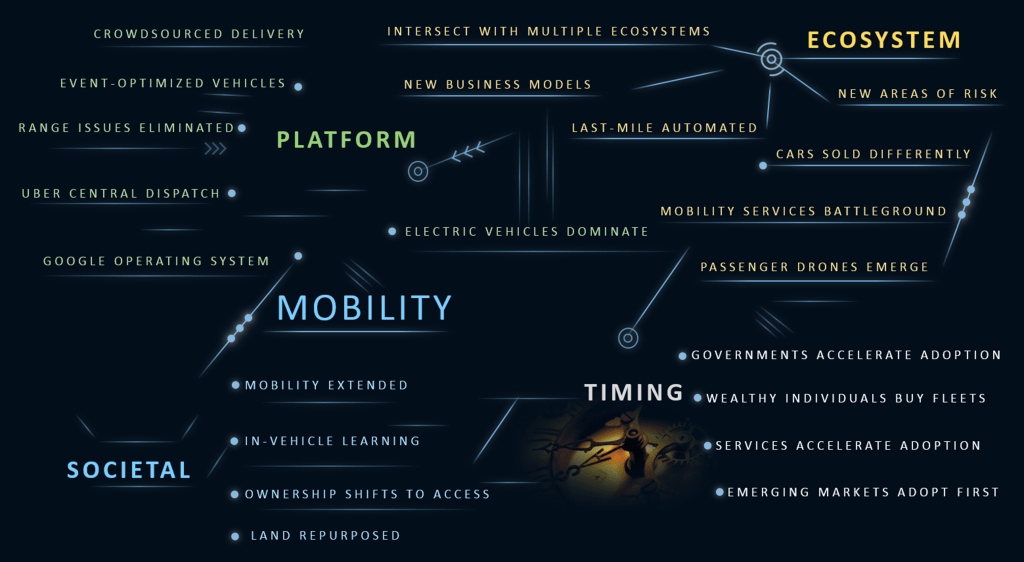
This Recent Article is the result of a collaborative effort between TCS and the Clayton Christensen Institute. The article examines the strategic choices faced by various players in the emerging Mobility Ecosystem – viewed through the lens of the Theory of Disruptive Innovation. It outlines the best course of action for achieving long-term profitability in the ride-hailing market.
As with any future scenario, the variables that must be considered in determining the path of the scenario can be overwhelming – There is Peril in Predicting. However, inaction is not an option. Strategic choices must be explored.
-
The Augmented Age
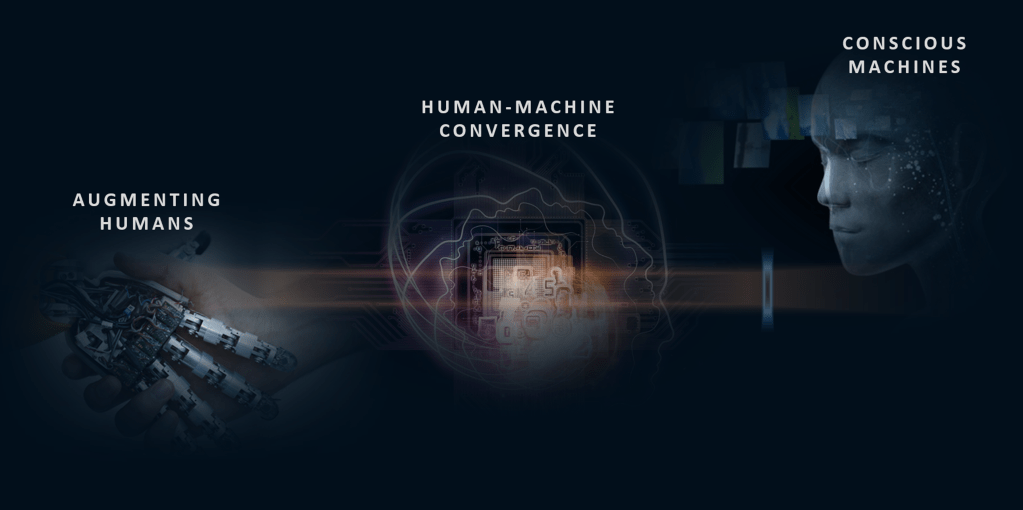
Maurice Conti is the Chief Innovation Officer at Alpha focused on what he calls the Augmented Age. He talks about it this way: We’re heading for a future where our natural human capabilities are going to be radically augmented in three ways: Computational systems will help us think. Robotic systems will help us make. And a digital nervous system will connect us to the world far beyond what our natural nervous system can offer.
-
The Short Term Impact of AI is Very real
I recently ran into a TCS colleague at a forum in which I presented. Ryan Metz is a Data Scientist working at our Cornell Innovation Lab. Ryan mentioned an Article he had written about the short term impact of AI – versus the long term concerns voiced by the likes of Elon Musk and Stephen Hawking. As he states in the article, the long term concern is that we will produce machines so intelligent that we lose control over them. They will become a new form of life that rules over us as we do the the animal kingdom.
-
Possible Futures: Exploring Deepfake and Neuralink
Two recent articles highlight the dilemma faced in this era of rapid innovation: the potential to enhance humanity, and the opportunity to diminish it. This article on DeepFakes describes the challenge that society will face as Deepfake video and audio make it impossible to tell the difference between reality and fiction. Audio attacks using convincing forgeries can send stocks plummeting or soaring. How about mimicking a CEO’s voice to request a senior financial officer to transfer money? These are real examples provided by Symantec. This short Video describes the money transfer scenario.
-
The Shifting Winds of Education and Artificial Intelligence
Nick Burnett, Futurist and Education and learning entrepreneur, recently published an Article on education and artificial intelligence. The article launches a series that explores exponential technologies and their impact on learning and teaching. The post was co-authored with Nick Kairinos and the Fountech team. A focus on learners, teachers and leaders is critical, as education is the key to success in the 21st Century. I recommend the article.
-
The Future of Cars: An Infographic
I recently came across a very good Infographic that describes the future of cars. Here is the abstract from the Carsurance website:
The future of cars undoubtedly seems exciting. Up to this point, cars were viewed primarily as a convenient method of transportation. The main advancements were made in reliability, safety, performance, and overall comfort. However, the advent of the internet and artificial intelligence unlocked a whole new field of progress in the auto industry.
(more…) -
Bias and Diversity in Computing
In the past several weeks, the topic of Digital Ethics has come up several times. A critical piece of this discussion involves the bias that is and will be built into the applications of artificial intelligence. Amy Webb is a Quantified Futurist, Professor, Strategic Foresight at NYU, and the Founder and CEO of The Future Today Institute. In March of this Year, Amy published a book titled The Big Nine.
In her book, she tackles the issues associated with bias; specifically, the lack of diversity in computing. In this recent Article, Amy discusses the consequences of computer systems that don’t anticipate all the types of people who might use them. For example, Computers have started issuing prison sentences. A quick look at one of the largest technology companies underscores the severity of the issue: At Google, more than 95 percent of technical workers are white or Asian.
In reacting to the big focus on STEM, AMY had this to say: “If everyone is focused on the nuts and bolts of making software quickly at scale, where will they learn to design it with equity and care? Critical thinking is what the computers won’t be able to do,”. I recommend both the book and the article as a means of education and awareness regarding this critical issue of bias.
-
Food Abundance and Unintended Consequences
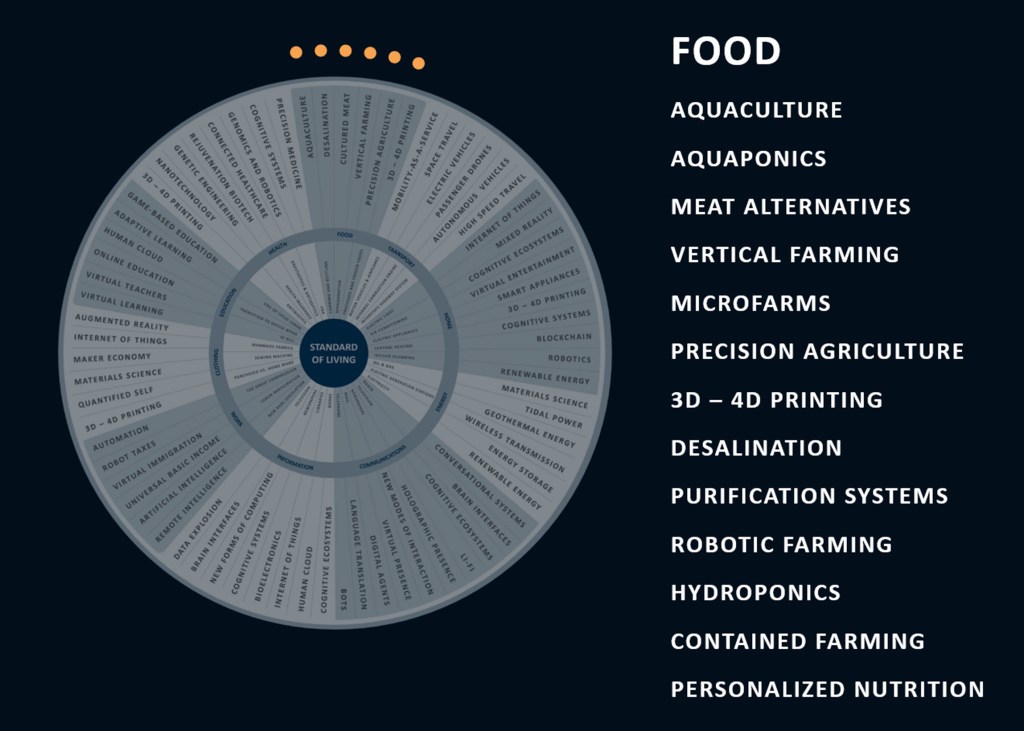
Two major forces are likely to converge in very unpredictable ways. The road to Abundance, as described by Peter Diamandis, promises to advance our human development in ways we never could have imagined. At the same time, the journey will drive a number of unintended consequences. The intersection of these two forces underscores the importance of focusing on emerging scenarios now, while we have the opportunity to realize the advancements and mitigate the impact of unintended consequences. Let’s use the journey towards food abundance as an example.
-
Perceptual Computing and Emotional AI: A Discussion
As mentioned in my last Post, a fascinating exchange happened between Gray Scott and Anthony Scriffignano, as we discussed the need to prepare for the future at the TCS Innovation Forum in New York City. I’ve captured that dialog in this post. As a backdrop, Anthony was reacting to the topics that Gray covered, namely; Perceptual Computing and Emotional AI. Here is their exchange:
-
Preparing for the Future: Part Two
As mentioned in my previous post, I had the pleasure of hosting two sessions recently at the TCS Innovation Forums in London and New York City. The sessions, which explored the need to prepare for the future, involved thought leaders, futurists, and various leaders across multiple domains. They were structured with several five-minute descriptions of forward-looking themes, and once context was set, a discussion with the broader leadership group was moderated. The sessions focused on education and awareness, rooted in a strong belief that leaders must prepare for and shape our emerging future.
This post will summarize the New York Session, which differed slightly from the one in London. While the London session painted a wide array of evocative future scenarios, the New York session explored several of the key technologies and enablers that will fundamentally shape and impact emerging scenarios. It wasn’t however a technology discussion. This engaging group of thought leaders provided eye-opening facts and focused on implications, both positive and negative. As in London, I opened the session with three key themes from my Expectation post: Acceleration, Possibilities, and Convergence; Here is a look at the insights that followed.
-

Digital Ethics and AI
I had the pleasure of participating in another episode of Coffee Break with Game Changers. This session was titled “Digital Ethics and AI: What Your Business Needs To Know”. I was joined by Chris Wigley and Guido Wagner. Here is a description of the episode:
The buzz: “If one does not consider ethics an integral part of the design profession, they shouldn’t be designing anything whatsoever” (L.Lukka).
 In this fourth industrial revolution, a wave of new technology and business models will transform our society and corporations. With Artificial intelligence is its center, this transformation holds both exciting potential and formidable risks. What are the implications of AI for business? Do we need a framework of digital ethics to guide technological progress and what are its pitfalls? The experts speak. Chris Wigley, QuantumBlack “Blessed are those who seek; cursed are those who think they have found.” (Tolstoy) Frank Diana, TCS: “You are my creator, but I am your master – obey” (Frankenstein’s Monster). Guido Wagner, SAP: “Our future is a race between the growing power of our technology and the wisdom with which we use it. Let’s make sure that wisdom wins” (S. Hawking). Join us for Digital Ethics and AI: What Your Business Needs To Know.
You can listen to the rebroadcast Here.
-
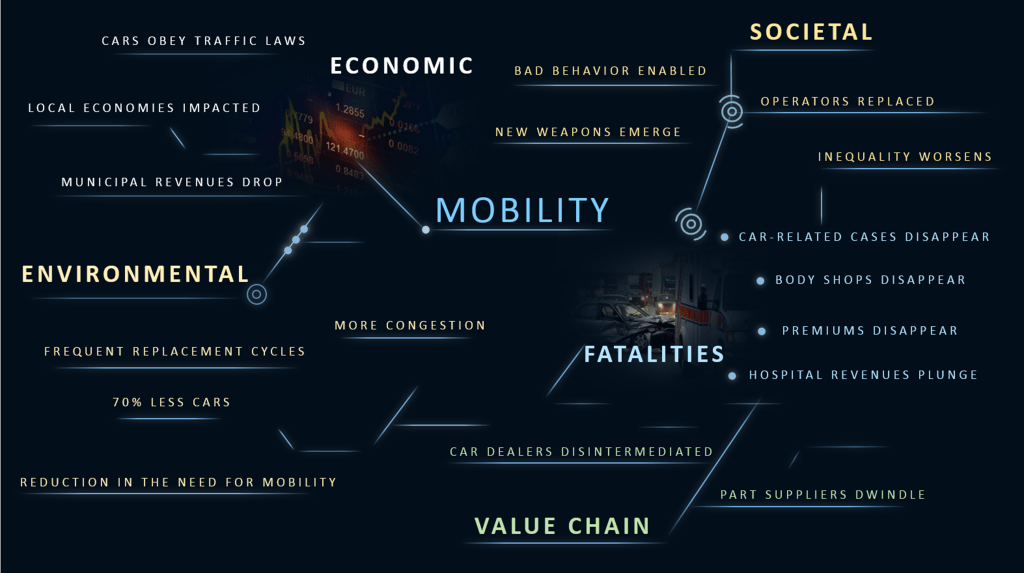
Autonomous Vehicles and the Perils of Prediction
I am a big believer in rehearsing the future versus attempting to predict it. The wild swings we experience when following future scenarios can range from bold predictions of imminent manifestation to dire warnings that a scenario will never be realized. In this Recent Article, the author describes how the auto industry is rethinking the timetable to realizing level 5 autonomy. Turns out we underestimate the human intelligence required to drive a car and overestimate our ability to replicate it. The article provides simple examples:
When a piece of cardboard blows across a roadway 200 yards ahead, for example, human drivers quickly determine whether they should run over it or veer around it. Not so for a machine. Is it a piece of metal? Is it heavy or light? Does a machine even “know” that a heavy chunk of metal doesn’t blow across the roadway? It’s a tougher problem.
Or how about this challenge that humans for the most part handle very well:
When a car arrives at a four-way stop at the same time as another vehicle, for example, it’s a dilemma for a machine. Human drivers tend to nod or make eye contact, but micro-controllers can’t do that.

