What job skills do we need for the future? A popular question that comes up a lot. In a Recent Post, I listed several: emotional intelligence, creativity, flexibility, adaptability, data literacy, and technology savviness. This Tweet of a World Economic Forum video adds complex problem solving, critical thinking, people management, working with others, and decision making to the list.
Category: Future Scenarios
-
Connecting our Brain to the Internet
In a world of knowledge abundance, there are so many things to consider. Knowledge has always been the engine that drives human development – and it has been throughout history. Knowledge expanded in the hunter-gatherer days with the invention of fire. In those days, a human obtained all its food by foraging. Although the source of food did not change, fire allowed humans to cook food and consume more calories. The human brain expanded with this caloric increase, and soon we invented language – the first in a series of innovations that drove the growth of knowledge. All that followed – from agriculture to the great inventions of the second industrial revolution – enabled us to advance as humans. I explored that progression Here.
-
Is Artificial Intelligence Dangerous?
A recent Article written by Futurist Bernard Marr describes a conversation with Oxford University Professor Nick Bostrom, New York Times best-selling author of Superintelligence: Paths, Dangers, Strategies. Although the books focus was on those things that could go wrong, this recent conversation with Bostrom acknowledged the enormous upside to artificial intelligence. You can see the full video of their conversation below.
Some of the AI impacts explored in the video are:
- AI will change the workplace and the jobs that humans do
- AI-enabled terrorism
- AI surveillance
- Social manipulation and AI bias
- Deepfakes
- Political, legal, and social ramifications
Bostrom advises that rather than avoid pursuing AI innovation, we should put ourselves in the best position possible, with scalable AI control methods, ethics and governance. If we don’t, those significant negative ramifications he described in his earlier book could be realized. But as noted, there are so many positive outcomes to consider. This revolution represents as it always does a need to Manage the humanity enhancing and humanity diminishing pathways.
-
Eradicating Disease and Disability
There’s been a lot of talk lately about the impact of Artificial Intelligence on Healthcare. An aging population is likely to place even more stress on a costly and ineffective healthcare system. There are other new innovations that are likely to improve healthcare efficiency and offer new ways to address global healthcare challenges. One such innovation is described in this Recent Article authored by science editor Jackson Ryan.
-
Longevity Escape Velocity
Google’s head of engineering, innovator and futurist Ray Kurzweil often discusses the concept of longevity escape velocity; or the point at which science can extend your life for more than a year for every year that you are alive. Kurzweil believes we are much closer than you might think. In fact, he believes we are just another 10 to 12 years away from the point that the general public will hit this longevity escape velocity.
-
The Impact of Capital on Exponential Progression
In a post back in 2018, I described a phenomenon that contributes to the rapid Acceleration of innovation and scientific breakthroughs. Peter Diamandis coined the term Techno-Philanthropists and compared and contrasted them to the Robber Barons of a different era. Billionaires get a lot of negative press these days – but one thing is clear: their wealth is both accelerating the pace of innovation and addressing some of the world’s greatest challenges. Stories described by Articles like this one highlight the point.
-
Food: A great Example of the Broad Changes Coming
In this recent Article, the authors describe the future of food in a way that captures the massive change driven by one future scenario: in this case, Food 2.0. Setting aside the changes likely in the form of lab-grown meats and 3D Printed foods, this story is more fundamental: it’s about farming. The article describes the current state of the industry, mostly one in decline.
-
The Future of Cars
Recently, someone shared a very interesting inforgraphic on the future of cars. I get these requests to share content on a regular basis, and I assess them based on their insight and potential value to my readers. This is an example of a very well done Infographic with a great deal of insight. Below is an introduction and the infographic. Enjoy!
-
Electric Batteries and the Grid
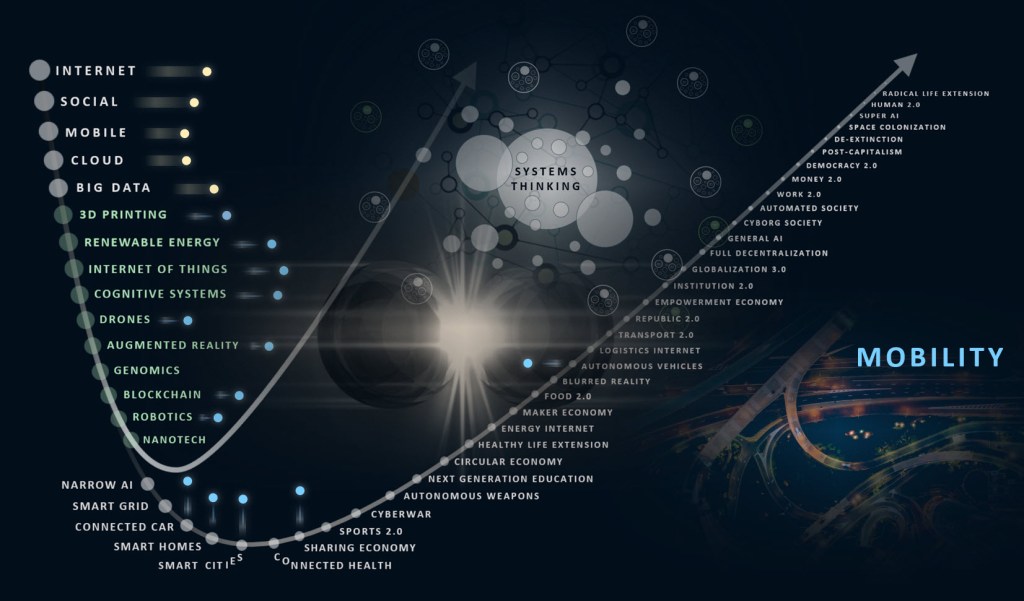
This Article provides a very good example of domains that are converging in ways that shape our future. In this example, innovations in science and technology converge with future scenarios involving the emerging Mobility Ecosystem and one that is often described as the emerging Energy Internet. Author Jeff McMahon indicates that there will be more than enough batteries in electric vehicles by 2050 to support a grid that runs on solar and wind—if the two are connected by smart chargers, according to experts at the International Renewable Energy Agency.
As described in an earlier post, these Intersections across multiple domains introduce new scenarios that amplify impact. In this example, the boundaries between mobility and energy blur, creating a synergistic linkage between the two ecosystems. This complex and unpredictable dynamic complicates our Future Thinking exercise – but it may be the most critical focus of any forward-looking effort. The above referenced article provides a good example of how the Convergence of science and technology leads to a convergence with multiple future scenarios. Visualization helps to understand the various dots that are connecting.
-
Wednesday Musings: Education, Energy, Currency, and Purpose
Every morning, I scan the horizon. Horizon Scanning is a systematic process that serves as an early warning system to inform decision makers about possible futures. It identifies actions, innovations, and events that have the potential to alter our future, both positive and negative. I am struck by the sheer volume of news, areas to consider, and emerging building blocks that are likely to impact society. The Possibilities – both good and bad – seem endless.
Thinking about the Future should be a normal part of every leaders day. With so many building blocks to consider, the need to understand them intensifies, as well as the various ways they are connecting. A Canvas that helps us to visualize can be very helpful. My scanning this morning underscores just how much to consider. In a short period of time, I explored the World Economic Forum’s continued focus on Purpose. Having just written about How Different Jobs will be in the next ten years, I read another Article on the need for a Global Reskilling revolution. As the world explores a profound shift in our energy paradigm, I learned that the windows in our buildings will provide all the Energy Required. The foundational elements of society are shifting. Even money is likely to transform, as Central Banks study the possibilities of Digital Currencies.
So, scan away my friends, the horizon is approaching rapidly.
-
Jobs will be very different in 10 years
As many focus on the future of work, various different perspectives are presented. A common theme is emerging: Jobs will be there, but they will be very different within the next decade. This recent Article draws three conclusions:
- In 10 years time, 50% of jobs will be changed by automation – but only 5% eliminated.
- 9 out of 10 jobs will require digital skills.
- Young, low-skilled and vulnerable people – all need help with up-skilling.
Several critical points are made by the World Economic Forum article:
-
Looking at Possible Futures
Many Future Scenarios are spawned by convergence across multiple domains. The most obvious Convergence is occurring between science and technology. I have been posting links to numerous articles that explore possible futures. These futures are important for us to understand, as they usher in a very Pivotal Decade. Here is another set of articles that help us envision the future.
-
Our Ultimate Job is to be Human
After posting this Article on Education and Learning, colleague and fellow Futurist Gerd Leonhard made me aware of his recent video. In his short video, Gerd describes why our ultimate job is to be human. Enjoy.
-
Learning and Education in the 2020s
How we handle learning and education in the coming decade will play a major role in determining societal outcomes. Will people gain the skills required by the jobs that scientific and technological advancement spawn? Will education enable us to operate in a future environment that requires collaboration, system leadership, resilience, a learning mindset and entrepreneurial drive? Will we unlearn the shareholder value focus and broaden our focus to consider the full stakeholder community? How we educate future leaders and a society of life-long learners will provide answers to these questions.
A new Article via the World Economic Forum delves into the topic, as the authors explore the university of the future and how it must adapt to train future leaders. The article states that universities must evolve in four ways to meet the demands of future leadership needs:
- Embrace technology
- Create more action-based learning models
- Understand the expanded role of business in society
- Support life-long learning
Education and learning remains a critical issue for me, as it lies at the heart of how society emerges from the transformative pressures of the coming decade. My recent posts share several thoughts on the topic.
The Shifting Winds of Education and Artificial Intelligence
Higher Education in the Age of Artificial Intelligence
MBA Education and Short Term Thinking
Future Hiring: Skills-Based or Credentials-Based?
-
Artificial Intelligence and Disease Diagnosis
The path to breakthrough innovation is usually paved by compelling reasons to address challenges. China’s flourishing economy and continuous progress of medical reform has driven rapid expansion in their healthcare system and significant service improvements. There are over one million medical institutions in China and insurance covers more than 95% of the Chinese population. Average life expectancy has reached 76.4 years – higher than in some high-income countries. As with other countries however, population aging has put enormous pressure on their healthcare system – a phenomenon likely to play out everywhere as baby boomers retire. New innovations are likely to improve healthcare efficiency and offer new ways to address these global healthcare challenges.
-
Future Hiring: Skills-Based or Credentials-Based?
An Article by IEEE Spectrum captured a dialog that occurred at a recent MIT conference. The topic: AI and the Future of Work. The conference discussion underscores the struggles between Techno-Optimism and Techno-Pessimism. Pessimistic when AI and automation are viewed as an industry-destroying path that takes jobs via self-driving technology, smart law algorithms, and robots that continue to put factory and warehouse workers out of work. Optimistic when those same technologies are viewed as augmentation that improves the employee experience.
-
An Animated Guide to Autonomous Driving
The future of cars is a popular topic these days. In a recent Article by Drew Page, he explores self-driving cars in detail, including the hardware, software, points of failure, issues, and levels of autonomy. The article uses this brilliant infographic from The Simple Dollar to describe these various areas. It is hard to get consensus from experts on when they envision full autonomy. In light of this, continuous education and awareness is critical, making articles such as this one critical. Although the benefits of full autonomy are fairly clear (a dramatic drop in auto fatalities, positive environmental impact, etc.), the risks are just as important to consider.
I highly recommend a quick read of the above mentioned article.
-
More Scenarios Added to our Emerging Future
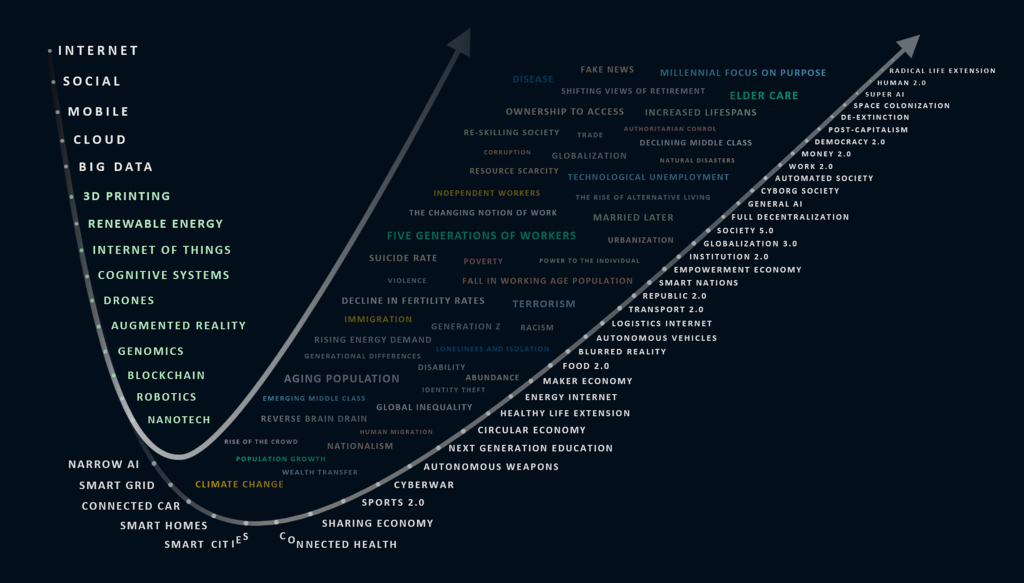
I periodically add more future scenarios to this visual that attempts to describe all the dots that are connecting to create our future. This future is complex, emerging from the combination of new and existing building blocks – a dynamic that enables the rapid pace that society is experiencing. The visual is described in detail Here.
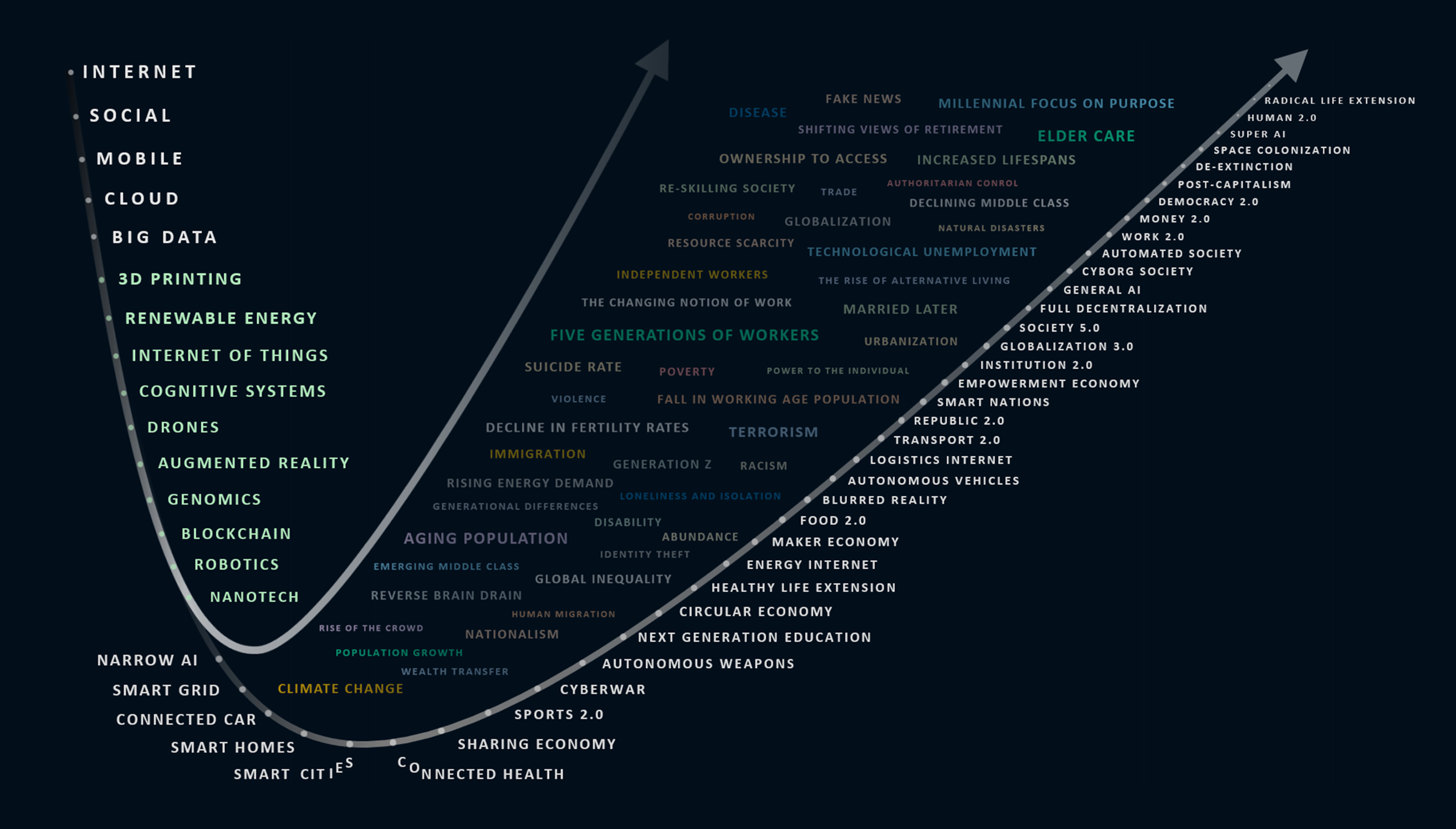
I have added two new Future Scenarios to the visual: Society 5.0 and Smart Nations. I have written about both recently. Each scenario is individually impactful – but the combinatorial effect is massively transformative. Tracking scenarios in an effort to See their path is the only hope in understanding their impact.

