Future Thinking

UPDATE: December 27, 2025. I posted this 10 years ago as I struggled with what I believed was traditional thinking in a world heading towards a bew reality. Ten years later, this series on systemic change captures what I was seeing back then.

I’m struggling with the term disruption and its effectiveness in driving urgency. Most definitions describe a radical change in an industry or business strategy, and most involve the introduction of a new product or service that creates a new market. My struggle is not with this decades old view of disruption, but its application in the context of our exponential world. The word disruption is viewed through a traditional lens. I end up in debates about the validity of a disruptive scenario as viewed through this lens, versus the massive implications of these future scenarios viewed through an exponential lens. The ensuing dialog focuses on:

  • Coming up with disruptive innovation before our competitors do
  • Embracing protectionist behavior to block a disruptor
  • I’m not worried, regulatory hurdles in my industry block the impact of disruptors
  • I’m safe, my industry is very stable

In the context of disruption, all valid places for our minds to go. In the context of what is likely a radically different world in the next 20 years, is it the right lens? For instance, Is any Industry Safe from Disruption? Through various discussion and dialog, my struggle with this lens intensified. At the core of the struggle is the dramatic impact that exponential progression is having on our world and the general lack of future thinking and foresight required to address it. If I had a discussion with you focused on disruption, you could very well tune me out because past success is our default lens. But if the discussion focused on this exponential future and the studies that project 40% of today’s Fortune 500 companies will cease to exist in 10 years, it should be a different conversation. Scenarios that are emerging suggest a radically transformative future that moves at a speed that most are unprepared for. Does a focus on disruption increase our level of urgency, or lull us into a false sense of security based on the past? Does our predetermined view of the term help us understand just how dramatic the changes that lie ahead are? Does it drive the realization that our organization characteristics and attributes must radically change if we are to remain viable? I’m not sure that it does.

That’s where I believe future thinking and foresight come in. By truly analyzing future scenarios, we can internalize both the radical change ahead, and the pace of that change. The lens of our analysis would focus on where the world is heading, and our potential role in that world. This analysis brings challenging questions into focus:

  • How does a traditional organization keep pace?
  • How does it find the talent required to deal with these scenarios?
  • How do traditional structures change to enable success and viability in this vastly different future?
  • How do these scenarios play out and on what timeline?
  • What are the potential obstacles that block a scenario?
  • What accelerators bring them to realization faster?
  • What is the organization response to a given scenario?
  • How do these scenarios converge, and what is the amplified effect of that convergence?
  • What are the emerging value ecosystems and how do I participate in value creation and capture?
  • What are the job implications and what does work look like in the future?

On a recent radio program, Futurist Gray Scott said something that stuck with me:

“If you’re not working with a futurist in your company right now, you’re already behind the game. I mean a futurist job is to come in and say to you; let’s embrace what is possible right. Forget what we’ve known because these startups are showing us that everything that we’ve known is wrong, that it can be broken and that technology is going to change the paradigm”

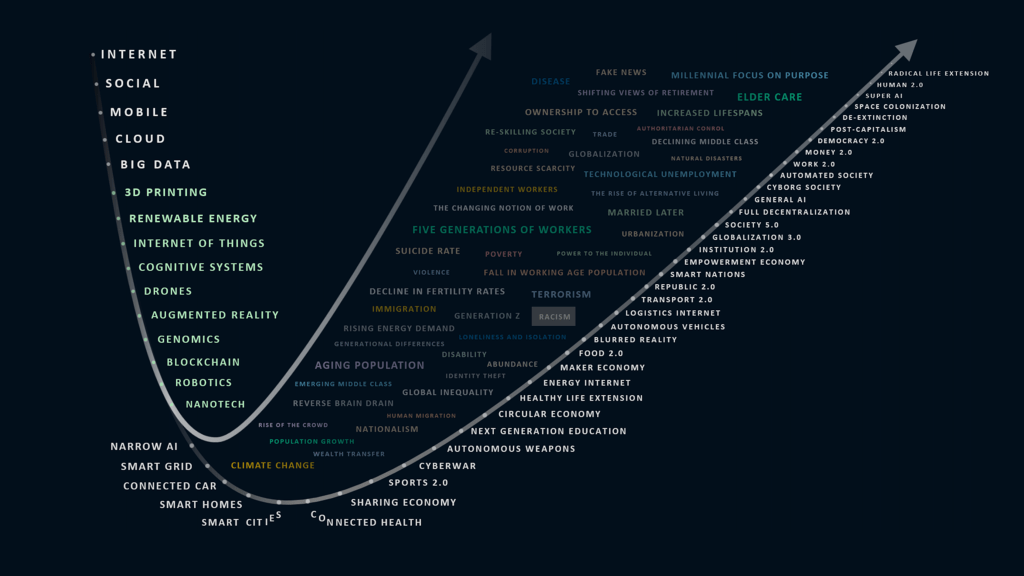
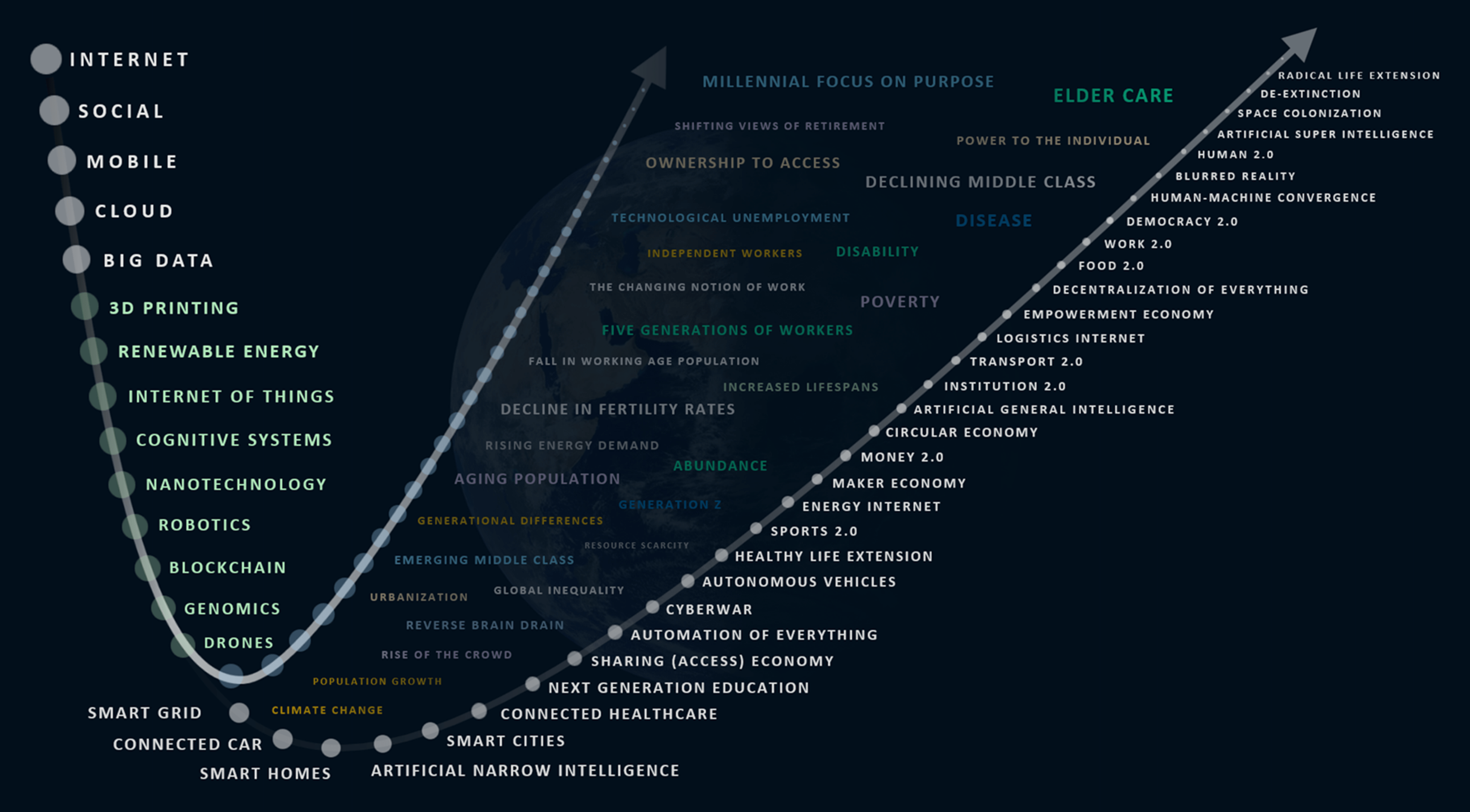
This massive paradigm shift is indeed the point. What we think will take ten years will likely take two or less. Therefore, our view of the future in the context of strategy and planning has to change. Future thinking, simulation, and the use of foresight are critical to this change. As a result of my struggles, I’ve made a subtle change to my anchor visual. The scenario curve was labeled “disruptive scenarios” – it now reads “future scenarios”. As subtle as that change seems, I hope it shifts the lens and places it squarely on future thinking.
Our Emerging Future


Discover more from Inside the Next Transition

Subscribe to get the latest posts sent to your email.

Comments

56 responses to “Future Thinking”

  1. […] I’m struggling with the term disruption and its effectiveness in driving urgency. Most definitions describe a radical change in an industry or business strategy, and most involve the introduction o…  […]

    Like

  2. Heidi Schwende Avatar

    Perhaps the word disruption should be replaced indeed. The connotation to most is that disruption is chaotic and causes disorder, which it does. Businesses have a tendency to hurry up and wait until the dust settles when things are disrupted. And at this point in time, nothing could be worse.

    Entering into a new era, while indeed disruptive leads us into a place where we need to not disrupt but transmutate.

    We’re in the same business as before, but the way we conduct that business is vastly different in the digital era than it was during the industrial era.

    But how indeed to we convey the extreme danger of playing the waiting game. The dust isn’t going to settle any time soon.

    Liked by 1 person

    1. Frank Diana Avatar

      Thanks Heidi. Your point on how we conduct business is spot on. The focus on disruption – a well placed focus – distracts from a true focus on the future and all of its ramifications.

      Like

  3. Arvind Kumar Avatar

    Change is the law of nature, it is the process of evoluation, which nobody can stop, it will happen at any case, the only way to tackle it to prepare for it.
    The social system should also be ready for this change, because change from industry to information age shall also change the how we live.

    Liked by 1 person

    1. Frank Diana Avatar

      Absolutely agree – thanks for adding to the dialog.

      Like

  4. valuetrendradar Avatar

    Reblogged this on valuetrendradar and commented:
    Totally agreed. It is all about the future, driven by a innovative task to re-engeneer what we do in business and in our lives. In that sense disruption (or disruptive) is dedicated to the way we think and not to the way we act and operate! — Interesting to see that in the famous documentation “Steve Jobs – Disruptive Innovation Documentary – One Last thing” Steve never used the term “disruptive” or “disruption” to describe his activities and tasks. — Andreas Weber, CEO of Value Communication AG, Mainz/Germany

    Like

  5. valuetrendradar Avatar

    Totally agreed. It is all about the future, driven by a innovative task to re-engeneer what we do in business and in our lives. In that sense disruption (or disruptive) is dedicated to the way we think and not to the way we act and operate! — Interesting to see that in the famous documentation “Steve Jobs – Disruptive Innovation Documentary – One Last thing” Steve never used the term “disruptive” or “disruption” to describe his activities and tasks. — Andreas Weber, CEO of Value Communication AG, Mainz/Germany

    Like

    1. Frank Diana Avatar

      Love it!You captured my point exactly – better than I did.

      Liked by 1 person

  6. valuetrendradar Avatar

    TX, Frank. Love your reply, too. I invented a program called “Train Your Brain”. It is based on my disruptive thinking and ideas how to identify the real value of communication. A group of my young international team members created a slide show and video. If you like please check it pout: Value Art+Com: How the Real Value of Communication works — via Hermeneutik – Dialektik – Innovatik — http://de.slideshare.net/zeitenwende007/value-artcom-how-it-works-hermeneutik-dialektik-innovatik-i-mac

    Liked by 1 person

  7. Marshall Kirkpatrick (@marshallk) Avatar

    A subtle but important distinction! I wonder if it’s a subject/object switch, in part. A focus on disruption makes disruption the subject and the company being discussed the object; it’s easy to focus on past success, as you suggest, and feel like *you* aren’t *really* the object in that scenario. It’s other people. Whereas saying that all companies need to look at the future clearly makes the company the subject and the future the object. It’s more compelling to look at yourself as the subject, I think.

    Liked by 1 person

    1. Frank Diana Avatar

      Great perspective Marshall! I like the subject/object lens

      Like

  8. Bruce Waltuck Avatar

    I have been working with Denise Easton on a book and workshops that are about the dynamics of disruptive experience. We define disruption and our framework for building response capacity in a journal article we published in the Journal for Quality and Participation. The book is tentatively titled “FLUXed: Survive and Thrive in a World of Disruption and Uncertainty.” The article is called “The World Acccording to FLUX.”

    In brief, we define disruptive experiences as those which exceed our ability to respond successfully. There is also a temporal dimension to how we perceive these experiences. Just as disruptive experience can be self-initiated (think creatives like Picassso, or the current Zappos journey with holocracy), the degree of urgency can be imposed and perceived externally, or consciously set internally.

    We describe the domains of emotion, knowledge, sense-making, and trying, in which our responses occur, and in which changes in our response capacities can occur (intentionally or otherwise).

    Happy to discusss this work anytime.

    http://www.getfluxed.com

    Like

  9. Michael Bier Avatar

    It’s much easier for companies and their leaders to focus on understanding “disruption”, and “disruptive forces”, especially on trying to stop the disruption, than it is to focus on the opportunities that are being borne in exponential change, and to do whatever it takes to make them happen.

    Like

  10. […] history where every company needs a Gerd Leonhard. For many of the reasons presented in the video, future thinking is rapidly growing in importance. As Gerd so rightly points out, we are still vastly […]

    Like

  11. […] history where every company needs a Gerd Leonhard. For many of the reasons presented in the video, future thinking is rapidly growing in importance. As Gerd so rightly points out, we are still vastly […]

    Like

  12. […] history where every company needs a Gerd Leonhard. For many of the reasons presented in the video, future thinking is rapidly growing in importance. As Gerd so rightly points out, we are still vastly […]

    Like

  13. Marshall Kirkpatrick's Blog » What will businesses do with data 2 years from now? Avatar

    […] “What we think will take ten years will likely take two or less,” says Frank Diana, Principal in Business Evolution at the $80B IT services firm Tata Consultancy Services, in a recent blog post.  […]

    Like

  14. […] I’m struggling with the term disruption and its effectiveness in driving urgency. Most definitions describe a radical change in an industry or business strategy, and most involve the introduction of a new product or service that creates a new market. My struggle is not with this decades old view of disruption, but its application in…  […]

    Like

  15. […] I’m struggling with the term disruption and its effectiveness in driving urgency. Most definitions describe a radical change in an industry or business strategy, and most involve the introduction of a new product or service that creates a new market. My struggle is not with this decades old view of disruption, but its application in…  […]

    Like

  16. […] I’m struggling with the term disruption and its effectiveness in driving urgency. Most definitions describe a radical change in an industry or business strategy, and most involve the introduction of a new product or service that creates a new market. My struggle is not with this decades old view of disruption, but its application in…  […]

    Like

  17. […] scenarios underscore the importance of Future Thinking, and provide a window into the drivers of business in the future. In the next post, we will […]

    Like

  18. […] above, view them through the lens of a radically different future, and leverage foresight and Future Thinking to explore the ramifications to your organization.  I’ll continue the focus on the future of […]

    Like

  19. […] IDC today announced its worldwide information technology (IT) industry predictions for 2016 and beyond. The predictions were published in a new IDC FutureScape report. As we embrace the notion of Future Thinking […]

    Like

  20. […] context of emerging categories. Leading indicators tell me that 2016 will see an increased focus on understanding the future in a way that enables this innovation. In this context, I expect to see more experimentation in […]

    Like

  21. […] history where every company needs a Gerd Leonhard. For many of the reasons presented in the video, future thinking is rapidly growing in importance. As Gerd so rightly points out, we are still vastly […]

    Like

  22. […] to the direction of these scenarios. Going forward, transformation must be a journey anchored in Future Thinking. The focus on societal issues, growth challenges, and viability will increase the dialog around […]

    Like

  23. […] the authors give us some great food for thought as to the potential path of the professions. As Future Thinking becomes more critical to success, this type of scenario analysis is extremely […]

    Like

  24. […] ultimately displace our current industry constructs. Given the uncertain nature of this transition, Future Thinking is a critical skill for any leader or organization to embrace. I have used the Driverless Car […]

    Like

  25. […] being 15 percent penetration of fully autonomous cars by 2030. As referenced in a recent post on Future Thinking, this type of scenario analysis is critical to help us both understand and shape our future. This […]

    Like

  26. […] we are to Think about the Future in a way that helps us thrive in that future, we must excel at connecting dots. I developed the […]

    Like

  27. […] impossible to predict. This visual reminds us that what lies ahead is overwhelming – making future thinking and the rehearsal of our emerging future a critical piece of our journey forward.The other posts […]

    Like

  28. […] This phenomenon is one of the drivers of the exponential progression that we are experiencing. Future thinking therefore becomes much more complex and the rehearsal of our emerging future becomes a critical […]

    Like

  29. […] posts is a great example of deriving the foresight required to navigate in this emerging future. Future thinking – the rehearsal of our emerging future – is increasingly a critical but complex […]

    Like

  30. […] posts is a great example of deriving the foresight required to navigate in this emerging future. Future thinking – the rehearsal of our emerging future – is increasingly a critical but complex piece of […]

    Like

  31. […] posts is a great example of deriving the foresight required to navigate in this emerging future. Future thinking – the rehearsal of our emerging future – is increasingly a critical but complex piece of […]

    Like

  32. […] posts is a great example of deriving the foresight required to navigate in this emerging future. Future thinking – the rehearsal of our emerging future – is increasingly a critical but complex piece of […]

    Like

  33. […] any venture we undertake in this age of pace-driven challenge, a future-oriented view is vital. Future Thinking is a highly iterative process supported by continuous rehearsal. Our efforts to create experiences […]

    Like

  34. […] Intersections, it continues to receive attention. It is by far the most effective component of any Future Thinking effort. Given the continued traffic to this two year old post, I am updating with current content. […]

    Like

  35. Benoit Blanchimot Avatar
    Benoit Blanchimot

    Might be a stupid question, however, is there any foundational article explaining the thinking behind the visual? It looks great, however, I was wondering about the shape of the curve, the positioning of the dots as well as the meaning of the x-axe and y-axe. Any explanation would be highly appreciated.

    Like

    1. Frank Diana Avatar

      This visual accompanies my emerging futures visual from earlier posts. It has no basis in traditional x an y axis thinking. I chose two curves to depict an exponential progression that goes out beyond the eye can see. The first curve spawns the second. It works effectively in an audience setting

      Like

  36. […] phase is all about Future Thinking, as the future is approaching faster than people think. Just look at the autonomous vehicle; a year […]

    Like

  37. […] approach represents one aspect of a Future Thinking exercise which seeks to understand the disruptive potential of current innovations in each domain. […]

    Like

  38. […] car to demonstrate the impact of these cycles, and the impact they have on emerging scenarios. In a Future Thinking context, analysis of these cycles must be part of our Rehearsing, or we will misjudge their timing […]

    Like

  39. […] What happens when multiple scenarios take hold? What happens when they converge and amplify their impact? These questions underscore the critical need for Future Thinking. […]

    Like

  40. […] In a recent book titled The Future of Work, author Darrell M. West describes the Work 2.0 scenario on this emerging future visual. In exploring possible implications of a shifting work paradigm, he gets prescriptive about possible responses. This implication-response exercise sits at the heart of Future Thinking. […]

    Like

  41. […] to demonstrate the impact of these cycles, and the impact they have on emerging scenarios. In a Future Thinking context, analysis of these cycles must be part of our Rehearsing, or we will misjudge the timing […]

    Like

  42. […] to demonstrate the impact of these cycles, and the impact they have on emerging scenarios. In a Future Thinking context, analysis of these cycles must be part of our Rehearsing, or we will misjudge their […]

    Like

  43. […] Future Thinking is not the forecasting of our past. Leaders must accept that pace and uncertainty dominates our future; versus allowing it to drive inaction. I find that story-telling and visualization help us digest multiple signals. This Future Thinking Canvas is an example of an approach I’ve used to help leaders see the intersections. At the heart of it lies Foresight. To that end, The Future Today Institute launched the 12th annual edition of their Technology Trends Report. Download the 2019 Report and infuse your future thinking with a fascinating look at the signals that represent our possible futures. […]

    Like

  44. […] time in understanding the Cycles of History and how they help us better understand the future. As Future Thinking becomes an increasingly bigger part of a leaders agenda, a historical perspective provides valuable […]

    Like

  45. […] about the Future should be a normal part of every leaders day. With so many building blocks to consider, the need to […]

    Like

  46. […] even consider the intersections across these trends. As I said when sharing the 2019 report, Future Thinking is not the forecasting of our past. Leaders must accept that pace and uncertainty dominate our […]

    Like

  47. […] a future that is both prosperous and sustainable. I have talked about stories in the context of Future Thinking and used a visual to tell these stories and provide a Future Thinking Canvas. A recent Article […]

    Like

  48. […] framework for thinking about the future. Having read through it, I highly recommend the approach to Future Thinking described by the authors. A very powerful part of their work is the use of Storytelling. Several […]

    Like

  49. […] that leaders must navigate. As the individual in the visual gazes into this future, the need for Future Thinking becomes apparent. Therefore, when we think about innovation, several possible futures must be […]

    Like

Leave a comment

Discover more from Inside the Next Transition

Subscribe now to keep reading and get access to the full archive.

Continue reading