A new McKinsey report focuses on the Disruptive trends that will transform the auto industry. Their work suggests that the world economies are dramatically changing via developments in emerging markets, the exponential pace of technology, sustainability policies, and changing consumer preferences around ownership. They see the rise of four disruptive trends in the automotive sector: diverse mobility, autonomous driving, electrification, and connectivity. For me, these findings underscore the movement from our current automotive industry to the future Mobility Ecosystem. If we can make the mental model shift from our long standing view of Industry and competition, to this emerging view of ecosystem and shared value, we can begin to visualize the different ways value will be created and captured in the future.
Category: Future Scenarios
-
Creating a Wellness Ecosystem
I am a firm believer that platform supported ecosystems will ultimately displace our current industry constructs. Given the uncertain nature of this transition, Future Thinking is a critical skill for any leader or organization to embrace. I have used the Driverless Car scenario as a way to describe future thinking and in this case, the progression towards a mobility ecosystem. I did a similar piece on Connected Health, which is likely the early manifestation of an emerging wellness ecosystem. This recent report on The Future Health Ecosystem provides a glimpse into the transition towards this wellness ecosystem. The author describes an expected shift of $1 trillion of the $3 trillion spent on healthcare to new players and business models; which could have devastating consequences for incumbents.
A Forbes article on this recent report looks at the major life transitions that the two largest generations in history are in the midst of – and the profound impact it will have on healthcare. Some of the very interesting findings – and clear drivers of a wellness ecosystem – are:
-
The Maker Economy
“Any time you give the means of production to everybody, it changes the world.” Chris Anderson, CEO of 3D Robotics
So it goes with the Maker Economy – otherwise referred to as the Maker Movement. According to Industry Analyst Jeremiah Owyang, the Maker Movement puts power in the hands of people to fund, design, prototype, produce, manufacture, distribute, market, and sell their own goods. According to youth market research firm Ypulse, 69% of millennials wish they could create a new product, and 81% would be interested in helping a company design one. This shift in production also shifts power from large, capital intensive enterprises to individual prosumers. As the focus on a next economy increases, so does the likelihood that it is driven by networks of prosumers versus large corporations.
This movement is not a future movement. According to the Infographic below, 135 million makers in America are already growing local economies and creating new jobs – contributing 18 million small businesses in the U.S. and accounting for two out of every three new jobs. When viewed through the lens of 3D Printing Forecasts, the future looks bright as well. One such forecast has the 3D Printing Industry becoming a $16 billion global industry within the next five years, with a 45.7 CAGR. It is also reviving the hardware sector, as VCs pumped $848 million into hardware start-ups in 2013 – nearly twice the prior record of $442 million set in 2012.
-
The Smart City
Next up in this ongoing look at disruptive scenarios is the Smart City. For the first time in history, more than 50% of the world’s population lives in cities, and that percentage moves to 70% by 2050.
-
The Sharing Economy
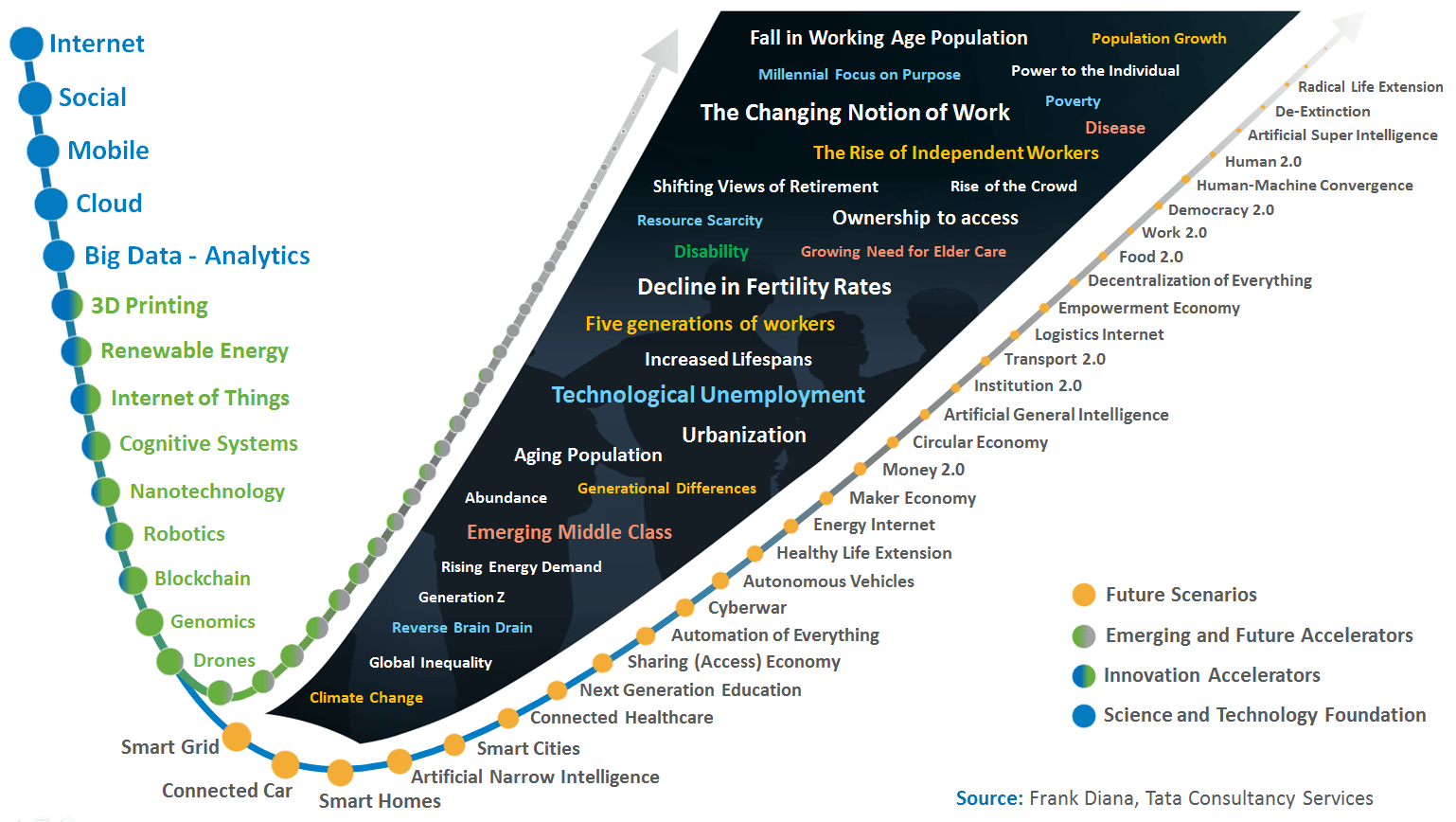
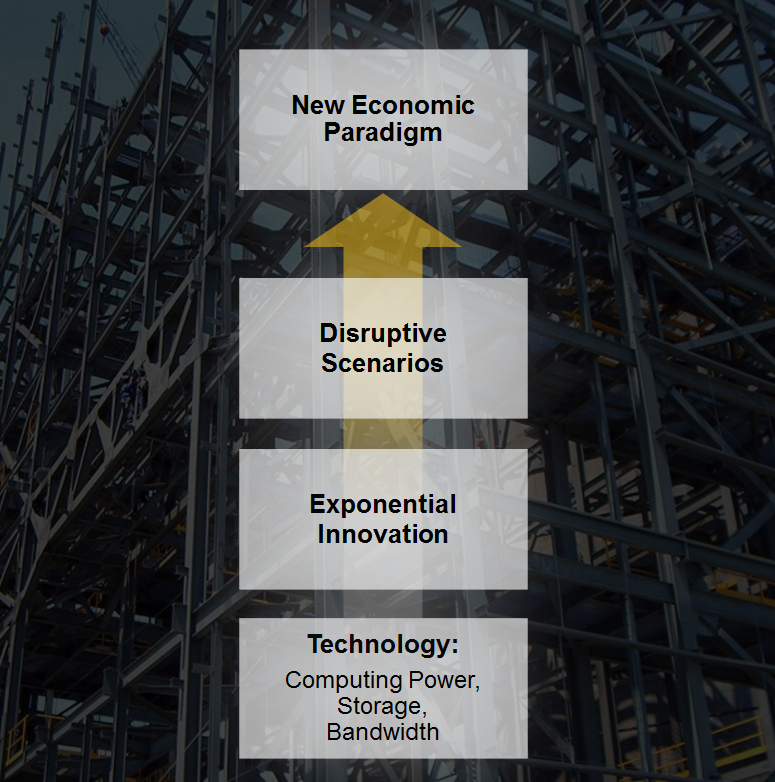
Something Economy: seems like a popular trend – stick a word in front of economy and use it to describe the next big thing. Some of these words are: Peer, Maker, Sharing, Gig, Collaborative, Green, Circular, Mesh, Digital, Innovation, semantic, and more. This combining of words speaks to the truly disruptive nature of the early 21st century. As part of my focus on business evolution and the inevitable move towards digital enterprises, I have analyzed a number of disruptive scenarios and their implications to traditional companies. This visual describes a combinatorial innovation dynamic that spawns disruptive scenarios:
-
Combinations and Disruption
A recent Report by John Hagel and others describes how the exponential improvement in technology is driving exponential innovation. The core technology building blocks (computing power, storage and bandwidth) continue unabated on a cost-performance improvement curve. These building blocks create a foundation for rapid advances in innovation, which in turn combine to create disruptive scenarios. A visual depiction of this phenomenon might look like this:

-
The Logistics Internet
The next post in this continued look at disruptive scenarios focuses on the Logistics Internet. In his recent book titled The Zero Marginal Cost Society, Jeremy Rifkin describes an Economic Paradigm Shift driven by a Third Industrial Revolution (TIR) platform. The Logistics Internet is one of three components that make up this TIR platform (communications and energy are the other two). As the three components converge, they create a general purpose technology platform that drives a third revolution. Mr. Rifkin believes we are in the early stages of an automated transport and logistics Internet, and he describes his thinking in this short Video.
In his new book, Rifkin describes the process by which suppliers and buyers connect and conduct business (Logistics) as the driver of the whole economic system. Yet, he maintains that the means by which goods and services are stored and delivered is grossly inefficient and unproductive. Rifkin suggests that a rethinking of the way we store and ship materials and goods is in order. Several supporting facts are provided in the book.
-
The Energy Internet
The focus on disruptive scenarios continues in the next several posts with a look at the work of Jeremy Rifkin and his recent book titled The Zero Marginal Cost Society. In his book, he describes the economic paradigm shifts of the past, and points to three elements that converge to create a general purpose technology platform to drive the shift: new forms of communication, new forms of energy, and new mechanisms for transport and logistics. Rifkin believes a powerful Third Industrial Revolution platform (The Internet of Things) is emerging to drive an economic paradigm shift in the next 40 years. The new form of communications in this context is the Internet, while renewable energy represents the new form of energy. The new mechanisms for logistics and transport involve sensors, coordinated logistic networks, renewable energy, and autonomous vehicles. Mr. Rifkin describes this Third Industrial Revolution platform as three Internets (Communication, Energy, and Logistics) converging to operate as one. He sees the Internet of things bringing these three elements together to manage (Communications), power (Energy), and move (Logistics) economic activity.
-
Connected Health
In my continued look at disruptive scenarios, the focus shifts to Connected Health. In a recent White Paper, the term is used as an umbrella description that covers digital health, eHealth, mHealth, telecare, telehealth, and telemedicine. Analyst firm IDC defines it as “a broad spectrum of technologies that use telecommunications to facilitate the exchange of health information and delivery of care across a geographic distance as well as manage chronic conditions and promote health and wellness.”
There are several drivers that make this both a viable and desperately needed scenario. According to the IBM Institute for Business Value, inefficiency in the Healthcare ecosystem wastes over 2 trillion USD per year. According to the popular Internet Trends Study produced by Mary Meeker each year, healthcare costs have reached 17% of the U.S. GDP and 27% of health spending is wasted. The same study found that over 25% of family income is likely to go to health spending in 2015, and 50% of bankruptcies are driven by health costs.
-
Next Generation Automation
This next post in the analysis of disruptive scenarios focuses on next generation automation enabled by combinatorial innovation. By way of reminder, the visual below depicts a convergence of innovations that have historically been viewed in isolation. As the building blocks of innovation multiply, their combination drives disruptive scenarios. By analyzing these scenarios, future implications and potential responses are determined.
-
The Smart Home
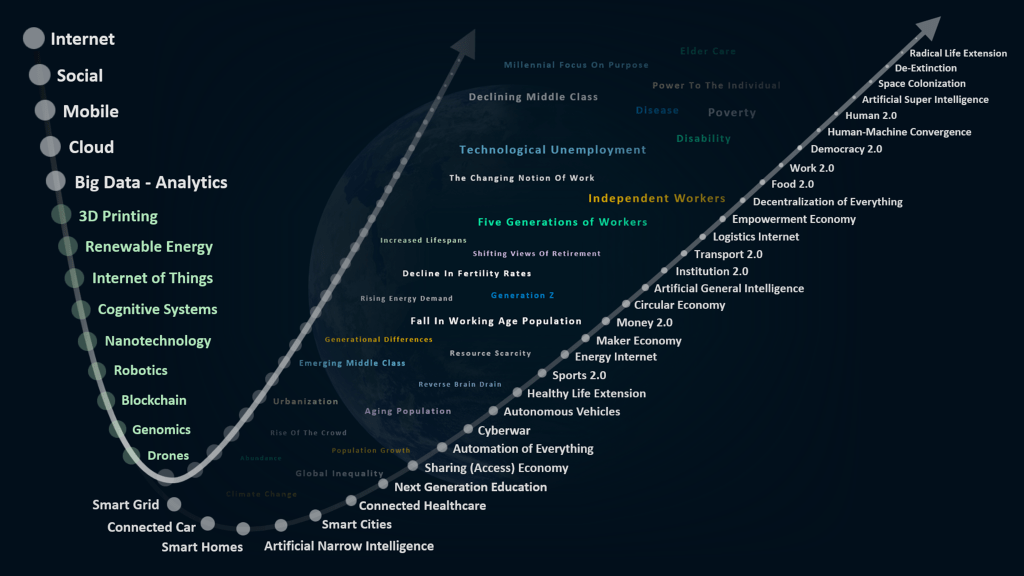
This post continues a disruptive scenario analysis focused on assessing the transformative environment that faces companies, Industries, Governments, and society as a whole. Much attention is paid to several digital forces (e.g. Mobile, Social, Cloud, Big Data, The Internet of Things, AI, Robotics), but for the most part, the focus is isolated in nature. As described in The Second Machine Age, the combinatorial effect of these forces enables disruptive scenarios at an unprecedented pace. While some of these forces and their combinations are growing more visible, many are far off on the horizon, and countless scenarios are not yet visible. The visual below depicts this phenomenon, underscoring the difficulty of responding to the forces in our line of sight – and the near insurmountable task of responding to those further on the horizon. At its furthest point, lack of visibility to future combinatorial innovation drives a high degree of uncertainty.
-
Transforming Medicine
The last two posts focused on disruptive scenarios driven by the future introduction of autonomous vehicles. However, the context for viewing disruptive potential must be broad – not just one possible scenario. With that in mind, let’s take a look at the Healthcare industry with a broader lens. The authors (Chunka Mui and Paul Carroll) of The New Killer Apps do a masterful job of doing just that. They make a rather bold statement in a chapter dedicated to the Healthcare industry – specifically:
“Without a course correction, hospitals will lose their central place in medicine and many will disappear.”
Strong maybe, but not hype. The risk is real and not limited to Healthcare. The visual below is a great representation of the law of disruption. The progression of technology is riding an exponential curve. With this acceleration comes a progression of disruption where incremental business change can no longer keep pace. Disruption and the need for transformative actions occur when this scenario takes hold, and the enterprise has not taken steps to respond. A failure to respond in this fast paced, change oriented world is likely catastrophic, but the opening for killer apps depicted in the visual presents both risk and tremendous market opportunity.

The Law of Disruption (source: Unleashing the Killer App)
-
Autonomous Vehicles: The Automotive Ecosystem
This post continues the disruption scenario discussion initiated by my earlier Insurance Industry Case Study. I’ve been using the autonomous vehicle (AV) as an example of a disruptive scenario with potential societal, economical, and environmental impact. In this post, the focus shifts to the scenario’s possible effect on the automotive ecosystem.
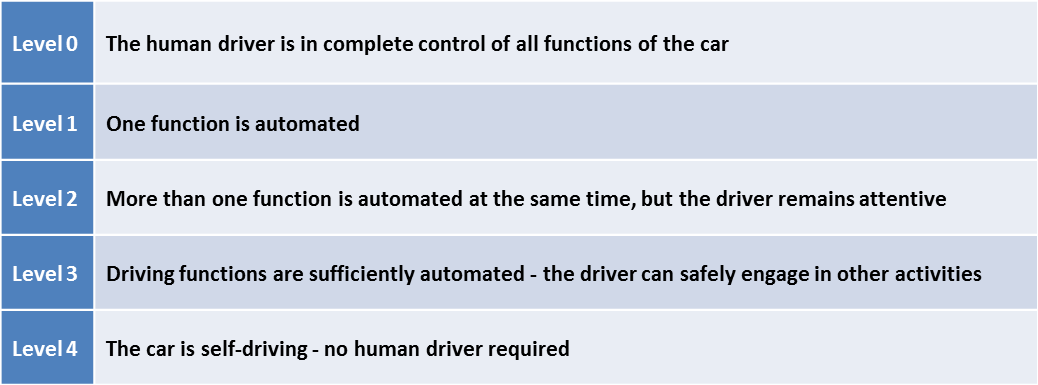
Autonomous vehicle technology can be viewed using a five-part continuum suggested by the National Highway Traffic Safety Administration (NHTSA), with different benefits realized at different levels of automation:
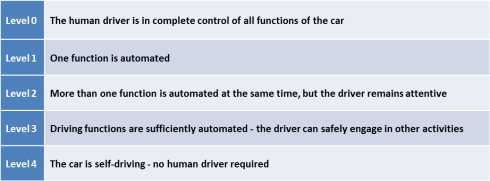
Last month, an IHS Automotive study predicted the world will have nearly 54 million self-driving cars by 2035. The study also predicts that nearly all vehicles in use are likely to be self-driving cars or self-driving commercial vehicles sometime after 2050. Meanwhile, automakers and others are unveiling both their plans for – and introduction of – automated features:
-
Why Focus on Disruption?
My post on the disruptive implications of the Autonomous Vehicle generated dialog that has been very insightful and provocative. Before posting additional analysis of the societal, economical, and environmental impact of emerging disruptive scenarios, I wanted to restate my reason for doing so, and share some great perspective from leaders that engaged in this recent dialog. I launched this last series to support the growing belief that: 1) we are entering what is likely the most transformative period in history, and 2) this should drive a sense of urgency for leaders everywhere. This coming period brings with it many possible disruptive scenarios, each with its own set of consequences. In my experience, leaders view these scenarios as too far off into the future to warrant their time – we’ve been conditioned to think short term. In their new book The Second Machine Age, Andrew McAfee and Erik Brynjolfsson provide their perspective on why the time to focus on the future is now. The three forces they describe (exponential, digital, and combinatorial) are perhaps the best description of the drivers behind the accelerating effect of disruption.
-
Autonomous Vehicles: A Disruption Case Study
At a recent news conference, U.S. federal transportation officials described Talking Cars and their ability to avoid deadly crashes by seeing it coming before you do. The U.S. government will likely require automakers to equip new vehicles with technology that lets cars warn each other if trouble lies ahead. A radio signal would continually transmit a vehicle’s position, heading, speed, and other information. Your vehicle would receive the same information back from other cars, and the on board computer would alert its driver to an impending collision. Alerts would come in varying forms: a flashing message, an audible warning, or a driver’s seat that rumbles. Some systems might even automatically brake to avoid an accident if that option is included. Examples of what the technology enables:
-
Cognitive Computing and the Internet of Things
2014 has started with a bang! If this is indicative of things to come – it will be an interesting and exciting year. Two major events usher in our New Year: IBM announcing the formation of the IBM Watson Group and Google acquiring Nest. We’ve heard a lot about the Internet of Things and the growing adoption of Smart Home components. Perhaps not as widely discussed is the emergence of cognitive computing – a space that IBM just made a huge bet on.
In my transformation series last year, I discussed the automation of knowledge work as both an emerging enterprise disruptor, and future enterprise enabler. Cognitive Computing promises to be a major driver of both sides of this equation. In its simplest form, cognitive computing is technology that allows us to ask natural language-based questions and get answers that support action, smarter decision making, and optimal outcomes. Gartner is weighing in and focused their recent 2013 Hype Cycle on the relationship between humans and machines. The focus – driven by the increased hype around smart machines, cognitive computing and the Internet of Things – is rooted in the belief that the divide between humans and machines is narrowing. Gartner encourages enterprises to look beyond the narrow perspective that only sees a future in which machines and computers replace humans. They see three main scenarios: 1) Augmenting humans with technology 2) Machines replacing humans 3) humans and machines working alongside each other. This is a very reasonable perspective on the likely path. The future enterprise as described through this Blog will use a combination of these scenarios to drive outcomes and transform stakeholder experiences (i.e., customer, employee, citizen, partner, etc.)