The next post in this continued look at disruptive scenarios focuses on the Logistics Internet. In his recent book titled The Zero Marginal Cost Society, Jeremy Rifkin describes an Economic Paradigm Shift driven by a Third Industrial Revolution (TIR) platform. The Logistics Internet is one of three components that make up this TIR platform (communications and energy are the other two). As the three components converge, they create a general purpose technology platform that drives a third revolution. Mr. Rifkin believes we are in the early stages of an automated transport and logistics Internet, and he describes his thinking in this short Video.
In his new book, Rifkin describes the process by which suppliers and buyers connect and conduct business (Logistics) as the driver of the whole economic system. Yet, he maintains that the means by which goods and services are stored and delivered is grossly inefficient and unproductive. Rifkin suggests that a rethinking of the way we store and ship materials and goods is in order. Several supporting facts are provided in the book.
Rifkin makes a strong argument: Products are generally stored in warehouses at high cost for long periods of time, often far away from where they will be shipped. These warehouses are underutilized or over-extended because of the seasonal nature of product lines, and logistical inefficiencies keep many time-sensitive products like food and clothes from being sold. Maybe the biggest inefficiency in the system is the circuitous routes (versus fastest routes) that products are often shipped – mostly because of reliance on giant centralized warehouses and distribution centers that serve large terrains. Rifkin explains that in the current distribution system, most private companies own one or a few warehouses or distribution centers, but rarely more than 20. He adds that most independents usually contract with one private enterprise, but rarely handle the logistics of more than ten enterprises. The net affect for private firms is a limited ability to store and move goods across the continent. One of the key obstacles in a global logistics system dominated by hundreds of thousands of private carriers is the absence of common standards and protocols.
According to Rifkin, large vertically integrated companies use their own internal fleets or outsource to private carriers to store and move goods. An interesting side note; Rifkin refers to vertically integrated companies as second industrial revolution companies. He spends considerable time highlighting the distributed nature of our digital world, and how this takes us from a vertical focus to a lateral (I use the word horizontal) focus. Companies that operate within the context of this paradigm shift are emerging third industrial revolution companies. He provides a historical perspective on why top-down and centralized command over logistics and transport was necessary to succeed in the past. But control came at the cost of lost efficiencies and productivity. The book describes examples of this loss, and the opportunity to drive next generation productivity. For example, Rifkin paints a picture of distributed delivery:

The example provided in the book looks at how it works in the current system and compares it to the outcome in a distributed system. In the current system, a trip from Quebec to Los Angeles and back would cover 10,000 kilometers round trip and take a total of 240 hours. The transported container would arrive in L.A. 120 hours later. In a distributed system, 17 different drivers are involved, averaging 3 hours of driving time a piece. Each driver would go to a drop-off point and return home that same day. In this system, the transported container arrives in L.A. in 60 hours.
At the heart of the envisioned Logistics Internet is the enterprise ability to use all of the 535,000 U.S. warehouses and distribution centers. Rifkin notes that if connected in an open supply network managed by sophisticated analytics and algorithms, companies could use the system to store items and route shipments in the most efficient manner possible. If stock is distributed among the network and located near the final market, this supply network leads to a reduction in lead times towards near zero. Other benefits are improved energy efficiencies, savings in fuel, and a reduction in carbon dioxide emissions.
Rifkin goes on to describe the business model needed to manage a regional, continental, and global logistics system. Consistent with the general theme of his book, Rifkin believes that collaborative models are the answer. He describes logistics cooperatives or other forms of commons management as a model that would allow each private firm to reap the cost benefits that flow from being part of a larger network. He sees integrated transport service providers increasingly taking on the task of clustering clients in cooperatives to realize the potential of a logistics Internet that facilitates lateral economies of scale.
So how is this vision realized? Some in the logistics industry are using Internet metaphors to re-think the sector; specifically, the open architecture metaphor of distributed Internet communications. Some of this thinking – as referenced in the book – comes from Benoit Montreuil from the University Research Center on Enterprise Networks, Logistics, and Transport. His piece on Global Logistics Sustainability provides further detail. Through this lens, the Logistics Internet becomes a single connected, transparent, and open system, requiring all products to be embedded in standardized modular containers that could be transported across all the logistics networks. Smart tags and sensors would be used for identification and sorting, and the entire system would operate via the same technical standard. The resulting system moves us from point-to-point and hub-and-spoke transport to distributed, multi-segment, and intermodal transport. Rifkin states that the technology is already available, and what’s needed is the acceptance of universal standards and protocols, and a business model to manage it.
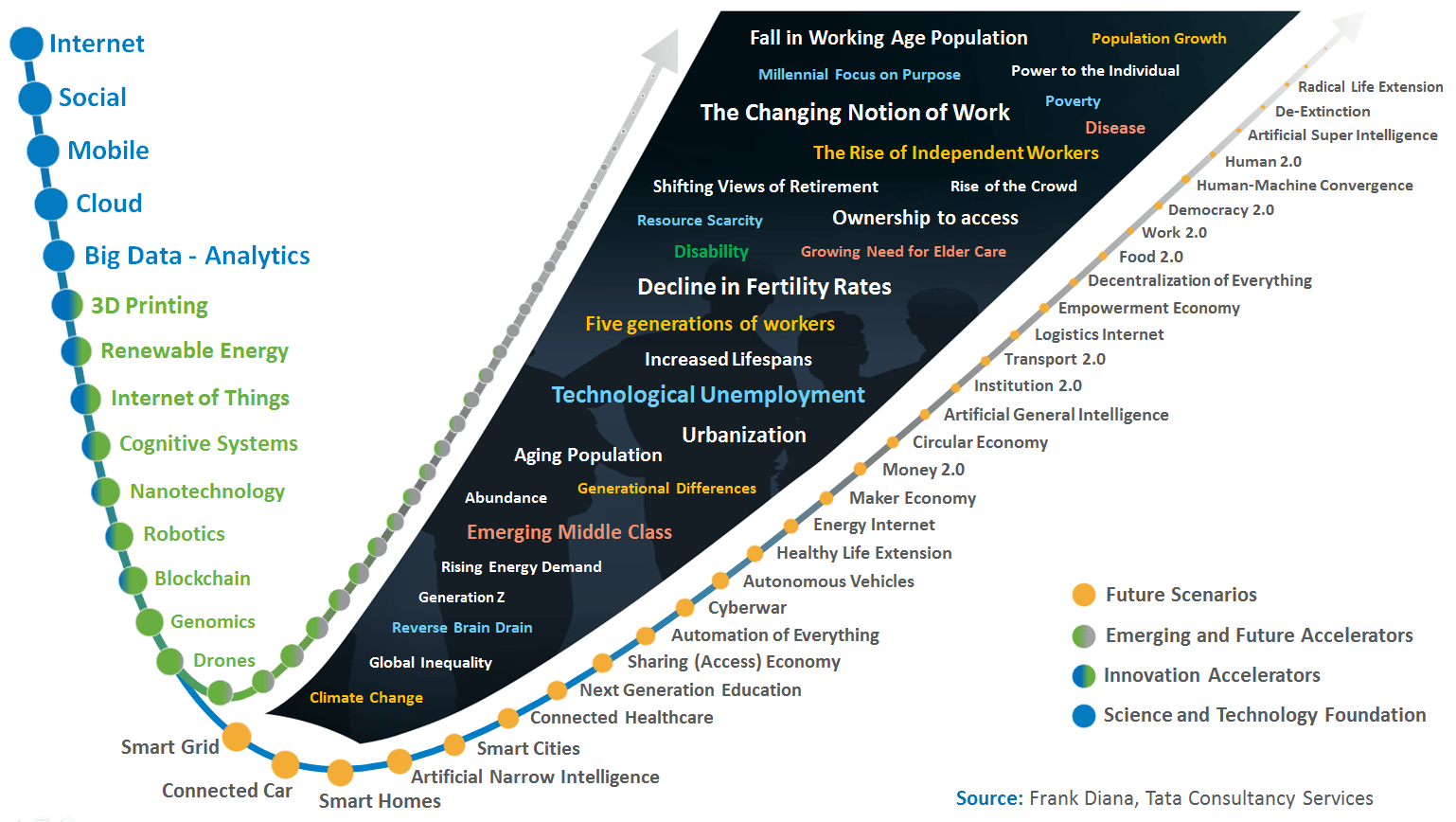
The three pieces of a Third Industrial Revolution platform would all be in place with the development of this Logistics Internet and its convergence with an emerging Energy Internet and our current Communications Internet. I will continue to explore the disruptive scenarios curve in the visual below, but in the next post, I’ll explore what could be the ultimate disruptive scenario: The Third Industrial Revolution platform.


Leave a Reply