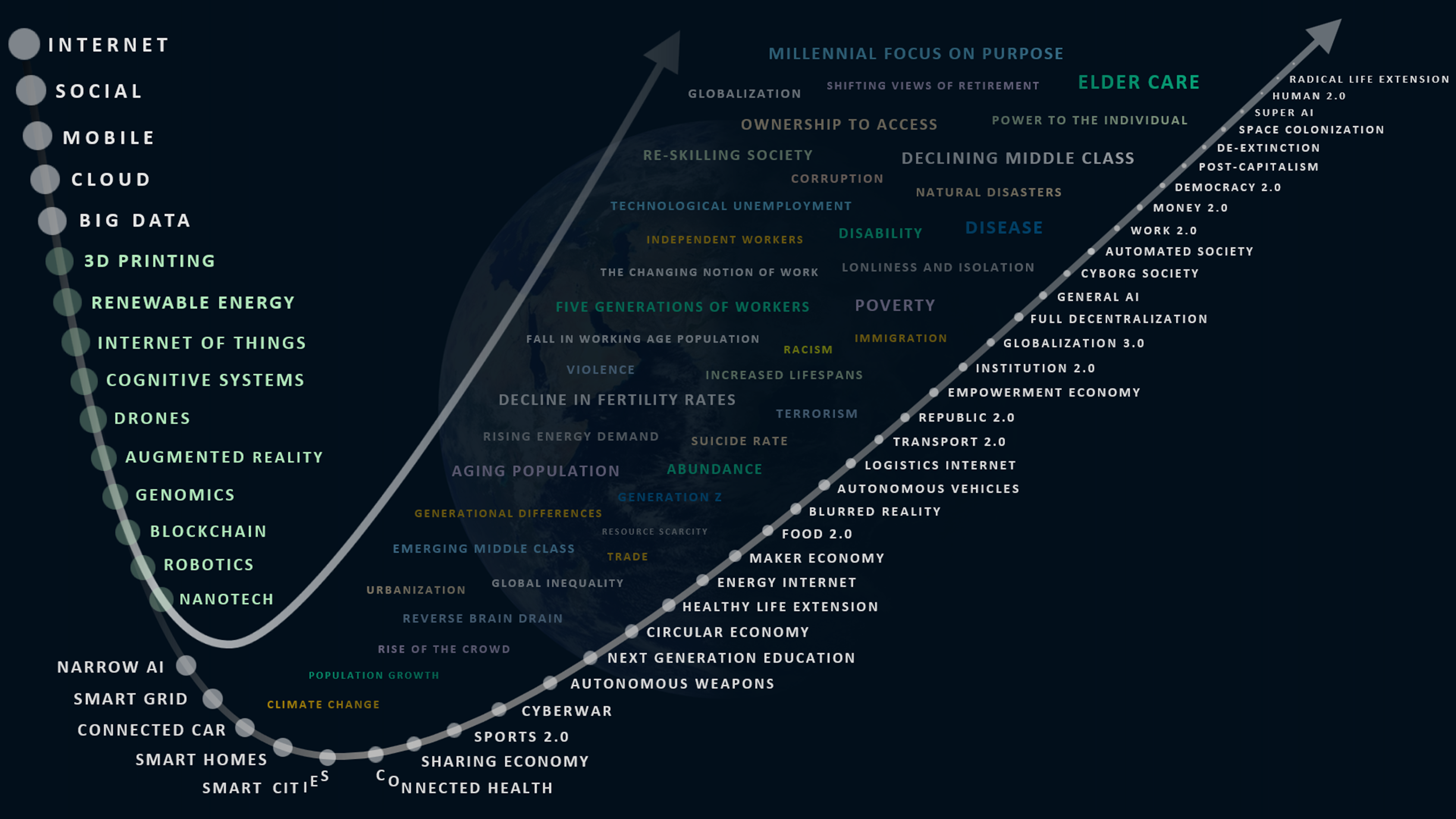
The world is about to enter a pivotal decade. This decade is likely to be remembered as the launching pad to a very different future. The next ten years are marked by uncertainty, complexity, and an inability to predict how an overwhelming number of Dots Connect to shape the decade. In a 2018 post, I looked at some work by Karen Harris and others that focused on some of the Macro Trends that drive the decade. In the supporting insights report, the authors see volatility emerging from the Collision of Demographics, Automation, and Inequality. These three factors drive a very Turbulent 2020s and Beyond.
Automation
Future Hiring: Skills-Based or Credentials-Based?
An Article by IEEE Spectrum captured a dialog that occurred at a recent MIT conference. The topic: AI and the Future of Work. The conference discussion underscores the struggles between Techno-Optimism and Techno-Pessimism. Pessimistic when AI and automation are viewed as an industry-destroying path that takes jobs via self-driving technology, smart law algorithms, and robots that continue to put factory and warehouse workers out of work. Optimistic when those same technologies are viewed as augmentation that improves the employee experience.
The Globotics Upheaval
In a recent book, Richard Baldwin takes us on a fascinating journey to the past, and then provides a peak into the next great transformation. In The Globotics Upheaval, Mr. Baldwin describes a cycle that has played out multiple times throughout human history. The cycle of transformation, upheaval, backlash and resolution (Let’s call it TUBS) was experienced each time the world entered periods of major disruption.  Mr. Baldwin introduces the Globotics Transformation as the third great economic transformation to shape our societies over the past three centuries. As he describes, the first was known as the Great Transformation started in the early 1700s, and it switched societies from agriculture to industrial and from rural to urban. The second started in the early 1970s, shifting the focus from industry to services – the Services Transformation. I take a different view of transformation in the context of Tipping Points – but the cycle is the same.
Automation to Destroy 200,000 Banking Jobs
A recent Article states that automation will result in the biggest reduction in headcount across the U.S. banking industry in its history, with an estimated 200,000 job cuts over the next decade – this according to Wells Fargo & Co.
MIT Report on the Future of Work
In a recent Article posted on the Singularity Hub, the author describes the first report of the MIT Task Force on the Work of the Future. This group of MIT academics was set up by MIT President Rafael Reif in early 2018 to investigate how emerging technologies will impact employment and devise strategies to steer developments in a positive direction. The primary finding from this report is that it’s the quality of the jobs we should worry about – not the quantity.
Preparing for the Future: Part Two
As mentioned in my previous post, I had the pleasure of hosting two sessions recently at the TCS Innovation Forums in London and New York City. The sessions, which explored the need to prepare for the future, involved thought leaders, futurists, and various leaders across multiple domains. They were structured with several five-minute descriptions of forward-looking themes, and once context was set, a discussion with the broader leadership group was moderated. The sessions focused on education and awareness, rooted in a strong belief that leaders must prepare for and shape our emerging future.
This post will summarize the New York Session, which differed slightly from the one in London. While the London session painted a wide array of evocative future scenarios, the New York session explored several of the key technologies and enablers that will fundamentally shape and impact emerging scenarios. It wasn’t however a technology discussion. This engaging group of thought leaders provided eye-opening facts and focused on implications, both positive and negative. As in London, I opened the session with three key themes from my Expectation post: Acceleration, Possibilities, and Convergence; Here is a look at the insights that followed.
Mapping the Path of Innovation
In a recent post, I asked my readers to help me identify those catalysts that force the actions required to steer our future towards advancing our human development. Feel free to respond to the Poll. The number one response was the rapid pace of innovation. That response supports my own opinion that the pace will ultimately force stakeholders across multiple domains to take action. Much like the Domain Convergence that occurred during our most Transformative Period in History, convergence is required if we are to take the correct path towards human flourishing.
Bursts of Possibility
Fast Future Research provides a glimpse into possible futures through a series of recently published books that focus on our Our Emerging Future and accelerate our learning and dialog. As with his previous books, Rohit Talwar enlists several authors in a new book just launched titled A Very Human future. An abstract for the book reads as follows:
As society enters the fourth industrial revolution, a major question arises—can we harness intense technological bursts of possibility to bring about a better world? A Very Human Future illustrates how the evolution of society, cities, people, businesses, industries, nations, and governments are being unexpectedly entangled by exponential technological disruption. This is not a book about technology but an exploration of how we make it serve humanity’s highest needs and ambitions.
Automation Risk Levels
A popular question these days is: Will a robot take my job? That question is as popular as: what should my child study in school? At the heart of both questions is the fear that we as a society will automate anything that can be automated. This website may help bring some clarity – at least in the context of automation risk level. It’s very quick, simply enter your job and an automation risk level expressed as a percentage will be returned.
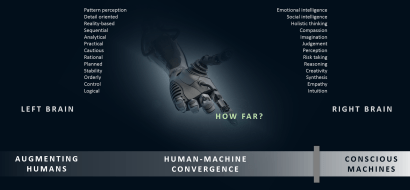
Ultimately, these questions are difficult to answer, as we cannot predict the jobs of the future – and required skill levels could be a moving target. The progression of automation can be viewed on a spectrum from augmenting humans to fully conscious machines. There are arguments being made on both ends of this spectrum – time will tell.
Republic 2.0 Added to Emerging Future Visual
In a recent book titled The Future of Work, author Darrell M. West describes the Work 2.0 scenario on this emerging future visual. In exploring possible implications of a shifting work paradigm, he gets prescriptive about possible responses. This implication-response exercise sits at the heart of Future Thinking.
No one can predict this complex and uncertain future – but exercises like this help us see possible futures. In seeing them, we position ourselves to proactively shape them. In the context of work, Mr. West explores several possible responses, including another future scenario which he calls Republic 2.0. How this scenario plays out has a direct impact on the path of other scenarios. The scenario speaks to a new kind of politics. Mr. West states:
The Future of Work

I just added another very good book to the Book Library: The Future of Work: Robots, AI, and Automation. Author Darrell M. West looks at a world in which our current views of work change. He explores the implications to our social contract and the policy decisions so critical to revising that contract for a new era. Structural change – which Mr. West explores in the book – has long been a tenet of my work. The future of many of our institutions will either change by our proactive acknowledgement that they must change – or they will be undermined.
The conversation so nicely positioned by our author is one that must happen at all levels of leadership. This does not have to be a Utopian versus Dystopian discussion. Rather, like the major disruptive periods of our past, leaders need to lead.
Birth Rates, Workers, and Volatility
I wrote about a recent analysis conducted by Bain & Company in an earlier post on the Turbulent 2020s and what it means for the 2030 and beyond. An interesting related exchange on Twitter focused on the impact of birth rates on the core issues of demographics, automation, and growth.
The Journey Continues
It’s been over a year since launching an Online Course focused on a complex and uncertain future. The course takes a Journey through the Looking Glass – a metaphorical expression that means: on the strange side, in the twilight zone, in a strange parallel world. It comes from the Alice and Wonderland literary work of Lewis Carroll, where he explores the strange and mysterious world Alice finds when she steps through a mirror. I have always found this to be a perfect metaphor for our times.
Every time the looking glass has appeared, the world has experienced a Tipping Point. While I firmly believe a tipping point is coming, the impact is likely a question of severity. Some believe that we have survived similar economic transitions in the past, while others disagree:
The Strategic Foundation
In my last post, I explored the evolution of business in the industrial age. This Fourth Iteration of Business establishes resilience on a foundation of automation and intelligence. Resilience may be more important than the productivity gains that are sure to be realized as we progress towards Business 4.0, providing the capacity to recover quickly as the pace of shifts accelerates. This visual represents a strategic foundation for Business 4.0.

The Fourth Iteration of Business in the Industrial Age
The evolution of business in the industrial age has mirrored the progression of three industrial revolutions; moving us from its first iteration to our current form. The emerging Fourth Industrial revolution ushers in another shift, culminating in something that likely looks much different than its predecessors. A brief look at this journey shows us the linkage:
Iteration One: The first industrial revolution introduced mechanization and had significant impacts on business and the labor force. Business in this period was transformed, as the steam engine enabled us to replace human and animal-based muscle with machines.
Iteration Two: Several forces converged during the second revolution to elevate our standard of living. The post-war period that followed was defined by a high level of consumption that drove business in the mass production era. Henry Ford famously said: “Any customer can have a car painted any color that he wants so long as it is black.”
Iteration Three: The third industrial revolution revolved around information technology, electronics, and communications, ushering in a period of computerization and automation. Businesses were once again transformed through significant gains in productivity and a shift away from Henry Ford era standard products to more customization.
The Turbulent 2020s and what it Means for 2030 and Beyond
In a recent insights report, authors Karen Harris, Austin Kimson and Andrew Schwedel look at macroeconomic forces and their impact on labor in 2030. The Collision of Demographics, Automation and Inequality will shape the 2020s – a collision that is already in motion. By 2030, the authors see a global economy wrestling with a major transformation, dominated by an unusual level of volatility. Here’s a summary of these three forces:
AN AGING WORKFORCE
As the global workforce ages rapidly, our authors forecast a slowing of U.S. labor force growth to 0.4% per year in the 2020s, thereby bringing an end to the abundance of labor that has fueled economic growth since the 1970s. Even as longer, healthier lives allow us to work into our sixties and beyond, it is not likely to offset the negative effects of aging populations. This labor force stagnation will slow economic growth, with negative side effects including surging healthcare costs, old-age pensions and high debt levels. On the positive side, supply and demand dynamics could benefit lagging wages for mid-to-lower skilled workers in advanced economies through the simple economics of greater demand and lesser supply – but that leads to their second major force: automation.
The Automation of Everything
In a Post from 2014, I explored the path of automation and a possible economic impact between $14 and $30 trillion. Almost four years later, my focus has shifted from economic to societal impact. How far will we take automation? Will automation augment us, freeing us from mundane and redundant tasks, or will it replace us? Is automation limited to those characteristics we typically associate with our left brain – or will it encroach upon our right brain characteristics?
These questions currently have no answer – just speculation. How far the slider in the visual below goes, drives a profound difference in the ultimate implications to society. The obvious area of impact is the future of work – if we do indeed realize decentralized autonomous organizations. Do our right brain characteristics become much more important in this future world, and do they represent a safe haven? I show three very impactful examples in presentations that would have us question whether or not machines can be creative, compassionate, and eventual companions.
Tipping Points in Human History
I’ve been talking lately about the two main tipping points in human history: from hunter-gatherer to agriculture, and agriculture to our industrial society. That second tipping point beginning about 1760 ushered in three revolutions. The First Industrial Revolution saw the rise of iron and textile industries and the mechanization of production through the use of water and the steam engine. This second tipping point saw a reduction in physical labor and a shift in where new forms of labor were required. The Second Industrial Revolution started in 1870, riding advances such as electricity, telephone and the internal combustion engine to drive rapid industrialization and globalization. A massive disruption followed, as established sectors were eliminated and new ones emerged.
A Dialog with The Center of Digital Intelligence
I had the pleasure of doing a video interview with Kevin Benedict today, where we discussed a number of topics, including the recent book Machine, Platform, Crowd: Harnessing Our Digital Future. Kevin is from the The Center of Digital Intelligence. Our wide ranging discussion can be viewed here.
Human Traits in an Exponential World
Our exponential world puts increasing pressure on our capacity to innovate and the speed and quality of idea flow. This dynamic coupled with the speed at which automation is likely to occur brings our right brain characteristics front and center. Creativity, imagination, big picture vision, emotional and social intelligence, empathy, and other human characteristics are critical to navigating in this emerging future. As automation accelerates, these human traits become even more critical. In a recent report by Citi on Technology at Work, the authors point to our propensity for social interaction, communication, and empathy being something machines can never replace.
Continue reading Reimagining the Future