
This week I attended the Annual Directions Conference held by research firm IDC. Because of the coronavirus, the conference was held online. Here are some of the key messages – a deeper analysis is provided by Michael J. Miller, chief information officer at Ziff Brothers Investments and can be found Here.
Family Life In 2025
The Fast Future team continues to provide foresight in various areas. In this recent Article they explore what family life may look like in 2025. The possible future they describe is built on a foundation of multi-sensory immersive experiences, while distance is eliminated. We will no longer miss family celebrations and story-telling rises to new levels. Imagine a grandparent telling stories from their past, brought to life in ways that stimulate our emotional sensations.
What Skills Do You Need To Outsmart Robots?
What job skills do we need for the future? A popular question that comes up a lot. In a Recent Post, I listed several: emotional intelligence, creativity, flexibility, adaptability, data literacy, and technology savviness. This Tweet of a World Economic Forum video adds complex problem solving, critical thinking, people management, working with others, and decision making to the list.
Connecting our Brain to the Internet
In a world of knowledge abundance, there are so many things to consider. Knowledge has always been the engine that drives human development – and it has been throughout history. Knowledge expanded in the hunter-gatherer days with the invention of fire. In those days, a human obtained all its food by foraging. Although the source of food did not change, fire allowed humans to cook food and consume more calories. The human brain expanded with this caloric increase, and soon we invented language – the first in a series of innovations that drove the growth of knowledge. All that followed – from agriculture to the great inventions of the second industrial revolution – enabled us to advance as humans. I explored that progression Here.
Is Artificial Intelligence Dangerous?
A recent Article written by Futurist Bernard Marr describes a conversation with Oxford University Professor Nick Bostrom, New York Times best-selling author of Superintelligence: Paths, Dangers, Strategies. Although the books focus was on those things that could go wrong, this recent conversation with Bostrom acknowledged the enormous upside to artificial intelligence. You can see the full video of their conversation below.
Some of the AI impacts explored in the video are:
- AI will change the workplace and the jobs that humans do
- AI-enabled terrorism
- AI surveillance
- Social manipulation and AI bias
- Deepfakes
- Political, legal, and social ramifications
Bostrom advises that rather than avoid pursuing AI innovation, we should put ourselves in the best position possible, with scalable AI control methods, ethics and governance. If we don’t, those significant negative ramifications he described in his earlier book could be realized. But as noted, there are so many positive outcomes to consider. This revolution represents as it always does a need to Manage the humanity enhancing and humanity diminishing pathways.
Eradicating Disease and Disability
There’s been a lot of talk lately about the impact of Artificial Intelligence on Healthcare. An aging population is likely to place even more stress on a costly and ineffective healthcare system. There are other new innovations that are likely to improve healthcare efficiency and offer new ways to address global healthcare challenges. One such innovation is described in this Recent Article authored by science editor Jackson Ryan.
The Intersection of Longevity and Finance
I have a fundamental belief that we will not solve the challenges ahead using the institutions and mechanisms of the past. These structures served us during a manufacturing era that looked very different than the world that has emerged in the last three decades. In a recent Article authored by Margaretta Colangelo, she provides an example of this phenomenon. In a time when populations are living much longer than previous generations, leaders are beginning to realize that institutions must be organized in a different way. Ms. Colangelo provides an example in the Finance space, stating that traditional banks weren’t designed to serve a large number of clients living a long time. Today, banks have a small number of clients who are over 100 and they are outliers. In the next decade that demographic will increase dramatically.
From Automation to Hyper-Automation
In a recent Article, Gartner says that no single tool available today can replace humans in the workplace. The article goes on to say that hyper-automation is a response to this challenge – bringing together different tools, technologies and techniques to amplify every company’s ability to automate more processes, more rapidly, with better results.
It is no secret that productivity has slowed. In a Post from 2016, I described this phenomenon in detail. According to Wikipedia, productivity is an average measure of the efficiency of production. It can be express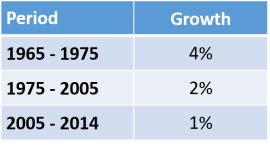 ed as the ratio of output to inputs used in the production process. In a Citi Report I shared in that post, they describe the significant slowing of labor productivity growth, which drives a focus on next generation gains. But In spite of technological progress and innovation, measured productivity growth is low by historical comparison.
Longevity Escape Velocity
Google’s head of engineering, innovator and futurist Ray Kurzweil often discusses the concept of longevity escape velocity; or the point at which science can extend your life for more than a year for every year that you are alive. Kurzweil believes we are much closer than you might think. In fact, he believes we are just another 10 to 12 years away from the point that the general public will hit this longevity escape velocity.
Holograms: Coming to a Concert Near You
As the dialog about massive change this decade amplifies, questions about societal implications come into focus. Of specific interest is the way society is likely to react to some of this change. In a recent Poll, I asked if people would be interested in interacting virtually with a lost loved one. Forty-seven percent of the respondents said no. These simple questions give us visibility to how we are likely to embrace or reject aspects of change in this decade.
Here is another question to consider – but first, take a look at this video:
Now the question – please take the quick poll.
Immigration, Innovation and the Coming Migrations
 I recently added a new book to my Book Library. Authors Peter Diamandis and Steven Kotler explore the acceleration of technology and the Upheaval we are likely to experience in the coming decade. Diamandis and Kotler investigate how exponentially accelerating technologies converge and impact both our lives and society as a whole. They ask key questions like: how will these convergences transform today’s legacy industries? What will happen to the way we raise our kids, govern our nations, and care for our planet?
The Mega-Trends that Shape the 21st Century
In a recent Article by Bryan Walsh, he describes the mega-trends that are likely to shape this century. These trends are driven by the Acceleration of innovation and a growing set of Societal Factors. In describing the seriousness of these trends, our author points to a forthcoming book titled “The Precipice”. In the book, author Toby Ord of Oxford’s Future of Humanity Institute gives one in six odds that humanity will suffer an existential catastrophe during the next 100 years — almost certainly due to our own actions.
In the book The Fourth Turning, authors William Strauss and Neil Howe illuminate the past, explain the present, and reimagine the future. They offer an utterly persuasive prophecy about how America’s past will predict its future. Here is what they had to say:
Nine Future Innovations That Will Change Urban Travel
Futuristic technologies and a new understanding of how our output impacts the world around us will change the face of transportation as we know it. New innovations hope to solve some of the biggest issues impacting transportation today by curbing pollution, reducing fatalities, and cutting down travel time.
Visionaries like Elon Musk are betting billions on big ideas that seem far fetched, but could become mainstream in the next few years. Hyperloop transportation tubes could be operating passenger services as early as 2021. These tubes would run at speeds of 600 mph or more and transport groups of passengers through pressurized tracks. Eventually, hyperloop hopes to tackle freight shipping too.
A Dear John Letter to HR
Nahal Yousefian is a Chief Human Resources Officer. She reached out recently to discuss her passion for disrupting the Human Resources function. She has moved from conforming in the system to learning about and experimenting with more effective models of organizational design, capability, and ultimately psychology. She pointed out that many systems and structures were designed precisely to reinforce a centralized, command and control flow of work versus an agile and responsive model. She has reframed her personal purpose at work and strives to create the world of work anew.
I will let her tell you the rest of the story in this brilliant Dear John letter that she wrote to HR. Every function, every institution, every mental model could benefit from a similar letter. It is my continued hope that more people like Nahal make it their personal purpose to think differently about these fossils from our past. Enjoy her letter.
Oregon futurist Predicts More change in next 10 years than the last 40
In a recent Post I said that this decade is likely to be remembered as the launching pad to a very different future. Seems Oregon Futurist Steve Brown agrees with me. Mr. Brown sees a whole lot of change by 2030. And he makes a bold prediction: “My expectation is that we’re going to see more change in the workplace and more change in our lives in the next ten years than in the last forty. It’s a bold statement to make, but I think it’s accurate,” said Brown. This recent Article describes each of the areas that he believes drives this change. Here is a summary:
The Impact of Capital on Exponential Progression
In a post back in 2018, I described a phenomenon that contributes to the rapid Acceleration of innovation and scientific breakthroughs. Peter Diamandis coined the term Techno-Philanthropists and compared and contrasted them to the Robber Barons of a different era. Billionaires get a lot of negative press these days – but one thing is clear: their wealth is both accelerating the pace of innovation and addressing some of the world’s greatest challenges. Stories described by Articles like this one highlight the point.
The Acceleration of Acceleration
In his recent Book Peter Diamandis describes why the future is faster than you think. At the heart of this phenomenon is the Acceleration of acceleration. The Convergence of multiple forces is driving this very fast future. As these Intersections occur, that pathway to a very different future opens wide. In the case of acceleration, Mr. Diamandis identifies seven forces that in effect accelerate the current acceleration dynamic. These are:
The Changing World of Human Resources
A recent Article explores those things keeping most Chief Human Resources officers (CHROs) up at night. According to Gartner, CHROs believe three topics are impacting the future of work: AI and automation, the gig economy and an aging yet multi-generational workforce. However, Gartner also believes that they are missing some key trends. They identified these six trends as areas for chief human resources officers to consider:
- Unethical Use of Employee Data
- Falling Barriers to Access
- Automation of the Manager Role
- Elimination of On-the-Job Learning
- Radical Transparency
- Rising Demand for Remote Work
Like every corporate function, human resources will face its share of change in the coming years. According to Gartner research, only 9% think their organisation is prepared for the future of work. Explore each trend in the article referenced above.
Food: A great Example of the Broad Changes Coming
In this recent Article, the authors describe the future of food in a way that captures the massive change driven by one future scenario: in this case, Food 2.0. Setting aside the changes likely in the form of lab-grown meats and 3D Printed foods, this story is more fundamental: it’s about farming. The article describes the current state of the industry, mostly one in decline.
Can you Reunite with a Lost Loved One?
In a recent book titled A World without Work, author Daniel Susskind described two fields of computing: computational creativity and affective computing. According to wikipedia, computational creativity is a multidisciplinary endeavour that is located at the intersection of the fields of artificial intelligence, cognitive psychology, philosophy, and the arts. The goal of computational creativity is to model, simulate or replicate creativity using a computer. This field of computing explores whether Creativity is the Sole Domain of Humans.
 Reimagining the Future