
Work life in the COVID era is still evolving after a year in which the global pandemic has altered many aspects of work. We learned about the importance of essential workers while accelerating a move to remote work. We put to rest a belief that remote work is unproductive and fully embraced all things digital. Along the way, we learned about Zoom Fatigue – a feeling like exhaustion or burnout. Mental health specialist Krystal Jagoo says that a lot of it comes down to the increased cognitive demands of video conferencing communication. Said another way, we are experiencing digital exhaustion. In a recent Article by Chris Matyszczyk, he provides insight from Microsoft – a company that most expect was ready for the virtual word. But when they explored their virtual world, what they found was in their words horrific:
Continue readingAn Education Revolution
There could hardly be anything more important for the future of the country than the strength of its education system.
Steve Denning
I read a great Article on education the other day written by leadership thinker Steve Denning. My passion for the future of education is expressed in frequent Posts on the topic – so the article struck a chord. As a leadership guru, Mr. Denning focused on the management of education and provided some fascinating statistics. For example, in 2006, only 43% of school personnel in the US were teachers, while in other countries, that percentage was 70 to 80%. Seems that this imbalance is driven by a compliance focus that has employees trying to monitor and comply with federal and state requirements. Mr. Denning believes that lost in this period of industrial-era bureaucracy is the purpose of organizations involved in education. He describes a current corporate revolution in management and leadership that he believes needs to take root in education. There are two very critical points made in the article that speak to a need to Think Differently.
Continue readingThe Changing Nature Of Clothing
As we look ahead to our continued human development, it is easy to focus on things like energy, transport, health, and food. Changes in these areas grow more evident by the day. But what about clothing? We rarely think of innovation in the context of what we wear, and for good reason: clothing has not really changed (except for style) in a long time. Clothing, however, is expected to change dramatically, according to a recent Article by Jared Lindzon. Advancements in manufacturing in four primary areas are the reason. Those advancements are increased connectivity; data; computational power; analytics; machine learning; artificial intelligence; human-machine interaction; and advanced engineering.
Continue readingA Renewed Focus On Our journey
In late 2017, we produced a video as part of a leadership course that focused on seeing the future at some level and rehearsing it in ways that advance it. In the last two weeks Hassan El Bouhali (a participant in the session) shared six different segments from the video on LinkedIn. The posts attracted a great deal of attention, triggering a thought to produce a follow up video. I covered the initial video back in 2018 via a blog post titled Perspectives on the Journey. TCS CTO Ananth Krishnan participated in the original session, driving a dynamic discussion with Hassan. I’ll bring the band back together to look back on our views from 2017, and look forward to what may lie ahead. In the meantime, here is the full video that supports the various segments that Hassan shared.
Wall Street Is Going Green
Continue readingWildfires burned nearly 10.4m acres across the US last year. The most costly thunderstorm in US history caused $7.5bn in damage across Illinois, Iowa, Nebraska and South Dakota. As the climate crisis swept the globe on a biblical scale it left in its wake a record number of billion-dollar disasters.
Dominic Rushe – Reading the writing on the wall: why Wall Street is acting on the climate crisis
What Big Things Can We Expect In 2021?
This week’s release of the Future Today Institute 2021 Trends Report gave leaders a lot to digest. What foresight can we quickly glean from the content? A recent Article via Amrita Khalid focused on the big trends to expect this year and beyond. At a high level, artificial intelligence, cryptocurrencies, 5G, and social credit scores make the list. More specifically, the article identifies six big trends for this year.
Continue readingFuture Today Institute: 2021 Trends Report
Each year the Future Today Institute releases a very comprehensive trends report during SXSW. In announcing this year’s report, Founder Amy Webb had this to say:
The cataclysmic events of the past year resulted in a significant number of new signals. As a result, we’ve analyzed nearly 500 tech and science trends across multiple industry sectors. Rather than squeezing the trends into one enormous tome as we usually do, we are instead publishing 12 separate reports with trends grouped by subject. We are including what we’ve called Book Zero, which shows how we did our work. There is also an enormous, 504-page PDF with all content grouped together as one document.
Amy Webb – Future Today Institute
These reports allow us to explore weak and strong signals in a way that helps us envision possible futures. Given the high levels of uncertainty, the sheer number of building blocks, and the Convergence occurring across domains, exploration, learning, and dialog are as critical as ever. You can download the report Here. There is a lot to digest – but that is exactly the point. Thanks to Amy and her team for their continued support of this exploration process.
Less Is More
An epoch is a period of time in history or a person’s life, typically one marked by notable events or particular characteristics. Although not officially approved, a working group has proposed that the world entered a new epoch called Anthropocene, or the human epoch. The starting point is still debated, as some believe it started at the beginning of the Agricultural Revolution 12,000–15,000 years ago, and others see it starting as recent as the 1960s. One proposal, based on atmospheric evidence, is to fix the start with the Industrial Revolution circa 1780, with the invention of the steam engine.
Continue readingAnimating History
What if you could bring your ancestors back to life? Creepy, or fascinating to see what it would have been like to interact with them? MyHeritage is a company focused on DNA testing and helping discover their family history. They recently developed what they call Deep Nostalgia, which uses AI to animate photos of people from the past. The company encourages you to decide for yourself by creating a video and sharing it with your family and friends. This Article describes how it works, shows some amazing examples from Twitter, and encourages people to try it. Those interested can do so on the MyHeritage Website. Look at the video below to watch the animation of history.
Sustainability: Not Just Talk Anymore
Sustainability is not a new topic. The United Nations Sustainable Development Goals have been in place since 2015 and were adopted by 193 countries. At the heart of these goals lies our desire to advance our Human Development. We may be in a better position to do so now then we have in quite some time. In fact, History tells us that the last time we experienced a period of great human development spanned the century from 1870 to 1970. While there have been notable efforts to realize these U.N. goals, progress has been slow. Let’s take energy as an example. It is a big part of the sustainability story and the Future of Energy has been discussed for years. However, progress towards that future has been slow. That could all change in the next decade. Several forces are Converging to accelerate the path of energy. One of those forces is a shift in orientation to purpose:
Continue readingAs We Accelerate In The Short Term – Horizons Move Closer
While COVID-19 is an acknowledged accelerant, we are accelerating towards a known destination. Remote learning and working should have evolved sooner; the digital foundation should have been a priority earlier; eCommerce should have exploded by now; and last-mile delivery is only just beginning. Although we may arrive at this destination sooner, acceleration now draws scenarios that are further out closer. Those that may have been reluctant to order online overcame their fears. The elderly on zoom calls is now a thing. With broader societal adoption comes an ability to more aggressively pursue innovative ideas that may have been further out. When combined with learning that comes from broader adoption, acceleration becomes a virtuous cycle.
Continue readingTransforming The Energy Paradigm
Yesterday, I Wrote about the speed at which change is likely to occur this century. Paradigm shifts will happen regularly, in stark contrast to the past, where paradigms had a long shelf life. From health and education to energy and transport, paradigms will shift. The energy transition is big discussion topic today, and rightfully so. The most transformative periods in history have been tied to energy transitions. While renewable energy dominates the dialog, rapid increase in energy demand can negate those gains. This short video captures parts of this dialog. Visit this YouTube Channel to join the discussion.
How Fast Will The World Change In Ten Years?
“Standing still is the fastest way of moving backwards in a rapidly changing world” – Lauren Bacall
By now, it should surprise no one that the world is changing very rapidly, but just how fast is an open question. Michael Simmons explores that question in a recent Article. When looking at the future back in 1930, the big concern was how to use the leisure time enabled by technology. Instead, a quote from the article describes the world that actually emerged:
Continue reading“Rather than being bored to death, our actual challenge is to avoid anxiety attacks, psychotic breakdowns, heart attacks, and strokes resulting from being accelerated to death.”
Geoffrey West
Views On The Role of Business Are Shifting Again
Prior to the 1980s (Specifically the post world war two era), there was a belief that business had a higher purpose than generating profits. This somewhat cyclical debate about the role of business is back again. Business in the post-war era served a broad set of stakeholders, not just the shareholder. Early business corporations formed in the late eighteenth and early nineteenth centuries were created specifically to create roads, canals, railroads, and banks. There was a focus on service, not maximizing investment returns. In these periods, business focused on stakeholder capitalism. Investopedia defines it this way:
Continue readingWe Live In A New Era – Our Institutions Need To Catch Up
The world is in a state of transition and has been for a while. Across multiple domains from society and geopolitics to the economy, the future looks very different. Driven in part by societal shifts and rapid advances in science and technology, the foundation of society is changing. However, the institutions that support that society are not evolving or changing fast enough. I call this phenomenon Institution 2.0 and track it as a future scenario.
One of those institutions is Education. Learning – and the role it played throughout history – is key to managing through periods of transition. This YouTube Channel contains a series of interviews that we conducted on the topic. This video teaser describes the role of education in this emerging era.
COVID-19 And The New Great Depression
In a new book by James Rickards, the author explores both the COVID-19 pandemic and its economic impact. A prolific writer, Economist, and adviser, Mr. Rickards predicts years of economic turbulence ahead. In The New Great Depression, Mr. Rickards sees the pandemic through an historical lens, where crisis presents a gateway between one world and the next. With an eye towards history, he concludes that the Keynes practical definition of a depression fits, and we are now in a new depression that is more far reaching than a mere technical recession. Along the way, the author wades into controversial topics such as China’s role in spreading the virus and the lockdown that ensued (which he calls the biggest policy blunder ever).
Continue readingThe Great Demographic Reversal
Beginning in 1990, several forces converged to shape the global economy. Globalization, demographics, technology, deflation, debt, and interest rates have all played a role. Now, according to a recent book, at least two of those forces are reversing. In The Great Demographic Reversal, authors Charles Goodhart and Manoj Pradhan describe these forces and their influence on the last thirty years of economic activity. With this convergence, the world experienced an extended deflationary period, which per the authors, was driven in part by a labor supply shock. The book said the following:
Continue readingTransforming The Energy Paradigm
The most transformative periods in history are linked to eras of energy transition. The most impactful was the emergence of fossil fuels. What does that say about what lies ahead? Have we entered a period of energy transition, and if so, are we on the cusp of another highly transformative period? Energy is just one piece of a very disruptive decade ahead – but it is perhaps the biggest piece. As we Accelerate Towards a new energy paradigm, what can we expect? One thing is certain: there are societal and geopolitical implications to consider.
Continue readingThe Exponential Era
Much of what is driving our emerging future is the exponential pace of science and technology. When combined with the Convergence of building blocks that span multiple domains, it becomes easy to see why the world seems to be moving so quickly. In a recent book titled “The Exponential Era”, authors David Espindola and Michael Wright explore this phenomenon and present an approach for surviving in a future that is moving so fast. This story is about an overwhelming number of building blocks and the rate at which they are converging. As this happens, long-standing beliefs and institutions are rendered obsolete. I had the honor of providing a quote for the book jacket:
Continue readingAre We Heading Towards A New World Order?
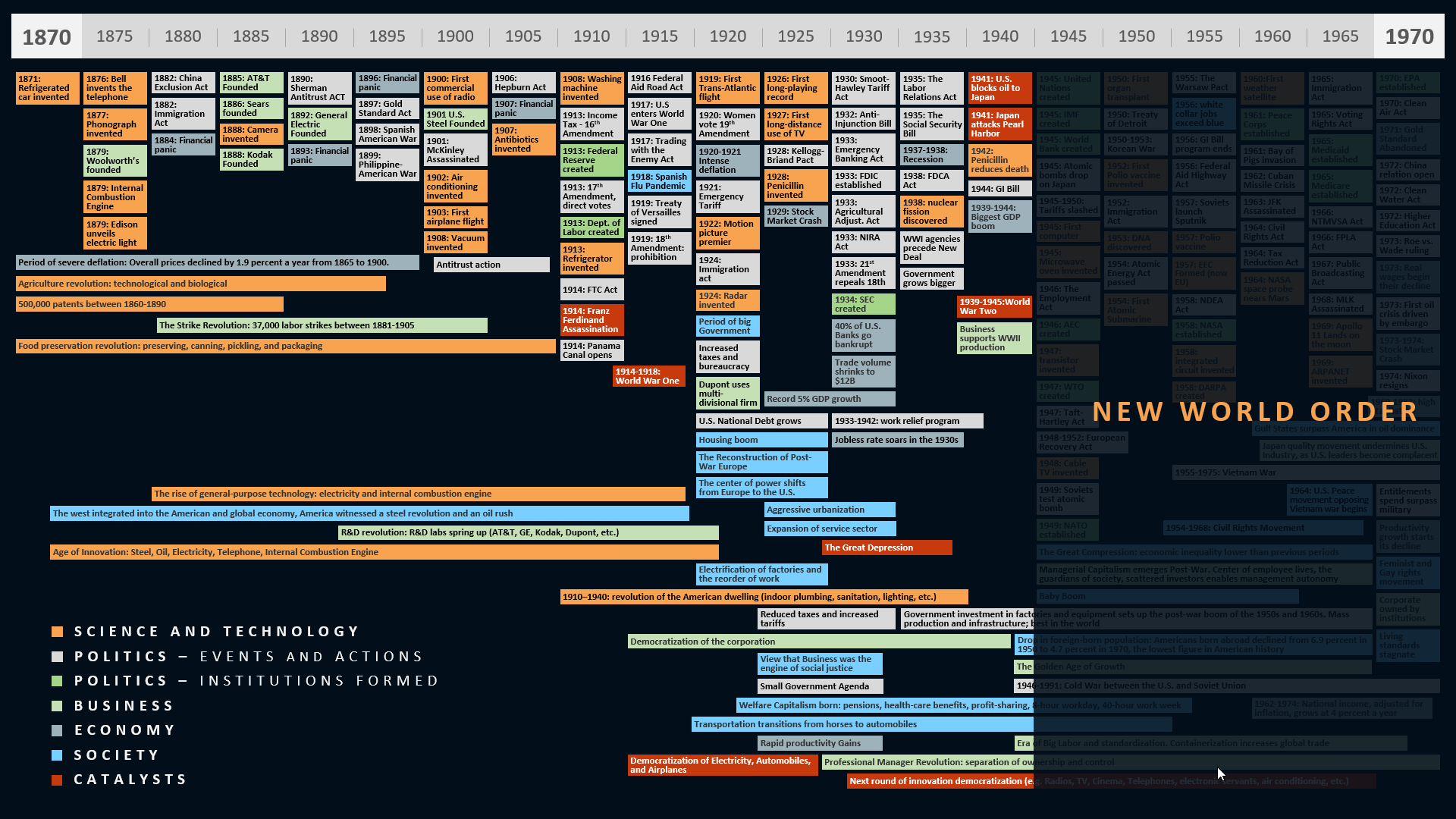
After World War Two, 730 delegates from all 44 Allied nations gathered in the U.S. at the Mount Washington Hotel in Bretton Woods, New Hampshire. The Bretton Woods Conference aimed to regulate the international monetary and financial order after the war ended. Held from July 1 to 22, 1944, agreements were signed and ratified by member governments, establishing the institutions that represented a new world order. This led to what was called the Bretton Woods system for international commercial and financial relations.
Continue reading Reimagining the Future