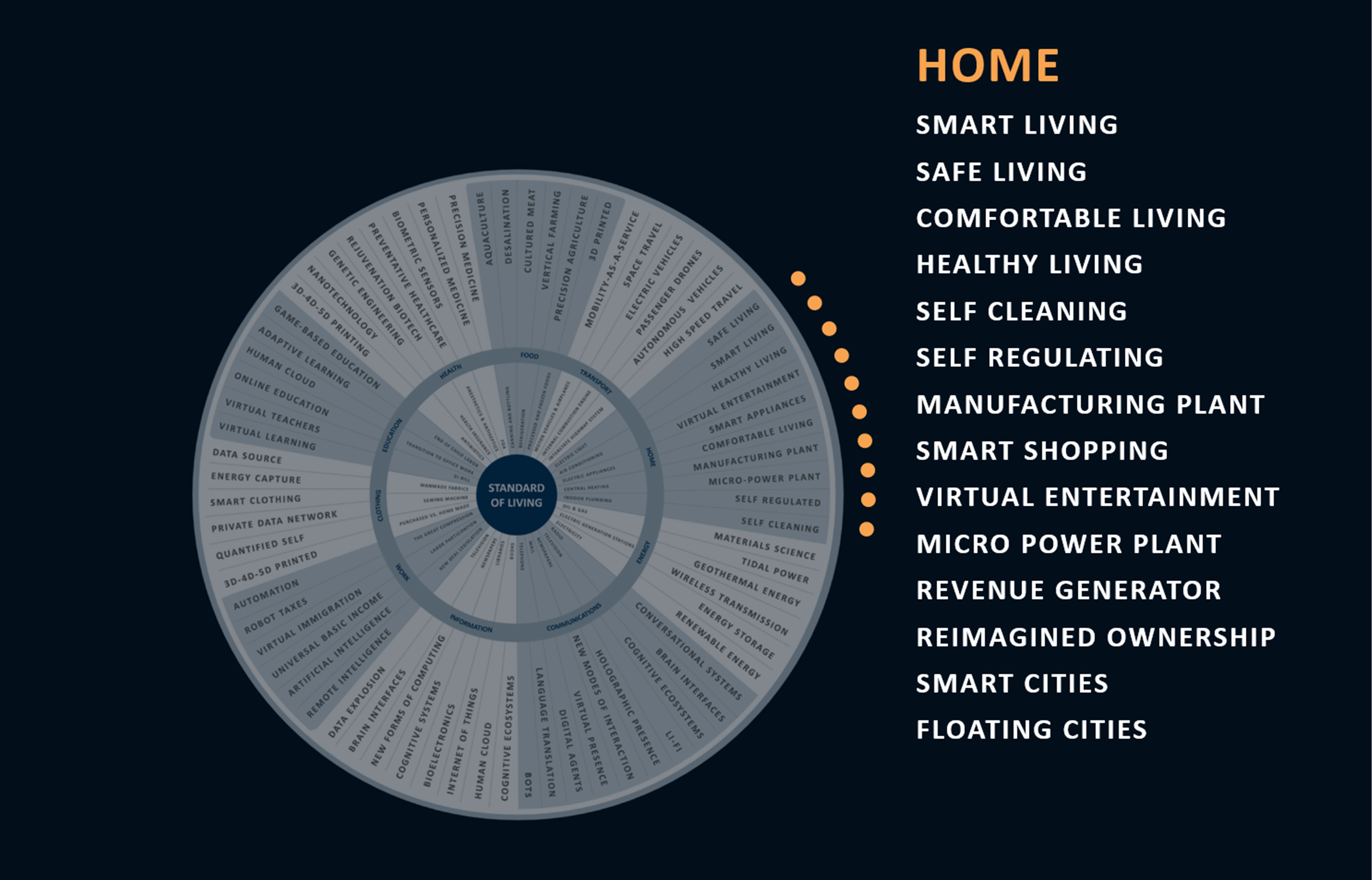
When I talk about this emerging era of great invention advancing the various areas of our well-being, I always include changes to the home. The home has remained quite static since great inventions of the second revolution (running water, sanitation, heating, air conditioning, etc.) established our modern-day home. For the first time since that period, the home is likely to see another shift. This was true prior to the pandemic, as the visual I use to describe this part of the innovation story describes.
It was 2014 when I was first exposed to the concept of an Energy Internet. It was Economist Jeremy Rifkin in his book The Zero Marginal Cost Society that introduced it as part of a broader vision for a new general purpose technology platform (GPTP). I have since written extensively about the Shifting Energy Paradigm and the implication for society. When evaluating the three foundational components of a GPTP (Energy, Communications, and Transport), changes to the energy component have historically driven the biggest societal transformations.
An event like a pandemic triggers a chain reaction. Like one domino setting the others in motion, COVID-19 is shaping a different future. The links in the chain represent multiple domains, and the reaction spans them all. Our challenge is to understand the Implications of these reactions and the way the World may Respond. I looked at this implication/response Framework in the early days of the pandemic. Now, we see signals that may provide more clarity as to possible paths. One domain where signals are emerging is work.
With a continued focus on the Future of Education and our need to Rethink it, I want to share a video from a great event that I had the privilege to participate in. The Children at Risk organization serves as a catalyst for change to improve the quality of life for children through strategic research, public policy analysis, education, collaboration, and advocacy. This event focused on education and learning.
Special thanks to Alexandra Whittington for inviting me to the event. As we gaze upon what is likely the most Disruptive decade in history, children and their future is something we should all rally behind. Enjoy the session.
Over the course of the last several years, videos shared on YouTube have allowed for various forms of story telling. Stories about the future help us visualize possible paths. Recently, new team member Kevin Benedict launched a TV series on the Channel focused on the future of business. He has had several fascinating guests covering a variety of topics. Now, Kevin is moderating a new series where I am joined by various guests focused on a future reimagined. Our inaugural session was launched last week.
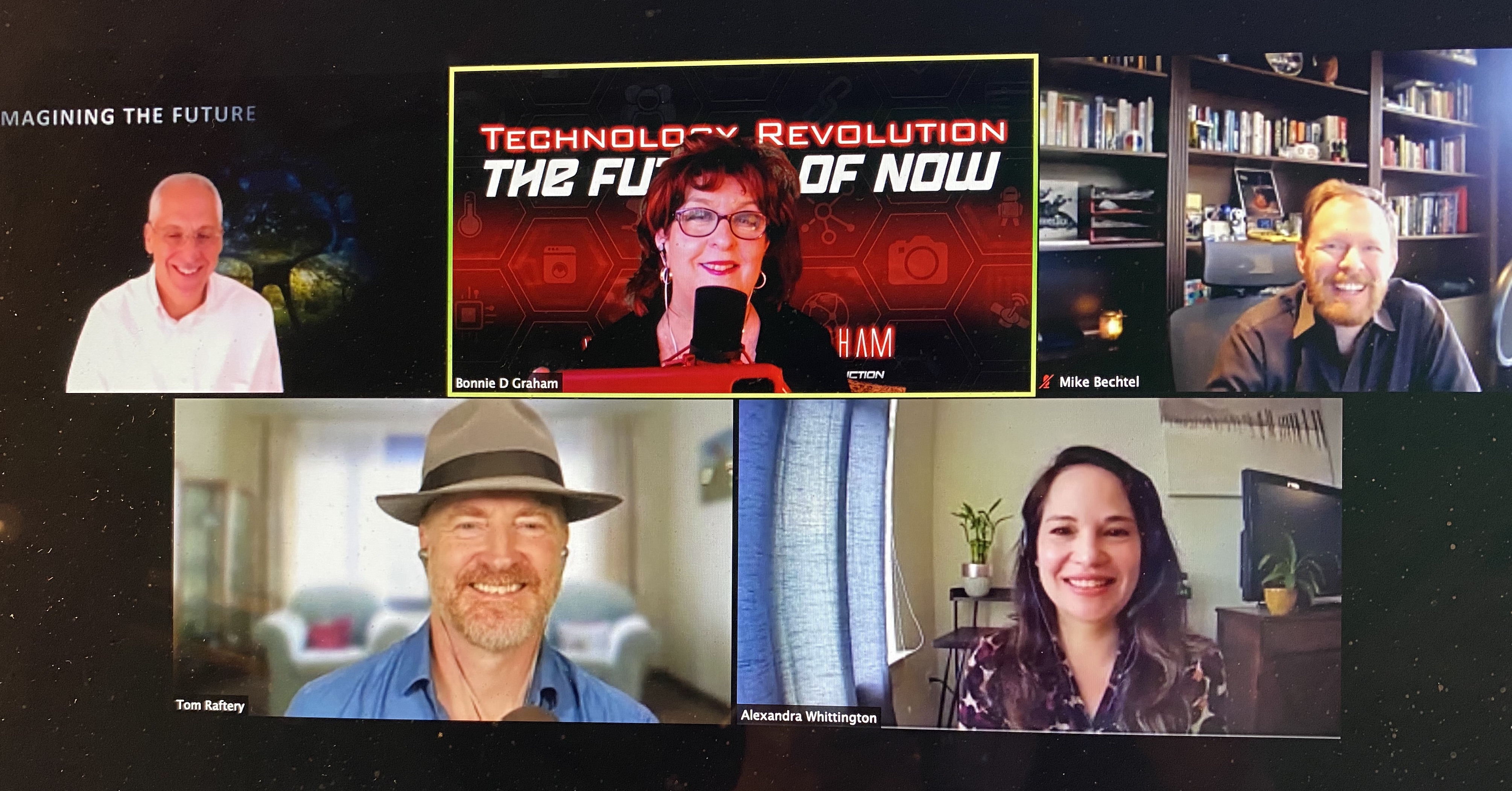
I once again had the privilege of joining Bonnie D. Graham to discuss the future. This time however, there was a great twist – the show happened on Zoom. All previous shows had a radio format, so Bonnie and I never actually saw each other. Well, all that changed last week as Bonnie did what most of the world has done – shift to a virtual video format.
I mentioned last week that I would spend time on education and our critical need to rethink it. To start that journey, fellow Futurist Alexandra Whittington joins our future of business show with host Kevin Benedict. Listen in to their wide ranging conversation about futurism and the rethinking of higher education.
Data gathered by LinkedIn, Coursera and the World Economic Forum was captured in a Future of Jobs Report recently published by The World Economic forum (WEF). A good summary is provided by senior writer Kate Whiting in her recent Article on the WEF website. Report content is showing up in varied places, with key finding.
As we Rethink Humanity, we appreciate that the next decade represents what is likely the fastest, deepest, most consequential disruption in history. By 2030, much of what we know could be completely reimagined. Something as basic as food and farming could look quite different, as the possibilities cover a wide spectrum. In the short term, we find different ways to farm, optimizing yield and improving our environment. In the long term, we likely witness the complete transformation of farming.
The acceleration of automation is not a direct outcome of the pandemic – it is simply more visible now. That visibility is one of the few bright spots in an otherwise horrible several months. The inequities that exist in the world are now more visible. The lack of preparation for a digital future has exposed those who did not see the need. In the case of automation, it was going to accelerate for a number of reasons, but the pandemic will Accelerate the Acceleration. One clear reason that this decade will see a massive investment in automation is the fall in Working Age population. Said another way, it is getting increasingly difficult to find skilled resources.
“Those who say it cannot be done should not interrupt those who are doing it.” – Thomas Alva Edison
That is a quote from a recent Article on Waymo’s announcement of a Completely Driverless Service for the general public in Chandler, Tempe and Mesa Arizona. The quote addresses all the skepticism that has surrounded the move towards autonomous vehicles. Author Enrique Dans describes the emerging service and has a message for the naysayers:
Here is a scenario I expect to see play out increasingly over time:
To address Japan’s rapidly aging workforce and labor shortage, contractor Obayashi Corporation has turned to automation by constructing a dam almost entirely with robots
I just finished another very good book and added it to my Book Library. COVID-19: The Great Reset was authored by Klaus Schwab and Thierry Malleret. Professor Klaus Schwab is the Founder and Executive Chairman of the World Economic Forum. He has argued that a company must serve not only shareholders but all stakeholders to achieve long-term growth and prosperity. To promote the stakeholder concept (something gaining considerable traction today), he founded the World Economic Forum. Thierry is the co-founder and main author of the Monthly Barometer, a succinct predictive analysis exclusively provided to private investors and some of today’s most influential opinion and decision-makers.
As artificial intelligence continues to both dominate the news and stimulate our imagination, many questions remain. One such question was explored in a recent Article. As the authors describe, artificial intelligence still needs to bridge the gap between mastering cerebral games like chess and Go and translating that impact to the physical world. The latter remains a bigger challenge.
Shopping malls are an example of the lasting impact that the global pandemic is likely to have on real estate. If the surge in online shopping represents a new normal, then what is to become of all those malls? In a recent Article, author Parija Kavilanz explores that question. According to data from research firm (REIS) Moody’s Analytics, the rate of mall vacancies is at a historic high of 9.8% in early September, exceeding the previous peak of 9.3% in 2011.
In a post from last year, I focused on the Convergence story. This story has one foot in the past, and another in the future. The realization of great advancements in human development during the late 19th and early 20th centuries is a convergence story. A period of great invention converged with other domains to enable our modern society. As we stand at the threshold of another period of great invention, the convergence story is more complicated. This time, complexity is added by the introduction of two new domains: philosophy and environment.
Two recent articles caught my eye this week. One article focused on the Fourth Generation of artificial intelligence, calling it artificial intuition. The other article explores the shift from artificial narrow intelligence to Artificial General Intelligence. In the case of artificial intuition, author Mark Gazit describes how helpful AI has become, and its ongoing limitations. Machine learning is still fully dependent on historic data. New and unknown scenarios leave data scientists helpless. Mr. Gazit suggests that in order to have true artificial intelligence, we need machines that can think on their own.
Slowly then quickly, that’s the story of exponential progression. When you reach an inflection point on the exponential curve, you reach an Acceleration of Acceleration. We have reached a point where Change has never been this Fast – yet it will never be this slow again. Artificial intelligence (AI) is a great example of this phenomenon.
In early 2019, I described the Three Focus Themes for the year. They were Acceleration, Convergence, and Possibilities. Little did I know that one of those themes would factor so prominently in 2020. In a recent Presentation, Mehlman, Castagnetti, Rosen & Thomas – a full-service, bipartisan government relations firm – describes 2020 as the year where forces already in play experience a great acceleration. One of those forces is mixed reality.
There was a lot going on in the world of travel prior to the pandemic. The emerging Mobility Ecosystem built on a foundation of innovation promises to disrupt this space as the decade progresses. The visual describes some of what lies ahead (click to view in a separate window).

 Reimagining the Future