Social Robots

In this last segment from the Health Summit in D.C., I responded to a question regarding loneliness, isolation and the policies that might help address this societal issue. Is it strictly a policy question? Like everything else in this exponential world, are building blocks emerging to address such issues in different ways? Like say, social robots?


Can Society Adapt to an Accelerating Pace of Change?

Updated December 15, 2017

Thanks to Parthasarathi V for his thought provoking comment on LinkedIn, and a link to a relevant article from Clay Shirky on the Collapse of Complex Business Models. His comment:

“We are having super abundance of everything – capital, talent, resources. The previously known scarce resources (e.g physical world scarcity, natural resources) are also abundant now thanks to technology. With every abundance there will be new scarcity that will be the point of friction. With every node of regulation we remove to promote innovation, new set of problems will emerge that needs to be regulated otherwise system will collapse.”

Continue reading

Harness All Possibilities

I had the pleasure of presenting at a recent function sponsored by Harness All Possibilities (HAP). The organization Founder – Rhonda Eldridge – has embarked on the following mission:

The fast pace of innovation, technology, geopolitics, socio-economics and demographic factors is driving disruption in industry – for both the employer and the employee. HAP’s purpose is to build a sense of connectedness while you embrace a transformational shift of your awareness and skill sets to prepare for 21st century engagement.

Continue reading

An Uncertain Future

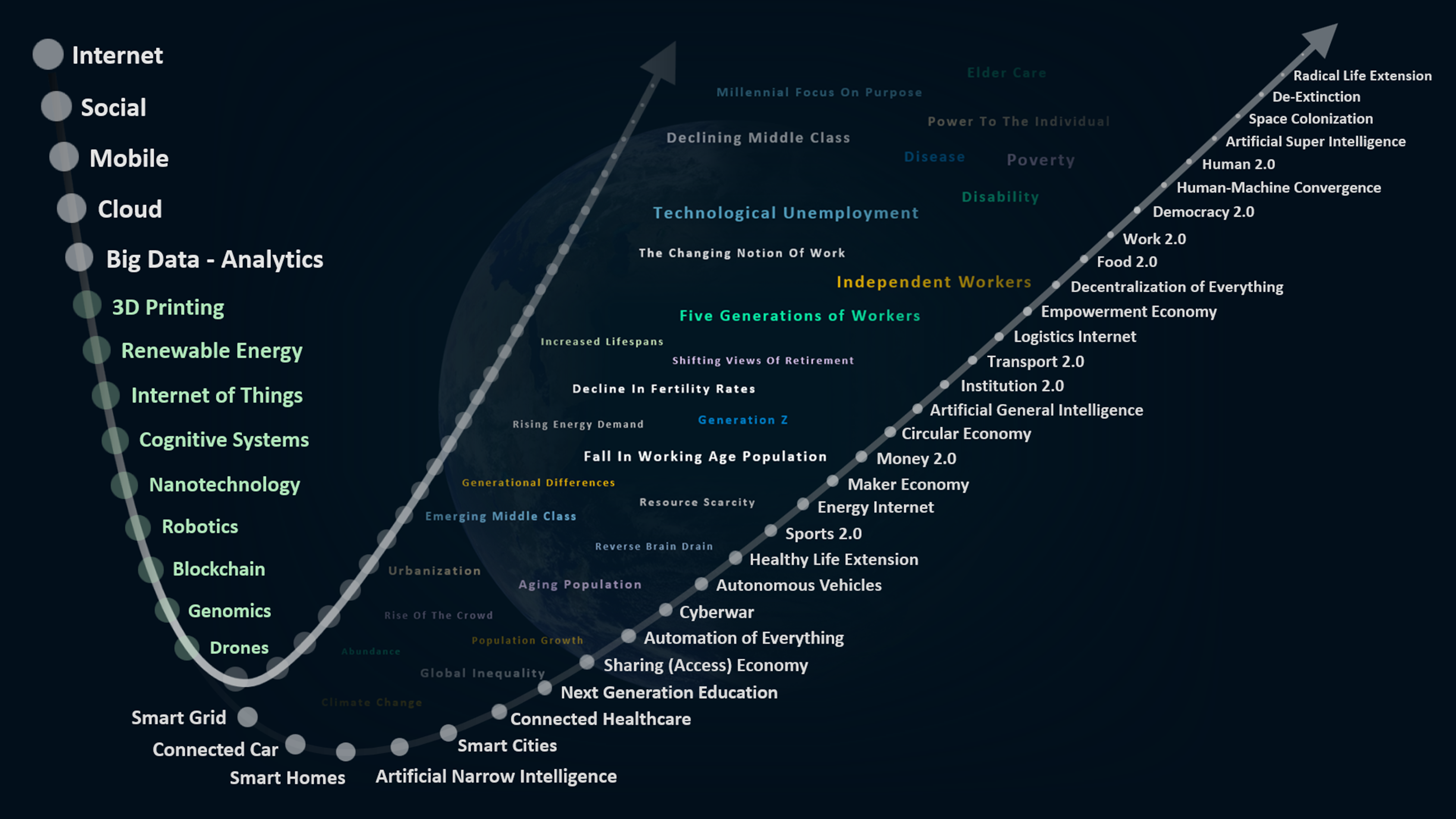
I have used this Emerging Future visual to demonstrate the overwhelming number of combinations that will conspire to create our future. The science and technology foundation converges with societal, political, economic, and environmental forces to build towards a very uncertain future. A future that I believe represents the third massive tipping point in human history.

This very short animated video describes the visual.

Will a Robot Take your Job?

In a recent article, Kevin Drum makes a compelling argument that You Will Lose Your Job to a Robot—and Sooner Than You Think. The piece is a little long, but this is a must read for everyone. At the heart of his argument lies the exponential progression of artificial intelligence (AI). Using the human brain as a barometer, AI will reach one tenth the power of the human brain by 2035. By 2045, we will have full human level AI.

Continue reading

Strategy and Multiple Futures

I recently engaged with fellow futurists on an article for Digitalist Magazine titled Why Strategic Plans Need Multiple Futures. I think the authors truly captured the challenges of strategic planning in a world where pace and the sheer volume of change makes our emerging future anything but predictable. The focus on story telling as the most effective way to communicate potential futures is powerful, and the Lowe’s example really brings that point home. I recommend this articles to leaders everywhere. Here is a powerful quote:

“Companies like Lowe’s are realizing that standard ways of planning for the future won’t get them where they need to go. The problem with traditional strategic planning is that the approach, which dates back to the 1950s and has remained largely unchanged since then, is based on the company’s existing mission, resources, core competencies, and competitors.

Yet the future rarely looks like the past. What’s more, digital technology is now driving change at exponential rates. Companies must be able to analyze and assess the potential impacts of the many variables at play, determine the possible futures they want to pursue, and develop the agility to pivot as conditions change along the way.”

Virtuous Cycles Accelerate Pace

In segment five of my interview with Chunka Mui, we discussed virtuous cycles and their ability to accelerate the pace of science, technology, and emerging future scenarios. Mr. Mui uses the driverless car to demonstrate the impact of these cycles, and the impact they have on emerging scenarios. In a Future Thinking context, analysis of these cycles must be part of our Rehearsing, or we will misjudge their timing and short term implications.

Chunka Mui is the managing director of the Devil’s Advocate Group, a consulting team that helps organizations design and stress test their innovation strategies. Mr. Mui published a popular book titled The New Killer Apps.

Segment five is a quick three minute video.

Continue reading

Is Creativity the Sole Domain of Humans?

The transition from our current industrial/information age to an augmented and then ultimately an automated society is underway. The role of humans in that society is an often discussed topic, where our right brain characteristics are likely to play a more dominant role. But are those characteristics the sole domain of humans?

Meet an Artificial Intelligence Virtual Artist called AIVA that was taught to compose classical music – an emotional art which is usually considered to be a uniquely human quality. Musical pieces composed by this AI are used as soundtracks for film directors, advertising agencies, and even game studios. Oh, and it released its first album called Genesis.

Life, Health, and Longevity

Healthy life extension is a future scenario depicted on this emerging future visual. In this era of genomics, precision medicine, and rejuvenation biotechnology, extending our healthy lives is not only possible, but likely. It is believed in some circles that the first person to live to 200 may have already been born.  This animated video was developed to support a recent event on the topic of life and health. It closes with a quick glimpse of TCS capability via a next generation sequencing facility and an analytics platform for genomics and metagenomics.


A Dialog with The Center of Digital Intelligence

I had the pleasure of doing a video interview with Kevin Benedict today, where we discussed a number of topics, including the recent book Machine, Platform, Crowd: Harnessing Our Digital Future. Kevin is from the The Center of Digital Intelligence. Our wide ranging discussion can be viewed here.

Machines, Platforms, and Crowds

Andrew McAfee and Erik Brynjolfsson – Authors of The Second Machine Age – wrote a new book which they launched in the middle of this year. Machine, Platform, Crowd: Harnessing Our Digital Future builds upon their first book, exploring three big trends that are reshaping the business world:

  1. The rapidly increasing and expanding capabilities of machines
  1. The large and influential young companies (Platforms) that bear little resemblance to the established incumbents in their industries, yet are deeply disrupting them
  1. The emergence of the crowd: the large amount of human knowledge, expertise, and enthusiasm distributed all over the world and now available

Continue reading

Taxing Robots

In this recent Article, Futurist Rohit Talwar explores the issue of robot taxes and long term unemployment. Although long, I recommend reading the entire article, but I captured some key points from the article below.

Continue reading

Belief Systems, Purpose, and Balance

At the Health Summit in D.C. two weeks ago, I was asked to articulate those things that leaders should consider as they navigate the complexity of our emerging future. The three that always top my list are:

  1. Resetting our intuition and belief system for a new era – think differently
  2. Shifting to a hybrid profit and purpose orientation
  3. Seeking a balance between innovation that enhances society and mitigating the risk of unintended consequences.

This two minute video captures that portion of our panel discussion.


Loneliness, Aging, Robots and Health

At the Health Summit in D.C. last week, I used this emerging future visual to describe the combination of building blocks that enable our healthy life extension – one of many emerging future scenarios. This two minute video captures that portion of our panel discussion.

One of the key issues that emerged during our panel dialog was the acceleration of aging and death associated with isolation and loneliness. Could robotic companions solve this problem? Do these advances – many that feel like science fiction – combine to solve the challenges that likely emerge as we live longer? Can Sophia be a robotic companion?

The Emerging Mobility Ecosystem

In segment four of my interview with Chunka Mui, we discussed the ultimate demise of our industry construct and the emergence of horizontal ecosystems that remove friction from our life experiences – one experience at a time. This platform-enabled transition can be witnessed in action today, as we watch the Mobility ecosystem form one piece at a time. We can no longer think of industries in isolation, as we witness the collision of various industries and a reconfiguration of the money flow – over $2.5 Trillion in car-related economic value. Chunka uses the example of the collision between the automotive and technology ecosystems to describe  this phenomenon: the shift from cars with computers inside, to computers with wheels on them.

Chunka Mui is the managing director of the Devil’s Advocate Group, a consulting team that helps organizations design and stress test their innovation strategies. Mr. Mui published a popular book titled The New Killer Apps.

Segment four is a quick three minute video.

You can view segment one – Autonomous Vehicles: An Interview with Chunka Mui – here.

You can view segment two – Reimagining Our Driverless Future – here.

You can view segment three – The Ripple Effect – here.

Continue reading

Milken Institute Health Summit

I had the pleasure of participating in the Milken Institute Health Summit earlier this week. A truly inspiring two days at one of the best run conferences I’ve attended. Great discussions with Pepsi CEO Indra Nooyi, Senators Corey Booker and Ben Sasse, and World Bank Group President Jim Yong Kim. The details and a video of the panel discussion I participated in are included below.

ABSTRACT

One of the most important public health findings in the last two decades is that medical care is far from the only factor in how long people live and the quality of their health. A key step to improving health outcomes for older adults–and reducing the costs to the health-care system–is to better integrate health-care and supportive services with housing and transportation at local levels. This session explores effective methods and solutions that can drive change and result in healthier aging on a vast scale. How can we encourage more communities across the country to make the needs of their older residents a priority as they plan for the future? How do we improve the critical connections between housing, health care, technology, transportation, and urban planning?

MODERATOR: Anand Parekh, Chief Medical Advisor, Bipartisan Policy Center

SPEAKERS

Catherine Anderson, Senior Vice President, Policy and Strategy, United Healthcare Community and State

Frank Diana, Principal, Tata Consultancy Services

Omar Nagji, Lead, Health Partnerships, Lyft

Allison Silberberg, Mayor, Alexandria, Virginia

Pattie Dale Tye, Segment Vice President, Bold Goal, Humana

View the full panel discussion Here.

The Ripple Effect

In segment three of my interview with Chunka Mui, we discussed the ripple effect that occurs with emerging scenarios, in this case, the driverless car. Chunka Mui is the managing director of the Devil’s Advocate Group, a consulting team that helps organizations design and stress test their innovation strategies. Mr. Mui published a popular book titled The New Killer Apps.

What fascinates me about these scenarios is the sheer breadth and depth of societal impact. In this segment, Chunka Mui does a great job of describing this impact. Here is a seven minute animated version of our discussion that picks up where segment two left off:

Continue reading

8 Billion Acts of Innovation

I had the pleasure of talking to Taimour Zaman of 8 Billion Acts of Innovation today. They have a TV show focused on Artificial Intelligence, with some incredible stories about current innovation in the field.

The 8 Billion Acts of Innovation venture capital TV show is focused exclusively on artificial intelligence. Recently introduced in Toronto, Canada by investment visionaries Sai Mohammed and Taimour Zaman, AI companies present their business cases and compete for venture capital financing. It’s the only show of its kind in the world, now being viewed by over 3 million people.

$20+ Million of Funding per Show

The show’s panel of investors are senior ‘C-level’ executives whose job is to assess AI companies’ business and financial potential. The funds are put up by Curah Capital, a Toronto-based private venture capital firm involved in real estate and technology.

Mr. Mohammed and Mr. Zaman’s objectives for their show:

1) Worldwide popularity via expanded TV coverage
2) Attract top AI companies from across the world
3) Award ever-larger funding amounts, and
4) Develop financed-firms into celebrated successes

We covered a wide variety of topics in this short video.

Reimagining Our Driverless Future

In segment two of my interview with Chunka Mui, we picked up our conversation with the driverless car scenario. Chunka Mui is the managing director of the Devil’s Advocate Group, a consulting team that helps organizations design and stress test their innovation strategies. Mr. Mui published a popular book titled The New Killer Apps.

Key points of discussion were:

  • If we eliminate auto fatalities, what happens to the need for auto insurance?
  • How to think about the timing of the autonomous vehicle scenario
  • The arms race towards the automotive ecosystem
  • Eliminating 90% of human accidents is plausible
  • Critical mass not needed to feel the impact of this scenario
  • From predicting to rehearsing – a portfolio of options
  • Understanding milestones, markers, obstacles and accelerants
  • Understanding extreme scenarios
  • Understanding the path of science and technology

Here is a six minute animated version of our segment two discussion that picks up where segment one left off:

You can view segment one here.

Continue reading

Autonomous Vehicles: An Interview with Chunka Mui

The convergence that is steering our emerging future manifests itself through a number of scenarios that drive multiple paradigm shifts. As the shifts themselves converge, they intensify the critical need for leaders to think differently about a world where the future arrives faster than people think. Some time ago, I had a great conversation with Chunka Mui regarding pace, the sheer number of shifts, and the need to think differently. We used the autonomous vehicle to explore the challenges of our emerging future. I will present the full discussion in five short segments, along with white board animation to visualize our dialog.

Chunka Mui is the managing director of the Devil’s Advocate Group, a consulting team that helps organizations design and stress test their innovation strategies. As a consultant on strategy and innovation, Mr. Mui has spent considerable time analyzing the autonomous vehicle scenario. He asked a question in his book The New Killer Apps about autonomous vehicles and what happens if traffic accidents are reduced by 90% as Google predicts. This simple question makes visible the broad and deep implications of these future scenarios. As society responds to their implications, new ecosystems emerge that alter our world. In this case, the vehicle is one of numerous components of an emerging mobility ecosystem that is defined by the responses that are playing out right now.

Here is the first of the five segments:

Continue reading