I wrote about a recent analysis conducted by Bain & Company in an earlier post on the Turbulent 2020s and what it means for the 2030 and beyond. An interesting related exchange on Twitter focused on the impact of birth rates on the core issues of demographics, automation, and growth.
Author: Frank Diana
-
Life 3.0: Being Human in the Age of Artificial Intelligence
I just added another very good book to the Book Library: Life 3.0: Being Human in the Age of Artificial Intelligence – A New York Times Best Seller. Author Max Tegmark takes a fascinating journey through possible AI futures. His physics oriented perspective provides an interesting point of view, as humanity wrestles with the ultimate path of artificial intelligence.
Mr. Tegmark tackles the discussion around how much machines will encroach on human domains, by illustrating a metaphor from Hans Moravec:
-
A Sixty Minute Sprint Through Our Emerging Future
I had the pleasure of keynoting the annual Hawaiian event hosted by the Independent Insurance Agents & Brokers of California. The 2018 Blue Ribbon Conference was a great four-day event that focused on many pressing issues: from employment law, to politics and robots, a broad array of challenges faces the industry.
You can view my hour long keynote via this Link. You will need to register in order to view it.
-
Game Changers: Designing the Future of Humanity
Today on Coffee Break with Game Changers, Bonnie D. Graham hosted a show focused on designing the future of humanity. You can listen to the rebroadcast here. The session abstract is included below, as well as a Twitter stream that provides insight into the topic and our discussion. The show participants included: Bonnie, Masha Krol, Ian Gertler, Maricel Cabahug and myself.
-
The Journey Continues
It’s been over a year since launching an Online Course focused on a complex and uncertain future. The course takes a Journey through the Looking Glass – a metaphorical expression that means: on the strange side, in the twilight zone, in a strange parallel world. It comes from the Alice and Wonderland literary work of Lewis Carroll, where he explores the strange and mysterious world Alice finds when she steps through a mirror. I have always found this to be a perfect metaphor for our times.
Every time the looking glass has appeared, the world has experienced a Tipping Point. While I firmly believe a tipping point is coming, the impact is likely a question of severity. Some believe that we have survived similar economic transitions in the past, while others disagree:
-
Supply Chain of the Future: Humans Optional?
As science and technology continue their rapid advance, traditional constructs are challenged; Supply chains are no exception. Here is a brief video that highlights many of the advances that transform how we think about supply chains in the future. As it wraps up, a curated set of videos that touch on several of these advances is provided. Special thanks to Bill Quinn, Rose Castellon-Rodriguez, and Kevin Mulcahy for producing the video.
Be sure to visit the Reimagining the Future YouTube Channel to explore additional topics.
-
Game Changers: Can We Teach Machines to Predict?
Today on Coffee Break with Game Changers, Bonnie D. Graham hosted a show focused on the future of prediction. You can listen to the rebroadcast here. The session abstract is included below, as well as a Twitter stream that provides insight into the topic and our discussion. The show participants included: Bonnie, Gray Scott, and myself
Episode Description
The buzz: “Those who have knowledge, don’t predict. Those who predict, don’t have knowledge.” (Lao Tzu)
Given the uncertainty, pace, and unexpected nature of today’s world, there are too many unknowns for us to effectively predict the future. Reality check: A convergence across science, technology, politics, society, economics, the environment, and growing ethics discussion, has created a complex web that requires the type of system thinking that may exceed our human capacity. Do machines hold the answer? Can they predict the path of an overwhelming number of possible futures?
The experts speak. Frank Diana, TCS: “We have a duty to think hard about what may be, so as to better prepare society for the changes that may come” (Richard Baldwin). Gray Scott, Futurist: “Prediction is not just one of the things your brain does. It is the primary function of the neo-cortex, and the foundation of intelligence” (Jeff Hawkins). Join us for Tech Magic or Hype: Can We Teach Machines to Predict?
-
Find out where you Stand on Artificial Intelligence
Technology is giving life the potential to flourish like never before, or to self-destruct – The Future of Life Institute.
I stumbled upon this organization while reading Life 3.0: Being Human in the Age of Artificial Intelligence by author Max Tegmark. Their mission is to catalyze and support research and initiatives for safeguarding life and developing optimistic visions of the future, including positive ways for humanity to steer its own course considering new technologies and challenges. They are a charity and outreach organization working to ensure that tomorrow’s most powerful technologies are beneficial for humanity – and the list of members is a whose who of the science and technology community.
In their view, technology is to thank for all the ways in which today is better than the stone age, and technology is likely to keep improving at an accelerating pace. From their website: with less powerful technologies such as fire, we learned to minimize risks largely by learning from mistakes. With more powerful technologies such as nuclear weapons, synthetic biology and future strong artificial intelligence, planning ahead is a better strategy than learning from mistakes.
They support research and other efforts aimed at proactively avoiding problems with a current focus on artificial intelligence. The book referenced above looks at the advance of AI and how it will impact life, exploring a broad spectrum of views on what will/should happen. Now, the organization is looking to expand the conversation to include as many voices as possible. Here is a look at the results of their Super Intelligence Survey. You can add your own voice by taking the survey here.
-
Higher Education in the Age of Artificial Intelligence
In a recent book titled, Robot-Proof: Higher Education in the Age of Artificial Intelligence, Northeastern University president Joseph Aoun proposes a way to educate the next generation of college students, supporting society in ways that artificial intelligence cannot. His underlying premise is that the existing model of higher education has yet to adapt to the seismic shifts rattling the foundations of the global economy – I firmly agree. It was Alvin Tofler that said: The illiterate of the 21st century will not be those that can’t read or write, but those who cannot learn, unlearn, and relearn.
(more…) -
Great Books to Consider
Several great books have informed my own personal journey towards our emerging future. The complex and uncertain nature of this future requires a level of system thinking that will challenge our ability to connect the dots that are emerging. Foresight analysis will be an iterative ongoing process, fueled by both human and machine-driven guidance.
Humans are investing considerable time in evaluating the path of many future scenarios. In various forums, I am often asked to recommend books that explore these scenarios. I have now added a Menu Item that lists a number of great books along with an Amazon link.
I hope your journey is as fascinating as mine has been to date.
-
The Great Reset
We face the task of understanding and governing 21st-century technologies with a 20th-century mindset and 19th-century institutions – Klaus Schwab: Shaping the Fourth Industrial Revolution.
In a video titled “The Great Reset”, economist Tyler Cowen uses a great metaphor of canaries in coal mines to describe the warning signals that seem like local events – but actually represent greater and broader stress. He uses several recent examples to highlight the growing stress in the system and the potential for a great reset in the future. Regardless of your belief system – it is hard to argue with the underlying logic. Whether we view this as the Fourth Age in human history, a third major Tipping Point, or a Great Reset, structural change is inevitable. This short seven minute video drives this point home.
-
The Fourth Age
Byron Reese recently authored a book titled The Fourth Age. I thoroughly enjoyed this fascinating look at history, and the focus on possible futures. In looking at the future, Mr. Reese explores the reasons that experts disagree on the path of these possible futures. He asks: why do Elon Musk, Stephen Hawking, and Bill Gates fear artificial intelligence (AI) and express concern that it may be a threat to humanity’s survival; and yet, why do an equally illustrious group, including Mark Zuckerberg, Andrew Ng, and Pedro Domingos, find this viewpoint so far-fetched as to be hardly even worth a rebuttal? The answer as described by the author lies not in what we know – but what we individually belief. This theme throughout the book is an interesting piece of self-reflection. See how you would answer the questions posed by the author.
-
Mary Meeker: Internet Trends 2018
On May 30th, Mary Meeker delivered her now famous Internet Trends Report for 2018. Enjoy.
-
The New Growth Playbook
Colleague and fellow Futurist Simon Torrance has developed a new online course titled: The New Growth Playbook. It provides new research and course content focused on business model transformation for the digital economy. You can access this new online course for senior executives Here.
It’s based on new in-depth analysis of the business model performance of over 500 leading companies, and provides an holistic approach for moving the valuation needle, particularly for incumbent organisations.
Special offer for my network: 20% discount if you book using this link. There’s also a free sample video case study here: How Amazon creates new growth flywheels. The course is getting some great feedback already, so pass the details along to others. Some early feedback is highlighted below:
- “Brilliant analysis.” Senior Partner, Global Management Consultancy
- “I recommend this course to all leaders.” Digital Director, Global Bank
- “Simon is at the forefront of digital trends.” Group Chief Strategy Officer, Global Telco
- “Simon is one of a very small number of senior consultants who truly understands platform-based business models and how traditional enterprises can successfully incorporate them” Senior Director, European Media Company
- “Simon is a thought leader extraordinaire!” Director of Leadership, Global Training Company
- “Simon adds a lot of value” CEO, Global Packaging Company
More at: http://www.newgrowthplaybook.com
-
Globalization’s Third Act
Globalization could be entering its third act. In a book titled The Great Convergence, Author Richard Baldwin describes the three constraints that have limited globalization: the cost of moving goods, the cost of moving ideas, and the cost of moving people. The first two acts of globalization occurred when the cost of moving goods and ideas dropped. While globalization raised the standard of living in several developing economies, the third constraint limited the breadth of impact.
In his closing chapter, Mr. Baldwin explores the possibility of a third act. This act is driven by dramatic advancements in areas that address the third constraint. If the cost of moving people were to drop, developing nations like South America, Africa, and others could be the beneficiaries of this third act. How will the cost of moving people drop? What advancements enable this third act? In his closing chapter, Mr. Baldwin touches on enabling innovations and their fascinating potential. Here is a brief look at these innovations:
-
Healthy Life Extension
One of the paradigm shifts on the future scenarios curve is healthy life extension. When I mention to an audience that the first person to live to 200 has already been born – it gets quite the reaction. Extending our healthy lives has many implications to very long held beliefs. These challenges to our belief systems are the reason I believe humanity is heading towards another Tipping Point – that moment in time where intuitions and beliefs built over long periods experience a considerable shift. It is the reason I titled my presentation “A Journey through the Looking Glass”.
Through the looking glass is a metaphorical expression. It means: on the strange side, in the twilight zone, in a strange parallel world. It comes from the idea of Lewis Carol’s novel: “Through the Looking–Glass“, and the strange and mysterious world Alice finds when she steps through a mirror. I firmly believe we are stepping through the looking glass.
Healthy life extension is a great example of a scenario on the curve upending long standing institutions. As visualized below, multiple building blocks converge to deliver this scenario.

-
Blurred Reality
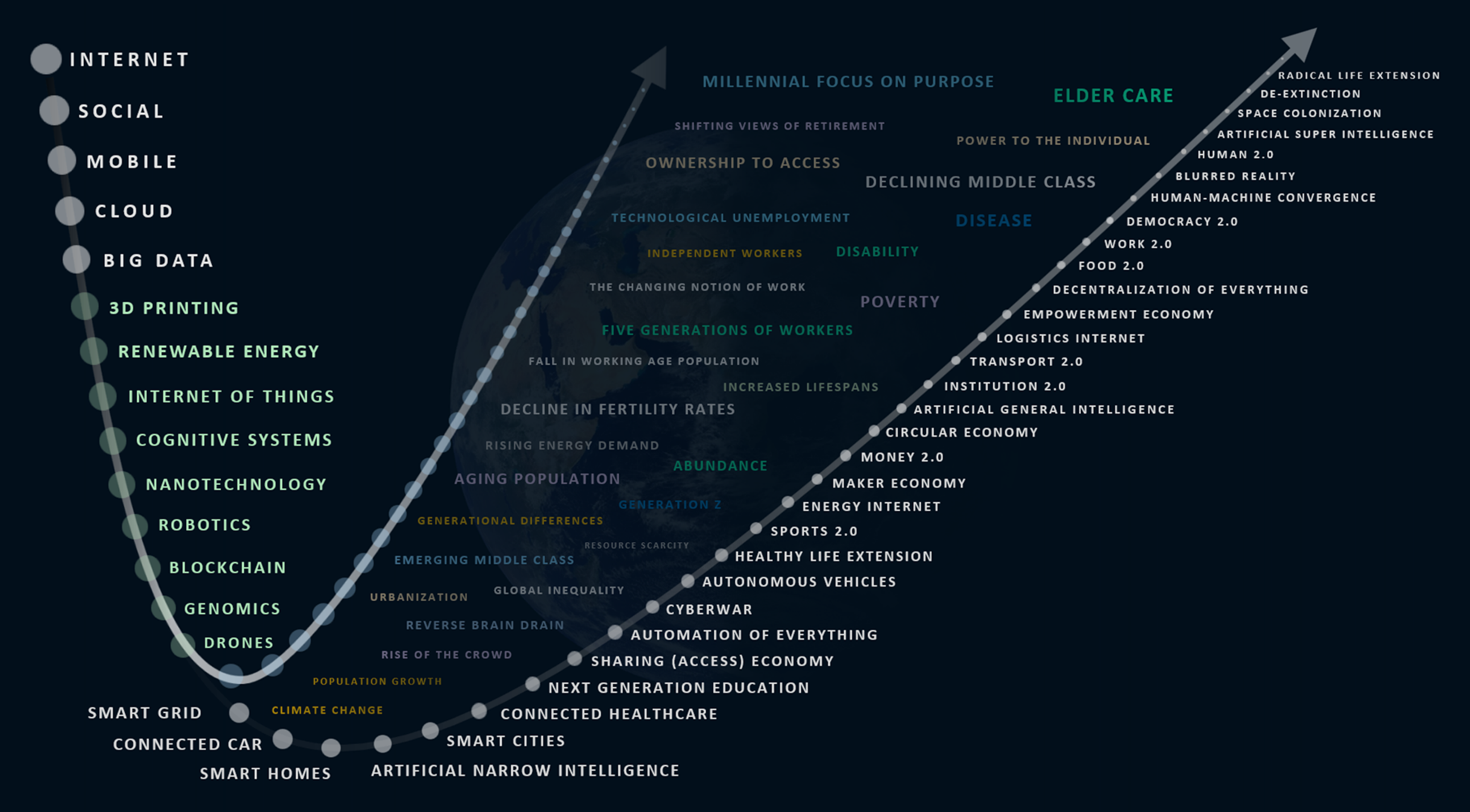
It is no longer a surprise to witness something progress exponentially. Add to that list virtual reality and its near term application in retail, games, sports, and other. As it progresses, the way we interact transforms slowly – and then suddenly. This is a great example of a building block on the science and technology curve spawning a scenario or shift on the future scenario curve – BLURRED REALITY.
-
Visualizing Our Emerging Future – Revised
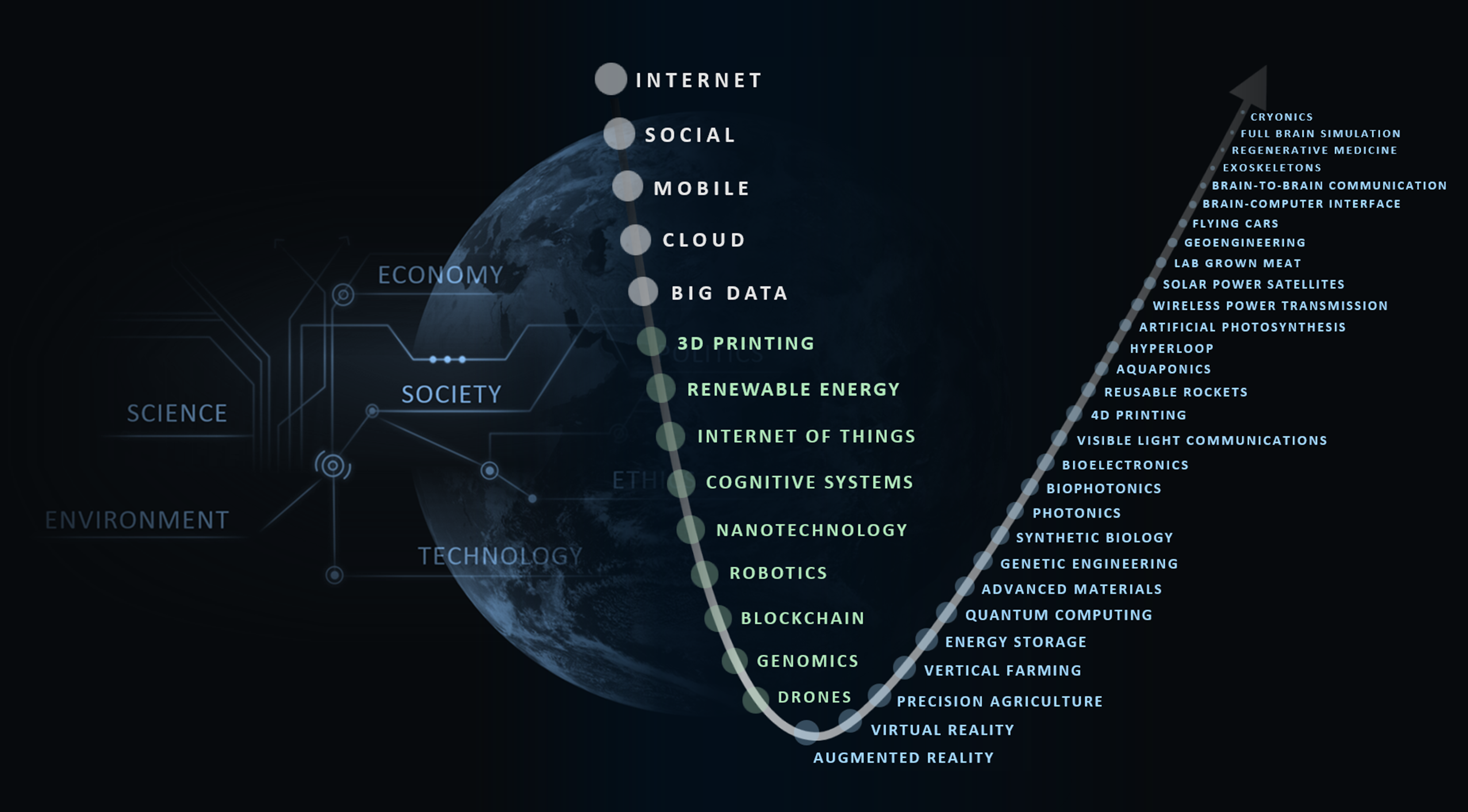
As our emerging future shifts continuously, our challenge is to shift with it. The number of building blocks that combine continues to explode, challenging our ability to track its complexity. I’ve used a visual representation of this challenge – and I see older versions floating around – so I am updating it via this post. When I use the visual in presentations, I build towards it to avoid its overwhelming nature (which I believe accurately reflects the overwhelming nature of the challenge). I will replicate the approach here by building towards the full visual.
Convergence across aspects of science, technology, economic forces, politics, society, our environment, and a growing conversation around ethics, is creating a highly uncertain world. At the heart of the pace dynamic is the exponential progression of science and technology – reflected in the first piece of the visual.
-
Ecosystem Models are Key to Future Strategies
Our structures and institutions are increasingly challenged by rapid innovation in science and technology. As Klaus Schwab stated in his book Shaping the Fourth Industrial Revolution, we face the task of understanding and governing 21st-century technologies with a 20th-century mindset and 19th-century institutions. One such institution is our vertically-oriented industry structure. We are in the early stages of An Ecosystem Evolution, where the boundaries between industries are completely blurred. The creation and capture of value is increasingly horizontal in nature, ultimately giving Rise to a Finite Set of Ecosystems.
As this shift occurs, our strategies are iterative in nature and guided by a constantly evolving view of emerging ecosystems. At the heart of this work lies Ecosystem Models. These models provide a range of possibilities inherent in emerging ecosystems, and identify three critical facets:

