Fast Future Research provides a glimpse into possible futures through a series of recently published books that focus on our Our Emerging Future and accelerate our learning and dialog. As with his previous books, Rohit Talwar enlists several authors in a new book just launched titled A Very Human future. An abstract for the book reads as follows:
Author: Frank Diana
Automation Risk Levels
A popular question these days is: Will a robot take my job? That question is as popular as: what should my child study in school? At the heart of both questions is the fear that we as a society will automate anything that can be automated. This website may help bring some clarity – at least in the context of automation risk level. It’s very quick, simply enter your job and an automation risk level expressed as a percentage will be returned.

Ultimately, these questions are difficult to answer, as we cannot predict the jobs of the future – and required skill levels could be a moving target. The progression of automation can be viewed on a spectrum from augmenting humans to fully conscious machines. There are arguments being made on both ends of this spectrum – time will tell.
Optimist or Pessimist?
In late 2016, having just finished reading The Rise and Fall of American Growth, I was thinking about an underlying theme of the book – the views of techno-optimists versus those of techno-pessimist. In the context of the books narrative, the techno-optimist believes that future innovations will indeed drive a resurgence of growth – albeit at the expense of jobs. The pessimist sees no return to growth and believes our best innovations are behind us. Two years ago, I posed a question via a Post: Are you a techno-optimist or techno-pessimist?
Mind-reading AI can see what you’re thinking and Draw a Picture
The brain is clearly one of the next great frontiers. In this World Economic Forum Article on reading minds, we get a glimpse into the exponential progression of brain science. The author cites research published by AI experts in China, the US and Japan showing that computers can replicate what people are thinking by using functional magnetic resonance imaging (fMRI) machines that measure brain activity – linked to deep neural networks that replicate human brain functions.
Dots in a Complex System are Connecting Rapidly
In their now popular book on The Second Machine Age Andrew McAfee and Eric Brynjolfsson describe one of the forces behind our accelerating pace. This force could be key to understanding the dynamics of our environment; the number of potentially valuable building blocks is exploding around the world, and the possibilities are multiplying like never before.
Unlearning May be our Biggest Challenge
The illiterate of the 21st century will not be those that can’t read or write, but those who cannot learn, unlearn, and relearn – Alvin Tofler, Rethinking the Future.
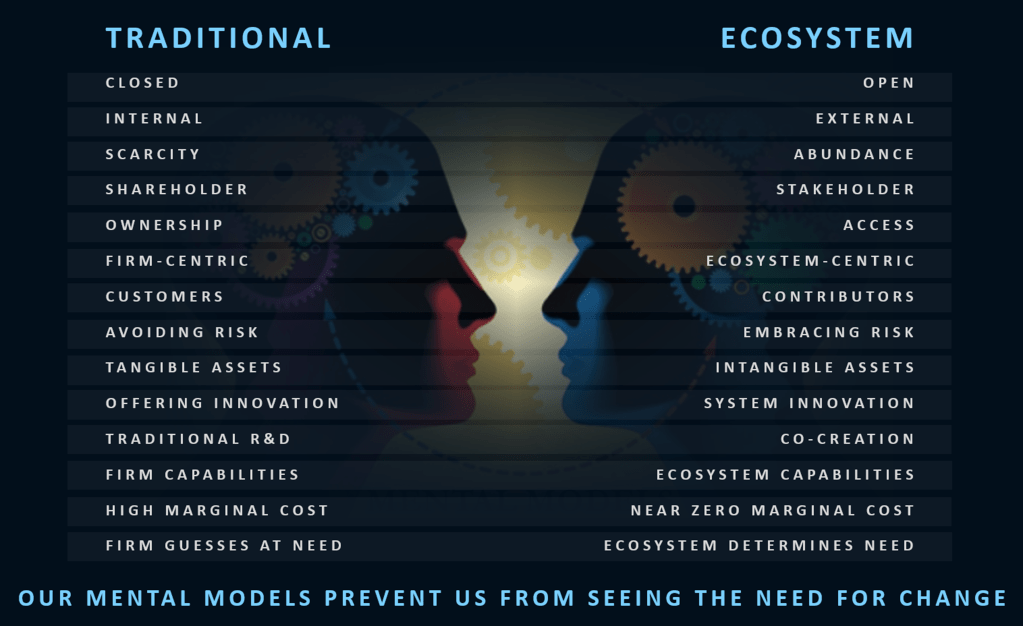
As we all become life long learners, unlearning could be our biggest challenge. Our mental models prevent us from seeing the need for change. We are creatures of the only world we have individually known. Even if you are one hundred years old, the mental models established after humanities second Tipping Point dominate your thinking. They form our intuitions and belief systems.
Monetization Strategies in Emerging Ecosystems

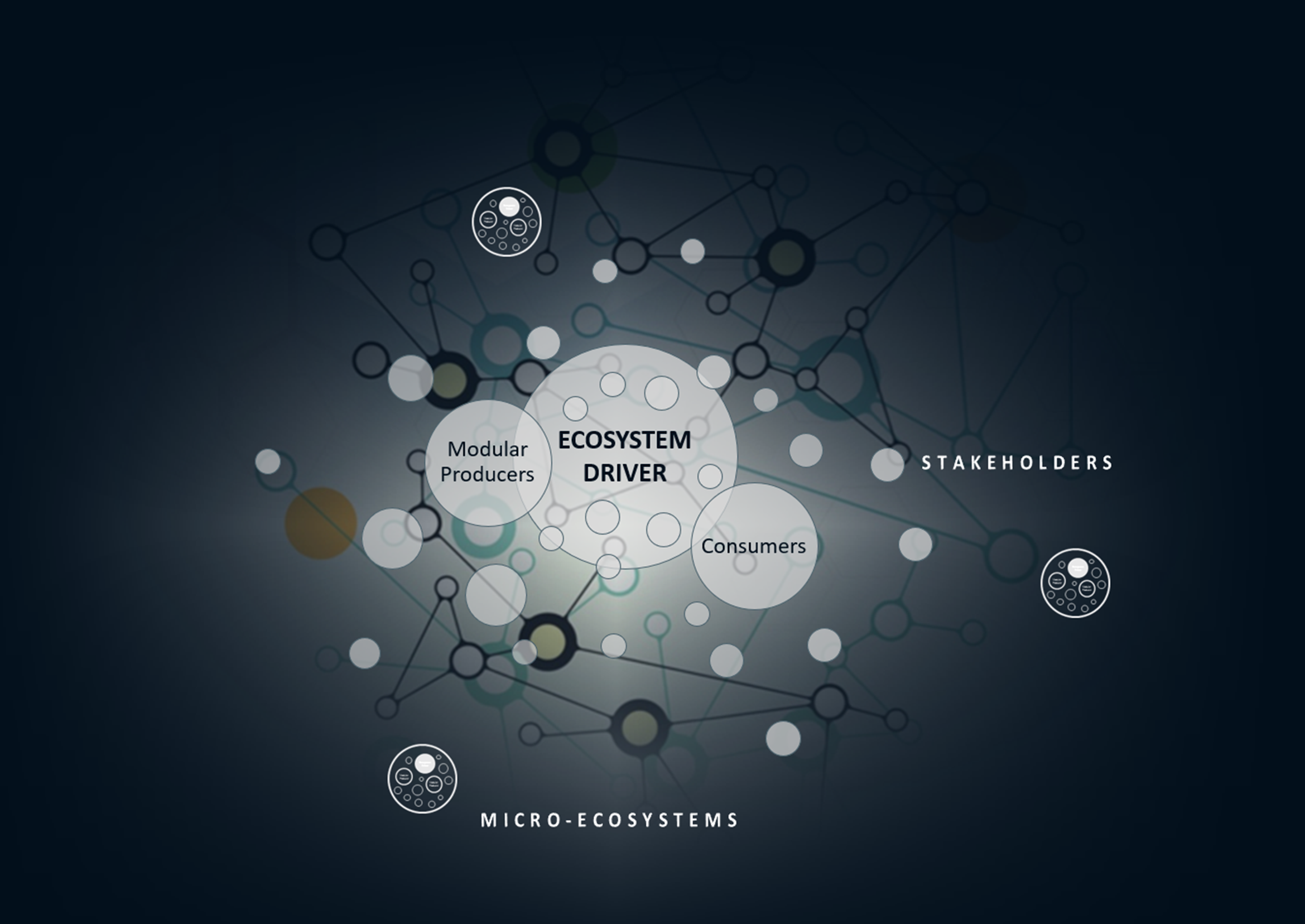
As horizontal ecosystems become the primary means of value creation and capture, organizations will embrace various monetization strategies. Given the proven growth potential of platforms (the foundation of ecosystems) and the increasing collapse of Industry boundaries, the urgency to understand ecosystem dynamics is growing. Ecosystems enable producers and consumers to interact in ways that create shared value. In many cases, stakeholders will play either role at any given time – a phenomenon some have called side switching.
The Future of AI – Predicting, Preparing, and Thriving in our Changing Future
I had the pleasure of recording a Podcast with AJ Goldstein on a wide ranging set of topics. The central theme was artificial intelligence. We took a journey to the future and explored several possible paths for artificial intelligence. AJ had the following kind words to say as he shared the Podcast in various channels:
Last month I had the opportunity to sit down with one of the world’s leading futurists, Frank Diana, to discuss the future of artificial intelligence.
Today the episode has been released, and it’s one of the most meaningful conversations I’ve had on the podcast.
Rather than provide a subjective one-sided view, with every question that I asked about the future of AI, Frank responded with presenting both sides. He helped me understand “what does the optimist say?”, “what does the pessimist say?”, “what is the utopian view?”, “what’s the dystopian view?”… and in this way it quickly became one of the most balanced conversations I’ve had the chance to be a part of.
With over 30+ years of experience to pull from, Frank provided so many fascinating lenses through which to view our changing future… all the while outlining an insightful playbook of what we can do as individuals, communities, and societies to prepare for the inevitable change that’s going to come.
AJ drove the discussion on the following topics:
- Addressing the two tipping points that have occurred thus far in humanity and changed what it means to be human– and the coming third tipping point.
- Addressing some of the common fears that people have about the implications of advanced AI and robotics on the future.
- How the shift to an automated society might cause initial elimination of jobs, but ultimately will allow more time for pursuit of creative, entrepreneurial endeavors.
- A discussion on the characteristics needed to succeed in a world of change, and what you personally should do to prepare for it.
Enjoy the show!
Are we all Designers?
Yesterday on Coffee Break with Game Changers, Bonnie D. Graham hosted a show focused on designing the future of humanity. You can listen to the rebroadcast here. The session abstract is included below. The show participants included: Bonnie, Masha Krol, Ian Gertler, Maricel Cabahug and myself.
In her opening monologue, Bonnie said:
The first impact of AI will be that more and more non-designers develop their creativity and social intelligence skills to bolster their employability – in the future, everyone will be a designer
With all the talk of AI and its potential negative impact on humanity, we lose sight of the positive. As an engine for augmentation, artificial intelligence is likely to advance our human potential. The effectiveness of what we do stands to improve – whether its creativity and design, or oriented in analytics. Some would prefer to call it “Augmented Intelligence” versus artificial intelligence. If we view the progression of AI on a spectrum, we could indeed reach the place of augmentation and never approach the other end of the spectrum. This lies at the heart of the artificial intelligence debate.

Republic 2.0 Added to Emerging Future Visual
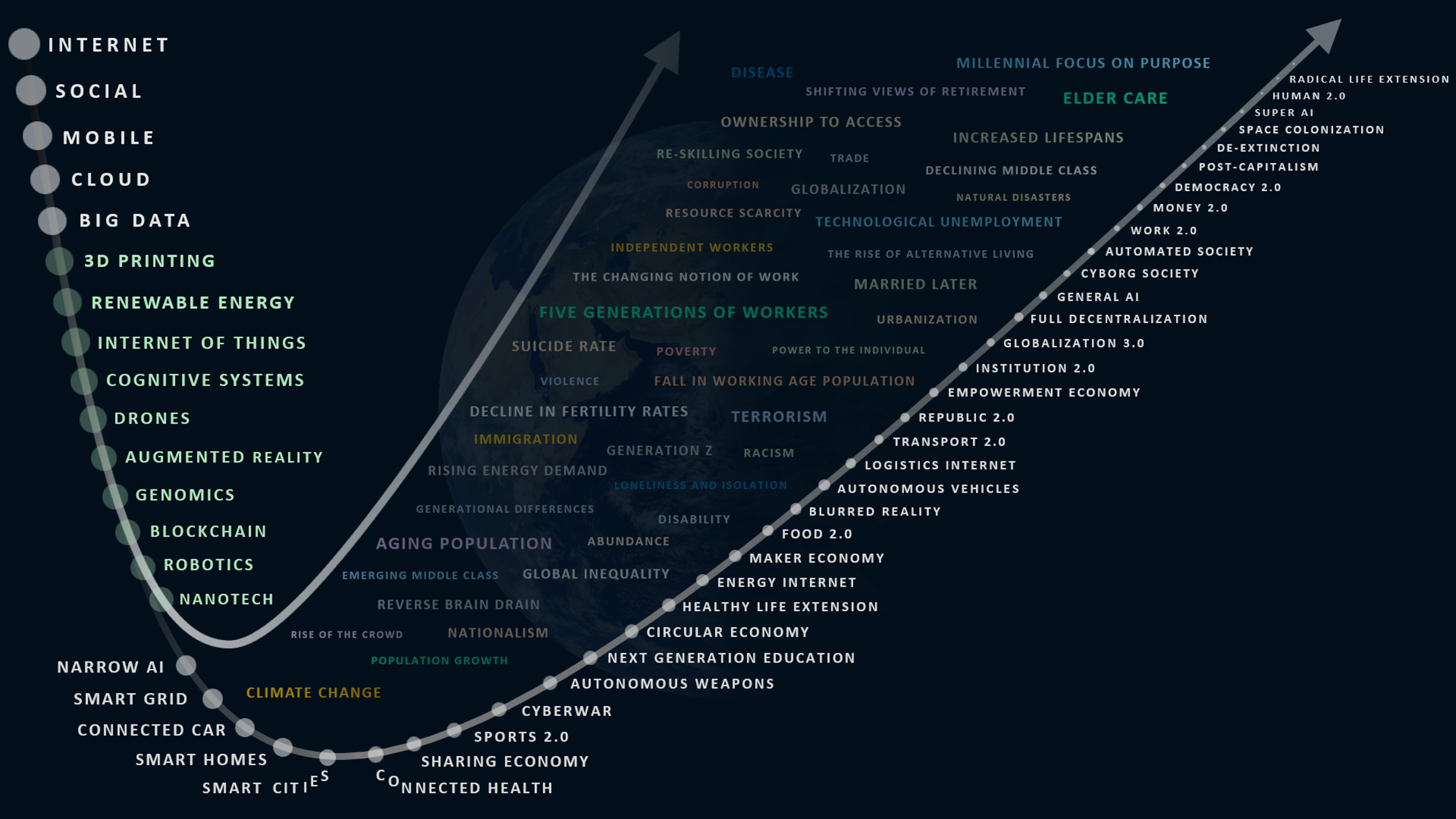
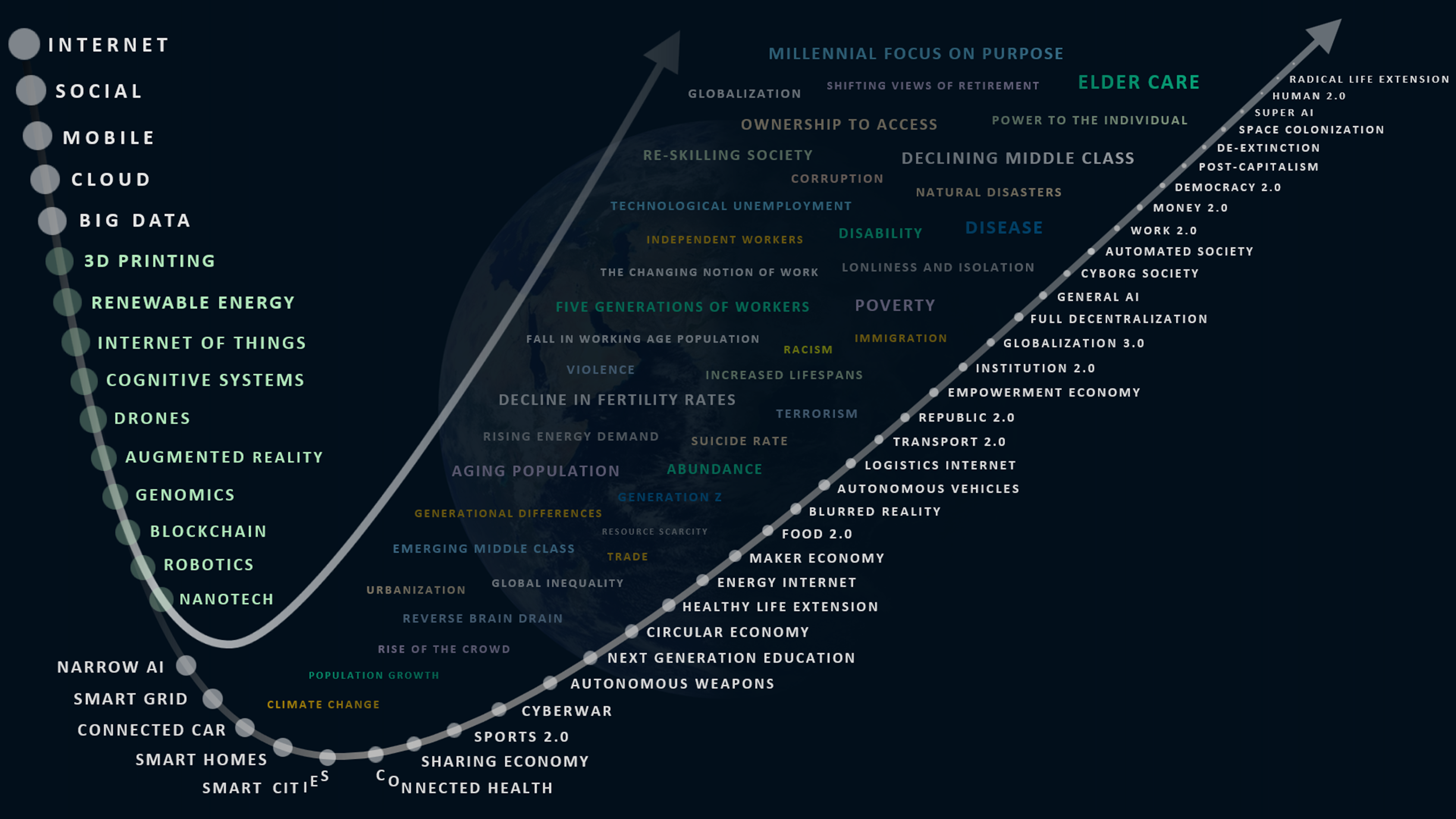
In a recent book titled The Future of Work, author Darrell M. West describes the Work 2.0 scenario on this emerging future visual. In exploring possible implications of a shifting work paradigm, he gets prescriptive about possible responses. This implication-response exercise sits at the heart of Future Thinking.
No one can predict this complex and uncertain future – but exercises like this help us see possible futures. In seeing them, we position ourselves to proactively shape them. In the context of work, Mr. West explores several possible responses, including another future scenario which he calls Republic 2.0. How this scenario plays out has a direct impact on the path of other scenarios. The scenario speaks to a new kind of politics. Mr. West states:
The Future of Work

I just added another very good book to the Book Library: The Future of Work: Robots, AI, and Automation. Author Darrell M. West looks at a world in which our current views of work change. He explores the implications to our social contract and the policy decisions so critical to revising that contract for a new era. Structural change – which Mr. West explores in the book – has long been a tenet of my work. The future of many of our institutions will either change by our proactive acknowledgement that they must change – or they will be undermined.
The conversation so nicely positioned by our author is one that must happen at all levels of leadership. This does not have to be a Utopian versus Dystopian discussion. Rather, like the major disruptive periods of our past, leaders need to lead.
Birth Rates, Workers, and Volatility
I wrote about a recent analysis conducted by Bain & Company in an earlier post on the Turbulent 2020s and what it means for the 2030 and beyond. An interesting related exchange on Twitter focused on the impact of birth rates on the core issues of demographics, automation, and growth.
Life 3.0: Being Human in the Age of Artificial Intelligence
I just added another very good book to the Book Library: Life 3.0: Being Human in the Age of Artificial Intelligence – A New York Times Best Seller. Author Max Tegmark takes a fascinating journey through possible AI futures. His physics oriented perspective provides an interesting point of view, as humanity wrestles with the ultimate path of artificial intelligence.
Mr. Tegmark tackles the discussion around how much machines will encroach on human domains, by illustrating a metaphor from Hans Moravec:
A Sixty Minute Sprint Through Our Emerging Future

I had the pleasure of keynoting the annual Hawaiian event hosted by the Independent Insurance Agents & Brokers of California. The 2018 Blue Ribbon Conference was a great four-day event that focused on many pressing issues: from employment law, to politics and robots, a broad array of challenges faces the industry.
You can view my hour long keynote via this Link. You will need to register in order to view it.
Game Changers: Designing the Future of Humanity
Today on Coffee Break with Game Changers, Bonnie D. Graham hosted a show focused on designing the future of humanity. You can listen to the rebroadcast here. The session abstract is included below, as well as a Twitter stream that provides insight into the topic and our discussion. The show participants included: Bonnie, Masha Krol, Ian Gertler, Maricel Cabahug and myself.
The Journey Continues
It’s been over a year since launching an Online Course focused on a complex and uncertain future. The course takes a Journey through the Looking Glass – a metaphorical expression that means: on the strange side, in the twilight zone, in a strange parallel world. It comes from the Alice and Wonderland literary work of Lewis Carroll, where he explores the strange and mysterious world Alice finds when she steps through a mirror. I have always found this to be a perfect metaphor for our times.
Every time the looking glass has appeared, the world has experienced a Tipping Point. While I firmly believe a tipping point is coming, the impact is likely a question of severity. Some believe that we have survived similar economic transitions in the past, while others disagree:
Supply Chain of the Future: Humans Optional?
As science and technology continue their rapid advance, traditional constructs are challenged; Supply chains are no exception. Here is a brief video that highlights many of the advances that transform how we think about supply chains in the future. As it wraps up, a curated set of videos that touch on several of these advances is provided. Special thanks to Bill Quinn, Rose Castellon-Rodriguez, and Kevin Mulcahy for producing the video.
Be sure to visit the Reimagining the Future YouTube Channel to explore additional topics.
Game Changers: Can We Teach Machines to Predict?
Today on Coffee Break with Game Changers, Bonnie D. Graham hosted a show focused on the future of prediction. You can listen to the rebroadcast here. The session abstract is included below, as well as a Twitter stream that provides insight into the topic and our discussion. The show participants included: Bonnie, Gray Scott, and myself
Episode Description
The buzz: “Those who have knowledge, don’t predict. Those who predict, don’t have knowledge.” (Lao Tzu)
Given the uncertainty, pace, and unexpected nature of today’s world, there are too many unknowns for us to effectively predict the future. Reality check: A convergence across science, technology, politics, society, economics, the environment, and growing ethics discussion, has created a complex web that requires the type of system thinking that may exceed our human capacity. Do machines hold the answer? Can they predict the path of an overwhelming number of possible futures?
The experts speak. Frank Diana, TCS: “We have a duty to think hard about what may be, so as to better prepare society for the changes that may come” (Richard Baldwin). Gray Scott, Futurist: “Prediction is not just one of the things your brain does. It is the primary function of the neo-cortex, and the foundation of intelligence” (Jeff Hawkins). Join us for Tech Magic or Hype: Can We Teach Machines to Predict?
Find out where you Stand on Artificial Intelligence
Technology is giving life the potential to flourish like never before, or to self-destruct – The Future of Life Institute.
I stumbled upon this organization while reading Life 3.0: Being Human in the Age of Artificial Intelligence by author Max Tegmark. Their mission is to catalyze and support research and initiatives for safeguarding life and developing optimistic visions of the future, including positive ways for humanity to steer its own course considering new technologies and challenges. They are a charity and outreach organization working to ensure that tomorrow’s most powerful technologies are beneficial for humanity – and the list of members is a whose who of the science and technology community.
In their view, technology is to thank for all the ways in which today is better than the stone age, and technology is likely to keep improving at an accelerating pace. From their website: with less powerful technologies such as fire, we learned to minimize risks largely by learning from mistakes. With more powerful technologies such as nuclear weapons, synthetic biology and future strong artificial intelligence, planning ahead is a better strategy than learning from mistakes.
They support research and other efforts aimed at proactively avoiding problems with a current focus on artificial intelligence. The book referenced above looks at the advance of AI and how it will impact life, exploring a broad spectrum of views on what will/should happen. Now, the organization is looking to expand the conversation to include as many voices as possible. Here is a look at the results of their Super Intelligence Survey. You can add your own voice by taking the survey here.
Higher Education in the Age of Artificial Intelligence
In a recent book titled, Robot-Proof: Higher Education in the Age of Artificial Intelligence, Northeastern University president Joseph Aoun proposes a way to educate the next generation of college students, supporting society in ways that artificial intelligence cannot. His underlying premise is that the existing model of higher education has yet to adapt to the seismic shifts rattling the foundations of the global economy – I firmly agree. It was Alvin Tofler that said: The illiterate of the 21st century will not be those that can’t read or write, but those who cannot learn, unlearn, and relearn.
Continue reading