
Last month, I wrote a piece for Time titled The Issue with Living Longer. In it, I explored a sobering reality: while global life expectancy continues to rise, the experience of those added years often falls short of what we imagine. Instead of extra time spent thriving, many people are spending those years managing chronic illness, cognitive decline, or financial instability.
Continue readingHealth
Invisible at Rush Hour
What it feels like to grow old in a society speeding past you.
The World Is Getting Older—Fast
Across the globe, populations are aging at unprecedented speed. By 2030, more than 1 in 6 people worldwide will be over 60. In countries like Japan, South Korea, Italy, and Germany, that number will be closer to 1 in 3. The dependency ratio is tipping. Pensions are under strain. Healthcare systems are overwhelmed. And in many cities, there are now more people leaving the workforce than entering it.
Continue readingThe General-Purpose Technology Evolution Framework
General purpose technologies, from the steam engine to electricity, have historically followed a predictable evolutionary path. Each GPT begins at the status quo, disrupting established ways of operating. Next, it moves to point solutions, where its application enhances specific areas without fundamentally transforming broader systems. Over time, these point solutions give way to broader applications, where the technology begins to reshape processes on a larger scale. Finally, the journey culminates in system-level change, where the technology redefines the way society, industries, and systems function as a whole.
Continue readingThe Future Of Longevity: Projected Gains In Global Life Expectancy By 2050
As the world advances in public health and medical interventions, significant increases in global life expectancy are anticipated by 2050. A recent analysis of the Global Burden of Disease (GBD) 2021 study reveals promising projections for both life expectancy and healthy life expectancy across various regions. A recent article delves into the key findings of the GBD 2021 study, examining the factors driving these changes and exploring alternative scenarios that could further impact global health outcomes.
Continue readingBridging The Global Trust Deficit: A Call For Centrist Collaboration

In today’s interconnected world, the necessity for global cooperation has never been more critical. Yet, paradoxically, we are witnessing a decline in collaborative efforts, replaced by rising competition and confrontation. A recent article via the World Economic Forum explores the growing trust deficit in international mechanisms, highlighting the challenges and opportunities of fostering centrist geopolitics. By examining historical precedents and modern examples, it offers insights into how practical, purpose-driven partnerships can restore global trust and address the compounding crises of our time.
Continue readingThe AI Revolution In Medicine
I finished reading a very timely book on the exploding topic of artificial intelligence. Two very important reasons to read this book: 1) the author’s early work with GPT-4 and 2) the focus on medicine. A dominant conversation occurring in board rooms across the world involves the critical question of generative AI and its impact on a business and/or an industry. One of the authors is Peter Lee, Corporate VP for Research and Incubations at Microsoft. He leads the company’s worldwide research labs. For the past six years, his primary focus has been on AI’s uses in healthcare and the life sciences.
Continue readingThe Expanding Possibility Space For Digital Twins
I have spent the last several months focused on all aspects of digital twins. The maturing of foundational building blocks has expanded their possibility space. Industrial applications are familiar to many, but the breadth of applications are now more visible. If we view digital twins through the lens of possibilities, we can apply them to the various challenges that continue to impact society. Using some of the UN sustainability goals as a guide, and with the help of ChatGPT via a question and answer session, let’s explore the possibilities:
Continue readingYour Future In The New Reality Of The Next Thirty Years
You will have the opportunity and the duty to create a decidedly better world. You will need to develop the wisdom to use this expansive power in advance of receiving it. Your success will decide if the future is a new age of enlightenment or darkness. Experience and maturity alone cannot provide the required wisdom fast enough. You will need to maximize your innate potential to accelerate wisdom.
Ben Lytle – The Potentialist I: Your Future in the New Reality of the Next Thirty Years
That quote is from a book I finished reading. Author Ben Lytle envisions the world of the next thirty years through the lens of human potential and opportunity, versus anxiety and fear. One of the most frequently asked questions I receive involves the human role in an increasingly automated future. The book describes what that world may look like in thirty years. With that vision in place, Mr. Lytle explores our human potential with an eye towards, skills, mindset, health, wealth, and success. The book accomplishes two very important things: it frames the forces that shape a very different future, and it describes a roadmap for us to thrive in that future. A very good read that I have added to my library.
Continue readingDigital Twins Reach A Tipping Point
I had the pleasure of joining Alan Shimel of Techstrong TV for a short Interview on digital twins. Our discussion explored the growing number of scenarios enabled by the convergence of multiple technologies. We discussed its application in the context of food and health in the short term, the Metaverse and smart cities in the medium term, and the off-planet economy in the long term. Alan does a great job with these interviews. You can explore several topics at Techstrong TV.
Innovation And Our Well-Being
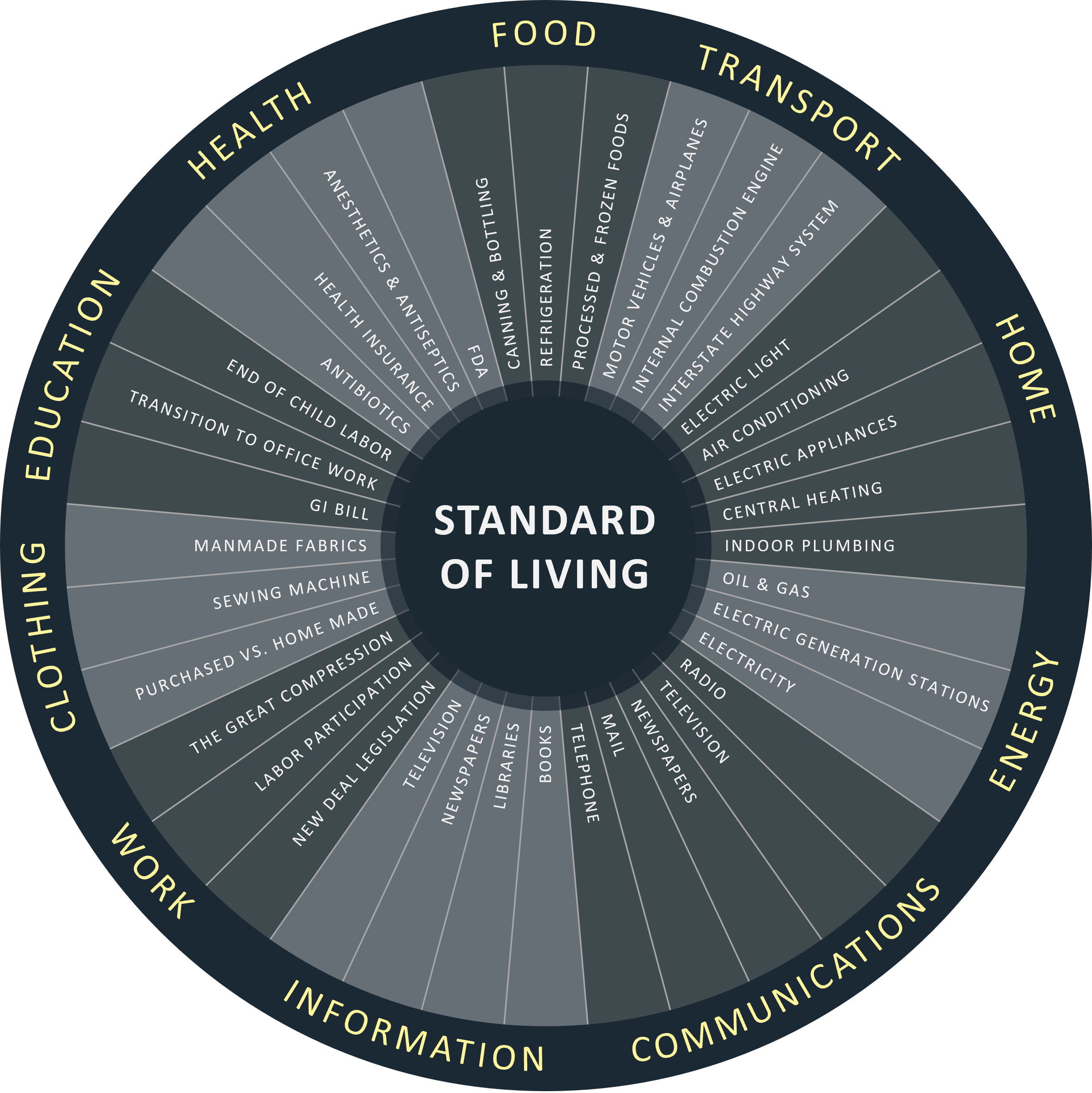
In a post from 2016, I launched an innovation wheel that captured the activity of the second industrial revolution. This activity set the standard of living that much of society enjoys today. As I mentioned in that earlier post, in a brilliant journey through the economic history of the western world, author Robert J. Gordon looks at The Rise and Fall of American Growth. The book focused on a revolutionary century that impacted the American standard of living more than any period before or after.
Continue readingHealthspan Is As Important As Lifespan
I like the way Daniel Davis described the prospects of humans living both longer and healthier lives. In his article on the topic of ageing, he points to scientific advancements that are leading to life extension. At the same time, he underscores a key tenet of the journey: healthspan is just as important as lifespan. This lies at the heart of a key future scenario identified as healthy life extension. That one scenario has many thinking about a world where people live much longer, healthier lives. Imagine a key institution like retirement. As much as we believe that our lives have always been segmented into three dominant phases (education, work, retirement), those phases represent a small portion of human history. This is an example of the institutional change that lies ahead. Now imagine a scenario referred to as radical life extension.
Continue readingInnovation Is Everywhere
My belief that human development will accelerate in the coming decade is fueled by a wave of emerging innovation both now and in the future. Our ability to invent dates back a very long time. Each new wave of invention builds upon the last, with subsequent waves accelerating on the strength of new building blocks that emerge and the growth of knowledge. We stand on the shoulders of brilliant people that came before us, and as inventors, inventions, and knowledge converged, our standard of living was elevated. No period represents this phenomenon better than the late 19th and early 20th century. It was early 2016 when I first attempted to capture the dynamics of that period visually.
Continue readingThe Journey: A World Of Ecosystems
In a continuation of my series titled “A Journey through the Looking Glass”, I will describe how convergence across multiple forces likely changes the organizing system of society. The focus of the post is on one element of this change: the way value is created and captured in the future. The post picks up from the last, where I explored the next phase of human development. The well-being discussion from that post flows naturally into a discussion about our life experiences. Those experiences will increasingly be enabled by ecosystems.
A WORLD OF ECOSYSTEMS
Yogi Berra is credited with saying that the future ain’t what it used to be. What a perfect way to describe a phase transition that completely changes the way we think about the future. In an earlier series post, I described the complexity, volatility, and uncertainty associated with envisioning possible futures. Indeed, the experimentation we often talk about in the context of innovation also applies to the future. While running for president in 1932 during the depths of the Great Depression, Franklin Roosevelt remarked:
Continue readingArtificial Intelligence May Predict Breast Cancer Risk
The best way to reduce cancer mortality is to prevent cancer from developing in the first place and accurate assessments of risk are essential
lambert leong – Artificial Intelligence Can See Breast Cancer Before It Happens
When looking at possible futures for health and wellness, healthy life extension and reducing the risk and impact of chronic diseases are at the top of the list. Amazing scientific and technological progress are leading the way. Artificial intelligence is poised to play a major role in the health and wellness future, and this recent article provides one example. The success of a deep learning study of breast cancer risk gives those involved confidence that predicting risk of late stage cancer is possible.
Continue reading2022 Prediction Season
It’s that time of year when the airwaves are filled with predictions. I launched my post on signals prior to the holidays, consciously avoiding the term prediction. Regardless of how I feel about predicting in the current environment, there are many thoughtful articles to consider. Here are several prediction articles that I have curated.
Continue readingTherapeutic Agents That Target Cancer Cells Directly
Two scenarios in our emerging future are healthy life extension and radical life extension. The former extends are healthy lives and the latter pursues immortality. At the heart of both scenarios lies astounding and rapid advances in science and technology. A recent article provides a great example while exploring the possibility of cancerous tumors eliminating themselves. Per the article, a new technology developed by University of Zurich (UZH) researchers enables the body to produce therapeutic agents on demand at the exact location where they are needed.
Continue readingFuturistic New Cities
I believe the smart city represents the intersection of multiple emerging ecosystems. Energy, transport, water, food, health, and more, could come together to create a more equitable and sustainable future. At least that’s the mission of Telosa. A recent article via Oscar Holland describes the vision of billionaire Marc Lore:
The cleanliness of Tokyo, the diversity of New York and the social services of Stockholm: Billionaire Marc Lore has outlined his vision for a 5-million-person “new city in America” and appointed a world-famous architect to design it.
Oscar Holland – Plans for $400-billion new city in the American desert unveiled
Per the article, the 150,000-acre proposal promises eco-friendly architecture, sustainable energy production and a purportedly drought-resistant water system. It embraces a “15-minute city design” that allows residents to access their workplaces, schools and amenities within a quarter-hour commute of their homes. The brief video describes the vision.
The Good Future: A Perspective Via Gerd Leonhard
We must make the right decisions now, if we want a good future
Gerd Leonhard – The Good Future is entirely possible, and it’s our choice!
That quote from fellow Futurist Gerd Leonhard comes from a recent film he produced to convey optimism about our ability to create a good future. He opens with several statements that are core to my beliefs about our emerging future. He states that what we have done for the last one hundred years is no longer going to be suitable for the future. In other words what got us here won’t get us there. It was back in 2013 when I wrote about the structural change expected in the future. Much like my belief that structures and institutions will change, Gerd believes that the current system is unfit for the future, driving the need for a different logic. He mentions something that he has been saying for years: science fiction is becoming science fact. In exploring the possibilities of a good future, he starts with a question: what does good look like? He proposes a definition of good that includes relationships, experiences, the planet, purpose, and prosperity.
Continue readingThe Probability Of Living Past 110 Is On The Rise
I posed this question in 2018 in a post on healthy life extension: Has the first person to live to 200 already been born? I ask that question in various forums to provide a good example of how one scenario can challenge current institutions and traditional thinking. In that earlier post, Johnty Andersen, had this perspective on that question:
Continue readingWhat Does A Recent Trend Study Tells Us About The Future?
Each year the Future Today Institute releases a very comprehensive trend study during SXSW. I just finished getting through this very comprehensive installment. In announcing this year’s report, Founder Amy Webb had this to say:
The cataclysmic events of the past year resulted in a significant number of new signals. As a result, we’ve analyzed nearly 500 tech and science trends across multiple industry sectors. Rather than squeezing the trends into one enormous tome as we usually do, we are instead publishing 12 separate reports with trends grouped by subject. We are including what we’ve called Book Zero, which shows how we did our work. There is also an enormous, 504-page PDF with all content grouped together as one document.
Well, Amy was not kidding, there is quite a bit to digest. The 12 separate reports referenced can be downloaded Here. As I do with each look into the future, I captured some highlights from this year’s trend study. I will start however with an important observation that Amy made in the opening of the report.
Continue reading Reimagining the Future