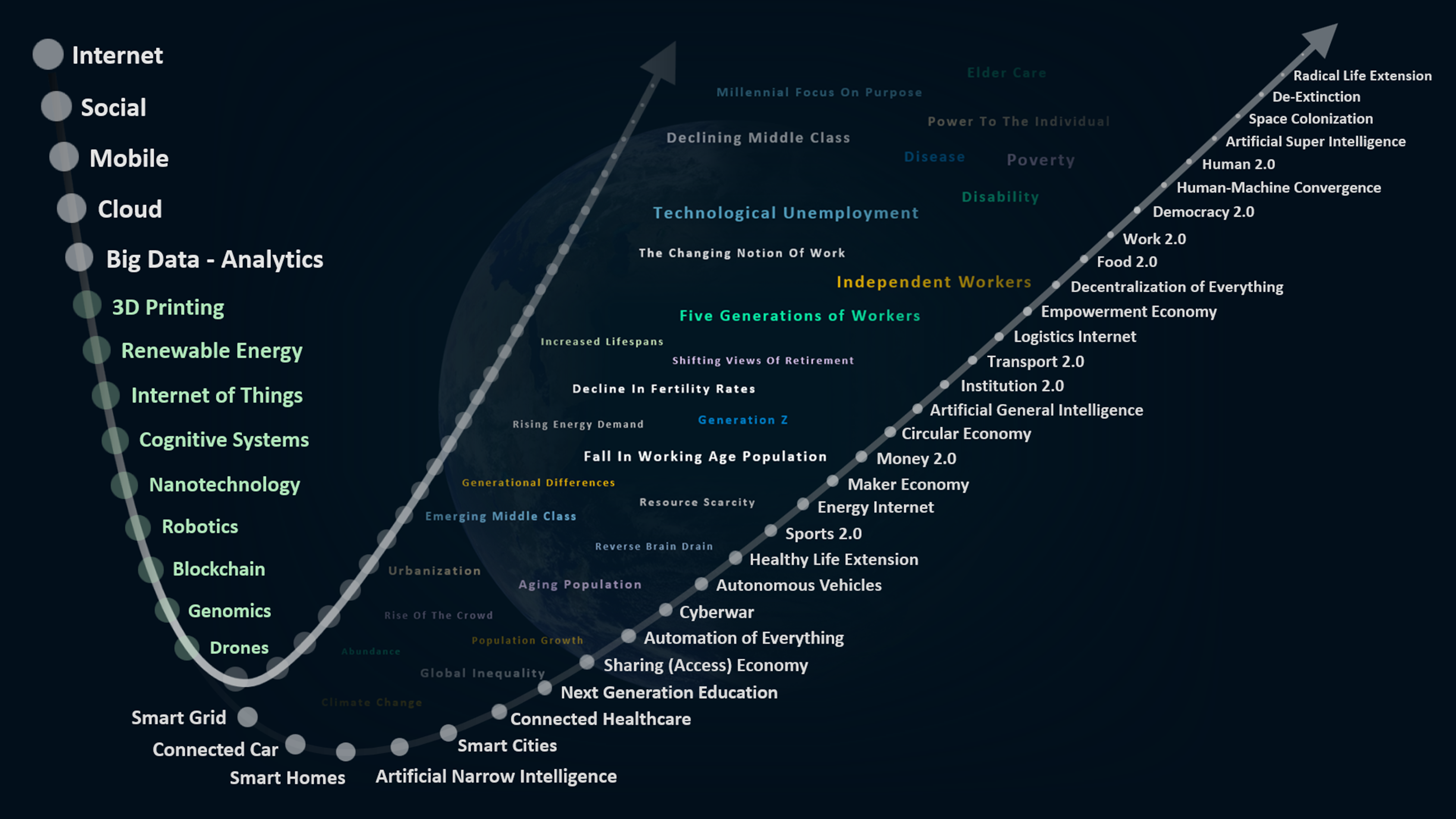
A key message in the Reimagining the Future body of work is that our growing digital world challenges every aspect of how we do business, how we govern and how we live. It will drive significant strategic, tactical and structural changes and fundamentally alter our long-standing beliefs, success strategies and institutional constructs. We’re already seeing it. Just look at companies like Amazon, Uber, Airbnb, Tencent, Google, Alibaba and Facebook. They are rewriting the rules and redefining how value is created and captured, using digitally-centered platforms and ecosystem-enabled business models.
Shaping the Fourth Industrial Revolution

In a new book titled Shaping the Fourth Industrial Revolution, Klaus Schwab explores a future shaped by scientific and technological advances. The book builds on his earlier work where he describes the emerging Fourth Industrial Revolution. In this latest work, the author describes how rapid advancement in science and technology promise to disrupt the digital systems of our day, creating entirely new sources of value. He touches on a key point that I have articulated in my anchor visual; that the digital technologies that organizations are struggling to make sense of today, turn into the core infrastructure that business models will take for granted tomorrow. Said another way; digital is the foundation for the innovation that is emerging.
The Future of Energy on Game Changers Radio
Today on Coffee Break with Game Changers, Bonnie D. Graham hosted a show focused on the future of energy. You can listen to the rebroadcast here. The session abstract is included below, as well as a Twitter stream that provides insight into the topic and our discussion. The show participants included: Bonnie, Gray Scott, Tom Franklin, and myself. You can take a deeper dive on the topic via this Discussion with David Cohen.
Show Abstract
The Energy Internet is positioned to transform our lives – perhaps on a larger scale than the Internet before it. This dynamic, distributed, and multi-participant Enernet – as some are calling it – is built around clean energy generation, storage and delivery. With a long list of innovators emerging, the resulting innovation will drive massive change, including how we think about cities, municipal services, transportation, insurance, real estate, financial services, and more.
YouTube Channel Launch
The journey to the future is gaining more attention for both the opportunity it presents, and the fear of unintended consequences. Dialog and proactive action are critical to shaping this emerging future in human-centric ways – a story line that is nicely articulated in a new book titled Shaping the Fourth Industrial Revolution. I am a firm believer that shaping the future requires a different mindset. As stated in the book, we must all adopt a zoom-in and zoom-out strategy: zooming in to acquire an understanding of the characteristics and potential disruptions of specific advances in science and technology; and zoom out to see the patterns and combinations that emerge.
The Rise of Ecosystems
When I first launched my Blog in 2010, it was titled Blurring the Boundaries. It was growing ever clearer that the lines between physical and digital, industries, business and IT, you name it, the lines were blurring. It was evident that our growing digital world would drive significant structural change. These new era structures would fundamentally alter our belief in long standing institutions like management, policy, process, procedure, legal frameworks, accounting principles, organization structure, business and operating models, governance, regulations, institutions, and the core characteristics of new era organizations. In essence, The Collapse of Traditional Structures will lead to a Third Tipping Point in Human History.
One of the most profound changes will be the dissolving of industry boundaries and the emergence of ecosystems. Our industry construct – born during revolutions that set the standard of living in the western world – will give way to a finite set of horizontal ecosystems. This visual depicts a perspective on an ultimate finite set of nine ecosystems.
Future Capability Profile

This recent Article describes how Sergey Brin and Larry Page founded Google on the conviction that STEM expertise was the dominant piece of the capability profile – setting its hiring algorithms to look for computer science students with top grades from elite science universities. In 2013, they decided to test this hypothesis by analyzing the hiring, firing, and promotion data accumulated since their incorporation in 1998.
Early 2018 Reading List
Update January 22nd: I am adding a book just released to this short list – Shaping the Fourth Industrial Revolution
I’m often asked for book recommendations that aid with future thinking exercises. A good source in 2018 for this type of exercise is Fast Future Publishing, whose goal is to profile the latest thinking of established and emerging futurists, foresight researchers and future thinkers from around the world, and to make that thinking accessible to the widest possible audience. Their innovative publishing model bypasses most traditional publishing channels and accelerates time to market. Two books that I’d recommend for early 2018 are described below, and a new book due out in the spring is also included.
Tipping Points in Human History
I’ve been talking lately about the two main tipping points in human history: from hunter-gatherer to agriculture, and agriculture to our industrial society. That second tipping point beginning about 1760 ushered in three revolutions. The First Industrial Revolution saw the rise of iron and textile industries and the mechanization of production through the use of water and the steam engine. This second tipping point saw a reduction in physical labor and a shift in where new forms of labor were required. The Second Industrial Revolution started in 1870, riding advances such as electricity, telephone and the internal combustion engine to drive rapid industrialization and globalization. A massive disruption followed, as established sectors were eliminated and new ones emerged.
Social Robots
In this last segment from the Health Summit in D.C., I responded to a question regarding loneliness, isolation and the policies that might help address this societal issue. Is it strictly a policy question? Like everything else in this exponential world, are building blocks emerging to address such issues in different ways? Like say, social robots?
Can Society Adapt to an Accelerating Pace of Change?
Updated December 15, 2017
Thanks to Parthasarathi V for his thought provoking comment on LinkedIn, and a link to a relevant article from Clay Shirky on the Collapse of Complex Business Models. His comment:
“We are having super abundance of everything – capital, talent, resources. The previously known scarce resources (e.g physical world scarcity, natural resources) are also abundant now thanks to technology. With every abundance there will be new scarcity that will be the point of friction. With every node of regulation we remove to promote innovation, new set of problems will emerge that needs to be regulated otherwise system will collapse.”
Harness All Possibilities
I had the pleasure of presenting at a recent function sponsored by Harness All Possibilities (HAP). The organization Founder – Rhonda Eldridge – has embarked on the following mission:
The fast pace of innovation, technology, geopolitics, socio-economics and demographic factors is driving disruption in industry – for both the employer and the employee. HAP’s purpose is to build a sense of connectedness while you embrace a transformational shift of your awareness and skill sets to prepare for 21st century engagement.
An Uncertain Future
I have used this Emerging Future visual to demonstrate the overwhelming number of combinations that will conspire to create our future. The science and technology foundation converges with societal, political, economic, and environmental forces to build towards a very uncertain future. A future that I believe represents the third massive tipping point in human history.
This very short animated video describes the visual.
Will a Robot Take your Job?
In a recent article, Kevin Drum makes a compelling argument that You Will Lose Your Job to a Robot—and Sooner Than You Think. The piece is a little long, but this is a must read for everyone. At the heart of his argument lies the exponential progression of artificial intelligence (AI). Using the human brain as a barometer, AI will reach one tenth the power of the human brain by 2035. By 2045, we will have full human level AI.
Strategy and Multiple Futures
I recently engaged with fellow futurists on an article for Digitalist Magazine titled Why Strategic Plans Need Multiple Futures. I think the authors truly captured the challenges of strategic planning in a world where pace and the sheer volume of change makes our emerging future anything but predictable. The focus on story telling as the most effective way to communicate potential futures is powerful, and the Lowe’s example really brings that point home. I recommend this articles to leaders everywhere. Here is a powerful quote:
“Companies like Lowe’s are realizing that standard ways of planning for the future won’t get them where they need to go. The problem with traditional strategic planning is that the approach, which dates back to the 1950s and has remained largely unchanged since then, is based on the company’s existing mission, resources, core competencies, and competitors.
Yet the future rarely looks like the past. What’s more, digital technology is now driving change at exponential rates. Companies must be able to analyze and assess the potential impacts of the many variables at play, determine the possible futures they want to pursue, and develop the agility to pivot as conditions change along the way.”
Virtuous Cycles Accelerate Pace
In segment five of my interview with Chunka Mui, we discussed virtuous cycles and their ability to accelerate the pace of science, technology, and emerging future scenarios. Mr. Mui uses the driverless car to demonstrate the impact of these cycles, and the impact they have on emerging scenarios. In a Future Thinking context, analysis of these cycles must be part of our Rehearsing, or we will misjudge their timing and short term implications.
Chunka Mui is the managing director of the Devil’s Advocate Group, a consulting team that helps organizations design and stress test their innovation strategies. Mr. Mui published a popular book titled The New Killer Apps.
Segment five is a quick three minute video.
Is Creativity the Sole Domain of Humans?
The transition from our current industrial/information age to an augmented and then ultimately an automated society is underway. The role of humans in that society is an often discussed topic, where our right brain characteristics are likely to play a more dominant role. But are those characteristics the sole domain of humans?
Meet an Artificial Intelligence Virtual Artist called AIVA that was taught to compose classical music – an emotional art which is usually considered to be a uniquely human quality. Musical pieces composed by this AI are used as soundtracks for film directors, advertising agencies, and even game studios. Oh, and it released its first album called Genesis.
Life, Health, and Longevity
Healthy life extension is a future scenario depicted on this emerging future visual. In this era of genomics, precision medicine, and rejuvenation biotechnology, extending our healthy lives is not only possible, but likely. It is believed in some circles that the first person to live to 200 may have already been born. This animated video was developed to support a recent event on the topic of life and health. It closes with a quick glimpse of TCS capability via a next generation sequencing facility and an analytics platform for genomics and metagenomics.
A Dialog with The Center of Digital Intelligence
I had the pleasure of doing a video interview with Kevin Benedict today, where we discussed a number of topics, including the recent book Machine, Platform, Crowd: Harnessing Our Digital Future. Kevin is from the The Center of Digital Intelligence. Our wide ranging discussion can be viewed here.
Machines, Platforms, and Crowds
Andrew McAfee and Erik Brynjolfsson – Authors of The Second Machine Age – wrote a new book which they launched in the middle of this year. Machine, Platform, Crowd: Harnessing Our Digital Future builds upon their first book, exploring three big trends that are reshaping the business world:
- The rapidly increasing and expanding capabilities of machines
- The large and influential young companies (Platforms) that bear little resemblance to the established incumbents in their industries, yet are deeply disrupting them
- The emergence of the crowd: the large amount of human knowledge, expertise, and enthusiasm distributed all over the world and now available
Taxing Robots
In this recent Article, Futurist Rohit Talwar explores the issue of robot taxes and long term unemployment. Although long, I recommend reading the entire article, but I captured some key points from the article below.
 Reimagining the Future