
My previous post launched a series that will tell the full story of my reimagined future. Described as a journey through the looking glass, the story began with a description of the series title and a look backward in time. This second post in the series will add to that historical perspective. Each subsequent post will feature a piece of our journey.
Continue readingArtificial Intelligence May Predict Breast Cancer Risk
The best way to reduce cancer mortality is to prevent cancer from developing in the first place and accurate assessments of risk are essential
lambert leong – Artificial Intelligence Can See Breast Cancer Before It Happens
When looking at possible futures for health and wellness, healthy life extension and reducing the risk and impact of chronic diseases are at the top of the list. Amazing scientific and technological progress are leading the way. Artificial intelligence is poised to play a major role in the health and wellness future, and this recent article provides one example. The success of a deep learning study of breast cancer risk gives those involved confidence that predicting risk of late stage cancer is possible.
Continue readingAn Automated Society
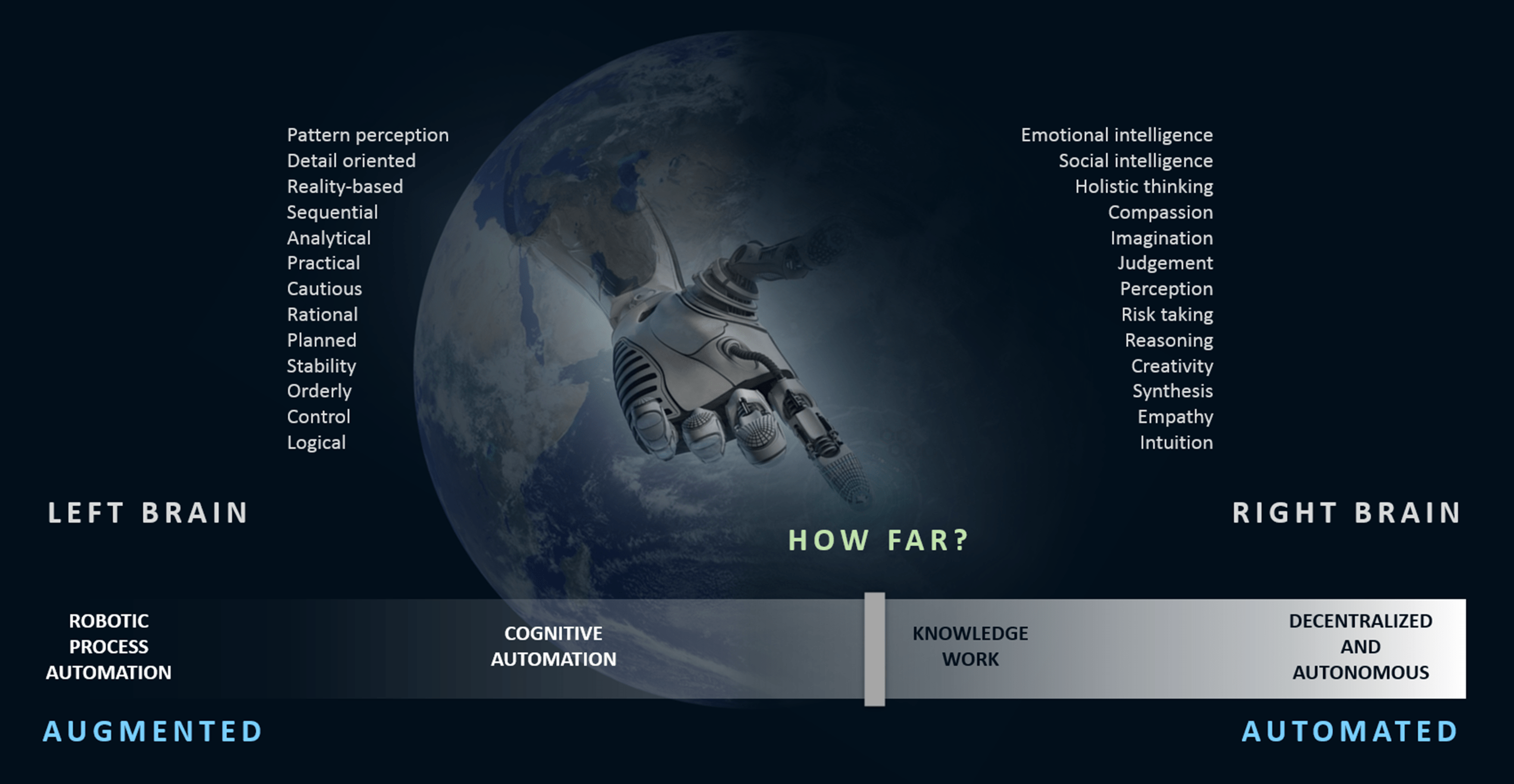
In a post from 2018, I explored the automation of everything. The open question I posed was: how far will automation go? In the four years since that post, signals have emerged that illuminate the possibilities.
Continue readingSignals From The Past
When I finished a recent book by Alec Ross titled The Raging 2020s, I spent time reflecting on the various signals captured in the book and what they might mean for the future. I wrote about both the book and the signals in early January. My team at TCS then produced this short video to capture the message. I have long believed that history can be very instructive – and these 19 signals could be just that. A special thank you to Kevin Mulcahy, April Harris, and Adam Boostrom for their efforts on the video.
De-extinction: Resurrecting Species That Have Died
Continue readingDe-extinction is the process of generating an organism that either resembles or is an extinct species. There are several ways to carry out the process of de-extinction. Cloning is the most widely proposed method, although genome editing and selective breeding have also been considered.
Wikipedia
The Purpose-Driven Corporation
I’ve had the pleasure of facilitating a CEO roundtable each of the last four years at the CEO of the year gala sponsored by Chief Executive Group. The 2021 winner was Merck’s Ken Frazier. This year, the roundtable explored the growing shift towards purpose. Specifically, the roundtable Topic was: “Purpose-driven: Implications for Strategy and Cross-Industry Collaboration”.
Continue readingEcosystem Business Strategy
I recently added a book to my library titled Winning the Right Game. I then had the pleasure of talking to the book’s author, Dr. Ron Adner. He was gracious enough to sit for an interview, which you can view below. This ecosystem topic is growing in importance, but success in a growing ecosystem world is not easy. Dr. Adner provides his thoughts on what it takes to succeed. Anyone exploring ecosystem business strategies will benefit from his advice.
Realizing Value On The Path To Artificial Intelligence
While debates about the long-term implications of Artificial Intelligence (AI) are likely to rage on, AI itself is not waiting for answers.
Continue readingWith AI and ML becoming ubiquitous across industries, it has the same potential to refactor the Fortune 500 as the internet has had over the past several decades
The Machine – making sense of AI
Geopolitical Forecasting
The growing convergence story promises to alter our view of possible futures. There are a number of likely shifts that make Geopolitics a critical piece of the story. These shifts add to the high degree of uncertainty reflected in the current environment. In light of this, evaluating geopolitical implications and their influence on the future is growing in importance. But how? I just finished a book titled Geopolitical Alpha that offers a perspective on how to improve forecast accuracy in the geopolitical domain.
Continue readingThe era of geopolitical ignorance is over. The days when investors and corporate decision-makers could be successful without much understanding of politics will be a footnote in the annals of history.
Marko Papic – Geopolitical Alpha
Non-Fungible Tokens
The hype surrounding non-fungible tokens (NFTs) is reaching a fever pitch. A recent article describes NFTs as data added to a file that creates a unique signature. It can be an image file, a song, a tweet, a text posted on a website, a physical item, and various other digital formats. Another article explores NFTs from the perspective of value.
Continue readingCentral Bank Digital Currency
With the publishing of a highly anticipated report on US central bank digital currency (CDBC) last Thursday, CDBC’s will likely get more media coverage. A CBDC would serve as a purely digital version of cash that’s backed by the Fed and just as available to the public as physical cash. This recent article describes both the pros and cons of a CDBC. One big pro is that a CBDC could bring safe, fast, and accessible payments. An example of a con is:
Continue readingWeb3
The current buzz surrounding Web3 represents the convergence of multiple domains. In the past, Web 3.0 represented the semantic web, which focused on making Internet data machine-readable. Web3 has moved to a broader place, including the Metaverse and decentralization. The metaverse is described by Wikipedia as a network of 3D virtual worlds focused on social connection. The metaverse itself is a huge buzzword these days, but its origins date back to Author Neil Stephenson when he coined the term in Snow Crash, a dystopian cyberpunk novel published in 1992. In the novel, the metaverse is described as a 3D shared virtual world – a whole universe of shared virtual spaces seemingly linked together with an ability to teleport between them. Games like Minecraft and Fortnite are close to the vision that he foresaw. You can explore more on the metaverse here.
Continue readingThe Third Age Of Aviation
Their electric plane achieved a top speed of 55.9 kilometers per hour on November 16, 2021. The plane also broke the record for the fastest time to climb to 3000 meters (202 seconds) as well as maintaining a record speed of 532 kilometers per hour for over 15 kilometers. What’s more, during those runs, the Spirit of Innovation clocked a top speed of 623 kilometers per hour.
Mark Jessen – on the Rolls-Royce all-electric aircraft
A recent article describes the record-breaking achievements of an all-electric aircraft developed by Rolls-Royce. The first video is a very short view into this program. The second provides a deep look into the future of aviation.
Continue readingAI 2022: Creativity, Ubiquity, and Public Policy
How far will artificial intelligence (AI) go? In a post earlier this week, I asked for the reader’s perspective on that question. The poll from that post is included here – please contribute your thoughts. In the nearer term, a recent article provides perspective on AI trends in 2022. Three key areas are addressed: creativity, ubiquity, and public policy. I have shown several examples of AI encroaching upon areas of human creativity. The article provides examples that mark a shift in the creative abilities of AI.
Continue readingThe Driverless Race
As the world pursues new mobility solutions, innovative new business models emerge. It is easy to lose faith in a given innovation. The slower than expected rise of autonomous driving is a case in point. But innovation does not stop at the technology level. The video below is a great example that blends autonomous technology with remote operations and a human driver. This remote piece of the model will play out in many scenarios as a stepping stone towards full autonomy. In this example, a remote operator gets the car to the rider, who drives from there. Once arriving at the destination, the remote operator takes over from there. This is similar to the path of autonomous trucking. These niche scenarios accelerate the path towards full autonomy.
The Economy Is A Critical Area Of Convergence
Much is said about the critical role that science and technology play in shaping the future. This area of convergence continues to have a profound impact on that future. I have described the importance of convergence in various posts in the past, highlighting the impact of other domains like geopolitics, philosophy, and society. Another key domain is the economy. Understanding the global economy is critical to illuminating possible futures. The role of Central Banks has been instrumental in navigating extreme events like COVID-19, as well as the various boom and bust financial cycles of the past.
Continue readingHow Artificial Intelligence Will Transform Everything
In 2015, best-selling author Martin Ford gave us Rise of the Robots: Technology and the Threat of a Jobless Future. In the fall of 2021, he followed that up with Rule of the Robots: How Artificial Intelligence (AI) Will Transform Everything. In his recent book, he explores various aspects of artificial intelligence – both positive and negative. He likens AI to electricity, perhaps the greatest general-purpose technology the world has ever known. A general-purpose technology is pervasive, improving over time, and able to spawn new innovations. In the Second Machine Age, the authors describe this phenomenon as a common element of each industrial revolution, including steam (First), electricity, Telephone, and internal combustion engine (second), and Internet (third).
We can go all the way back to fire to witness the impact of these pervasive innovations. In an article from July of 2021, Sundar Pichai, the chief executive of Google’s owner Alphabet, said that he believes artificial intelligence (AI) will eventually have a bigger impact than fire, electricity, and the Internet. This poll from my post on the topic explored the reaction to that belief. Fifty-eight percent of respondents agreed with him. Please take the poll and lend your voice to the conversation.
Continue readingSpace – The Final Frontier
Hypersonic airlines? Is that a byproduct of our focus on space technology? Could I fly from New York to London in 30 minutes? Space is a great example of the broad ecosystems that form around a given domain. It also illuminates the convergence associated with them. For example, space intersects with domains like Internet, communications, GPS, and Intelligence, via satellites, resources, via space mining, energy, via solar panels closer to the sun, as well as wireless energy transmission, travel, via hypersonic flight, tourism, shelter, via space habitats, and military, via space forces. There are other areas of intersection, and each area underscores the growing importance of ecosystems.
Continue readingWinning The Right Game
My belief in a shifting organizing system dates back several years. The work of leading think tank RethinkX effectively highlights why. History tells us that a collapse is inevitable when the existing system can no longer adapt fast enough to order-of-magnitude improvement in technological capabilities. When this condition is present, a new organizing system is required. RethinkX defines an organizing system as:
Continue reading Reimagining the Future