
In January, I launched a poll that represented a form of rehearsing the future. Rehearsing versus predicting allows us to envision possible futures. Complex adaptive systems contain multiple intersecting building blocks behaving and interacting in ways that make prediction impossible. Although we can’t predict, we can inform our rehearsing with an ever-expanding amount of insight and foresight. In addition, technology now enables us to continuously probe and learn. Learning our way forward through continuous learning loops enables rehearsing. To that end, the poll looked ahead and asked if people believed that artificial intelligence would ultimately be more impactful than fire, electricity, or the Internet. The results were fascinating.
Continue readingImmigration By Country
Immigration continues to be a hot button issue in our polarized society. I shared a book back in 2020 that explored the reasons for this polarization. The book identified several societal changes that contribute to this alarming trend. A recent article provides a glimpse into the societal challenge of immigration, providing this visual that identifies the immigration make-up of countries. The article states that there were 272 million immigrants in 2020, amounting to 3.5% of the global population.
Continue readingThe History Of Energy Transitions
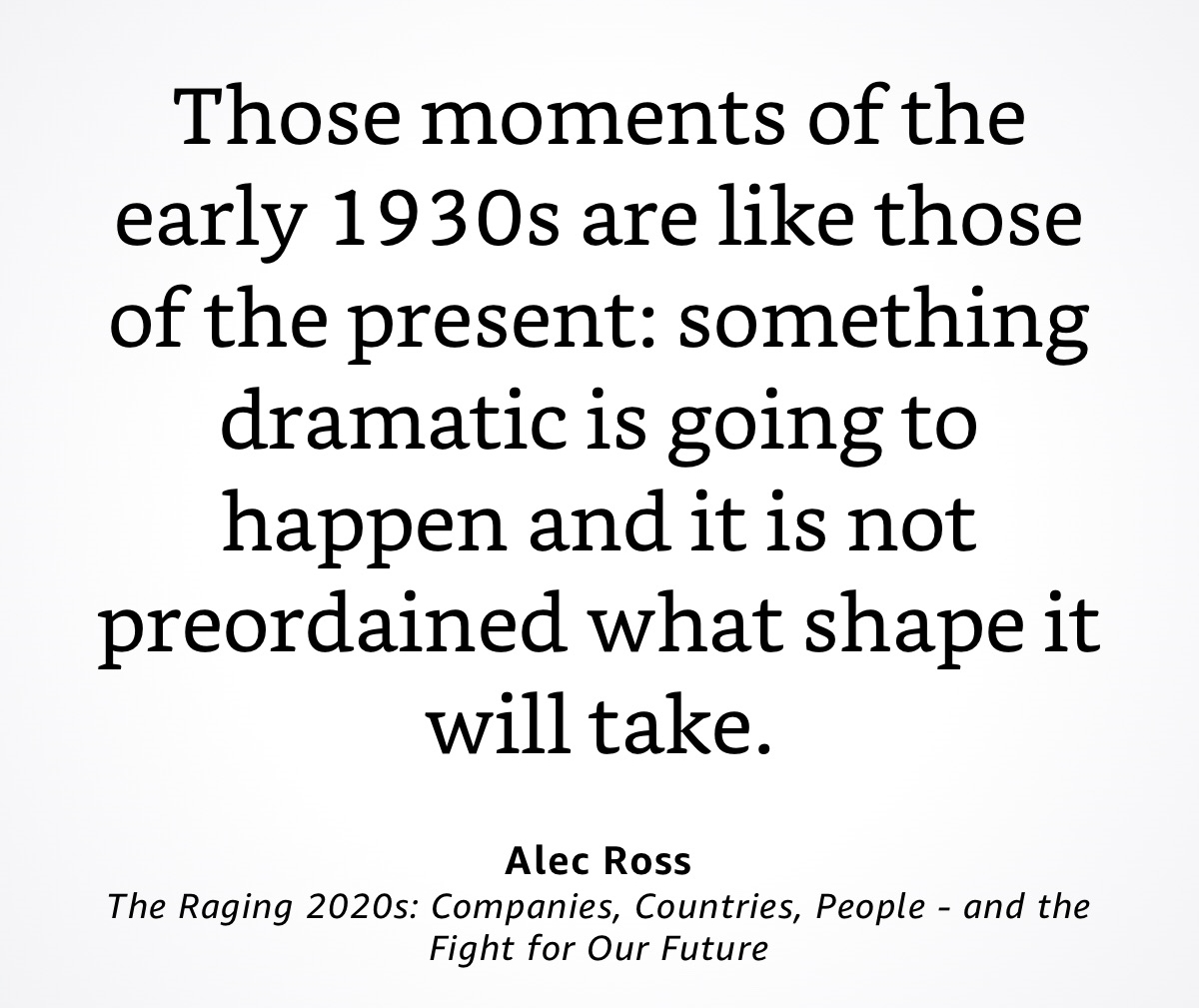
Energy transitions throughout history have ushered in times of dramatic change. While energy may be the biggest piece of this emerging story, it is part of a bigger narrative in what increasingly looks like a phase transition. That notion of dramatic change is echoed by several prominent sources. For example, Alec Ross in his recent book The Raging 2020s speaks of a world that resembles the 1930s, a growing sentiment that maps to my research on the period beginning in 1920.
As the visual below illustrates, that 1930 date aligns with the energy transition. That period began the long transition towards our current fossil fuel era – representing a major transitory period for the world. This recent article reflects on the history of energy transitions and the drastic change in our sources of energy over the last 200 years.
Continue readingThe Genesis Machine
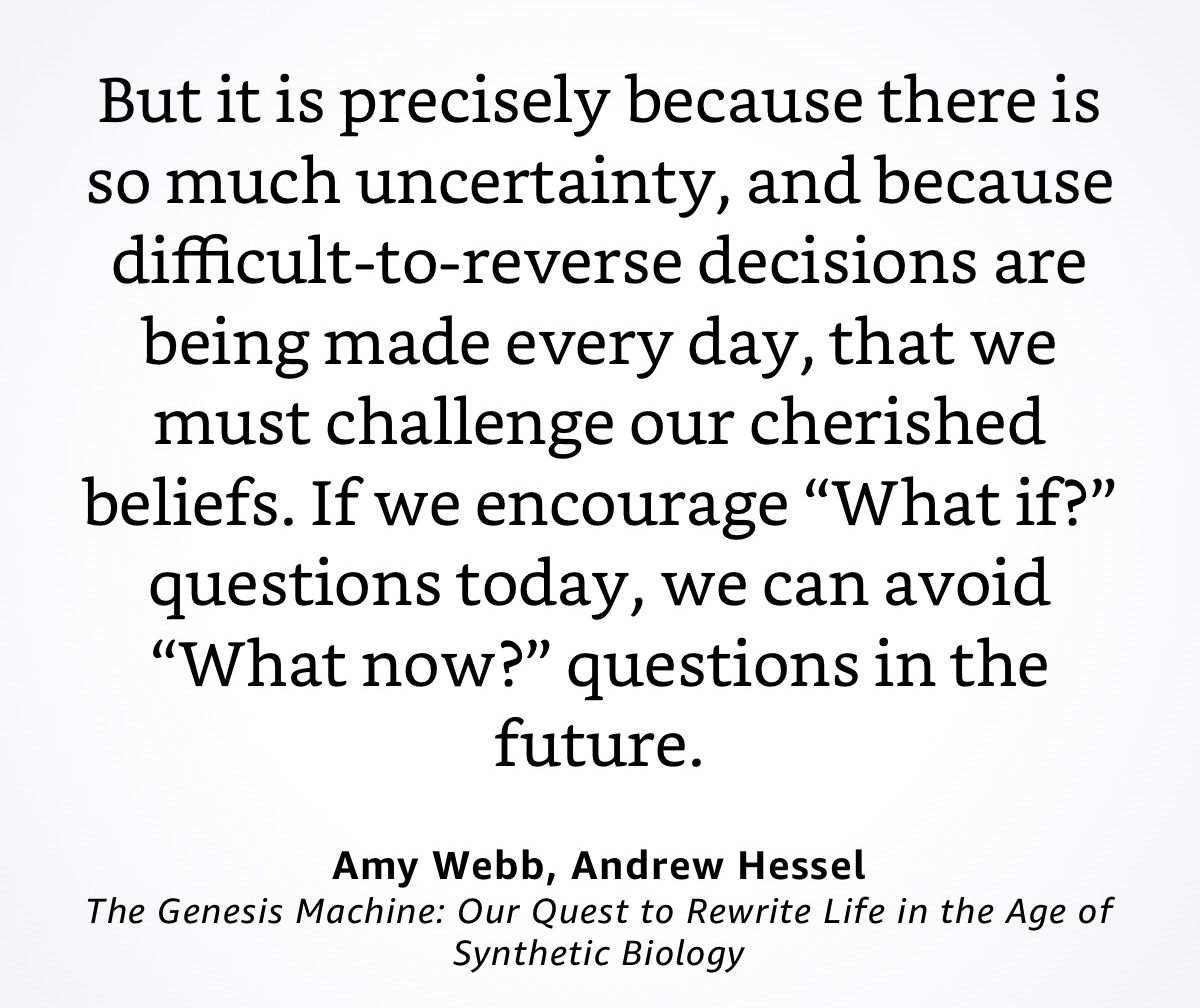
I just finished reading my latest book titled The Genesis Machine, in which authors Amy Webb and Andrew Hessel explore the world of synthetic biology. Although not as widely discussed as AI, Blockchain and others, it is perhaps the best example of why the future may look very different than the past. I have argued that the world is in the early stages of a phase transition. The content of the book represents a clear reason why.
The authors provide a riveting look into the world of synthetic biology. The book focuses initially on its origins, shifts to the here and now, and then pivots to a glimpse of the future. They provide several scenarios that help the reader envision that future, and in so doing, allow us to see both the potential for human development, as well as the possibility of several destructive paths. The book closes with a discussion on our way forward. As a world-renowned Futurist, Amy knows how to tell a story, and it is through storytelling that individuals can see the possibilities along both paths. The authors define synthetic biology as:
Continue readingDisrupting The Way We Travel
Put bluntly: The infrastructure we have in one era isn’t the infrastructure we’ll need in the next.
Devin Liddell – A futurist predicts the 3 biggest disruptions to how we’ll travel
That quote from a recent article can be applied to anything. For example, the institutions created in one era are not suited for the next. In the article, Futurist Devin Liddell looks at what he believes are the three biggest disruptions coming to travel. He begins by looking at the transformative changes existing infrastructure will struggle to support. First, as mentioned in an earlier post on urbanization, seventy percent of the human population is projected to live in cities by 2050. Second, climate change is poised to wreak havoc on cities, ninety percent of which are coastal. Lastly, the phenomenon of blurring boundaries takes the world of physical infrastructure and merges it with the digital domain.
Continue readingUrbanization And The Rise Of Megacities
By 2050 it’s predicted that 68% of the world’s population will live in a major city — that’s 2 in 3 people. According to this recent article, less than 10% of people lived in urban areas in 1800. Today, more than 4.3 billion people or 55% of the world’s population live in urban settings.
This macro-level societal force will converge with forces from other domains to shape an uncertain future. One such domain is technology, where the rise of smart cities will coincide with the rise of megacities. What is a megacity?
Continue readingOur Immersive Future
I have long believed that the way we interact as humans is on an accelerating journey towards massive change. Whether the next interaction frontier involves the brain or a broad Metaverse vision, it is almost certain that how we interact will change. There have been several waves of change to our interaction paradigm through at least three stages of transformation. However, the next transformation will alter many long-standing beliefs, and as we explore possibilities, emerging scenarios can be very illuminating.
Continue readingInnovation Is Everywhere
My belief that human development will accelerate in the coming decade is fueled by a wave of emerging innovation both now and in the future. Our ability to invent dates back a very long time. Each new wave of invention builds upon the last, with subsequent waves accelerating on the strength of new building blocks that emerge and the growth of knowledge. We stand on the shoulders of brilliant people that came before us, and as inventors, inventions, and knowledge converged, our standard of living was elevated. No period represents this phenomenon better than the late 19th and early 20th century. It was early 2016 when I first attempted to capture the dynamics of that period visually.
Continue readingScience Fiction and The Future
Michio Kaku is an American theoretical physicist, futurist, and popularizer of science. He is a professor of theoretical physics in the City College of New York and CUNY Graduate Center. In a recent article, he makes three predictions about the future. His first is his belief that humanity will become an interplanetary species.
Continue readingThe Future Of Mobility
In one of my posts from a recent series titled A Journey through the Looking Glass, I focused on the complexity, uncertainty, and volatility of our current environment. Although this dynamic makes it difficult to envision possible futures, the “Future of” question is a growing focus among leaders around the world. While many themes have emerged, mobility is a common topic of discussion. Current conversations are dominated by electric vehicles, batteries, and charging infrastructure. However, the future of mobility is much bigger than our current focus.
Continue readingClimate Investing 2.0
According to this recent article, there is a surge in environmental, social, and corporate governance (ESG) investing, which is attracting record amounts of capital and bringing shareholder activism to the forefront. In contrast to the first wave of climate investing, this second wave will benefit from a more established ecosystem. In 2021, global venture capital funding for clean technology hit $43 billion, which was more than double the $20 billion invested in 2020. Experts believe that the trend is just getting started.
Continue readingFord To Use Robots To Operate 3D Printers
A recent article describes how Ford intends to use robots to operate 3D Printers. According to the article, Ford’s Advanced Manufacturing Center has developed an interface that allows machines from different suppliers to speak to each other in the same language and operate parts of the production line autonomously. The article explains how Ford’s patent-pending system solves a crucial bottleneck in the production line by using robots to operate the 3D printers through the night without human interaction.
Video Reflecting Artificial Intelligence Poll Results
In 2015, best-selling author Martin Ford gave us Rise of the Robots: Technology and the Threat of a Jobless Future. In the fall of 2021, he followed that up with Rule of the Robots: How Artificial Intelligence (AI) Will Transform Everything. In his recent book, he explores various aspects of artificial intelligence – both positive and negative. When I finished that book I launched a poll that attracted a significant response. After analyzing the results, Adam Boostrom and April Harris produced this brief video. What did the respondents believe? After viewing the video, give us your thoughts via the same poll.
Innovation At Scale
The world is experiencing another period of great invention. We have the building blocks of the future, but to drive human advancement, the resulting innovation needs to scale. Organizations are getting better at experimenting, prototyping, and delivering minimum viable products. But scaling innovation remains a challenging endeavor. As the organizing system of our world changes, structural shifts will follow. One such shift involves the way we create and capture value, which increasingly takes the form of ecosystems. These emerging ecosystems complicate our scaling efforts.
In a recent book titled The Voltage Effect, author John A. List shares his perspective on how to make good ideas great and great ideas scale. He provides a number of examples that describe why some ideas are built to fail, while others are built to scale. Given the importance of the topic, I highly recommend the book and have added it to my library. The Amazon abstract is provided below.
Continue readingThe Future Home
It is interesting to watch the patterns in which foresight questions emerge. I’ve seen periods where one specific domain is asked about more frequently than others, with the future of our homes currently a popular topic. The question is coming from multiple industries like construction, insurance, entertainment, healthcare, and banking. That’s not surprising given the horizontal nature of value creation and capture in the future. You may ask, what is there to talk about, the home has not changed much in a long time. However, a stop at the home section of the innovation wheel captures some of the changes coming to the home.
Continue readingNorway Embarks On A Floating Highway Project
The Norwegian Public Roads Administration is determined to create the world’s first floating highway. Coastal Highway Route E39 is projected to cut the 21 hour travel time between Norwegian cities by at least half through the elimination of seven different ferry crossings. The historic roadway project will cost more than $47 billion. The video below describes this ambitious project.
The Journey: Living In Times Of Transition
In the wrap-up to my series titled “A Journey through the Looking Glass”, I will cover why this story is so important to me personally. As was described throughout the series, we live in a time of considerable change. A period that in my view only has a few historical precedents. I could be completely wrong, as I am not a believer in prediction – but the risk is too high to ignore. Through the years, as I have told versions of this story, I sensed that my audience felt no compelling reason to act. They had low levels of urgency when compared to challenges they faced day-to-day. It was that lack of urgency that pushed me towards more effective storytelling to change perception.
Continue readingThe journey: A Great Reset
In a continuation of my series titled “A Journey through the Looking Glass”, I will summarize the discussion to date and describe how it is likely to drive a great reset. The post picks up from the last, where I explored the emerging world of ecosystems.
The series started with a description of the title. As stated, I believe we are on a journey through the looking glass – a metaphorical expression that means on the strange side, in the twilight zone, in a strange parallel world. It comes from the Alice and Wonderland literary work of Lewis Carroll, where he explores the strange and mysterious world Alice finds when she steps through a mirror. I have always found this to be a perfect metaphor for our times. The future world on the other side of this fictitious mirror is complex, uncertain, volatile, and unexpected. Much like Alice did not recognize the world she entered, we are unlikely to find a recognizable world emerging.
Continue readingThe Journey: A World Of Ecosystems
In a continuation of my series titled “A Journey through the Looking Glass”, I will describe how convergence across multiple forces likely changes the organizing system of society. The focus of the post is on one element of this change: the way value is created and captured in the future. The post picks up from the last, where I explored the next phase of human development. The well-being discussion from that post flows naturally into a discussion about our life experiences. Those experiences will increasingly be enabled by ecosystems.
A WORLD OF ECOSYSTEMS
Yogi Berra is credited with saying that the future ain’t what it used to be. What a perfect way to describe a phase transition that completely changes the way we think about the future. In an earlier series post, I described the complexity, volatility, and uncertainty associated with envisioning possible futures. Indeed, the experimentation we often talk about in the context of innovation also applies to the future. While running for president in 1932 during the depths of the Great Depression, Franklin Roosevelt remarked:
Continue readingThe Journey: The Next Phase Of Human Development
In a continuation of my series titled “A Journey through the Looking Glass”, I will touch on the next phase of human development. The post picks up from the last one where I explored two historical paths of innovation. To this point in our story about the future, we have explored the past, identified signals that may help us understand the future, and applied that learning in a way that helps us envision it. In telling this story, a common reaction is split between fear and fascination. Indeed, both reactions are human responses we must consider when gazing into the future. In truth, we are part optimist and part pessimist. I explored that sentiment in a poll dating back to 2016. In that poll, 44% identified as optimists, 16% as pessimist, and 38% were somewhere in the middle. What do you think?
In this segment, I will view the future through the lens of fascination and optimism.
Continue reading
 Reimagining the Future