A Dear John Letter to HR

Nahal Yousefian is a Chief Human Resources Officer. She reached out recently to discuss her passion for disrupting the Human Resources function. She has moved from conforming in the system to learning about and experimenting with more effective models of organizational design, capability, and ultimately psychology. She pointed out that many systems and structures were designed precisely to reinforce a centralized, command and control flow of work versus an agile and responsive model. She has reframed her personal purpose at work and strives to create the world of work anew.

I will let her tell you the rest of the story in this brilliant Dear John letter that she wrote to HR. Every function, every institution, every mental model could benefit from a similar letter. It is my continued hope that more people like Nahal make it their personal purpose to think differently about these fossils from our past. Enjoy her letter.

Continue reading

Oregon futurist Predicts More change in next 10 years than the last 40

In a recent Post I said that this decade is likely to be remembered as the launching pad to a very different future. Seems Oregon Futurist Steve Brown agrees with me. Mr. Brown sees a whole lot of change by 2030.  And he makes a bold prediction: “My expectation is that we’re going to see more change in the workplace and more change in our lives in the next ten years than in the last forty. It’s a bold statement to make, but I think it’s accurate,” said Brown. This recent Article describes each of the areas that he believes drives this change. Here is a summary:

Continue reading

The Changing World of Human Resources

A recent Article explores those things keeping most Chief Human Resources officers (CHROs) up at night.  According to Gartner, CHROs believe three topics are impacting the future of work: AI and automation, the gig economy and an aging yet multi-generational workforce. However, Gartner also believes that they are missing some key trends. They identified these six trends as areas for chief human resources officers to consider:

  1. Unethical Use of Employee Data
  2. Falling Barriers to Access
  3. Automation of the Manager Role
  4. Elimination of On-the-Job Learning
  5. Radical Transparency
  6. Rising Demand for Remote Work

Like every corporate function, human resources will face its share of change in the coming years. According to Gartner research, only 9% think their organisation is prepared for the future of work. Explore each trend in the article referenced above.


A World Without Work

I Just finished another great book. This one is titled A World Without Work authored by Economist Daniel Susskind. A World Without WorkThe author explores a phenomenon that we have discussed many times over the centuries: Technological Unemployment. Drawing on almost a decade of research in the field, Susskind argues that machines no longer need to think like us in order to outperform us, as was once widely believed. The book describes a world where more and more tasks that used to be far beyond the capability of computers – from diagnosing illnesses to drafting legal contracts, from writing news reports to composing music – are coming within their reach. Mr. Susskind tells a compelling story to support his conclusion: the threat of technological unemployment is now real.

Continue reading

The Future of Cars

Recently, someone shared a very interesting inforgraphic on the future of cars. I get these requests to share content on a regular basis, and I assess them based on their insight and potential value to my readers. This is an example of a very well done Infographic with a great deal of insight. Below is an introduction and the infographic. Enjoy!

Continue reading

The Future is Faster than you Think

In a recent Interview, Peter Diamandis talks about the rapid pace of innovation and how it is about to get a lot quicker. Diamandis has always had a positive outlook on the path of innovation – and although I share his optimism, there is no disputing societies need to map that Path. His ability to explore possible futures is very instructive, as leaders everywhere must understand the potential to advance our human development.

Mr. Diamandis believes we will see more change in the coming decade than we have in the last 100 years. He speaks of the Convergence of building blocks in the science and technology domains which contribute to the quickening pace. I’ve explored this notion of intersections in the past, but with a broadened focus. Convergence is occurring across multiple domains, not just science and technology. That additional convergence across society, economy, geopolitics, environment, philosophy, and business introduces a set of additional accelerants – but they also create obstacles.

In looking at possible futures, here are some of his predictions:

Continue reading

Yuval Harari Paints Pictures of Possible Futures

In his book titled Homo Deus, Yuval Harari provides a look into possible futures; he echoed those themes as he addressed the attendees of this years annual meeting of the World Economic Forum. I encourage everyone to read his Address, as it touches on the three existential threats that he believes humanity faces: nuclear war, ecological collapse, and technological disruption. Given the attention paid to the first two, Mr. Harari focused his address on technological disruption.

Continue reading

Looking at Possible Futures

Many Future Scenarios are spawned by convergence across multiple domains. The most obvious Convergence is occurring between science and technology. I have been posting links to numerous articles that explore possible futures. These futures are important for us to understand, as they usher in a very Pivotal Decade. Here is another set of articles that help us envision the future.

Continue reading

Can History Point to Possible Futures?

A view into history helps us better understand the future. A recent Article describes this phenomenon in detail, exploring how to apply historical reasoning to the future. I have invested considerable time in understanding the Cycles of History and how they help us better understand the future. As Future Thinking becomes an increasingly bigger part of a leaders agenda, a historical perspective provides valuable input. As described in the article, the goal is to reason well, using an understanding of history to think more clearly about a range of possible futures and how probable a given outcome might be.

Continue reading

Our Ultimate Job is to be Human

After posting this Article on Education and Learning, colleague and fellow Futurist Gerd Leonhard made me aware of his recent video. In his short video, Gerd describes why our ultimate job is to be human. Enjoy.

Change Has Never Been This Fast – It Will Never Be This Slow Again

Happy New Year all! As we enter the next decade, an expression that is now popular rings true: Change Has Never Been This Fast – It Will Never Be This Slow Again. It is not just the speed of change – which many attribute to Exponential Progression driven in part by the Convergence of Science and TechnologyFuturistic Developmentsbut the sheer number of Dots Connecting in what is a very complex system. As is customary this time of year, there is no shortage of content focused on the year or decade ahead.

Continue reading

The Fourth Turning

Update July 19, 2024: since I posted this in 2019, surviving author Neil Howe launched a follow up book last year titled The fourth Turning is Here. The number of visits to this original post has ramped considerably, signaling a resonance with the books message. As a result, I recently posted additional thoughts on the topic here.


The Fourth Turning

I just finished a book titled The Fourth Turning. I wasn’t sure I wanted to invest the cycles, but given my year-long focus on the past, I thought I’d give it a go – and I’m glad I did. In my continued efforts to reimagine the future, books such as this provide a richness of historical perspective. Although history was a key aspect of the book, I was more intrigued by the focus on generations, archetypes, and the cycles of our history (which last the length of a long human life). What intrigued me as a Futurist is the claim by the books authors that our past can indeed predict our future – it’s a compelling argument when viewed through the lens of these historical cycles.


So add another book to my Book Library. It was written in 1997 and accurately predicted some of the events that occurred in what the book refers to as a period of unraveling. If the cycle which has repeated itself six times was to do so again, we would have entered a crisis period somewhere prior to 2010 (great recession anyone). The crisis period would last one generation – moving towards a resolution that dramatically alters the social order by the late 2020s. Here is how the cycle is described by the book abstract.

Continue reading

Stakeholder Capitalism

As we close out 2019, the world is getting ready to gather once again in Davos-Klosters, Switzerland for the World Economic Forum Annual Meeting.  The 2020 event is held from January 21st through the 24th. Stakeholder Capitalism is a major theme for this years event. Klaus Schwab, Founder and Executive Chairman of the World Economic Forum describes the need for a better kind of capitalism. In this recent article describing why we need the Davos Manifesto, he describes the three models of capitalism. The current dominant model is shareholder capitalism – a model that enabled hundreds of millions of people around the world to prosper, as profit-seeking companies unlocked new markets and created new jobs. This model is embraced by most Western corporations and holds that a corporation’s primary goal should be to maximize its profits.

Continue reading

The Globotics Upheaval

In a recent book, Richard Baldwin takes us on a fascinating journey to the past, and then provides a peak into the next great transformation. In The Globotics Upheaval, Mr. Baldwin describes a cycle that has played out multiple times throughout human history. The cycle of transformation, upheaval, backlash and resolution (Let’s call it TUBS) was experienced each time the world entered periods of major disruption. The Globotics UpheavalMr. Baldwin introduces the Globotics Transformation as the third great economic transformation to shape our societies over the past three centuries. As he describes, the first was known as the Great Transformation started in the early 1700s, and it switched societies from agriculture to industrial and from rural to urban. The second started in the early 1970s, shifting the focus from industry to services – the Services Transformation. I take a different view of transformation in the context of Tipping Points – but the cycle is the same.
Continue reading

More Scenarios Added to our Emerging Future

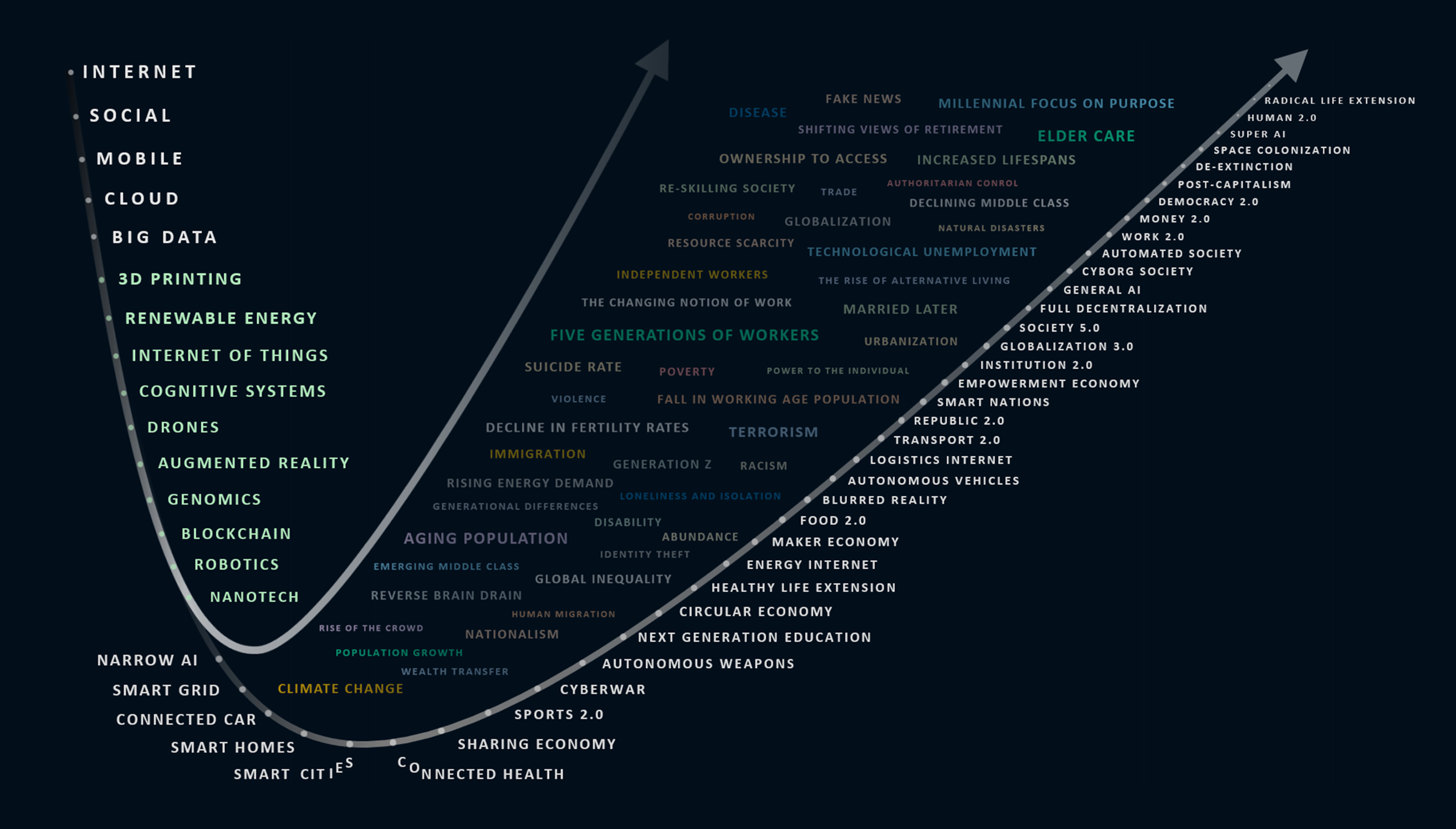
I periodically add more future scenarios to this visual that attempts to describe all the dots that are connecting to create our future. This future is complex, emerging from the combination of new and existing building blocks – a dynamic that enables the rapid pace that society is experiencing. The visual is described in detail Here.

Our Emerging Future

I have added two new Future Scenarios to the visual: Society 5.0 and Smart Nations. I have written about both recently. Each scenario is individually impactful – but the combinatorial effect is massively transformative. Tracking scenarios in an effort to See their path is the only hope in understanding their impact.

Smart Nations

Add Singapore to the list of Nations establishing a Smart Nation agenda. In a recent Article authored by Eileen Yu, she describes the launch of Singapore’s national artificial intelligence (AI) strategy. The Singapore government aims to drive AI adoption to generate economic value and provide a global platform on which to develop and test AI applications. As future scenarios go, Smart Nations represent a complex intersection of multiple ecosystems – broader than similar complexities associated with the Smart City scenario.

Continue reading

The Economists’ Hour

I just added another fascinating book to my Book Library titled The Economist’s Hour authored by Binyamin Appelbaum. Mr. Appelbaum is the lead writer on economics and business for The New York Times Editorial Board. From 2010 to 2019, he was a Washington correspondent for the Times, covering economic policy.

I find every journey to the past instructive, The Economist Hourand my hope is we can Learn from History. This book chronicles the role of the Economist, their foray into political waters, and their societal impact. Looking back in time can be surprising, as core beliefs are challenged. What can we learn from this look back? What do we do differently as a result? This is a fascinating journey that I highly recommend. The book abstract from Amazon is included below. The author’s conclusion?

Their fundamental belief? That government should stop trying to manage the economy. Their guiding principle? That markets would deliver steady growth, and ensure that all Americans shared in the benefits. But the Economists’ Hour failed to deliver on its promise of broad prosperity. And the single-minded embrace of markets has come at the expense of economic equality, the health of liberal democracy, and future generations.

Continue reading

The Future of Employee Compensation

A recent Article on the future of work focused on an important piece of  the story: a future employee compensation model. Author Dwight Chestnut proposes a new model that he calls the Empowered Employee Compensation Model (EECM). This new workplace compensation model was the result of a new economic research initiative. The model replaces hourly wages, salaries and benefits with ten new income resources and benefits and is projected to drive a three-fold increase in the aggregate standard of living.

Continue reading

The Hybrid Job Economy

The notion that a renaissance man is more important today than ever is presented in recent Research by Burning Glass Technologies. Perhaps the best renaissance man of all time was Leonardo da Vinci, who was highly esteemed for his broad knowledge of many fields. The research concludes that we must all become more da Vinci-like in our careers. Said another way: learning a single skill in isolation has a short shelf life. Learning complementary skills becomes critical in what the research describes as a hybrid job economy.

Continue reading

The Next 50 Years of Digital Life

Dr. Micah Altman – Director of Research, Center for Research in Equitable and Open Scholarship (CREOS) at MIT – recently made me aware of a Survey that probed several questions about the future of our Digital world. The survey was conducted by Elon University and the Pew Research Internet and Technology Project to imagine social and technological evolution over the next 50 years. The respondents were technologists, scholars, practitioners, strategic thinkers and others.

Continue reading