
As we stand at the threshold of another profound technological shift, many refer to this moment as the “Fourth Industrial Revolution.” Historically, we’ve used the term “industrial” to describe revolutions centered primarily on advances in production, efficiency, and the scaling of physical labor – whether through steam-powered machines, electrical infrastructure, or digital automation. Each industrial revolution significantly reshaped how we lived and worked but always remained anchored in improving productivity and mechanization.
Continue readingSynthetic Biology
The Fastest Tech Transition In History: How Businesses And Governments Can Lead Or Lag
Historically, the diffusion of transformative technologies has been constrained by institutional inertia, workforce adaptation, and the challenge of transferring tacit, hands-on expertise. As a result, decades often separated invention from widespread adoption. Today, however, powerful General Purpose Technologies – artificial intelligence, quantum computing, and synthetic biology – may defy that pattern, diffusing faster than ever. What makes this era different, and how should businesses and governments respond?
Continue readingThe Next Human Revolution: Will Technology Change Who We Are?
Throughout human history, there have been only a handful of moments so transformative that they redefined what it means to be human. These tipping points were not merely technological breakthroughs or changes in societal norms – they were profound inflection points, moments when the trajectory of civilization bent so sharply that the “before” and the “after” became fundamentally different worlds.
Continue readingA Different Kind Of Disruption: Skills, Invention, And The Future Of Work
As the world enters what may be the most transformative period since the dawn of industrialization, comparisons to past eras of great invention are both understandable and necessary. The steam engine, electrification, and mass production systems redefined economies, reshaped societies, and triggered massive employment shifts. Today, artificial intelligence, quantum computing, and synthetic biology are poised to do the same. Yet beneath the surface of these historical parallels lies a crucial divergence – one that could reshape not just work, but the social fabric itself.
Continue readingThe Next Phase Of Power Transitions
My latest series of posts are driven by what I believe are two of the biggest forces that ultimately determine our future: General Purpose Technologies and geopolitical dynamics. In a previous post, I described the role of Necessity, Invention and Convergence in driving the diffusion of general purpose technologies. Necessity drives invention, but true trasitions occur when necessity and invention converge across industries, economies, and societies. However, as technological competition accelerates, particularly in artificial intelligence (AI), a deeper question emerges: What determines the diffusion of transformative technologies, and how does that shape global power dynamics?
Continue readingWill This General Purpose Technology Cycle Accelerate System-Level Change Faster Than Ever?
Throughout history, General Purpose Technologies have reshaped economies, industries, and societies. Steam power, electricity, and computing all followed a familiar trajectory – initial invention, slow diffusion, and eventual transformation that restructured industries and economies. Each of these transitions took decades, often constrained by infrastructure needs, workforce adaptation, and institutional resistance. Yet today, as we stand at the intersection of artificial intelligence, synthetic biology, and quantum computing, the question arises: Will this General Purpose Technology cycle break historical patterns and accelerate system-level change faster than ever before?
Continue readingThe New Era Of General Purpose Technologies: Why Ecosystems, Not Industries, Will Define The Future
Throughout history, General Purpose Technologies (GPTs) have reshaped economies, industries, and societies, driving profound shifts in how value is created and distributed. Yet, while the transformative nature of GPTs is widely acknowledged, the inevitability of ecosystems as the dominant economic structure of the future is not fully appreciated. Traditional industries, once defined by clear boundaries, will slowly be replaced by interconnected ecosystems where businesses, institutions, and governments collaborate to solve challenges that no single entity or sector can address alone. This shift is not merely a byproduct of technological advancement – it is an economic and structural necessity.
Continue readingThe Great Convergence: When Necessity Meets Invention and Innovation
History has shown that when necessity, invention and innovation converge, the result is transformative change. From the steam engine to artificial intelligence, periods of economic, societal, and technological strain have consistently pushed invention innovation to new heights. These inflection points – where high-pressure needs meet breakthrough ideas – can drive unprecedented leaps in productivity, reshaping industries, economies, and even entire civilizations.
Continue readingThe Catalyst Effect: How Transformative Inventions Shape Humanity’s Future
Throughout history, catalysts—key events and turning points—have ignited profound shifts in human behavior and societal evolution. From conflicts like World War II to scientific breakthroughs such as the discovery of electricity, each milestone has propelled us into new realms of possibility and understanding. Today, as we stand on the precipice of a technological revolution driven by artificial intelligence (AI), humanoid robots, quantum computing, synthetic biology, and space technology, it is crucial to reflect on how these transformative developments will reshape our future. I have viewed this emerging period as a looking glass moment.
Continue readingFuture Today Institute – 2024 Tech Trends Report
Each year, Amy Webb and her Future Today Institute launch their tech trends report. This edition of the annual report tracks more than 700 technology and science trends that are likely to influence every industry. Amy had this to say about the report on LinkedIn:
Continue readingWhat History Tells Us About Human Action
Historically, it takes catastrophe to drive humans to act in periods where action is clearly needed. Wars and financial crashes are dominant catalysts throughout history. This poll considers the catalysts that drive humans to act in an era demanding action. Please take a minute to respond below. Pick those catalysts that you feel strongly about – and/or add to the list.
The Catalysts of Change
Two recent books The Fourth Turning is Here and The Coming Wave have each underscored the critical need for human action. But as I described in a post on Learning from History, it takes catalysts to drive actions that ultimately shape our future. A combination of breath-taking innovation, societal forces, depression and war, represent some of the catalysts that established a post-world war II era. As we stare into an uncertain, volatile and complex future, what are the catalysts likely to force human actions? The poll below has been conducted twice, pre-and-post pandemic. However, so much has changed since then. Please help me build on this list and identify the most significant catalysts. Choose all catalysts that you feel will contribute – or add anything that I am missing. For a deeper description of catalysts, please see the lessons from history post.
Continue readingThe Coming Wave
Permeating humanity’s oral traditions and ancient writings is the idea of a giant wave sweeping everything in its path, leaving the world remade and reborn.
Mustafa Suleyman – The Coming Wave
That quote from a book published this month is closely aligned with the compelling argument made by the authors of The Fourth Turning. While the latter book describes rebirth in the context of generational turns, this one views it through the lens of AI and Synthetic Biology. The Coming Wave comes to us from Mustafa Suleyman, the Co-Founder of DeepMind. The author defines a wave as a set of technologies coming together around the same time, powered by one or several new general-purpose technologies with profound societal implications. Thinking back, one major study found that twenty-four general-purpose technologies have emerged over the entire span of human history. Artificial intelligence and synthetic biology are likely to add to that number. The question I have asked in a poll is this: will they be more profound in their impact then previous technologies? Consider that fire, language, writing, electricity, the printing press, the steam engine, the Internet, the domestication of plants and animals, and the wheel, are all on the list. To even be considered among that list speaks volumes. But to be thinking in terms of most profound?
Continue readingDigital Twins Reach A Tipping Point
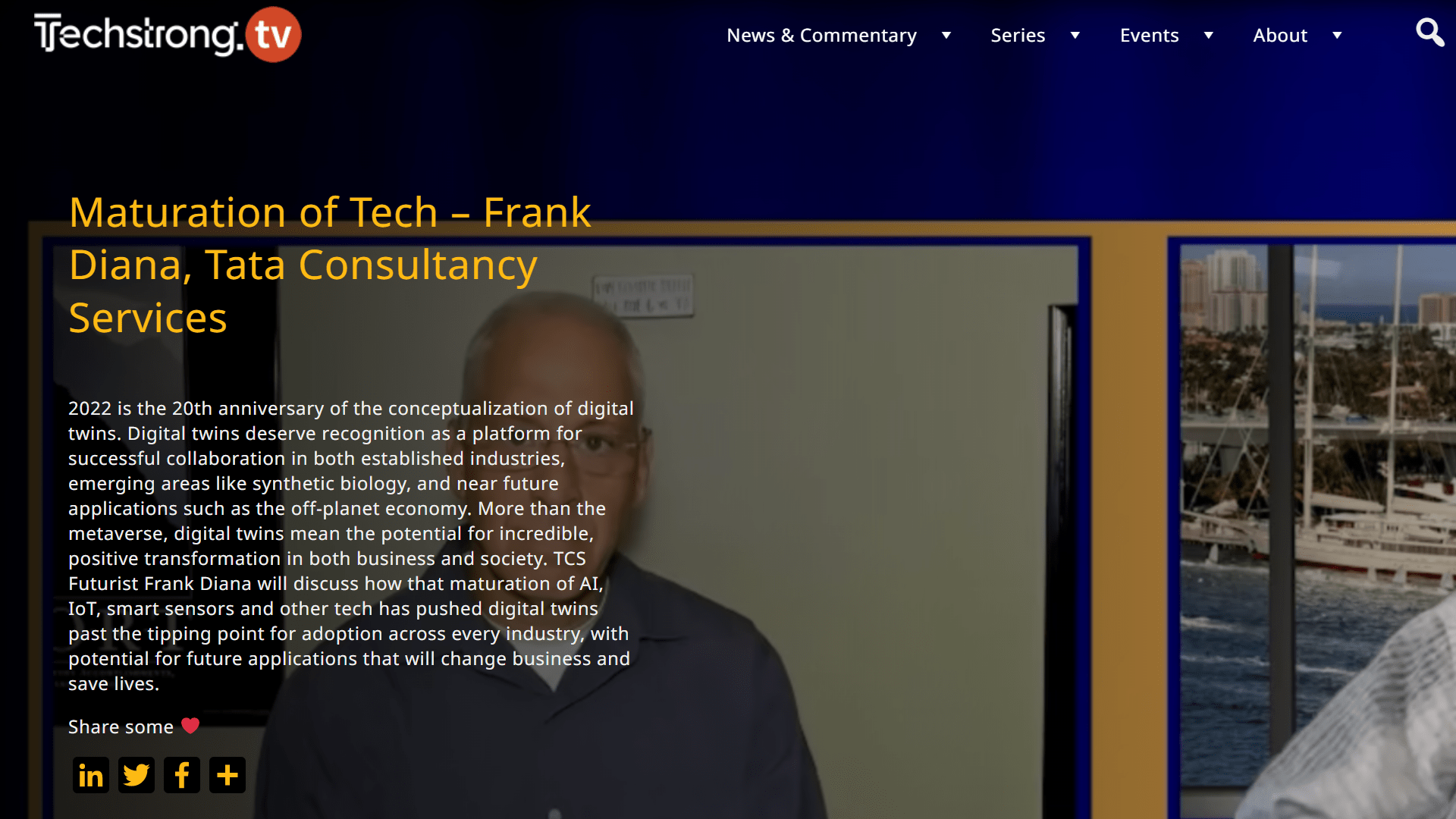
I had the pleasure of joining Alan Shimel of Techstrong TV for a short Interview on digital twins. Our discussion explored the growing number of scenarios enabled by the convergence of multiple technologies. We discussed its application in the context of food and health in the short term, the Metaverse and smart cities in the medium term, and the off-planet economy in the long term. Alan does a great job with these interviews. You can explore several topics at Techstrong TV.
The Genesis Machine
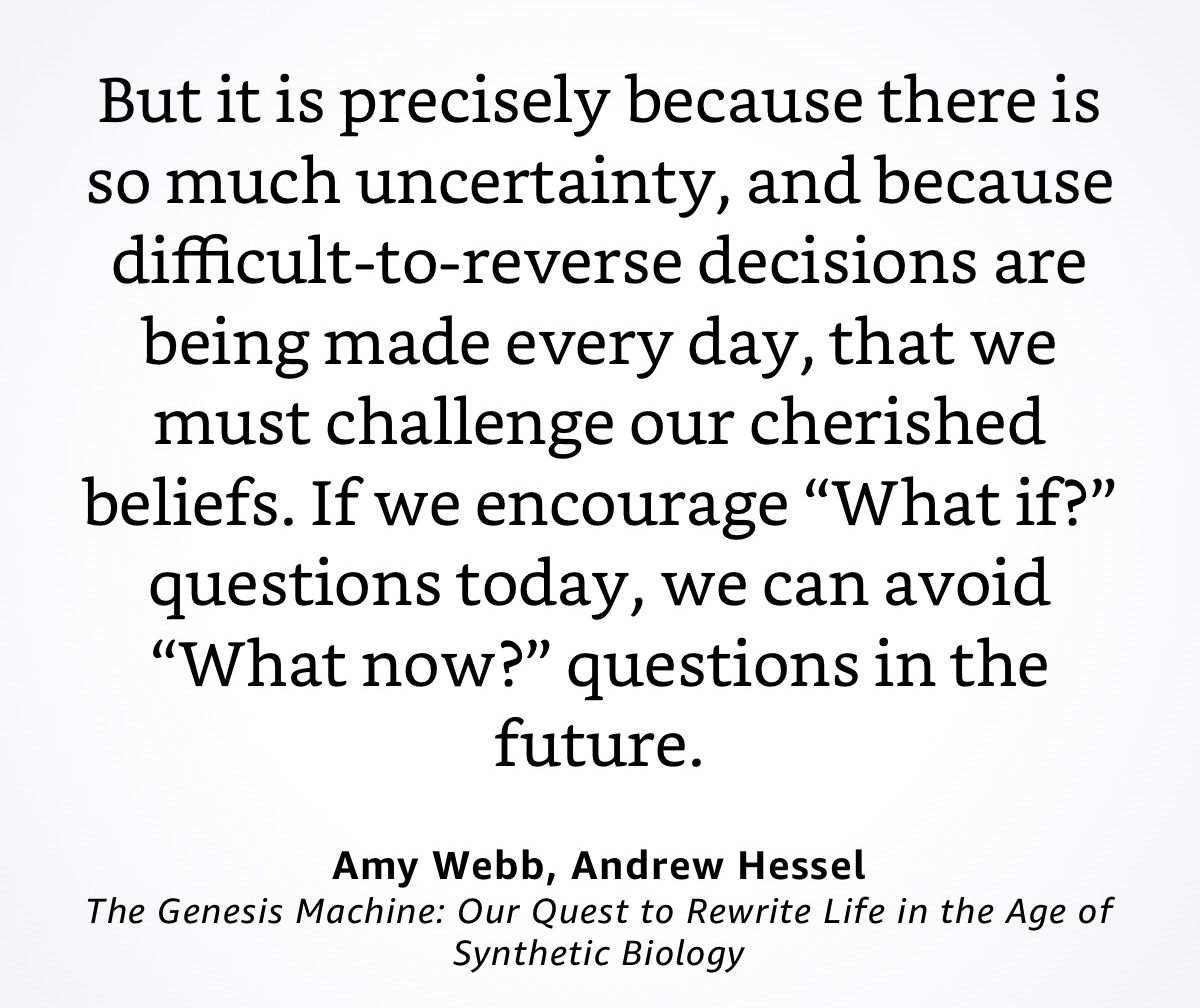
I just finished reading my latest book titled The Genesis Machine, in which authors Amy Webb and Andrew Hessel explore the world of synthetic biology. Although not as widely discussed as AI, Blockchain and others, it is perhaps the best example of why the future may look very different than the past. I have argued that the world is in the early stages of a phase transition. The content of the book represents a clear reason why.
The authors provide a riveting look into the world of synthetic biology. The book focuses initially on its origins, shifts to the here and now, and then pivots to a glimpse of the future. They provide several scenarios that help the reader envision that future, and in so doing, allow us to see both the potential for human development, as well as the possibility of several destructive paths. The book closes with a discussion on our way forward. As a world-renowned Futurist, Amy knows how to tell a story, and it is through storytelling that individuals can see the possibilities along both paths. The authors define synthetic biology as:
Continue readingWhat Does A Recent Trend Study Tells Us About The Future?
Each year the Future Today Institute releases a very comprehensive trend study during SXSW. I just finished getting through this very comprehensive installment. In announcing this year’s report, Founder Amy Webb had this to say:
The cataclysmic events of the past year resulted in a significant number of new signals. As a result, we’ve analyzed nearly 500 tech and science trends across multiple industry sectors. Rather than squeezing the trends into one enormous tome as we usually do, we are instead publishing 12 separate reports with trends grouped by subject. We are including what we’ve called Book Zero, which shows how we did our work. There is also an enormous, 504-page PDF with all content grouped together as one document.
Well, Amy was not kidding, there is quite a bit to digest. The 12 separate reports referenced can be downloaded Here. As I do with each look into the future, I captured some highlights from this year’s trend study. I will start however with an important observation that Amy made in the opening of the report.
Continue readingIs The Digital Era Over?
I had a discussion last week that focused on a post-digital world. It was an open question about the state of digital and the related transformation journey. Although the digital maturity of organizations is not where I envisioned it – and Covid-19 underscored the point – digital should be a foundational piece of a bigger story. The continued digital discussion ignores the bigger contributions of science and the boardroom conversations around purpose and innovation. A recent article goes one step further in declaring that the digital era is over, and we are in a New Era of Innovation. In it, Greg Satell makes the exact argument I made above.
Continue reading Reimagining the Future