The Catalysts that Drive Human Action

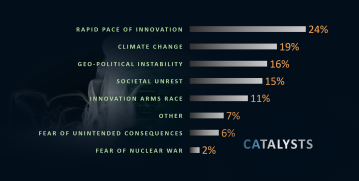
The conversation regarding catalysts that drive human action has been fascinating. This poll initially launched back in February has had a great response – with some great insight. Please take the poll if you have not already.


One of our Lessons from History was the presence of catalysts that drove actions that ultimately shaped our future. The major catalysts of the second revolution were astounding levels of innovation,

Catalysts
Click to open in a new window

World War One, The Great Depression, World War Two, and the eventual democratization of innovation. What catalysts force stakeholder actions that ultimately shape our emerging future? Please help me build on this list and identify the most significant catalysts. Choose all catalysts that you feel will contribute – or add anything that I am missing. For a deeper description of catalysts, please see the lessons from history post.

Reimagining the Future

Future thinking has often focused on a three-horizon framework that allows for the continued advancement of  core business, while planning for emerging opportunities. I believe the challenge these days is time compression associated with rapid advancement. When someone says to me: “I’m not worried about five years from now”, my reaction is always the same. What looks to be five years out is likely only 18 months away: A phenomenon I describe in this piece on Acceleration.

Continue reading

The Future of AI – Predicting, Preparing, and Thriving in our Changing Future

I had the pleasure of recording a Podcast with AJ Goldstein on a wide ranging set of topics. The central theme was artificial intelligence. We took a journey to the future and explored several possible paths for artificial intelligence. AJ had the following kind words to say as he shared the Podcast in various channels:


Last month I had the opportunity to sit down with one of the world’s leading futurists, Frank Diana, to discuss the future of artificial intelligence.

Today the episode has been released, and it’s one of the most meaningful conversations I’ve had on the podcast.

Rather than provide a subjective one-sided view, with every question that I asked about the future of AI, Frank responded with presenting both sides. He helped me understand “what does the optimist say?”, “what does the pessimist say?”, “what is the utopian view?”, “what’s the dystopian view?”… and in this way it quickly became one of the most balanced conversations I’ve had the chance to be a part of.

With over 30+ years of experience to pull from, Frank provided so many fascinating lenses through which to view our changing future… all the while outlining an insightful playbook of what we can do as individuals, communities, and societies to prepare for the inevitable change that’s going to come.


AJ drove the discussion on the following topics:

  • Addressing the two tipping points that have occurred thus far in humanity and changed what it means to be human– and the coming third tipping point.
  • Addressing some of the common fears that people have about the implications of advanced AI and robotics on the future.
  • How the shift to an automated society might cause initial elimination of jobs, but ultimately will allow more time for pursuit of creative, entrepreneurial endeavors.
  • A discussion on the characteristics needed to succeed in a world of change, and what you personally should do to prepare for it.

Enjoy the show!

Republic 2.0 Added to Emerging Future Visual

In a recent book titled The Future of Work, author Darrell M. West describes the Work 2.0 scenario on this emerging future visual. In exploring possible implications of a shifting work paradigm, he gets prescriptive about possible responses. This implication-response exercise sits at the heart of Future Thinking.

No one can predict this complex and uncertain future – but exercises like this help us see possible futures. In seeing them, we position ourselves to proactively shape them. In the context of work, Mr. West explores several possible responses, including another future scenario which he calls Republic 2.0. How this scenario plays out has a direct impact on the path of other scenarios. The scenario speaks to a new kind of politics. Mr. West states:

Continue reading

A Sixty Minute Sprint Through Our Emerging Future

Reimagining the Future

I had the pleasure of keynoting the annual Hawaiian event hosted by the Independent Insurance Agents & Brokers of California. The 2018 Blue Ribbon Conference was a great four-day event that focused on many pressing issues: from employment law, to politics and robots, a broad array of challenges faces the industry.

You can view my hour long keynote via this Link. You will need to register in order to view it.

Game Changers: Can We Teach Machines to Predict?

Today on Coffee Break with Game Changers, Bonnie D. Graham hosted a show focused on the future of prediction. You can listen to the rebroadcast here. The session abstract is included below, as well as a Twitter stream that provides insight into the topic and our discussion. The show participants included: Bonnie, Gray Scott, and myself

Episode Description

The buzz: “Those who have knowledge, don’t predict. Those who predict, don’t have knowledge.” (Lao Tzu)

Given the uncertainty, pace, and unexpected nature of today’s world, there are too many unknowns for us to effectively predict the future. Reality check: A convergence across science, technology, politics, society, economics, the environment, and growing ethics discussion, has created a complex web that requires the type of system thinking that may exceed our human capacity. Do machines hold the answer? Can they predict the path of an overwhelming number of possible futures?

The experts speak. Frank Diana, TCS: “We have a duty to think hard about what may be, so as to better prepare society for the changes that may come” (Richard Baldwin). Gray Scott, Futurist: “Prediction is not just one of the things your brain does. It is the primary function of the neo-cortex, and the foundation of intelligence” (Jeff Hawkins). Join us for Tech Magic or Hype: Can We Teach Machines to Predict?

Continue reading

Visualizing Our Emerging Future – Revised

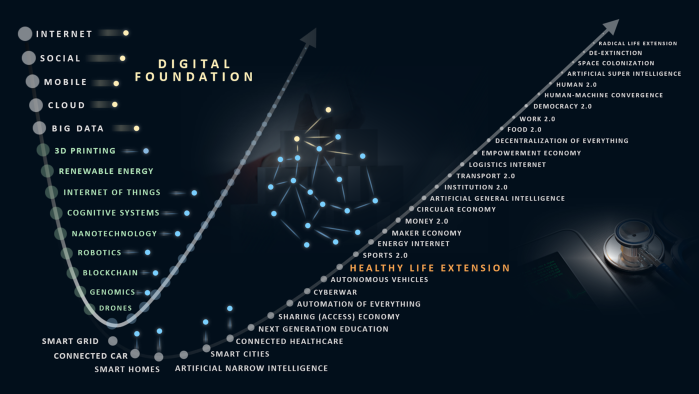
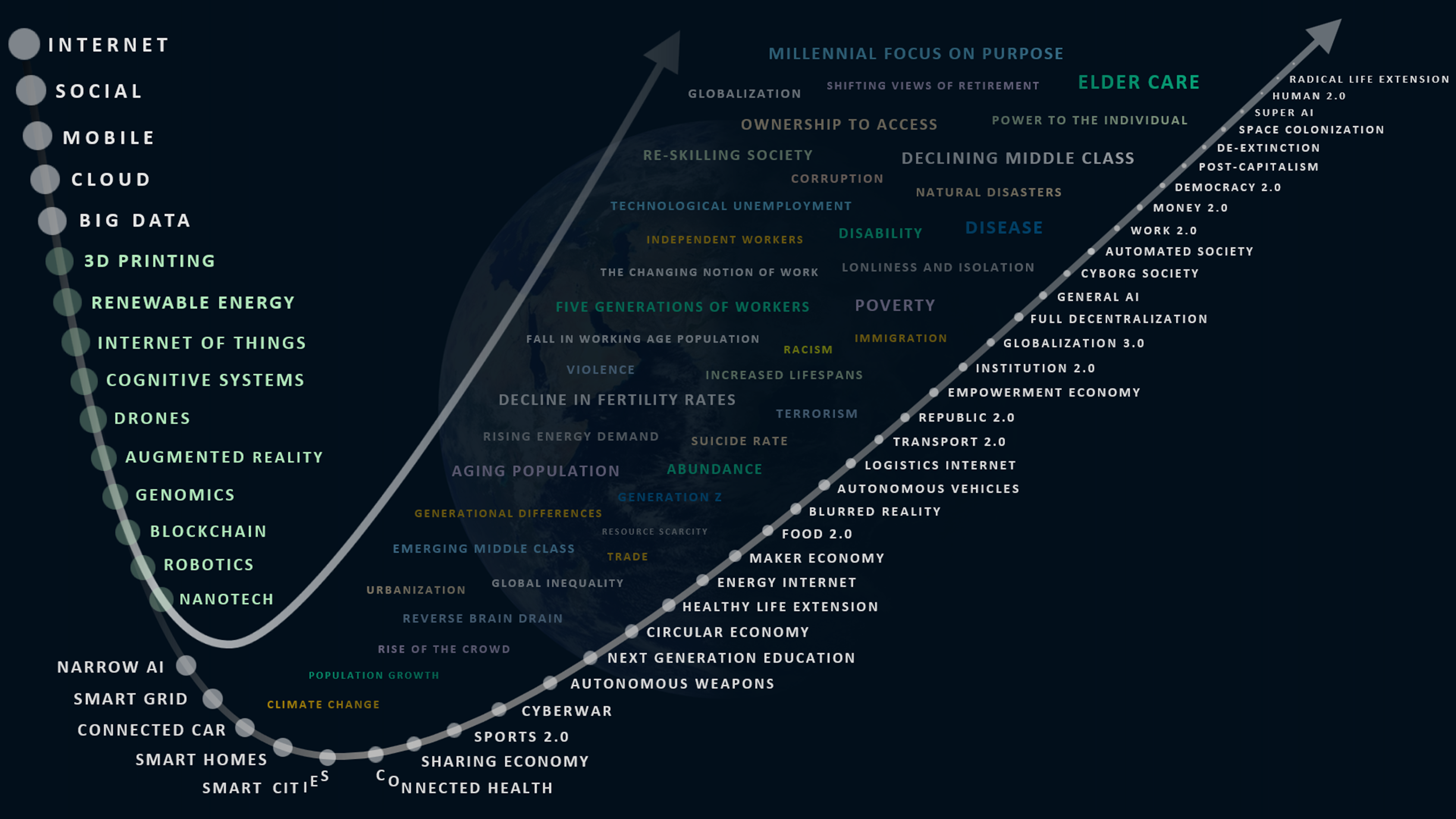
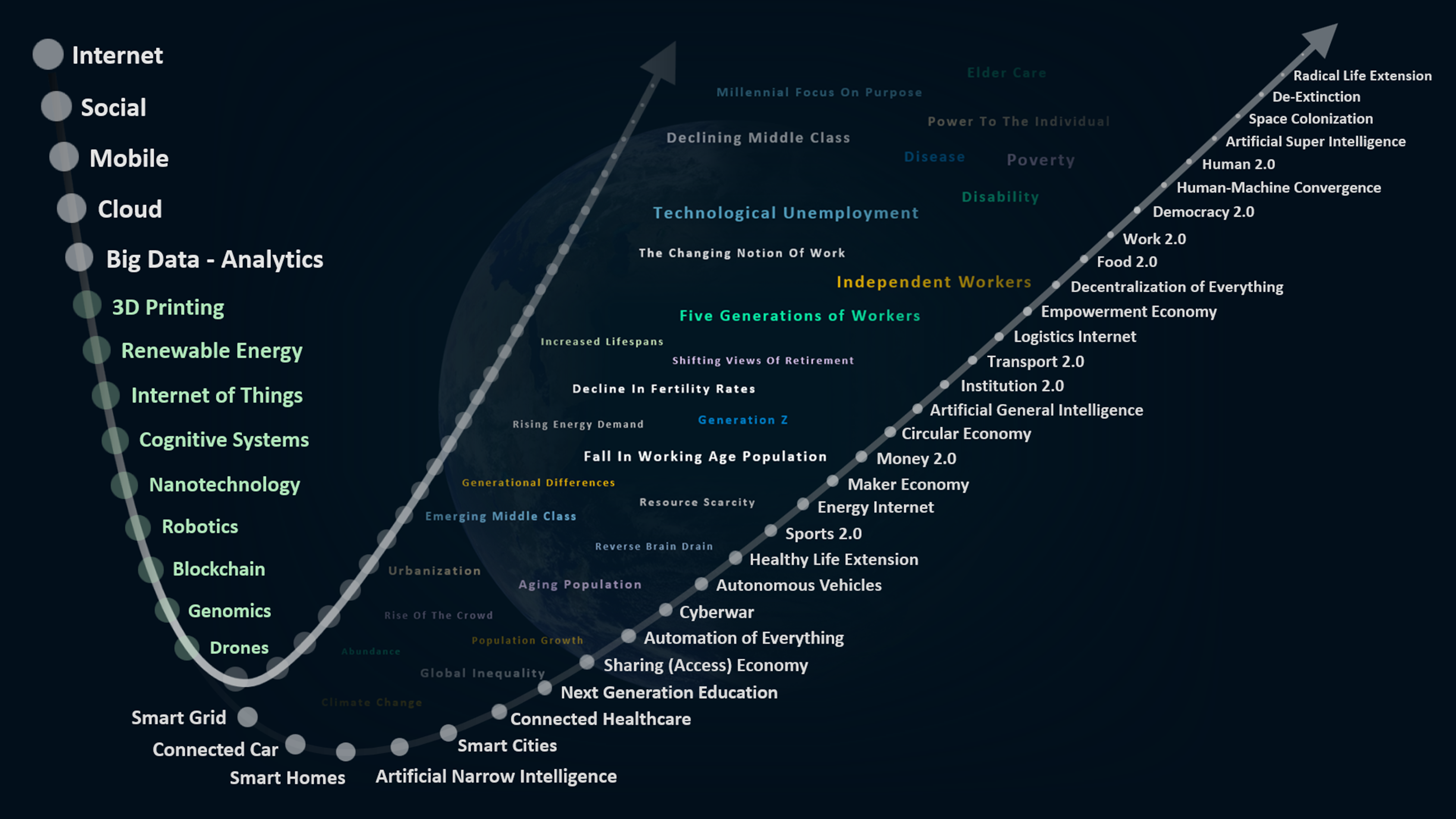
As our emerging future shifts continuously, our challenge is to shift with it. The number of building blocks that combine continues to explode, challenging our ability to track its complexity. I’ve used a visual representation of this challenge – and I see older versions floating around – so I am updating it via this post. When I use the visual in presentations, I build towards it to avoid its overwhelming nature (which I believe accurately reflects the overwhelming nature of the challenge). I will replicate the approach here by building towards the full visual.

Convergence across aspects of science, technology, economic forces, politics, society, our environment, and a growing conversation around ethics, is creating a highly uncertain world. At the heart of the pace dynamic is the exponential progression of science and technology – reflected in the first piece of the visual.

Science and Technology Curve

Continue reading

YouTube Channel Launch

YouTube Channel

The journey to the future is gaining more attention for both the opportunity it presents, and the fear of unintended consequences. Dialog and proactive action are critical to shaping this emerging future in human-centric ways – a story line that is nicely articulated in a new book titled Shaping the Fourth Industrial Revolution. I am a firm believer that shaping the future requires a different mindset. As stated in the book, we must all adopt a zoom-in and zoom-out strategy: zooming in to acquire an understanding of the characteristics and potential disruptions of specific advances in science and technology; and zoom out to see the patterns and combinations that emerge.

Continue reading

Early 2018 Reading List

Update January 22nd: I am adding a book just released to this short list – Shaping the Fourth Industrial Revolution

I’m often asked for book recommendations that aid with future thinking exercises. A good source in 2018 for this type of exercise is Fast Future Publishing, whose goal is to profile the latest thinking of established and emerging futurists, foresight researchers and future thinkers from around the world, and to make that thinking accessible to the widest possible audience. Their innovative publishing model bypasses most traditional publishing channels and accelerates time to market. Two books that I’d recommend for early 2018 are described below, and a new book due out in the spring is also included.

Continue reading

An Uncertain Future

I have used this Emerging Future visual to demonstrate the overwhelming number of combinations that will conspire to create our future. The science and technology foundation converges with societal, political, economic, and environmental forces to build towards a very uncertain future. A future that I believe represents the third massive tipping point in human history.

This very short animated video describes the visual.

Strategy and Multiple Futures

I recently engaged with fellow futurists on an article for Digitalist Magazine titled Why Strategic Plans Need Multiple Futures. I think the authors truly captured the challenges of strategic planning in a world where pace and the sheer volume of change makes our emerging future anything but predictable. The focus on story telling as the most effective way to communicate potential futures is powerful, and the Lowe’s example really brings that point home. I recommend this articles to leaders everywhere. Here is a powerful quote:

“Companies like Lowe’s are realizing that standard ways of planning for the future won’t get them where they need to go. The problem with traditional strategic planning is that the approach, which dates back to the 1950s and has remained largely unchanged since then, is based on the company’s existing mission, resources, core competencies, and competitors.

Yet the future rarely looks like the past. What’s more, digital technology is now driving change at exponential rates. Companies must be able to analyze and assess the potential impacts of the many variables at play, determine the possible futures they want to pursue, and develop the agility to pivot as conditions change along the way.”

A Future Thinking Canvas

Our exponential pace is due in part to the overwhelming number of building blocks available to innovate. Understanding how these building blocks combine provides a glimpse into possible futures. In this visual, dots connect to portray the building blocks that are likely to extend our healthy lives – a key emerging future scenario.

Healthy Life Extension - Combinatorial

Continue reading

The Timing of Future Scenarios

Timing. It’s one of the most difficult facets to consider when thinking about the future. We know that convergence across societal, political, economic, science and technological forces is creating many future scenarios. We also know that enablement is happening at an exponential pace. Some believe (present company included) that the coming macro-level tipping point is likely to impact humanity on a scale only experienced twice in human history (hunter-gatherer to agriculture and agriculture to industrial). There will be many micro-level tipping points on the journey towards an automated society – and the timing of those tipping points is impossible to predict.

Continue reading

Discussing the Future of Sports

This story was posted this morning to promote a fund raiser that I am participating in on Tuesday evening, June 13th at 6:00 p.m. We will be discussing the future of sports, and its implications to fans, stakeholders, arenas, the athlete, humans, and the sports themselves. Here is an excerpt from the article by  and a glimpse into what I will be presenting.

This event will take place from 6 to 8 p.m. Tuesday night in the Brown Recruiting Pavilion behind the south end zone, with proceeds to benefit the Rutgers women’s soccer team. Details for the event can be found here.

Join us if you live in New Jersey.

Continue reading

Our Emerging Future: Revised

Our Emerging Future

Several months have past without adding to the emerging future visual. In this post on Visualizing our Emerging Future, I described the origins of the visual and how it is being used. Two specific activities have prompted me to add two new scenarios to the visual:

Continue reading

Reimagining the Future: Week Two of the Online Course Launched

Week two of Reimagining the Future has just launched! Week one drew a large audience and generated great dialog. A big thank you to those who have participated so far. As discussed in the course, we must collectively take control of creating our future. Our hope is this course and related dialog are just one small step on that journey. There is still plenty of time to take the full course, you can enroll here.

Continue reading

Our Journey Forward: Thoughts from Futurists

I had the great fortune of working with three very accomplished futurists in the production of our upcoming course titled:  Reimagining the Future – A Journey through the Looking Glass. SAP’s Susan Galer interviewed these futurists in support of the course launch on May 23rd. The SAP Post provides a glimpse into the course, with thoughts from futurists and industry leaders. Here are several quotes from the post.

Continue reading

Reimagining the Future – A Journey Through the Looking Glass

openSAP Promo Slide

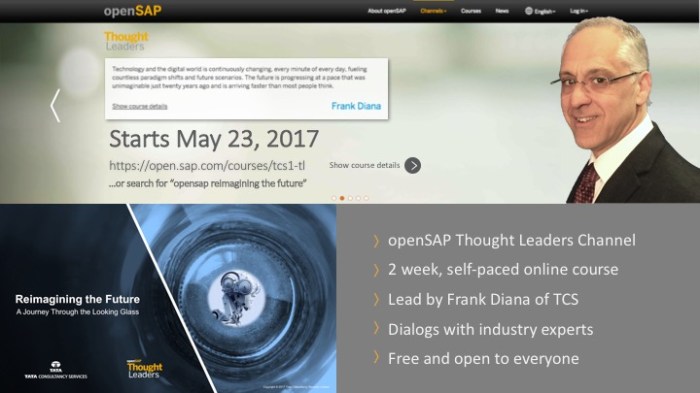
I have spent the better part of two months filming an online thought leadership course focused on our emerging future. The free course will be available starting May 23rd. I had the pleasure of working with futurists Gerd Leonhard, Gray Scott, and Chunka Mui. In addition, I was joined by Element Fleet Management executive Michele Cunningham, as well as TCS CTO Ananth Krishnan, and BRP CIO Hassan El Bouhali.

A video promo of the course along with the course description are available here. I hope you take the time to journey with me through the looking glass. course summary and bios for my guests are also included below.

Continue reading

A Glimpse into a Possible Future

I saw a glimpse into a possible future in a book titled Homo Deus, written by Yuval Noah Harari in 2016. Before his journey forward, the author explores the past. His conclusions challenged my core belief system in a very uncomfortable way. His arguments were logical and thoughtful (whether I agree with them or not), and based on a foundation of life science, algorithms, and biotechnology.  This look forward once again raises the question of Ethics. The author himself makes this point when he says:

“The rise of AI and biotechnology will certainly transform the world, but it does not mandate a single deterministic outcome. All the scenarios outlined in this book should be understood as possibilities rather than prophecies. If you don’t like some of these possibilities you are welcome to think and behave in new ways that will prevent these particular possibilities from materializing.”

I’ve given the main themes of this possible future a label and provide a quick look using excerpts directly from the book. You decide for yourself if this future represents an enhanced or diminished humanity.

Continue reading

See the Future, Rehearse it and Adapt to the Inevitable Shifts

In my last post, I described a Sense and Respond model that sits at the heart of several activities, including scenario, opportunity, and risk analysis. As complexity and pace continue to intensify, uncertainty increases. To survive in this Emerging Future, we must embrace a framework for future thinking,  and an organization that can adapt as it shifts. In essence, we must see the future, rehearse it, continuously monitor for shifts, and adapt as the shifts occur. A sense and respond model sits at the core of the framework – but represents the biggest cultural challenge.

Continue reading