
The earlier posts introduced the sense that the world’s operating logic is beginning to shift, explored what compression feels like in daily life, and laid out the four-stage pattern that has shaped every major transition in history. Post Four explained why those transitions do not come from singular breakthroughs but from the interaction of multiple domains moving together. Before we can measure that interaction in today’s world, we need to understand the deeper forces that give convergence its power. These forces have shaped every civilizational transition across the long arc of history. They determine when pressure accumulates, how tightly systems couple, and what pushes society toward a threshold.
Food
Vignette: Cooking With Grandma’s Digital Twin
It’s a rainy Sunday in 2029. You step into your kitchen and greet a familiar voice:
“Wash your hands first — and don’t forget, you always overcook the garlic.”
It’s your grandmother. Or rather, her AI-trained twin — a rich synthesis of voice recordings, handwritten recipe notes, photos, and family video calls. Her likeness lives in your kitchen’s AI assistant, trained not only on the technical aspects of her cooking but the emotional cues too — her sayings, her pacing, even her eye-roll when you forget the bay leaves.
Tonight, you’re making her famous Sunday stew.
As you begin, her voice guides you through each step.
“This is the part where we stir slowly — remember how we’d hum together at this point?”
The AI pulls up a shared memory — a short home video from when you were seven, standing on a stool next to her, stirring that same pot. You smile. You hum.
As you plate the stew, she adds one last note:
“Serve it with that crusty bread from the bakery — just like Grandpa liked.”
The food is real, the memory is enhanced, and your kitchen has become a portal to the past — powered by code, but steeped in love, culture, and identity.
Breaking The Cycle: How Digital Twins Can Preserve Wisdom And Rewire The Future
History doesn’t just repeat itself because we forget the facts. It repeats because we lose the wisdom of those who lived through it. When the last voices of a generation fade – those who endured war, depression, migration, or reinvention – we lose more than stories. We lose anchors. We lose quiet guidance in moments of moral fog. We lose the ability to ask: “What would you have done?”
Continue readingCan Vertical Farming Address Our Food Challenges?
UPDATE: THE LINK TO THE ARTICLE IS NO LONGER AVAILABLE
A recent article seeks to dispute the recent negative press that vertical farming has received. Written by Arama Kukutai, the CEO of a company called Plenty, the article explores the headlines that might have you believe vertical farming is on life support, and provides a closer look that reveals a different story. While climate change, population growth, and soil erosion threaten our global food security, vertical farming offers a beacon of hope. This innovative approach to indoor agriculture boasts significantly higher yields than traditional methods, all while using less land and precious water.
Continue readingLiving Standards Have Improved Around The World
Continue readingAs the Industrial Revolution gathered momentum, circa 1800, virtually all countries had a life expectancy at or below 40 years; today, just six countries have a life expectancy below 60 years. Put another way, a daughter born into a family in Lesotho or the Central African Republic — the countries with the lowest life expectancy today, each at around 53 years — can expect to live a longer and healthier life than the newborn daughter of an Englishman or American in the year 1800.
Tony Morley – 9 astonishing ways that living standards have improved around the world
Relocalization
Are there other forces lurking that could indeed lead to relocalization? Might a world where our food, energy, and products are created locally drive deglobalization? An open question with massive implications. Relocalization is a geopolitical building block – one of many that contribute to future thinking exercises.
Continue reading
Innovation And Our Well-Being
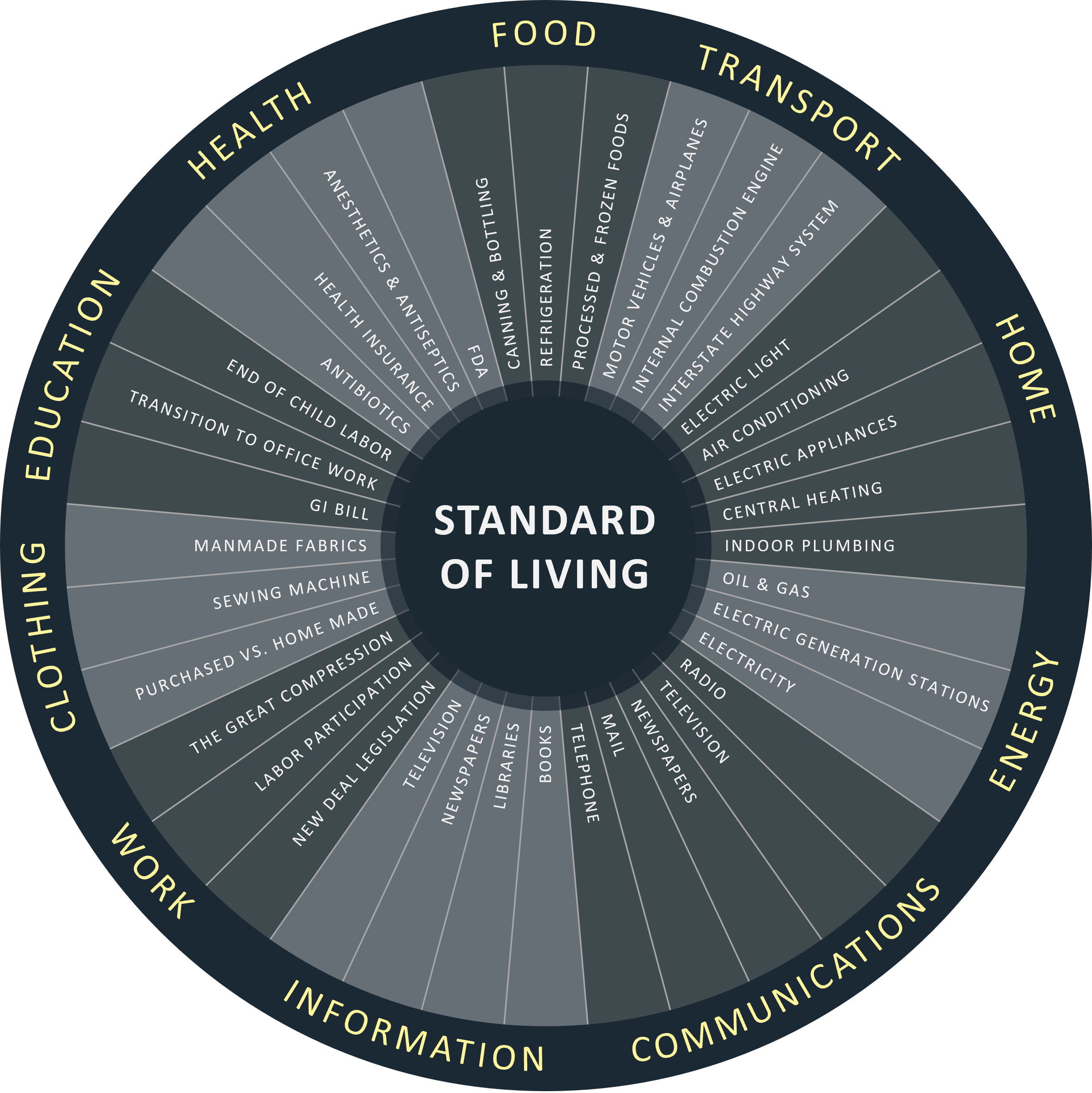
In a post from 2016, I launched an innovation wheel that captured the activity of the second industrial revolution. This activity set the standard of living that much of society enjoys today. As I mentioned in that earlier post, in a brilliant journey through the economic history of the western world, author Robert J. Gordon looks at The Rise and Fall of American Growth. The book focused on a revolutionary century that impacted the American standard of living more than any period before or after.
Continue readingInnovation Is Everywhere
My belief that human development will accelerate in the coming decade is fueled by a wave of emerging innovation both now and in the future. Our ability to invent dates back a very long time. Each new wave of invention builds upon the last, with subsequent waves accelerating on the strength of new building blocks that emerge and the growth of knowledge. We stand on the shoulders of brilliant people that came before us, and as inventors, inventions, and knowledge converged, our standard of living was elevated. No period represents this phenomenon better than the late 19th and early 20th century. It was early 2016 when I first attempted to capture the dynamics of that period visually.
Continue readingThe Journey: A World Of Ecosystems
In a continuation of my series titled “A Journey through the Looking Glass”, I will describe how convergence across multiple forces likely changes the organizing system of society. The focus of the post is on one element of this change: the way value is created and captured in the future. The post picks up from the last, where I explored the next phase of human development. The well-being discussion from that post flows naturally into a discussion about our life experiences. Those experiences will increasingly be enabled by ecosystems.
A WORLD OF ECOSYSTEMS
Yogi Berra is credited with saying that the future ain’t what it used to be. What a perfect way to describe a phase transition that completely changes the way we think about the future. In an earlier series post, I described the complexity, volatility, and uncertainty associated with envisioning possible futures. Indeed, the experimentation we often talk about in the context of innovation also applies to the future. While running for president in 1932 during the depths of the Great Depression, Franklin Roosevelt remarked:
Continue readingFuturistic New Cities
I believe the smart city represents the intersection of multiple emerging ecosystems. Energy, transport, water, food, health, and more, could come together to create a more equitable and sustainable future. At least that’s the mission of Telosa. A recent article via Oscar Holland describes the vision of billionaire Marc Lore:
The cleanliness of Tokyo, the diversity of New York and the social services of Stockholm: Billionaire Marc Lore has outlined his vision for a 5-million-person “new city in America” and appointed a world-famous architect to design it.
Oscar Holland – Plans for $400-billion new city in the American desert unveiled
Per the article, the 150,000-acre proposal promises eco-friendly architecture, sustainable energy production and a purportedly drought-resistant water system. It embraces a “15-minute city design” that allows residents to access their workplaces, schools and amenities within a quarter-hour commute of their homes. The brief video describes the vision.
The Extraction Age Gives Way To The Creation Age
In their book titled Rethinking Humanity, RethinkX Founders Tony Seba and James Arbib describe a transition from an age of extraction to an emerging age of creation. The extraction age began with agriculture and continued through the industrial period. The authors describe the age of extraction as follows:
Continue readingThe Good Future: A Perspective Via Gerd Leonhard
We must make the right decisions now, if we want a good future
Gerd Leonhard – The Good Future is entirely possible, and it’s our choice!
That quote from fellow Futurist Gerd Leonhard comes from a recent film he produced to convey optimism about our ability to create a good future. He opens with several statements that are core to my beliefs about our emerging future. He states that what we have done for the last one hundred years is no longer going to be suitable for the future. In other words what got us here won’t get us there. It was back in 2013 when I wrote about the structural change expected in the future. Much like my belief that structures and institutions will change, Gerd believes that the current system is unfit for the future, driving the need for a different logic. He mentions something that he has been saying for years: science fiction is becoming science fact. In exploring the possibilities of a good future, he starts with a question: what does good look like? He proposes a definition of good that includes relationships, experiences, the planet, purpose, and prosperity.
Continue readingResilience Is Top Of Mind These Days
Resilience is the capacity to recover quickly from difficulties. That word is suddenly in everyone’s vocabulary. Whether it is individual or organizational, resilience helps us withstand adversity and bounce back. The pandemic can be credited for our heightened awareness, but it was just a matter of time before we all got here. The factors described in my Post yesterday describe why: complexity, pace, volatility, unpredictability, and the unexpected. These factors have always been there, but during specific transformative eras throughout human history, they combined in ways that challenged the existing order.
Continue readingThe Next Generation Of Farming
As we Rethink Humanity, we appreciate that the next decade represents what is likely the fastest, deepest, most consequential disruption in history. By 2030, much of what we know could be completely reimagined. Something as basic as food and farming could look quite different, as the possibilities cover a wide spectrum. In the short term, we find different ways to farm, optimizing yield and improving our environment. In the long term, we likely witness the complete transformation of farming.
Continue readingTectonic Shifts Expected As Digital Expands
Prognosticators continue to point to massive shifts in the aftermath of COVID-19. In this recent Article, author Bhaskar Majumdar explores an aggressive convergence of the physical and digital worlds. Pointing to the domains that have already converged – education and entertainment – Mr. Majumdar sees this phenomenon overwhelming all aspects of our lives. In the near future, he sees it impacting banking, medicine, trade, shopping, dining and sports. As we come to terms with social distancing in a post-COVID world, some level of change is inevitable.
COVID-19 Tuesday Morning News
The COVID-19 crisis is fast-moving with information bombarding us in real-time. On this Tuesday morning, as we awake to more isolation and rising numbers, there is much to consider across every domain. Some like Enrique Dans are writing about the changes coming to Education. Issues like a drop in school attendance, obsolescence of teaching methods, technology barriers of entry to education, and an aversion to face-to-face interaction are likely to change education as we know it. As it is with every domain, institutions, academic directors, teachers or students who are unable to adapt will simply have no place in this new scenario. As a new normal emerges, educators are likely to revise their teaching methods and evaluation approaches, among other things.
Food: A great Example of the Broad Changes Coming
In this recent Article, the authors describe the future of food in a way that captures the massive change driven by one future scenario: in this case, Food 2.0. Setting aside the changes likely in the form of lab-grown meats and 3D Printed foods, this story is more fundamental: it’s about farming. The article describes the current state of the industry, mostly one in decline.
Looking at Possible Futures
Many Future Scenarios are spawned by convergence across multiple domains. The most obvious Convergence is occurring between science and technology. I have been posting links to numerous articles that explore possible futures. These futures are important for us to understand, as they usher in a very Pivotal Decade. Here is another set of articles that help us envision the future.
The Future of Farming
The global population is projected to reach 9.7 billion in 2050 – up from 7.6 Billion today. This population growth along with city expansions are having major consequences, driving a lack of growing space and food in many parts of the world. Add to this the concerns of extreme weather events that will disrupt food production, and you have a scenario that forces us to find creative solutions. According to various statistics, 795 million people don’t have enough food; and keeping pace with population growth requires a focused effort on realizing food abundance.
Society 5.0
I found a very refreshing Article today describing Japan’s vision for the fifth iteration of society. Our hunter-gatherer days represent the first iteration, with agriculture coming in as number two and the industrial and information revolutions rounding out the next two. I’ve written about the Tipping Points in human history – and this vision of a future society is aligned with my point of view on the next tipping point. With each tip, we have experienced Unintended Consequences. Big visions such as these would be wise to ensure a balancing of the Opposing forces of Innovation.
 Reimagining the Future