
Sundar Pichai, the chief executive of Google’s owner Alphabet, believes that artificial intelligence (AI) will eventually have a bigger impact than fire, electricity, and the Internet. Historically, general purpose technologies have driven two major tipping points – from the hunter-gatherer era to the agrarian, and agrarian to industrial. Advancement of human development through transformative periods like this had two common drivers: the growth of knowledge and inventions that served as a platform for society. With that in mind, Mr. Pichai’s assessment when viewed through the lens of history could be spot on. Artificial intelligence combines both drivers in a way that prior platform technologies did not. AI is a general purpose technology that is increasingly woven into the fabric of society, and it could ultimately represent the pinnacle of knowledge attainment.
Continue readingThe Critical Need For Foresight
Foresight is growing in importance – and it is great to see leaders focused here. In this world of complexity, uncertainty, and rapid pace, generating foresight is not easy. It is a moving target, with change dynamics altering even the safest predictions. We need look no further than the impact of COVID-19 on the pictures of possible futures we were painting just 18 months ago. As difficult as it is, we are fortunate to have people like Alexandra Whittington around to help. She recently tweeted a pandemic influenced view of the future of population, work, and lifestyles.
In some cases, COVID-19 exacerbated trends that already existed. For example, birthrates were already dropping around the world, a phenomenon that grew more acute in the past 18 months. Africa was viewed as the outlier, contributing to future population growth even in the face of declining fertility rates. If the 2020 Oxfam study referenced in the visual below is accurate, a reversing of family planning gains could drive more growth.
Continue readingMeet The Jetsons
We wanted flying cars, instead we got 140 characters
– Peter Theil
That quote dates back to 2013. Reid Hoffman reacted to our progress since then in a recent Tweet.
Much progress has indeed been made as demonstrated by the video below. However, this article provides a word of caution:
Continue readingInterview With Amanda Blyth – AIST Publications Manager
I had the pleasure of keynoting the AIME 150th anniversary event last week. In advance of that session, I did a short interview addressing five questions posed by Amanda Blyth, publications manager for the association of Iron and Steel Technology. The questions were in the areas of energy, digital transformation, sustainability, skills needed in 2030, and remote work. The interview can be viewed below. Note: I misspoke during the interview. When addressing the skillset question, I for some reason reversed our left and right brain characteristics. It is our right-brain that houses those characteristics that make us distinctly human.
Thoughts On Adaptability And Resilience
As mentioned in my recent posts, it was 2017 when I participated in a discussion with TCS CTO Ananth Krishnan and CIO extraordinaire Hassan El Bouhali. An animated video was produced to capture a dialog that was initiated as part of an online leadership course focused on the future. The first post launched segment one, which focused on Seeing the Future. The second described the need to relentlessly Rehearse the Future. Given the number of shifts likely to occur, and the pace at which they arise, our ability to adapt is of utmost importance. Here is the abstract for this series followed by the final segment focused on adaptability and resilience.
ABSTRACT: Perspectives on the Journey
A key message in the Reimagining the Future body of work is that our rapidly emerging future challenges every aspect of how we do business, how we govern and how we live. It will drive significant strategic, tactical and structural changes and fundamentally alter our long-standing beliefs, success strategies and institutional constructs. We’re already seeing it. Just look at companies like Amazon, Uber, Airbnb, Tencent, Google, Alibaba and Facebook. They are rewriting the rules and redefining how value is created and captured, using digitally-centered platforms and ecosystem-enabled business models.
As complexity and pace continue to intensify, uncertainty increases and volatility comes to the forefront. Our daily challenges do not disappear however, making the balance between pragmatism and future thinking critical. I invited two business leaders to share their insights and perspectives on the complexity of this transformative journey and the leadership challenges that emerge.
Perspectives On The Journey 2.0 – Rehearsing The future With Ananth Krishnan And Hassan El Bouhali
As mentioned in my recent post, it was 2017 when I participated in a discussion with TCS CTO Ananth Krishnan and CIO extraordinaire Hassan El Bouhali. An animated video was produced to capture a dialog that was initiated as part of an online leadership course focused on the future. The earlier post launched segment one, which focused on Seeing the Future. Given the uncertainty, volatility, and pace of our world, we can only see possible paths. That makes the second piece of the discussion critical: rehearsing the future. Here is the abstract for this series followed by segment two.
Continue readingPerspectives On The Journey 2.0 – A Dialog With Ananth Krishnan And Hassan El Bouhali
It was 2017 when I participated in a discussion with TCS CTO Ananth Krishnan and CIO extraordinaire Hassan El Bouhali. An animated video was produced to capture a dialog that was initiated as part of an online leadership course focused on the future. Upon a recommendation from Hassan, we did a follow-up session several weeks back. This iteration of perspectives on the journey looks back at our original discussion and then ventures into the future. As we did in the first iteration, we broke the dialog into three pieces: seeing the future, rehearsing it, and adapting to its eventual shifts. I will share each video separately starting with “SEE”. We will then animate shorter versions that capture key aspects of our discussion and share them as they become available. As a reminder of what we focused on in this series, here is the original abstract followed by the “SEE” video.
Continue readingWhat Do AI and Kurt Cobain Have In Common?
I never thought I would put artificial intelligence and Kurt Cobain in the same sentence. As we continue to explore the path of AI and its reach, one critical question is just how far it will encroach on our right brain characteristics. Those traits that make us distinctly human have long been considered out of AI’s reach. Yet, we slowly see signs that we could be wrong. What do AI and Kurt Cobain have in common? A new song. This song titled “Drowned in the Sun” was written by Google’s AI as described by Vanessa Bates Ramirez in a recent article. Read the full article for a fascinating look at how this was accomplished.
Continue readingReverse Migration: The Danger Of Prediction
I have often stated that prediction is a fool’s errand. The sheer number of building blocks, the pace at which they emerge, and the combinatorial nature of innovation all conspire to complicate the art of prediction. For example, predictions about urbanization and smart cities point to 72% of the world population living in cities by 2050. This and other projected disruptors have many people believing that we will need an intuition reset.
Continue readingThe Future Of Shopping
In our continuous effort to see possible futures, one need only look around the world for glimpses of emerging futures. Whether it’s companion and care robots in Japan (driven by an aging society that is now a global phenomenon), a new race into space, or the automation of war, the world is throwing off signals. With this in mind, China may be providing a glimpse into the future of shopping.
Organizing For An Ecosystem World
As we witness the rise of ecosystems, organization structure becomes a critical area of focus. How do we operate in an increasingly horizontal world versus the vertical structures of the past? Should organization structure mimic the ecosystems that they will ultimately operate in? Do organizations ultimately become platforms? A recent video gives us answers provided by an early pioneer: Haier.
A Perspective On Where We Are On The Autonomous Vehicle Journey
Francesco Biondi doesn’t mince words in his recent assessment of autonomous vehicles both today and into the future. I looked back on my thoughts regarding this scenario in a recent post, concluding that self-driving cars have not evolved to where experts predicted. There was a lot of hype across industries regarding the disruptive potential of this one scenario. I remember the countless conversations about insurance premiums drying up, or how Internet companies would displace the automakers – so I get the skepticism. As Mr. Biondi asks: what went wrong?
Continue readingThe Road To Artificial General Intelligence
The tremendous advancements in artificial intelligence remain focused in narrow applications. As described in a recent article authored by Ben Dickson, these narrow systems have been designed to perform specific tasks instead of having general problem-solving abilities. The quest for general problem-solving ability has long been pursued, with many focused-on replicating aspects of human intelligence like vision, language, reasoning, and motor skills. Now, a new paper submitted to the peer-reviewed Artificial Intelligence journal describes an argument put forward by scientists at U.K.-based AI lab DeepMind. They argue that intelligence and its associated abilities likely emerge by rewarding maximization versus formulating and solving complicated problems.
Continue readingAre Electric Vehicles Taking Over Faster Than We Think?
We are in the middle of the biggest revolution in motoring since Henry Ford’s first production line started turning back in 1913.
Justin Rowlatt – Why electric cars will take over sooner than you think
That quote from a recent article brings to mind a fundamental truth: there are divergent opinions on just about any emerging future scenario. Author Justin Rowlatt states that we have past the tipping point; that milestone where electric vehicle sales begin to overwhelm traditional car sales. As the big car makers position themselves to sell only electric vehicles at some point this decade, one must wonder what factors led to those decisions. One of those factors comes from government, as they ban the sales of traditional vehicles on some predetermined timeline. The author however points to the speed of the technological revolution the world is experiencing. I liken this period to the early days of the second industrial revolution. A period of great invention which is likely surpassed by the period we have entered – with the big difference being the speed of realization.
Continue readingEmerging Technologies With Near Term Impact
Given the overwhelming number of science and technology building blocks available and emerging, keeping pace is a monumental task. Harder still is identifying those that have near-term impact. A recent article by Kevin Dickinson identifies ten emerging technologies projected to impact us in the short term – many of which were accelerated by COVID-19. Here is a quick look at the list.
Continue readingWhy Does Digital Transformation Fail?
Let me start by stating I dislike the overused word transformation. I like it even less when it is paired with the word digital. First, if we are not in a perpetual state of transformation in this era of uncertainty, volatility, and rapid pace, we are not likely to advance our organizations or society. Second, digital is foundational and should be part of the fabric of any business, not an optional transformation initiative. When stated as digital transformation, it feels like an event as opposed to standard operating procedure. Are you considering the use of emerging technology to create value? That’s an everyday activity given how many technological building blocks exist and how many are on the horizon. Considering a new business model? It is not the transformative event it once was, but something that happens with regularity. Extreme event rattled the status quo? Likely part of the standard operating environment going forward.
Continue readingSeismic Shocks In The Never Normal
Thinking it’s going back to the calm old normal, forget it. It’s a world of volatility. That’s what I call the never normal.
Peter Hinssen – Thriving in the Never Normal
I obviously agree with that quote for the most part. I would argue that the old normal wasn’t all that calm. It took a pandemic to illuminate what was lurking beneath the surface. However, this is a brilliant short keynote on the decade ahead. It is loaded with great quotes and examples of reinvention. Holding on to the past is a losing strategy, as a funny segment in the video makes clear:
Continue readingThe Implications Of Slowing Population Growth
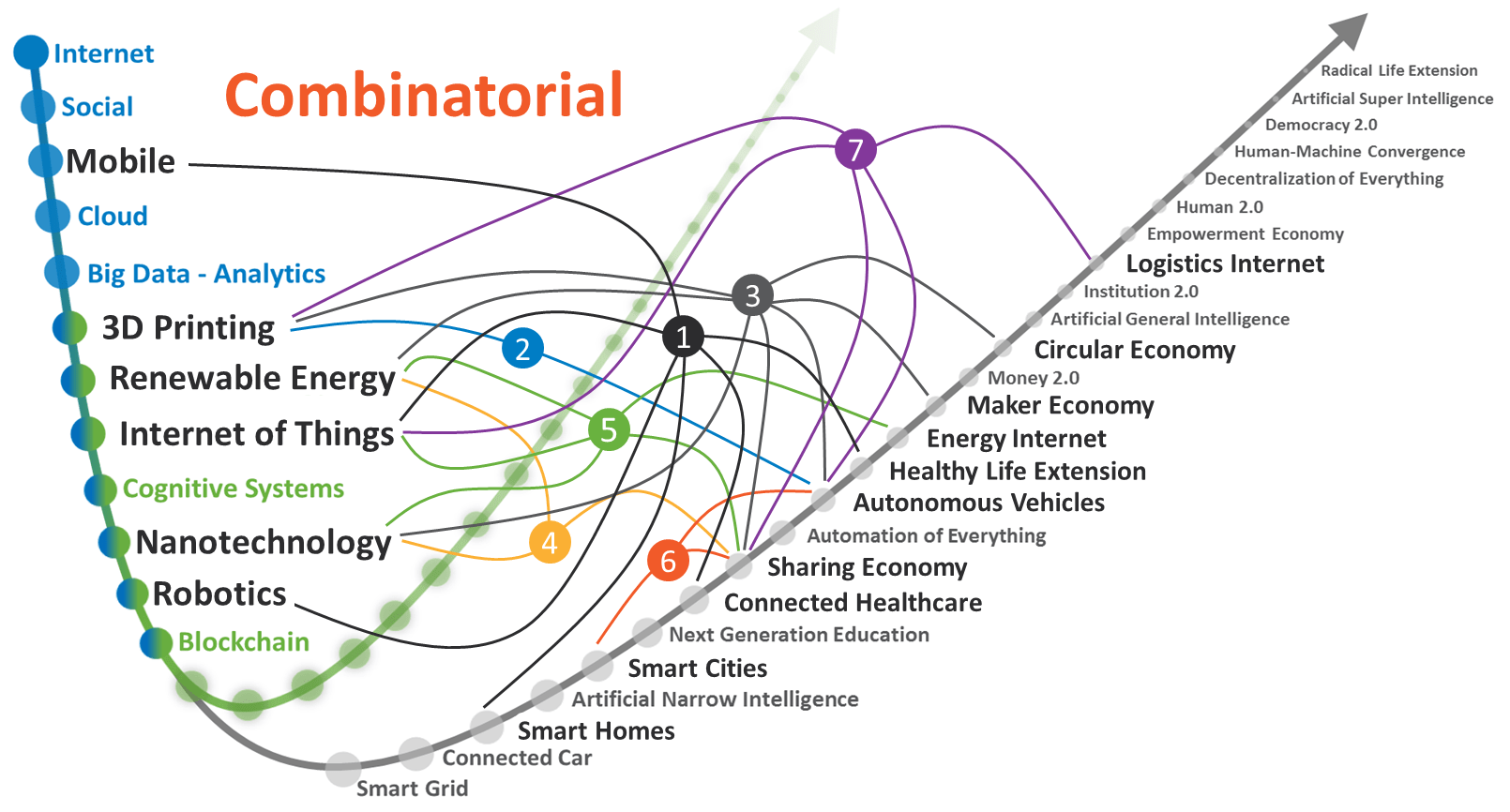
The power lies at the intersections. When I first started using the term “Combinatorial”, people thought I was making words up. Although I would like to take credit for the word, I first came across it when reading The Second Machine Age, a fascinating book by Andrew McAfee and Eric Brynjolfsson. In a post from 2015, I explored several possible combinations that represented disruptive power. A visual from that post attempted to show how science and technology spawned a number of several scenarios, using two curved lines, one for science and technology, and the other for scenarios. As the building blocks combined across the curves, the world would transform.
Continue readingEcosystems Set To Redistribute $60 Trillion In Annual Revenue By 2025
In a post back in 2013, I focused on value ecosystems and how they would blur the lines between industries, making Industry constructs irrelevant in the future. At the time, I said the phenomenon would accelerate and companies would ultimately identify the relevant ecosystem(s) that enable their growth strategies. It was clear back then that ecosystems are complex, relationship-oriented, and represent future growth opportunities that are increasingly outside a company’s traditional business.
Continue readingEmerging Signals On The Future Of Work
While the world continues to navigate the challenges of a global pandemic, discussion of a post-pandemic future is ramping. The future of work is a dominant piece of that post-pandemic discussion. There are still more questions than answers, but the signals are flying. Three recent articles focused on distinct pieces of this future: Performance, Identity Economy, and Making a Hybrid Work model. The article on performance highlights the pandemic as catalyst and accelerant. The need to rethink how we view performance was clear pre-pandemic – but mostly not acted upon. The events of the last 15 months may be driving action.
Continue reading Reimagining the Future