Our exponential world puts increasing pressure on our capacity to innovate and the speed and quality of idea flow. This dynamic coupled with the speed at which automation is likely to occur brings our right brain characteristics front and center. Creativity, imagination, big picture vision, emotional and social intelligence, empathy, and other human characteristics are critical to navigating in this emerging future. As automation accelerates, these human traits become even more critical. In a recent report by Citi on Technology at Work, the authors point to our propensity for social interaction, communication, and empathy being something machines can never replace.
Continue readingOur Emerging Future
All aspects of our emerging future
Digital: We’ve Only Just Begun
“Digitization has barely started, and so has the accompanying upheaval”
– Jacques Bughin, Mckinsey
That’s a scary thought – but accurate. That thought comes from a recent Mckinsey Insights post titled: Think digital is a big deal? You ain’t seen nothing yet. Thanks to Heidi Schwende for sharing this article.
Their research finds that digital technologies and processes have penetrated only about 35% of an average industry, which says that a third of the products and operations that could be digitized have been. Yet this is more than thinking about digitizing the other 65% – it’s a moving target. The phrase “You ain’t seen nothing yet” captures that well. As the innovation accelerators that I describe in my Anchor Visual accelerate, digital is merely the foundation. A reimagined world is built on that foundation – and without it, organizations cannot participate in Reimagination. Here are other key insights from the Mckinsey post:
Reimagining the Future – A Journey Through the Looking Glass
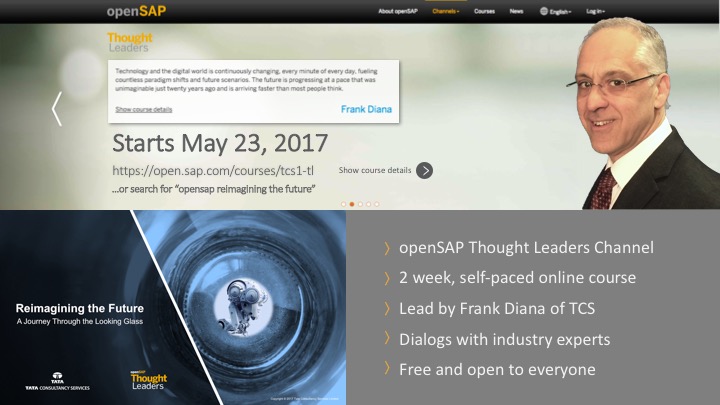
I have spent the better part of two months filming an online thought leadership course focused on our emerging future. The free course will be available starting May 23rd. I had the pleasure of working with futurists Gerd Leonhard, Gray Scott, and Chunka Mui. In addition, I was joined by Element Fleet Management executive Michele Cunningham, as well as TCS CTO Ananth Krishnan, and BRP CIO Hassan El Bouhali.
A video promo of the course along with the course description are available here. I hope you take the time to journey with me through the looking glass. course summary and bios for my guests are also included below.
How will we Interact in the Future?
In recent post on the transformation of interaction, I talked about the changing ways in which we interact with our machines and each other. These changes combine with the emergence of ecosystems to complicate the experience journey. Well, if you saw my last post on our possible future, that journey could get very complicated. I’ve expanded my original visual to incorporate three additional categories of interaction, and some of what science and technology have in store (potentially) for our interaction paradigms. Continue reading
See the Future, Rehearse it and Adapt to the Inevitable Shifts
In my last post, I described a Sense and Respond model that sits at the heart of several activities, including scenario, opportunity, and risk analysis. As complexity and pace continue to intensify, uncertainty increases. To survive in this Emerging Future, we must embrace a framework for future thinking, and an organization that can adapt as it shifts. In essence, we must see the future, rehearse it, continuously monitor for shifts, and adapt as the shifts occur. A sense and respond model sits at the core of the framework – but represents the biggest cultural challenge.
Uncertainty Drives the need to Sense and Respond
“The rhythm of technology is changing the rhythm of business, and we’re all going to need to adapt” – Jeff Gothelf and Josh Seiden, Authors of Sense and Respond
Back in 2013, in a post on sense and respond systems, I talked about the drivers that would push organizations towards a sense and respond paradigm. There are no bigger drivers than volatility and uncertainty, and nearly four years since that post, that fact is becoming clearer. In a recent book by Jeff Gothelf and Josh Seiden, they elevate sense and respond to a position that is core to achieving an adaptive enterprise. They see feedback loops and a movement away from command and control as the enabling mechanisms that allow us to thrive in the digital age.
Continue readingIntersections Promise to Drive Multiple Paradigm Shifts
Since the time I completed this post on Disruptive Power and Intersections, it continues to receive attention. It is by far the most effective component of any Future Thinking effort. Given the continued traffic to this two year old post, I am updating with current content. The visual below connects the intersections of 8 combinatorial scenarios. This is not an exhaustive set of connections; it is strictly intended to describe the scenarios at a high level. 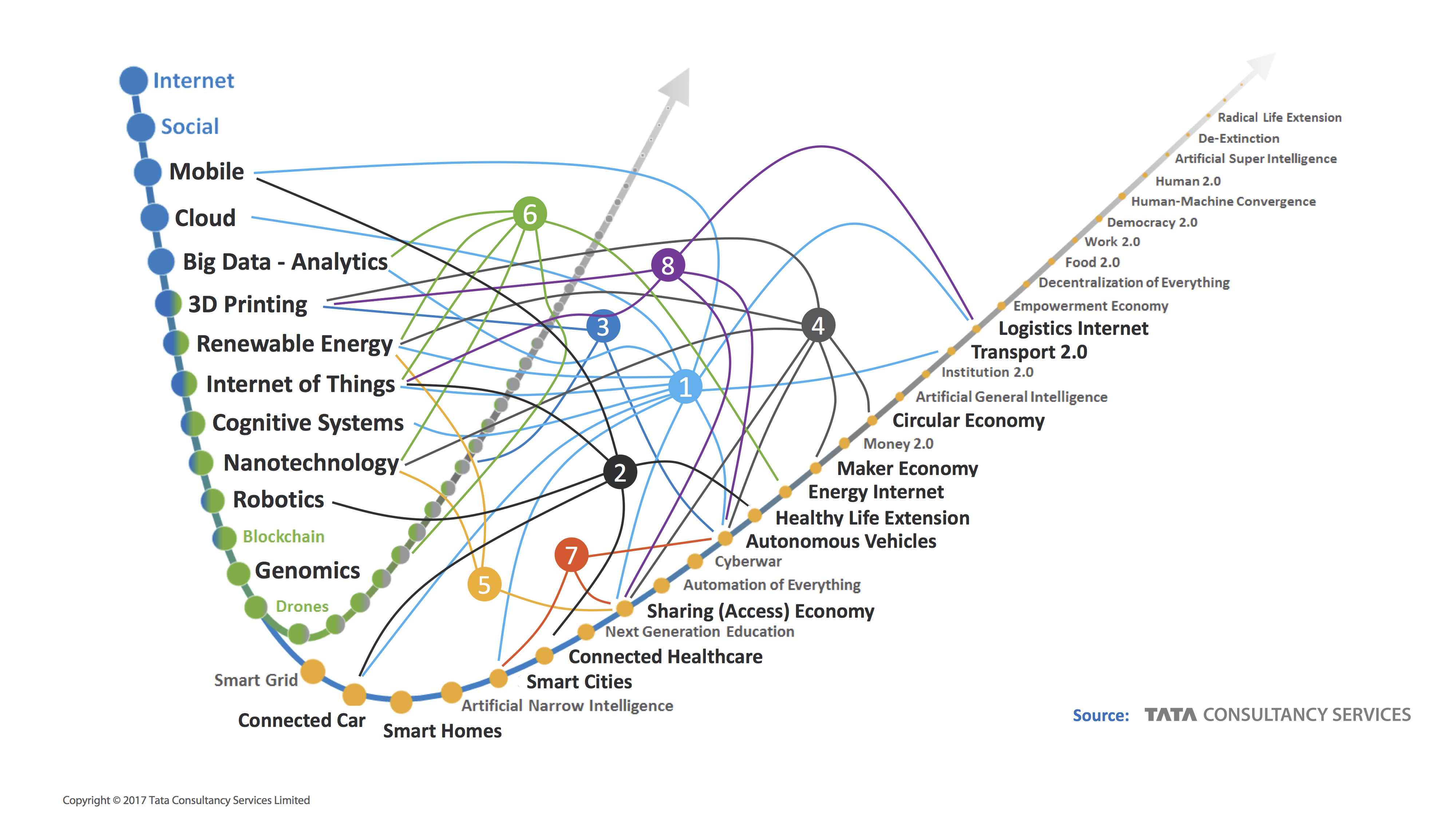
Figure 1: Intersections amplify both power and impact
The Experience Journey Gets Complicated
My ongoing work on emerging future scenarios has driven a renewed focus on experience. Several factors are converging to shift the experience end game; specifically, the evolution of Ecosystems and the transformation of Interaction. These two forces – themselves the result of combinatorial innovation – are converging. While the way we interact continues to shift, a parallel evolution towards ecosystems is occurring. This ecosystem evolution introduces systemic complexity and combines with a shifting interaction paradigm to alter the way we think about experience.
 Figure 1: Phase One of a pending shift in interaction paradigms
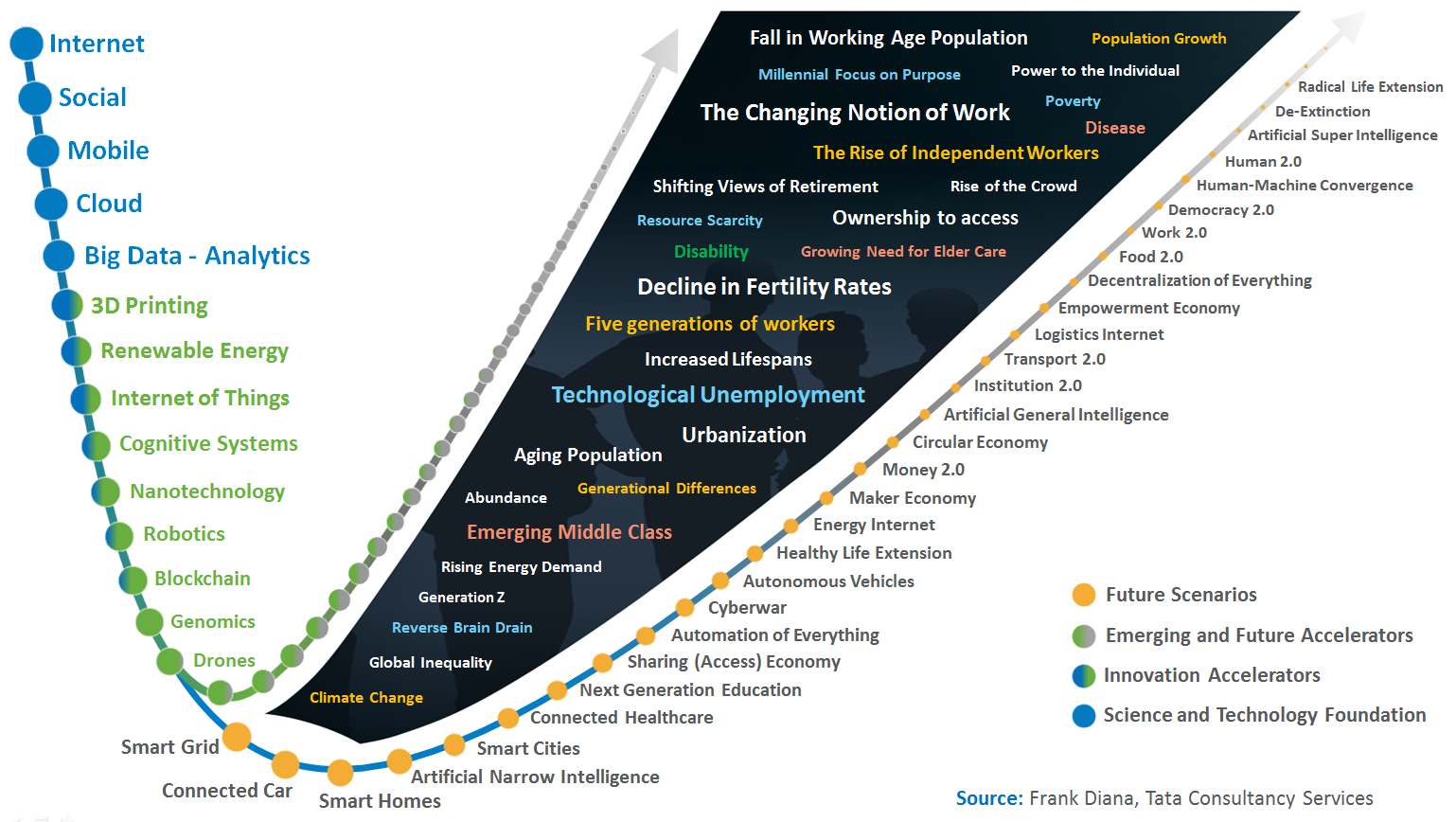
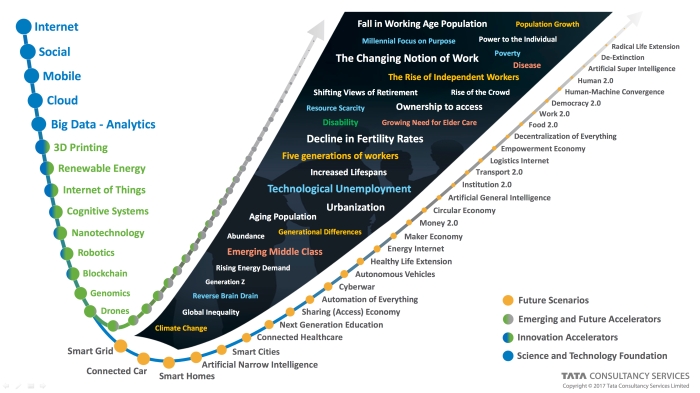
Visualizing our Emerging Future
As the pace of science, technology, and societal change accelerates, a vision of our future is emerging. Many future scenarios are viewed as science fiction, or thought to have timelines that are too far into the future to worry about. I hold a firm belief that these timelines are collapsing and future scenario analysis is critical both at a business and societal level.
I have used this visual as a driver of future scenario analysis. It has been captured and utilized in workshop and events. It is described in a post on Connecting Dots, which I view as a critical leadership trait.
The Collapse of Traditional Structures: An Ecosystem Evolution
In my previous post on the Transformation of Interaction, I mentioned the emergence of ecosystems and their likely impact on how we experience life. Together, the evolution of interaction and ecosystems plays a significant role in how we view experiences going forward. I referred to this in 2013 as the movement towards Next Generation Experiences. In the coming months, I will share a point of view that captures a finite set of future ecosystems. To position that discussion, it is helpful to look at how this evolution may ensue.

The Transformation of Interaction
Back in 2013, as Smartphone use was growing, I wrote about Next Generation Experiences; viewing customer experience through a lens of constant change, where failure to address foundational elements meant falling further behind. Since then, our mode of interaction witnessed a third transformation, as touch became a critical piece of our everyday experiences. Now, we find ourselves approaching the next significant change in interaction paradigms: the Fourth Transformation driven by mixed reality.
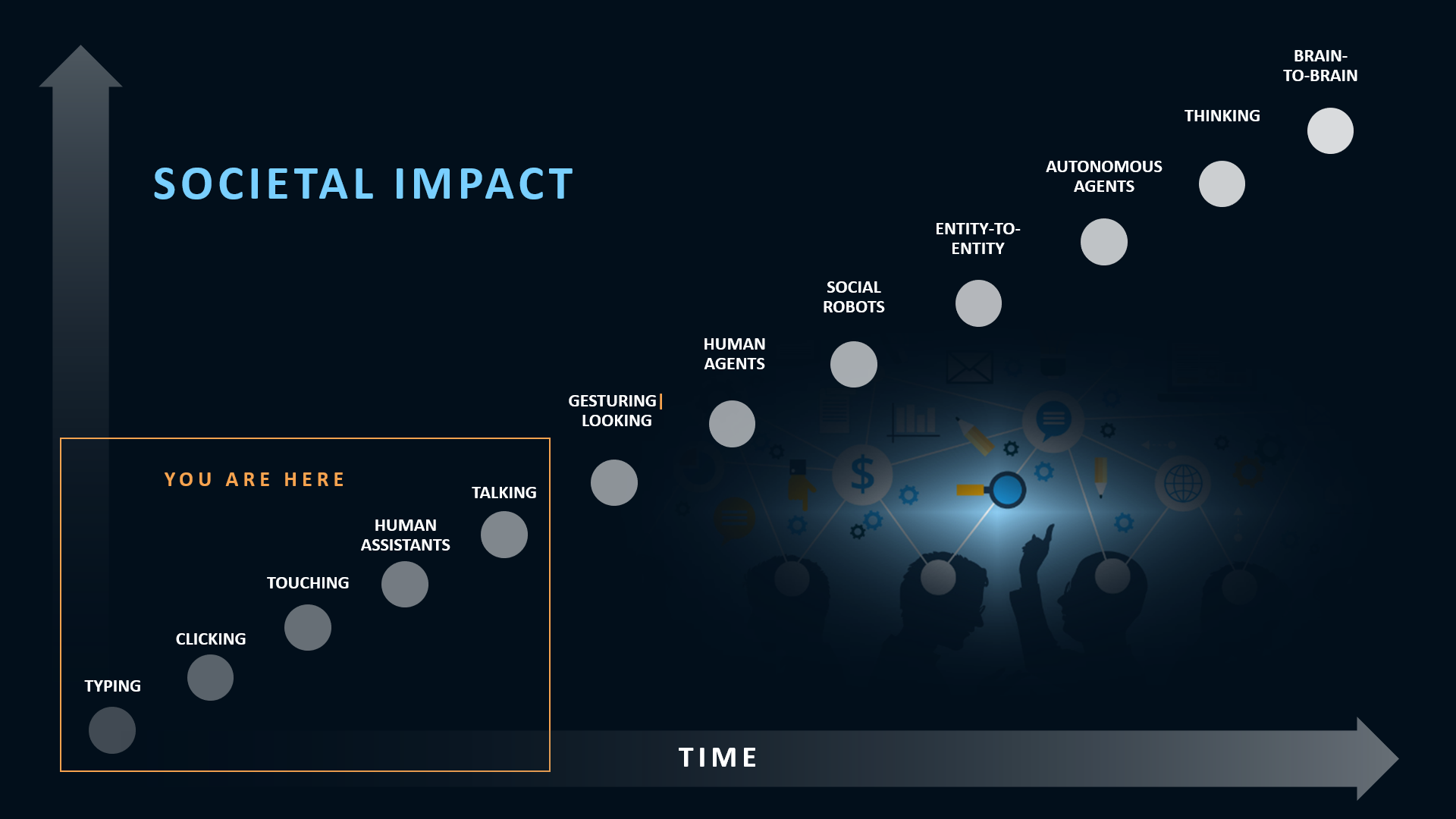
Technological Tipping Points
The World Economic Forum’s annual meeting occurred last week in Davos with a theme of responsive and responsible leadership. The session had me thinking back to research conducted by their Global Agenda Council in March 2015 on the Future of Software & Society. The research focused on technological tipping points and the perception of when these tipping points would occur. The responses from a community of over 800 executives and experts from the information and communications technology sector were used to produce a timeline of possible tipping points ranging from 2018 to 2027.
Continue readingPodcast with Gerd Leonhard
This morning I had the pleasure of discussing the future with Gerd Leonhard. Gerd was listed by Wired Magazine as one of the top 100 most influential people in Europe. His recent book on Technology vs Humanity begins the dialog on ethics in an exponential world.
Our theme was reimagining the future and the topics ranged from artificial intelligence to exponential progression.
Reimagining the Future
The future is arriving faster than most people think.
When we look around us, we see a world in which digital is now woven into the fabric of our lives. Where convergence of paradigm shifts is now the new norm and the pace of change is accelerating exponentially. We are now living in a looking-glass world; where everything we think we know is being challenged, including our long-held notions of success and failure. At the same time it’s a world where we can imagine, create and enable like never before.
Revolution and the Innovation wheel
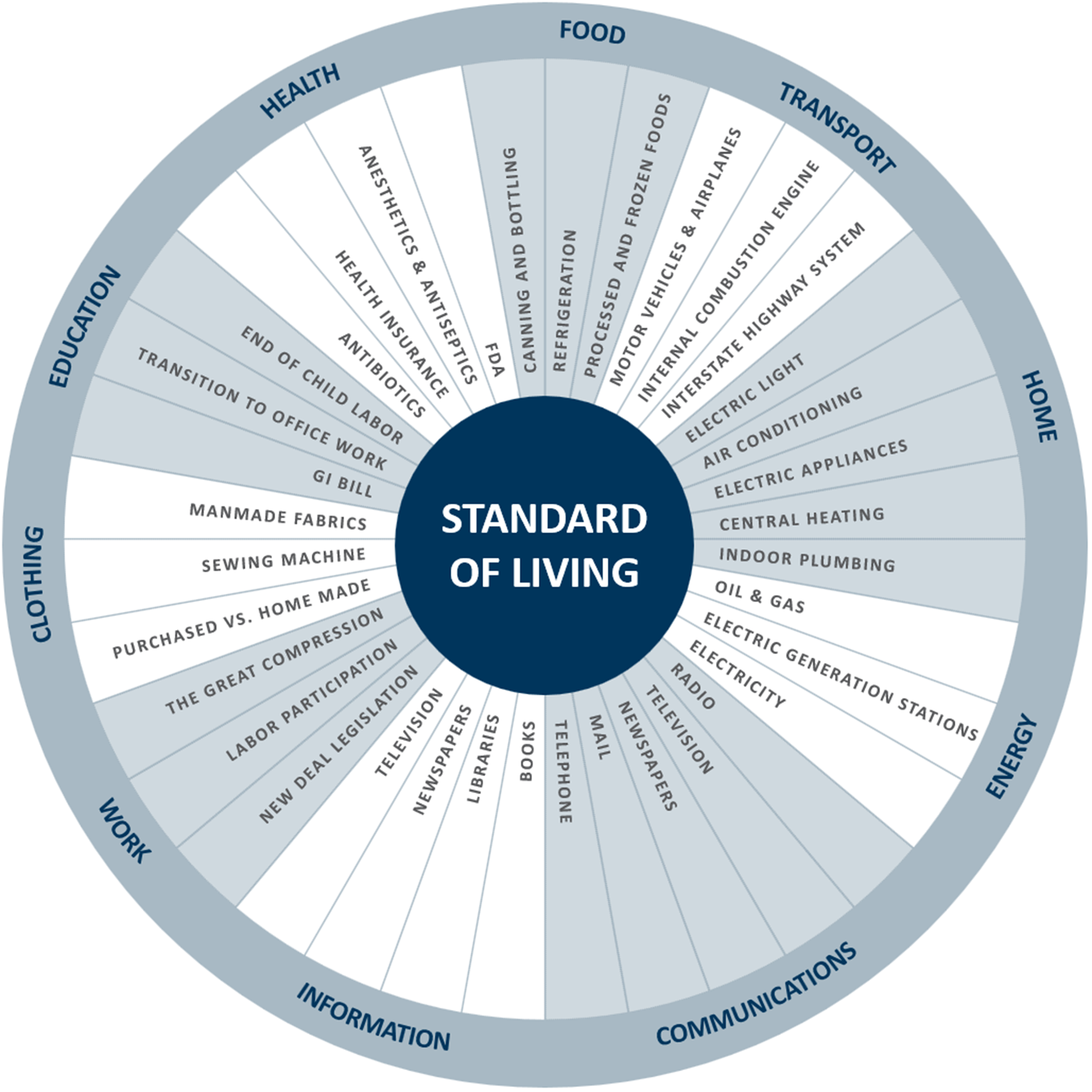
In a brilliant journey through the economic history of the western world, author Robert J. Gordon looks at The Rise and Fall of American Growth. This recent book focuses on a revolutionary century that impacted the American standard of living more than any period before or after. Our standard of living is typically viewed as the ratio of total production of goods and services (real GDP) per member of the population. But this measure fails to truly capture enhancements to our well-being. Human well-being is influenced by advances in the areas of food, clothing, shelter, energy, transport, education, health, work, information, entertainment, and communications. The special century (1870 – 1970) that followed the Civil War was made possible by a unique clustering of what the author calls the great inventions. Clearly – as the visual I developed depicts – the great inventions of the second industrial revolution significantly improved our well-being:
Techno-Optimist or Techno-Pessimist?
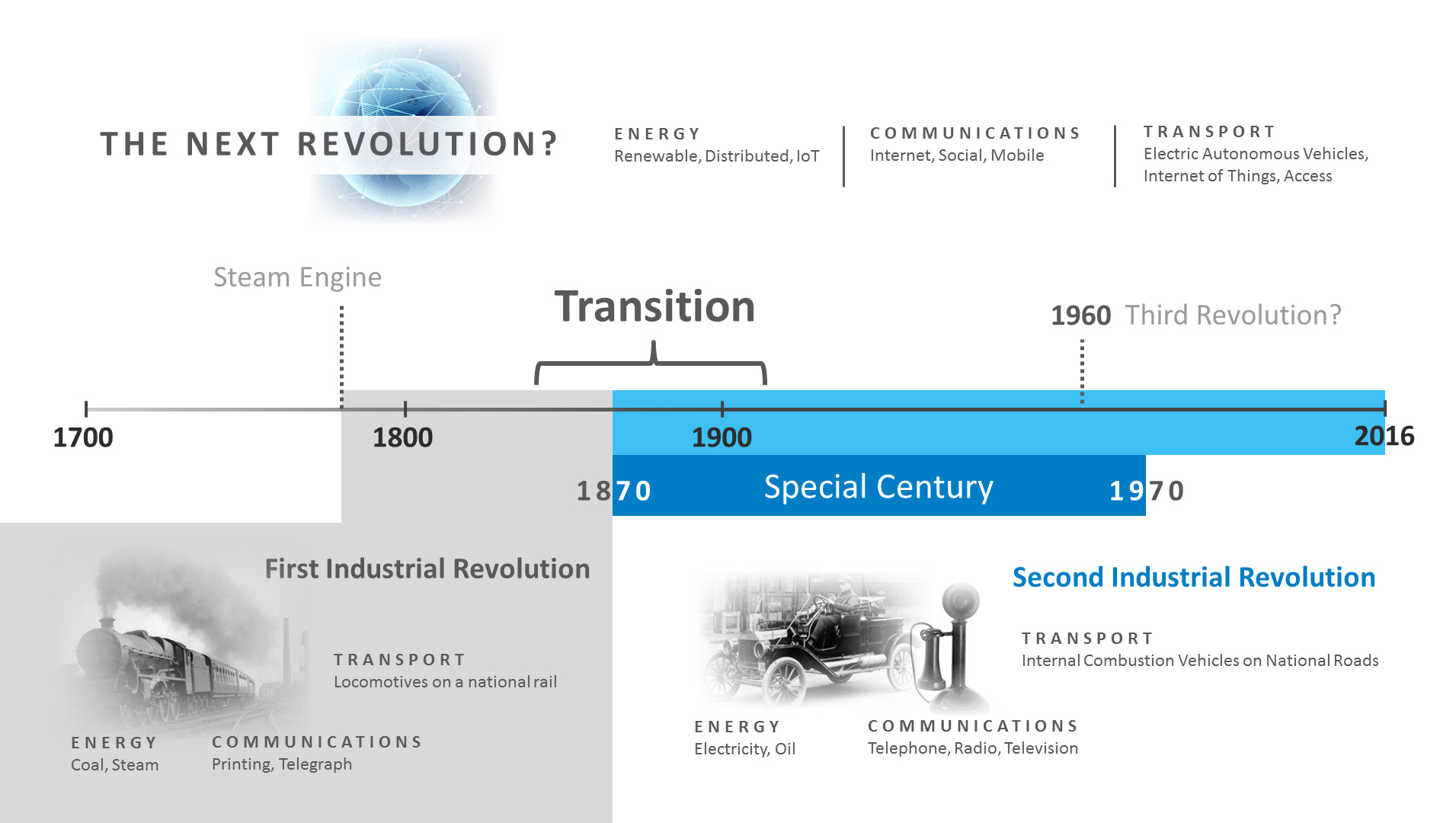
A recent book by Robert J. Gordon titled The Rise and Fall of American Growth shines a light on technological innovation and its past and future impact on growth. The premise of the book is that the innovations of the special century (1870 – 1970) cannot be replicated. As such, the author does not envision a return to growth for America (hence the title). The book is very well written, and I will touch on aspects of it in future posts. For this post, I’d like to gauge the reader’s level of optimism or pessimism.
Innovation Killer Organization Chart
Heidi Schwende recently shared a picture on LinkedIn that perfectly captures the challenges facing large traditional companies. Exponential progression, the pace it is driving, and the capacity of companies native to digital to innovate put the traditional company at a severe disadvantage.
Technological Socialism and Demonetization
In a recent post titled Demonetized Cost of Living, Peter Diamandis describes how technological socialism (i.e. having our lives taken care of by technology) will drive our cost of living close to zero. A similar case was made by Economist Jeremy Rifkin in his book titled The Zero Marginal Cost Society. Diamandis defines demonetization as the ability of technology to take a product or service that was previously expensive and making it substantially cheaper, or potentially free; removing money from the equation. Demonetized is one of the Six D’s of digital, as described by Diamandis.
Technology and Ethics
Some in the Futurist community are focused on technology and ethics. Gerd Leonhard has been particularly vocal on the topic. I’ve dedicated a section of my keynote to what I believe will be a growing dialog. I use this slide to pose a question to the audience:
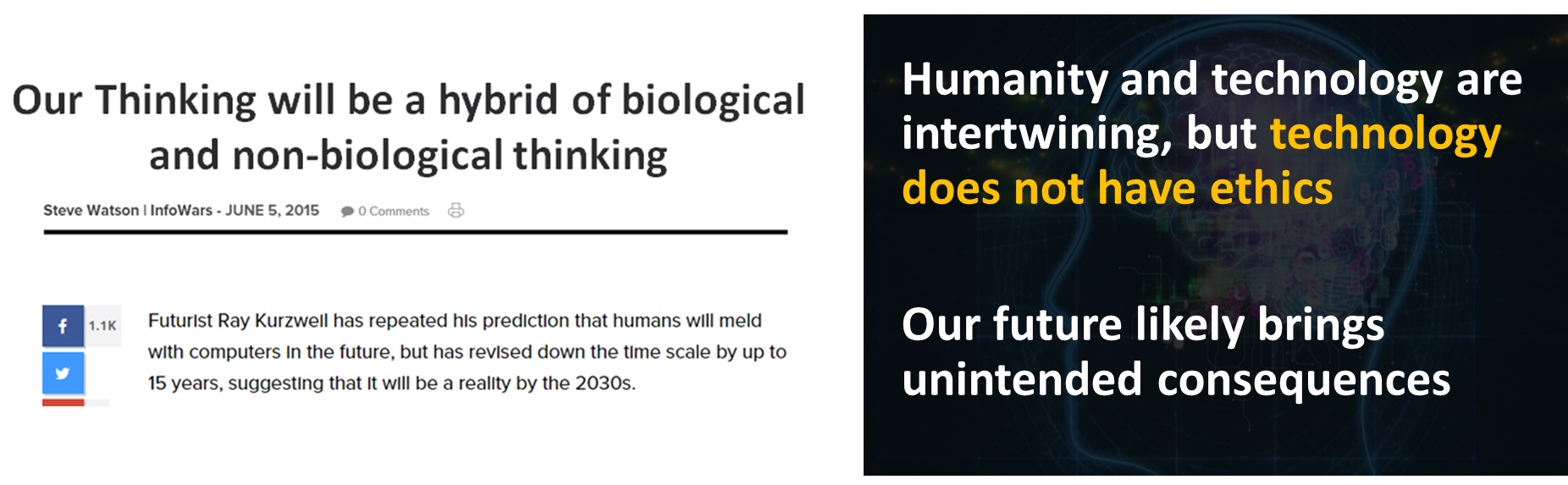
The example provided above comes from Ray Kurzweil, famous Futurist, Inventor and author. In an appearance at last years Exponential Finance conference, Kurzweil said this:
“Our thinking will be a hybrid of biological and non-biological thinking. We’re going to gradually merge and enhance ourselves. In my view, that’s the nature of being human – we transcend our limitations. We’ll be able to extend (our limitations) and think in the cloud. We’re going to put gateways to the cloud in our brains.”
Ecosystem Models and Value Design
The road to future ecosystems is paved by stakeholder action in the coming decades. These ecosystems support life experiences and have no regard for industry boundaries. Over time, established peer-to-peer relationships lead to value creation and capture for all ecosystem participants. Along the way, value design gets complicated, as multi-stakeholder ecosystems introduce complexity. It is value design that I believe challenges traditional thinking, both in how we view relationships and how we share value. As traditional thinking gives way, the resulting ecosystems have the potential to move towards the collaborative commons described by Jeremy Rifkin.
 Reimagining the Future