Digital: We’ve Only Just Begun

“Digitization has barely started, and so has the accompanying upheaval”

Jacques Bughin, Mckinsey

That’s a scary thought – but accurate. That thought comes from a recent Mckinsey Insights post titled: Think digital is a big deal? You ain’t seen nothing yet. Thanks to Heidi Schwende for sharing this article.

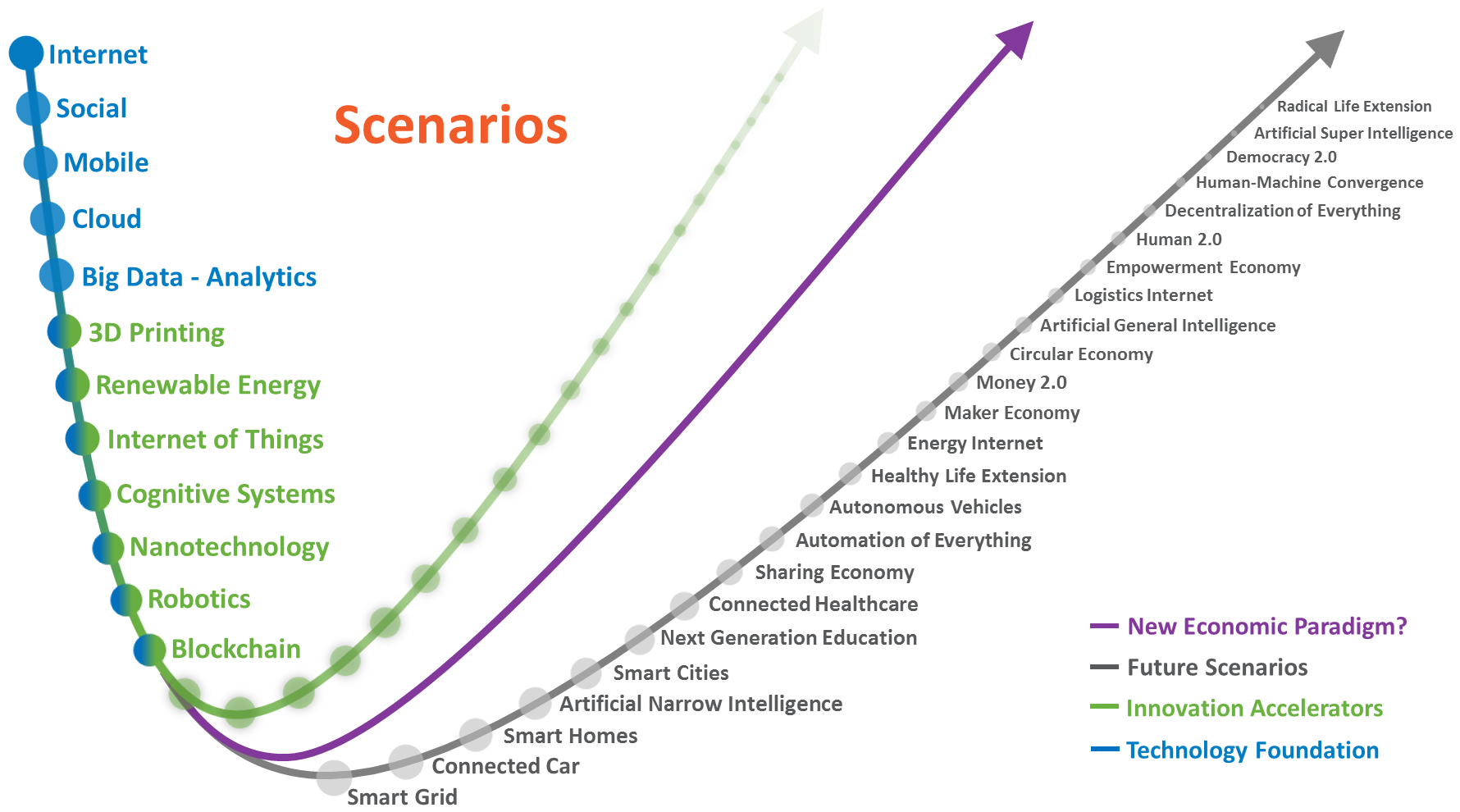
Their research finds that digital technologies and processes have penetrated only about 35% of an average industry, which says that a third of the products and operations that could be digitized have been. Yet this is more than thinking about digitizing the other 65% – it’s a moving target. The phrase “You ain’t seen nothing yet” captures that well. As the innovation accelerators that I describe in my Anchor Visual accelerate, digital is merely the foundation. A reimagined world is built on that foundation – and without it, organizations cannot participate in Reimagination. Here are other key insights from the Mckinsey post:

Continue reading

Reimagining the Future – A Journey Through the Looking Glass

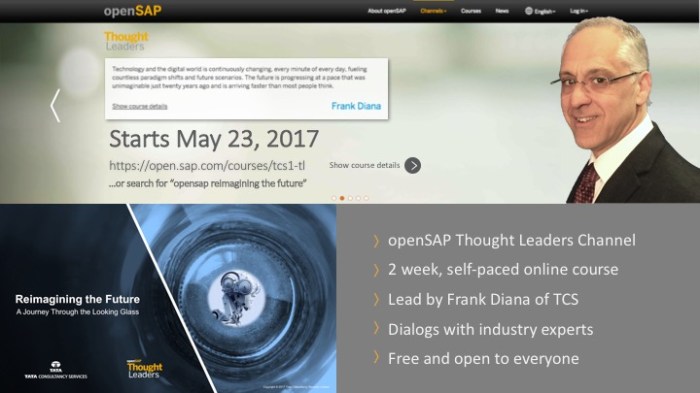
openSAP Promo Slide

I have spent the better part of two months filming an online thought leadership course focused on our emerging future. The free course will be available starting May 23rd. I had the pleasure of working with futurists Gerd Leonhard, Gray Scott, and Chunka Mui. In addition, I was joined by Element Fleet Management executive Michele Cunningham, as well as TCS CTO Ananth Krishnan, and BRP CIO Hassan El Bouhali.

A video promo of the course along with the course description are available here. I hope you take the time to journey with me through the looking glass. course summary and bios for my guests are also included below.

Continue reading

How will we Interact in the Future?

In recent post on the transformation of interaction, I talked about the changing ways in which we interact with our machines and each other. These changes combine with the emergence of ecosystems to complicate the experience journey. Well, if you saw my last post on our possible future, that journey could get very complicated. I’ve expanded my original visual to incorporate three additional categories of interaction, and some of what science and technology have in store (potentially) for our interaction paradigms. Continue reading

Uncertainty Drives the need to Sense and Respond

“The rhythm of technology is changing the rhythm of business, and we’re all going to need to adapt”Jeff Gothelf and Josh Seiden, Authors of Sense and Respond

Back in 2013, in a post on sense and respond systems, I talked about the drivers that would push organizations towards a sense and respond paradigm. There are no bigger drivers than volatility and uncertainty, and nearly four years since that post, that fact is becoming clearer. In a recent book by Jeff Gothelf and Josh Seiden, they elevate sense and respond to a position that is core to achieving an adaptive enterprise. They see feedback loops and a movement away from command and control as the enabling mechanisms that allow us to thrive in the digital age.

Continue reading

Intersections Promise to Drive Multiple Paradigm Shifts

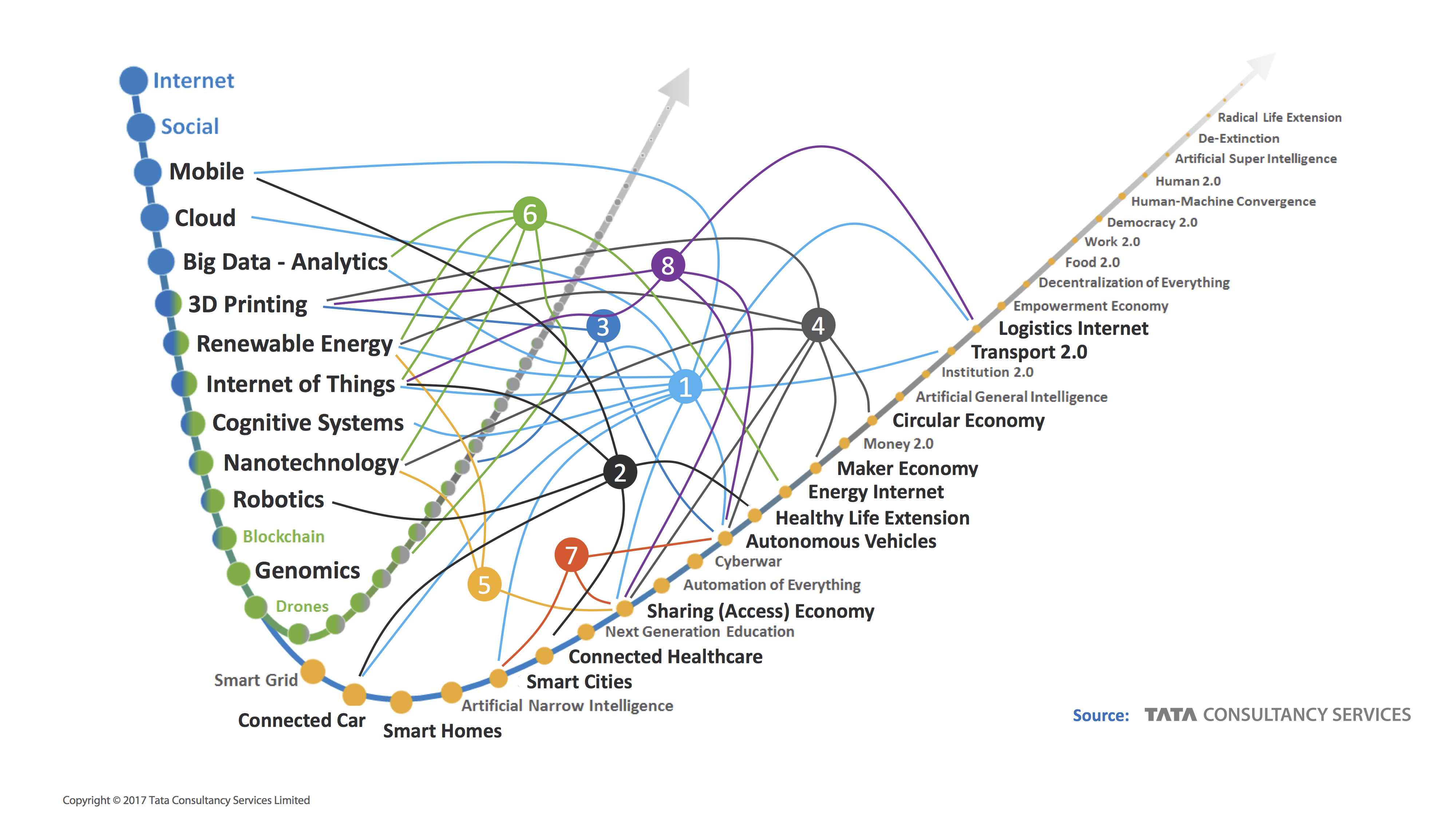
Since the time I completed this post on Disruptive Power and Intersections, it continues to receive attention. It is by far the most effective component of any Future Thinking effort. Given the continued traffic to this two year old post, I am updating with current content. The visual below connects the intersections of 8 combinatorial scenarios. This is not an exhaustive set of connections; it is strictly intended to describe the scenarios at a high level. disruptive-power

Figure 1: Intersections amplify both power and impact

Continue reading

Visualizing our Emerging Future

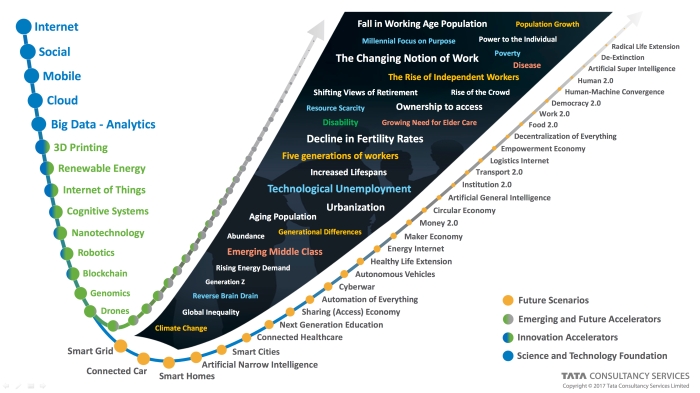
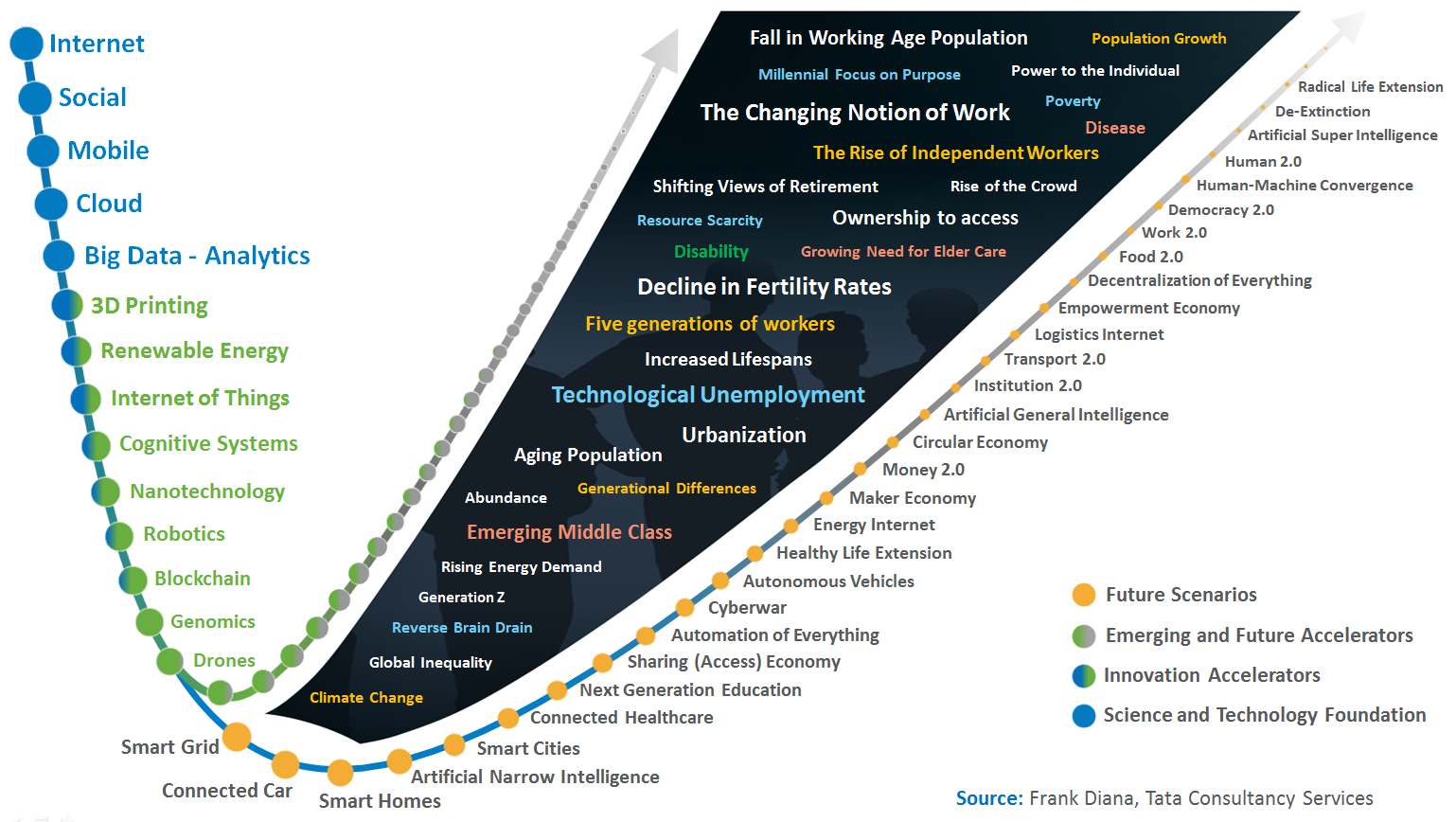
As the pace of science, technology, and societal change accelerates, a vision of our future is emerging. Many future scenarios are viewed as science fiction, or thought to have timelines that are too far into the future to worry about. I hold a firm belief that these timelines are collapsing and future scenario analysis is critical both at a business and societal level.

I have used this visual as a driver of future scenario analysis. It has been captured and utilized in workshop and events. It is described in a post on Connecting Dots, which I view as a critical leadership trait.

emerging-future

The Collapse of Traditional Structures: An Ecosystem Evolution

In my previous post on the Transformation of Interaction, I mentioned the emergence of ecosystems and their likely impact on how we experience life. Together, the evolution of interaction and ecosystems plays a significant role in how we view experiences going forward. I referred to this in 2013 as the movement towards Next Generation Experiences. In the coming months, I will share a point of view that captures a finite set of future ecosystems. To position that discussion, it is helpful to look at how this evolution may ensue.

Ecosystem Maturity Model

Continue reading

Technological Tipping Points

The World Economic Forum’s annual meeting occurred last week in Davos with a theme of responsive and responsible leadership. The session had me thinking back to research conducted by their Global Agenda Council in March 2015 on the Future of Software & Society. The research focused on technological tipping points and the perception of when these tipping points would occur. The responses from a community of over 800 executives and experts from the information and communications technology sector were used to produce a timeline of possible tipping points ranging from 2018 to 2027. 

Continue reading

Podcast with Gerd Leonhard

This morning I had the pleasure of discussing the future with Gerd Leonhard. Gerd was listed by Wired Magazine as one of the top 100 most influential people in Europe. His recent book on Technology vs Humanity begins the dialog on ethics in an exponential world.

Our theme was reimagining the future and the topics ranged from artificial intelligence to exponential progression.

Continue reading

Reimagining the Future

The future is arriving faster than most people think.

When we look around us, we see a world in which digital is now woven into the fabric of our lives. Where convergence of paradigm shifts is now the new norm and the pace of change is accelerating exponentially. We are now living in a looking-glass world; where everything we think we know is being challenged, including our long-held notions of success and failure. At the same time it’s a world where we can imagine, create and enable like never before.

Continue reading

Revolution and the Innovation wheel

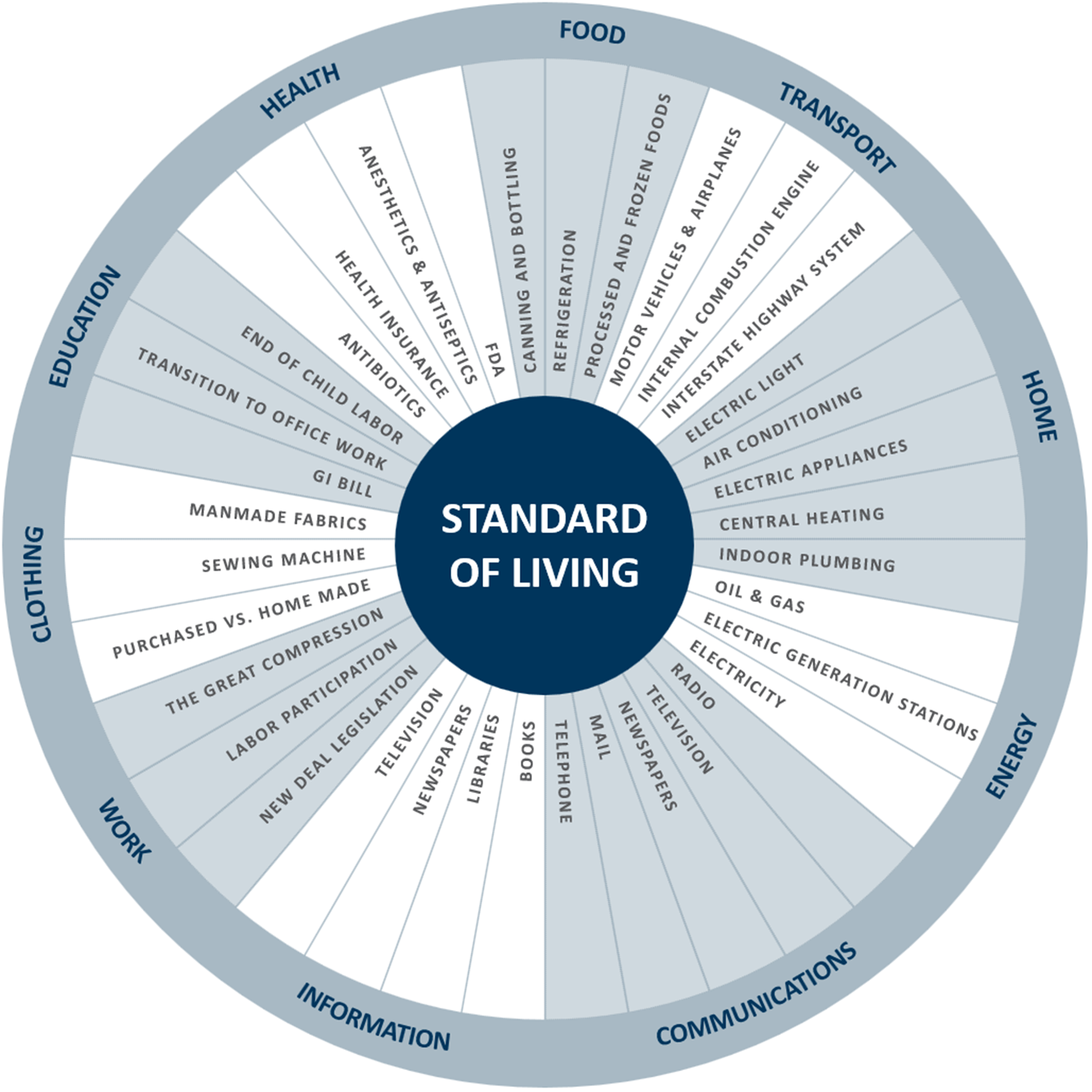
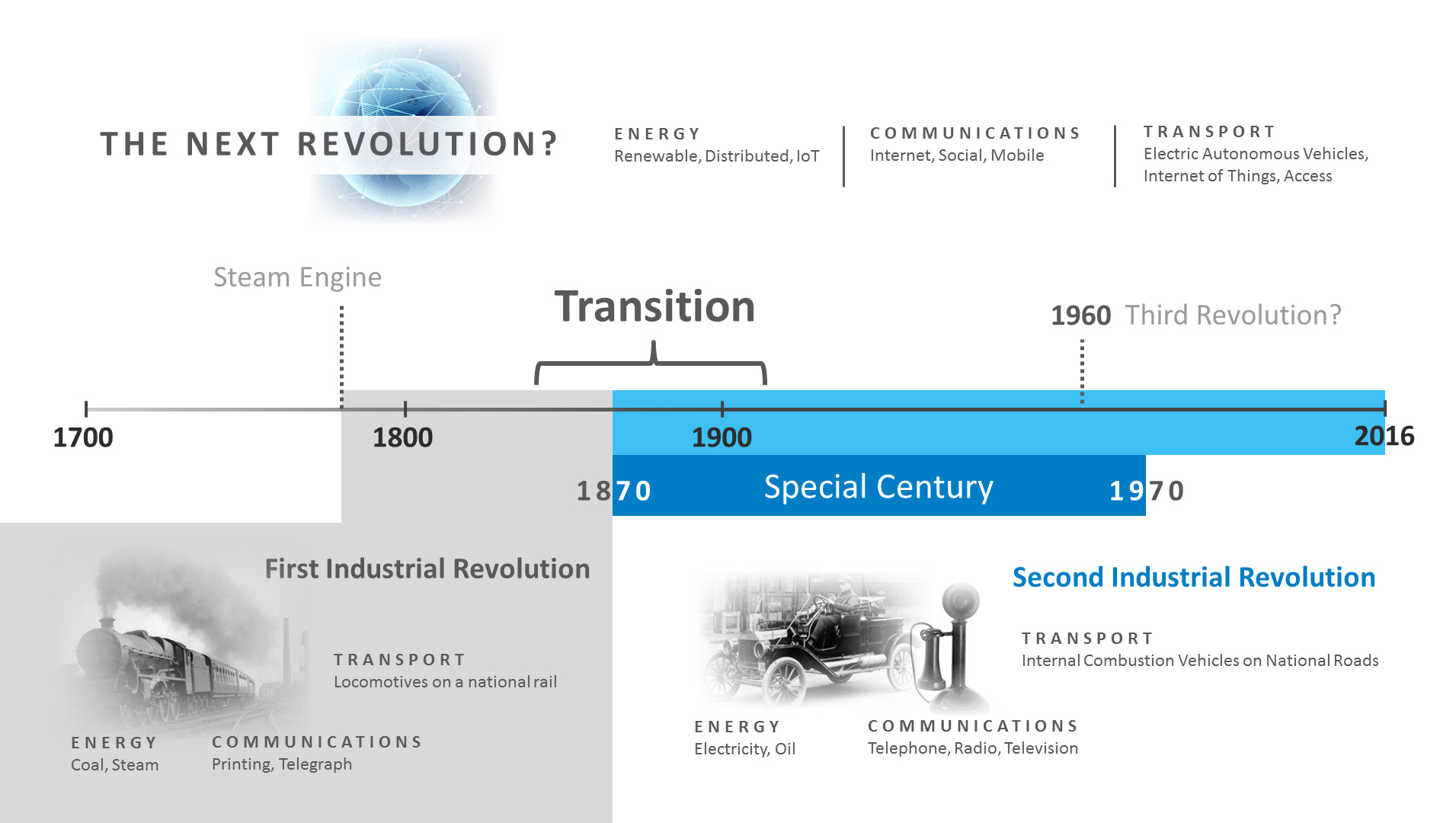
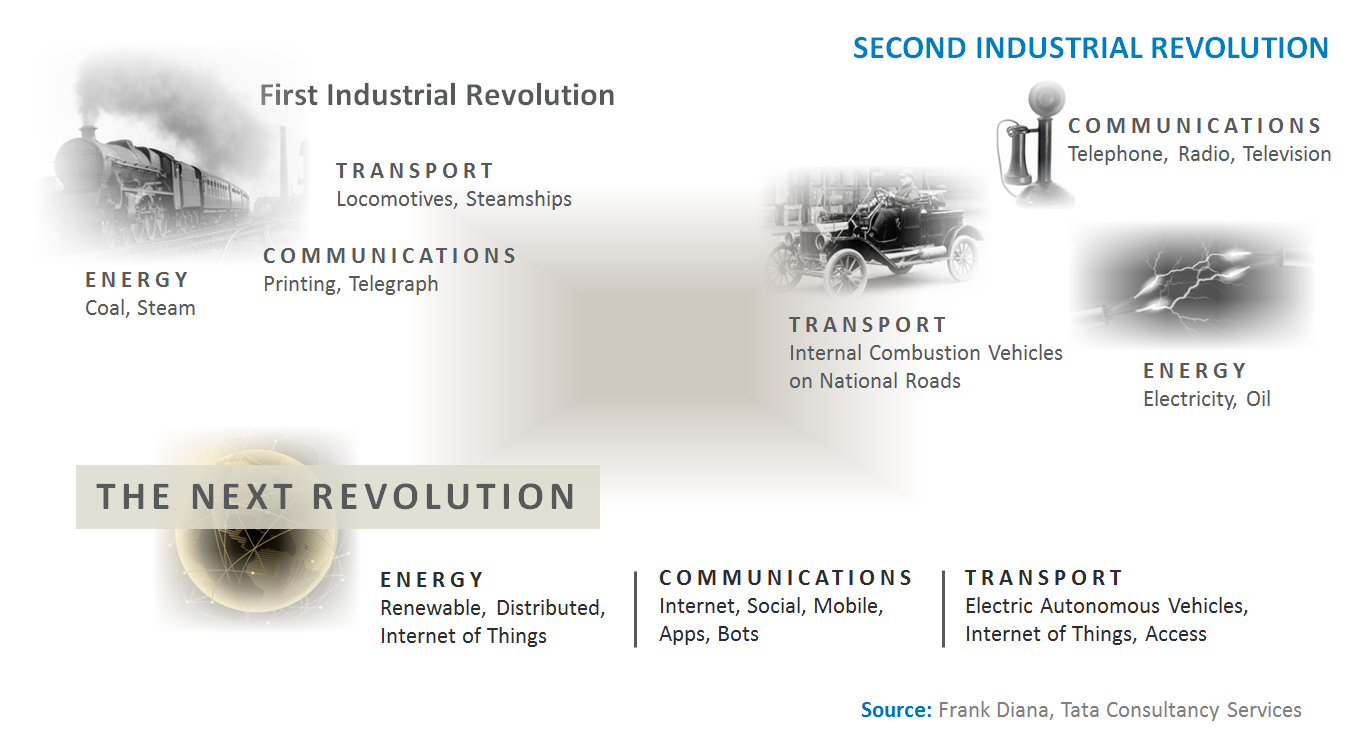
In a brilliant journey through the economic history of the western world, author Robert J. Gordon looks at The Rise and Fall of American Growth. This recent book focuses on a revolutionary century that impacted the American standard of living more than any period before or after. Our standard of living is typically viewed as the ratio of total production of goods and services (real GDP) per member of the population. But this measure fails to truly capture enhancements to our well-being. Human well-being is influenced by advances in the areas of food, clothing, shelter, energy, transport, education, health, work, information, entertainment, and communications. The special century (1870 – 1970) that followed the Civil War was made possible by a unique clustering of what the author calls the great inventions. Clearly – as the visual I developed depicts – the great inventions of the second industrial revolution significantly improved our well-being:

Second Revolution Innovation Wheel

Continue reading

Techno-Optimist or Techno-Pessimist?

the-revolutions

A recent book by Robert J. Gordon titled The Rise and Fall of American Growth shines a light on technological innovation and its past and future impact on growth. The premise of the book is that the innovations of the special century (1870 – 1970) cannot be replicated. As such, the author does not envision a return to growth for America (hence the title). The book is very well written, and I will touch on aspects of it in future posts. For this post, I’d like to gauge the reader’s level of optimism or pessimism.

Continue reading

Technology and Ethics

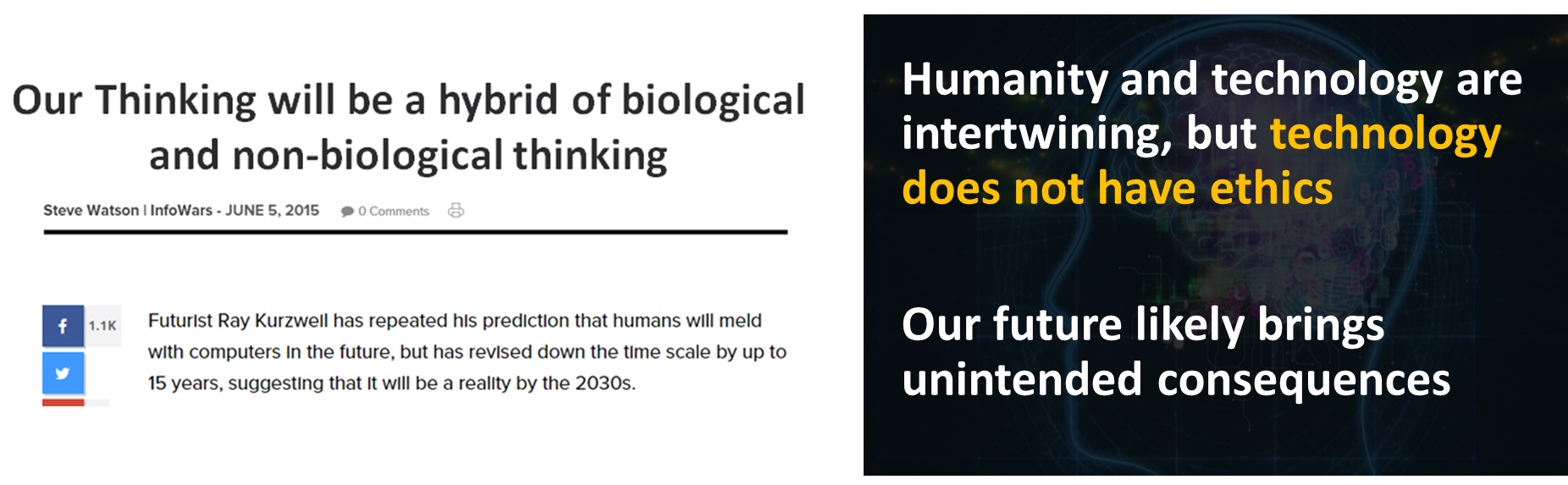
Some in the Futurist community are focused on technology and ethics. Gerd Leonhard has been particularly vocal on the topic. I’ve dedicated a section of my keynote to what I believe will be a growing dialog. I use this slide to pose a question to the audience:

Technology and Ethics

The example provided above comes from Ray Kurzweil, famous Futurist, Inventor and author. In an appearance at last years Exponential Finance conference, Kurzweil said this:

“Our thinking will be a hybrid of biological and non-biological thinking. We’re going to gradually merge and enhance ourselves. In my view, that’s the nature of being human – we transcend our limitations. We’ll be able to extend (our limitations) and think in the cloud. We’re going to put gateways to the cloud in our brains.”

Continue reading

IoT: Unleashing the Mother of all Infrastructures

On a January 26th Game Changers Radio show, a panel of Futurists will focus on the Internet of Things (IoT) and its world changing implications. Here are some of my thoughts in advance of that discussion. I’ll start with a quote from Carl Bildt, Chair of the Global Commission on Internet Governance and a member of the World Economic Forum’s Global Agenda Council on Europe:

“Very soon the Internet of Things will become the Infrastructure on which all other infrastructures are based.”

That bold statement supports thinking in some circles that a General Purpose Technology Platform (GPT)  is emerging, the foundation of which is The Internet of Things. This emerging GPT likely alters our world more dramatically than the GPTs of the first and second Industrial Revolutions:

general-purpose-technology-platform

Continue reading

World Economic Forum – Deep Shift

A must read on six mega-trends, their tipping points and societal impacts. I recommend this for anyone with interest in where the world is heading, and/or tasked with future thinking in the context of strategy. I commend the World Economic Forum for their efforts here, as education is likely to spur action. The six mega-trends are:

  1. People and the internet
  2. Computing, communications and storage everywhere
  3. The Internet of Things
  4. Artificial intelligence (AI) and big data
  5. The sharing economy and distributed trust
  6. The digitization of matter

Here is a tipping point timeline from the report:

Many leaders are struggling with the sheer number of future scenarios and some indication of when the tipping point may arrive. This material provides critical input into the scenario and response analysis process. Enjoy the read.

IDC Predicts a DX Economy

IDC today announced its worldwide information technology (IT) industry predictions for 2016 and beyond. The predictions were published in a new IDC FutureScape report. As we embrace the notion of Future Thinking

This forward looking guidance is critical. Here is a snippet from the report:

“The disruptive impact of digital transformation is about to be felt in every industry as enterprises ‘flip the switch’ and massively scale up their DX initiatives to secure a leadership role in the DX economy,” said Frank Gens, Senior Vice President and Chief Analyst at IDC. “In the next two years, two-thirds of Global 2000 CEOs will put DX at the center of their growth and profitability strategies. By the end of this decade, IDC predicts that the percentage of enterprises with advanced DX strategies and implementations will more than double.”

IDC predicts that the scale-up of digital business strategies will drive more than half of enterprise IT spending within the next 24 months, rising to 60% by 2020. Mastery of 3rd Platform technologies will be table stakes for successfully executing DX business initiatives and “Cloud First” will become the new mantra for enterprise IT. Virtually none of the other 3rd Platform technologies or major DX initiatives is possible in scaled-up implementations without the Cloud as the foundation. By 2020, IDC predicts that enterprise spending on cloud services, the hardware and software to support cloud services, and the services for implementing and managing cloud services will exceed $500 billion, more than three times what it is today.

Source: FutureScape

Additional predictions were provided:

  1. By the End of 2017, Two-Thirds of the CEOs of the G2000 Will Have Digital Transformation at the Center of Their Corporate Strategy
  2. By 2017, 60% Companies with a DX Strategy Will Deem It Too Critical for Any One Functional Area and Create an Independent Corporate Executive Position to Oversee the Implementation
  3. By 2018, 80% of B2C Companies Will Have Created Immersive, Authentic Omni-Experiences for Customers, Partners, and Employees; 60% of B2B-Centric Companies Will Have Done the Same
  4. The Top New Investment Areas Through 2017 Will Be Contextual Understanding and Automated Next Best Action Capabilities
  5. In 2016, 65% of Large Enterprises Will Have Committed to Become Information-Based Companies, Shifting the Organizational Focus to Relationships, People, and Intangible Capital
  6. By 2018, 75% of the G2000 Will Have Deployed Full, Information-Based, and Economic Models or “Digital Twins” of Their Products/Services, Supply Network, Sales Channels, and Operations
  7. By 2020, 60% of the G2000 Will Have Doubled Their Productivity by Digitally Transforming Many Processes from Human-Based to Software-Based Delivery
  8. In 2016, the Level of Connectivity Related to Products, Assets, and Processes Will Increase 50% for All Industry Value Chains
  9. The Sharing Economy Will Give Rise to the Networked Free Agent and Skill-Based Marketplaces, Resulting in More than 10% of Work Being Sourced in this Fashion in Mature Economies by 2019
  10. By 2018, at Least 20% of All Workers Will Use Automated Assistance Technologies to Make Decisions and Get Work Done

No Ordinary Disruption

In my last future of business series post, I focused on a recent book titled No Ordinary disruption. That post explored the author’s belief that our intuitions must be reset. In that same book, the authors explore what they call “trend breaks”, or shifts away from the trends of the recent past. This post will look at these breaks and their impact on 21st century organizations – and it starts with value. In the rapidly growing world of ecosystems, the way value is created and captured is changing. But, more fundamentally, even our traditional views of value are being challenged. The authors use GDP as a way to underscore this point. They estimate that digital capital is now the source of roughly one-third of total global GDP growth, with value delivered via intangible assets like Google’s search algorithm or Amazon’s recommendation engine. Even our long standing view of capital itself is shifting, as human creative capital becomes a critical source of value.

Additionally, future value increasingly accrues to consumers. In a recent article titled Why Every Aspect of Your Business is about to Change, the author talks about the destruction of value for incumbents and the creation of value for consumers in the form of consumer surplus. They use a powerful example to make their point: Skype brought in $2 billion in 2013, but McKinsey calculates that at the same time, they transferred $37 billion away from telecom firms to consumers via free or low-cost calls. Even the innovative new company only gets a fraction of the value created (Skype: $2 Billion, Consumers $37 Billion). So back to value and GDP: consumer surplus is not accounted for in the way we measure GDP. This creates two challenges: First, do we need to change the way we measure value? Second, how do companies monetize the newly created consumer surplus?

So what does this mean for the future of business? Let’s start with something right from the aforementioned book: On the first day of classes at Ivy League colleges, it was common for the dean to warn students: “Look to the left, look to the right. One of you won’t be here next year.” That seems very appropriate when looking through the lens of company viability. This real phenomenon unfolds over the next decade, driven in part by several trend breaks as identified by the authors:

Continue reading

Your business is about to change – Fortune

Source: Why every aspect of your business is about to change – Fortune

Great piece. This is very timely given the future of business series that I am currently focused on. The major themes:

  1. Asset heavy to asset-light
  2. Employees are the business – but you likely need less of them
  3. Winners win big, the rest fight very hard
  4. Corporate life expectancy shrinks
  5. The continued move towards a frictionless economy
  6. Speed equals survival
  7. Low capital companies out performing heavy capital competitors
  8. Growth before profits
  9. The 21st Century Corporation
  10. Competition gets tougher

Enjoy the read!

A version of this Fortune article appears in the November 1, 2015 issue of Fortune with the headline “Every aspect of your business is about to change.”

Intuition Resets

Will our fundamental beliefs be challenged in the coming decade? In a recent book titled No Ordinary Disruption, the authors talk about the need for an intuition reset, where everything we thought we knew about the world seems to be wrong. They see our world changing radically from the one in which those intuitions that drive our decision making were formed. Skeptics abound, but I for one see the writing on the wall. In the future-of-business series kick-off, I focused on Future Scenarios as a major force in altering the future of business. Let’s continue the series by focusing on other forces.

In the book referenced above, the authors compare the coming transformative period with the Industrial Revolution of the late 18th and early 19th centuries – where one new force changed everything. As I have tried to depict in my future scenario Visual, we are dealing with multiple forces or shifts that are converging. In their analysis, the authors conclude that our world is undergoing an even more dramatic transition due to this convergence. They focus on four forces (urbanization, technological change, aging, and connectivity) and deem that any of them would rank among the greatest changes the global economy has ever seen. Compared with the Industrial Revolution, they estimate that this change is happening ten times faster and at 300 times the scale, or roughly 3,000 times the impact – digest that as you consider whether our fundamental beliefs will change in the coming decade. Here is a quote from the book: “Although we all know that these disruptions are happening, most of us fail to comprehend their full magnitude and the second and third-order effects that will result. Much as waves can amplify one another, these trends are gaining strength, magnitude, and influence as they interact with, coincide with, and feed upon one another. Together, these four fundamental disruptive trends are producing monumental change”

Continue reading

Future Scenarios

In my recent post on the Future Business Landscape, I shared predictions pulled together by SAP. The sources for this type of information are multiplying, which for me signals the start of a growing focus on the future of business. With this post, I am launching a series that delves into what that future might look like, starting in a logical place with future scenarios. This visual representing a series of paradigm shifts has anchored my thinking for some time, and sits at the heart of this future.

 emerging-future

Continue reading