
As we have seen over the last several months. COVID-19 is impacting multiple domains. I had explored the Possible Implications across these domains in a post earlier this year. The visual below reflects some of that work (click to enlarge). Now months later, we see indications of potential paths or responses.
Continue readingFuture Scenarios
A Glimpse Into Your Views On Catalysts For Change
As I mentioned in a recent Post, the global pandemic has altered how we think about our world. However, one thing is constant if not amplified by it: society needs to act if we hope to shape a future that advances human development. The rapid pace of innovation – riding on antiquated institutions – required our attention pre-pandemic. In a post-pandemic world, both of those factors are amplified. The inadequacies of our institutions are more visible now than ever; and innovation that may have unfolded over years is realized in months.
Continue readingThe World
When we look into the future and try to understand its path, we must consider the geopolitical sphere as a key area of influence. To that end, I just added another book to my Book Library. The World: A Brief Introduction was written by Richard Haass, an American Diplomat. Per the book abstract, The World is designed to provide readers of any age and experience with the essential background and building blocks they need to make sense of this complicated and interconnected world.
Human Development Index
Human development has advanced considerably since the start of the industrial revolution. 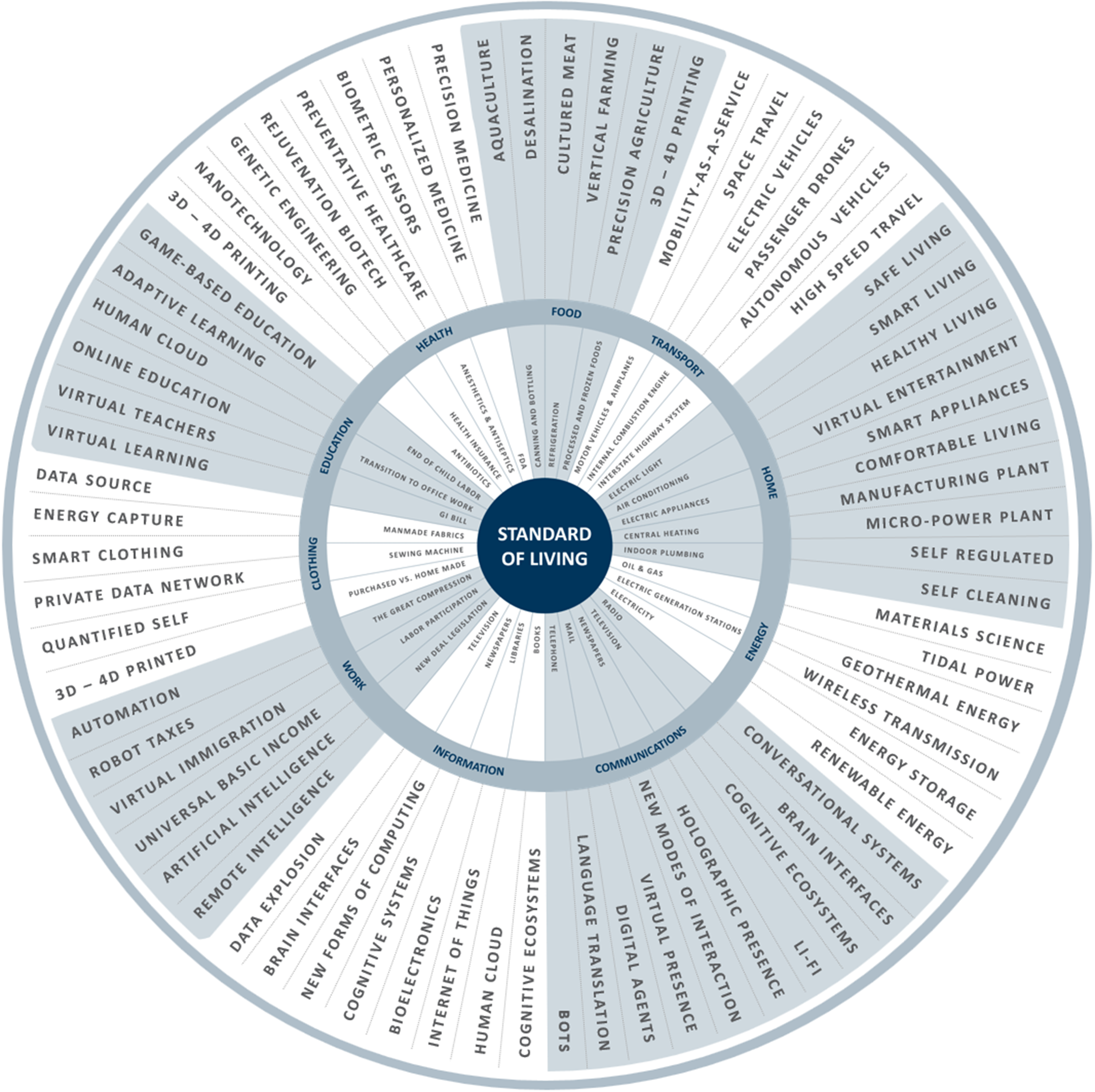 Economist Robert J. Gordon describes this Human Development Journey and concludes that, as far as standard of living is concerned, we have journeyed as far as we can. While thinking about that assessment, I set out to consider this new age of great invention and its impact on human development. The result was the development of this innovation wheel (click to enlarge).
Revisiting The Catalysts Of Change
Seems like an eternity has past since I first launched this Poll on the catalysts that drive human action. As I mentioned back then, one of our Lessons from History was the presence of catalysts that drove actions that ultimately shaped our future. The major catalysts of the second revolution were astounding levels of innovation, World War One, The Great Depression, World War Two, and the eventual democratization of innovation. The question I asked in the poll was: What catalysts force stakeholder actions that ultimately shape our emerging future?
Flying Cars
We’ve been focused on flying cars since the Jetsons showed us the possibilities. With all the distractions of the last several months, it is easy to lose sight of the progress made on several innovation fronts. The flying car is no exception, as describes in this recent Article by Charlie Osborne. The vertical take-off and landing (VTOL) industry is plowing ahead. A vertical take-off and landing (VTOL) aircraft is one that can hover, take off, and land vertically. Japan plans on sending these flying cars into the skies in three years. Per the article, Japan-based SkyDrive has developed a two-seater eVTOL vehicle currently at the testing stage. In addition to Japan, Uber, Boeing, Airbus, AeroMobil, and others are exploring the VTOL space. Flying taxis is one area of focus. A quote from SkyDrive captures it well:
Is Wireless Electricity Part Of The New Energy Paradigm?
Yesterday, I wrote about the potential Acceleration towards a New Energy Paradigm. 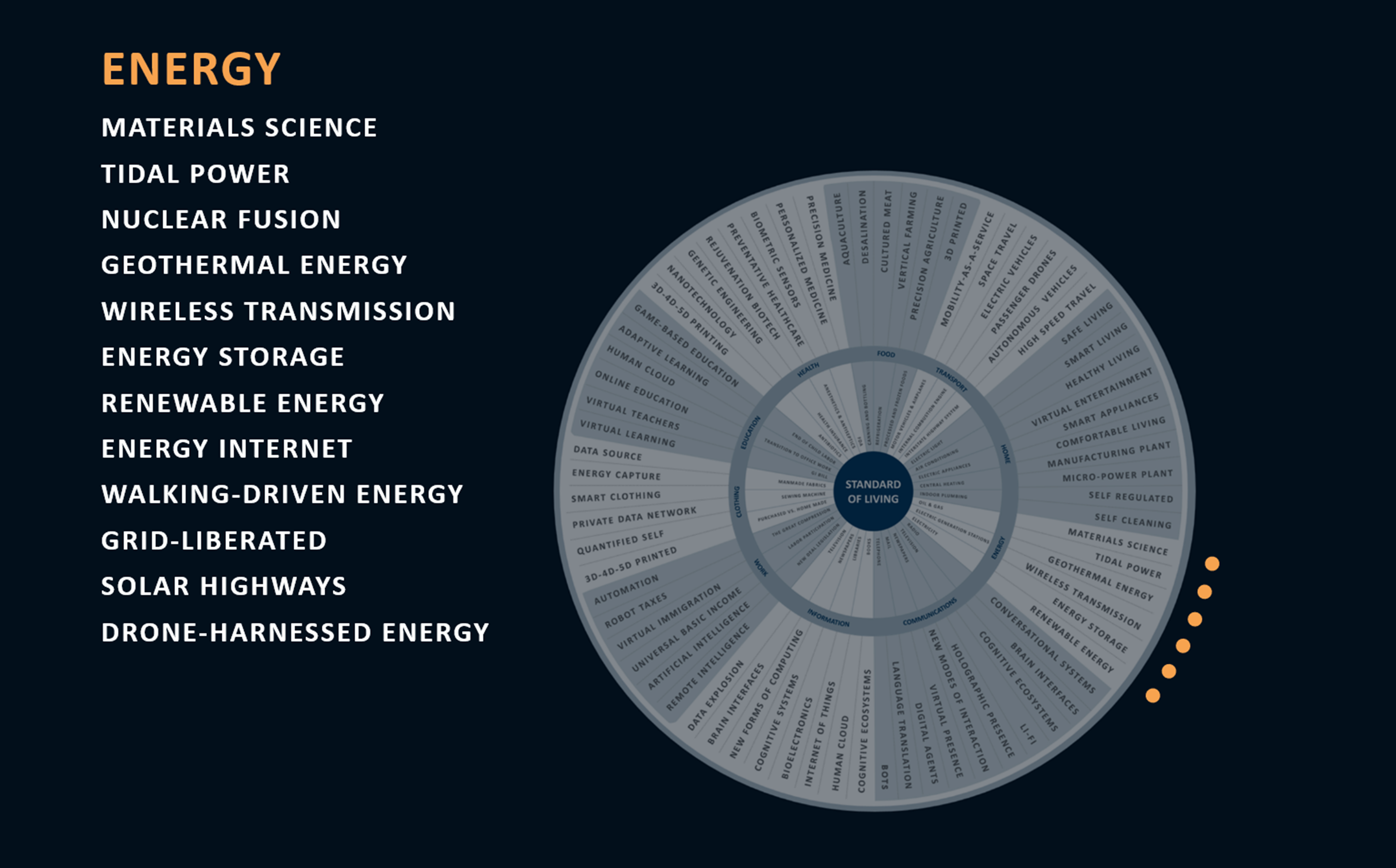 When we consider the building blocks on the innovation wheel that shape this emerging paradigm, the change is likely significant. One such building block is the wireless transmission of electricity.
This recent Article describes new innovation that enables this transmission. It was Nikola Tesla that first worked on Wireless Energy and Power Transfer. He almost succeeded when his experiment led him to the creation of the Tesla coil. It was the first system that could wirelessly transmit electricity. From 1891 to 1898 he experimented with the transmission of electrical energy using a radio frequency resonant transformer of the Tesla coil, which produces high voltage, high frequency alternating currents.
Accelerating Towards A New Energy Paradigm
My Post yesterday revisited the intersections that shape our future. Convergence across multiple domains sets these intersections in motion. In this context, convergence refers to a virtuous cycle where events in one domain spur action in another. The great inventions (electricity, telephone, and internal combustion engine) were clustered together at the end of the 19th century, forming a virtuous cycle that drove a period of astounding innovation. Several Catalysts drove an enabling convergence across the economy, science, technology, business, geopolitics, and a broader set of societal issues.
Revisiting the Intersections That Shape Our Future
The building blocks of our future are numerous, and they are intersecting in ways that drive rapid shifts. I Visualized this phenomenon a while back, trying to depict the complexity of our world and the challenges it represents. It was Futurist Gerd Leonhard that gave me the idea. As someone who used my Anchor Visual in keynotes, he reflected on how impactful it might be to demonstrate the convergence that was occurring across the visual.
Considering The lessons Of History
In exploring a Post Pandemic Society, I first took a look at what we could learn from history. A recent article took a similar view. Written by Kevin Sneader and Shubham Singhal, Their Look Back at History explores the experience of Japan, the United States, and Western Europe, post-World War Two. The article explores the inclusive growth that was sustained for two decades following the war. As technologies developed for war were adapted for peace-time use, poverty, government debt, and inequality fell, while living standards improved and prosperity spread broadly.
The Passion Economy
In 2014, I had this to say about the trend of putting a word in front of the word economy and declaring a new era: Something Economy: seems like a popular trend – stick a word in front of economy and use it to describe the next big thing. Some of these words are: Peer, Maker, Sharing, Gig, Collaborative, Green, Circular, Mesh, Digital, Innovation, semantic, and more.
The Future Is All About Uncertainty
When developing an online leadership course back in 2017, the focus was on the uncertain future that was unfolding. The course took A Journey Through The Looking Glass – a metaphorical expression that means: on the strange side, in the twilight zone, in a strange parallel world. It comes from the Alice and Wonderland literary work of Lewis Carroll, where he explores the strange and mysterious world Alice finds when she steps through a mirror. I have always found this to be a perfect metaphor for our times. Every time the looking glass has appeared, the world has experienced a Tipping Point. While I firmly believe a Tipping Point is coming, the impact is likely a question of severity.
The Future Of Work: Outcomes, Trust, And Empowerment
As the world focuses on a global pandemic, remote work has been a popular topic. As reported by Brian Fung, Google just Announced the extension of their remote work policy to July of 2021 – an acknowledgement that the pandemic could be with us a while. Siemens decided to make their policy permanent, but as this Recent Announcement indicates, their approach is very refreshing. Following in the footsteps of others, Siemens is adopting a new model that will allow employees worldwide to work from anywhere they feel comfortable. The permanent standard allows employees to leverage the new model for an average of two to three days a week. This article by Justin Bariso focuses on the refreshing part of the announcement, reflected in this quote by incoming CEO Roland Busch:
The Third Tipping Point
I have invested considerable time exploring the tipping points in human history. When I say tipping point, I mean a fundamental change in the nature of being human. As described in my Post on the topic, there were two main tipping points in human history: from hunter-gatherer to agriculture, and agriculture to our industrial society.
MIT Releases Deepfake video of Nixon Announcing NASA Apollo 11 Disaster
Per a recent Article via Bonnie Burton, MIT and Mozilla embarked on an initiative to help us better understand the disturbing power of deepfake videos in a new project called “In Event of Moon Disaster.” The resulting video below combines actual footage from the Apollo 11 mission with the delivery of a speech that Richard Nixon was prepared to deliver if the mission failed. The disturbingly real video used artificial intelligence to make Nixon’s voice and facial movements convincing. The contingency speech (which can be found in National Archives) was read aloud by an actor.
Future-Back Thinking
I am a big believer in storytelling. Stories about the future and how it may unfold help us create a future that is both prosperous and sustainable. I have talked about stories in the context of Future Thinking and used a visual to tell these stories and provide a Future Thinking Canvas. A recent Article describes this approach as future-back thinking. The article explores the work of Mark W. Johnson and Josh Suskewicz, co-authors of Lead from the Future: How to Turn Visionary Thinking into Breakthrough Growth.
The Great Acceleration
This research on the likely acceleration driven by the pandemic is a must read. Per their Website, Mehlman, Castagnetti, Rosen & Thomas is a full-service, bipartisan government relations firm whose partners and principals have decades of political and policy experience. The presentation is U.S. centric and a little heavy on politics. However, it captures many of the issues that are converging across multiple domains (business, society, science, technology, environment, philosophy, economics, and geopolitics). I believe it captures one of the most impactful aspects of the current COVID-19 crisis: the acceleration of forces that were already in play. It is a quick walk through of the following topics:
Continue readingVisualizing How Money Works
My continued research into solutions for some of our most pressing societal issues led me to an incredibility good book that simplifies the concepts behind modern monetary theory. Author J. D. Alt uses visualization to simplify the theory, making how money works easier to understand. His book – Diagrams and Dollars – was recently added to my Book Library. The book’s premise is that we have the way money is created and its flow through the system backwards.
The Future Of The Office And Changing Work For The Better
Can we ever go back to the way things were? That’s the question Manon DeFelice asks in a recent Article that explores the return to the office. The article provides some interesting insights. For instance, about 62% of Americans say they have worked from home during the COVID-19 pandemic, according to a recent Gallup Poll. A majority (59%) of those individuals say that remote work would be welcome post-pandemic. One of the concerns often stated about remote work is the impact on productivity. Well, Ms. DeFelice shares results from a YouGov Survey that found 54% of professionals ages 18-74 felt that working from home has had a positive impact on their productivity.
Robots And The Future Of Work
The phrase “The robots are coming” is often repeated these days. What does their arrival mean for the future of work? That question has short term implications, and the potential for profound long-term impacts. Ask around and you get vastly different perspectives on the question. We seem as polarized on the topic as we are about anything these days. A very good perspective was provided recently in an Article authored by Daphne Leprince-Ringuet. The article explores the possible changes to work as robots become a common feature in the work environment.
 Reimagining the Future