Life 3.0: Being Human in the Age of Artificial Intelligence

I just added another very good book to the Book Library: Life 3.0: Being Human in the Age of Artificial Intelligence –  A New York Times Best Seller. Author Max Tegmark takes a fascinating journey through possible AI futures. His physics oriented perspective provides an interesting point of view, as humanity wrestles with the ultimate path of artificial intelligence.

Mr. Tegmark tackles the discussion around how much machines will encroach on human domains, by illustrating a metaphor from Hans Moravec:

Continue reading

Game Changers: Designing the Future of Humanity

Today on Coffee Break with Game Changers, Bonnie D. Graham hosted a show focused on designing the future of humanity. You can listen to the rebroadcast here. The session abstract is included below, as well as a Twitter stream that provides insight into the topic and our discussion. The show participants included: Bonnie, Masha KrolIan GertlerMaricel Cabahug  and myself.

Continue reading

Game Changers: Can We Teach Machines to Predict?

Today on Coffee Break with Game Changers, Bonnie D. Graham hosted a show focused on the future of prediction. You can listen to the rebroadcast here. The session abstract is included below, as well as a Twitter stream that provides insight into the topic and our discussion. The show participants included: Bonnie, Gray Scott, and myself

Episode Description

The buzz: “Those who have knowledge, don’t predict. Those who predict, don’t have knowledge.” (Lao Tzu)

Given the uncertainty, pace, and unexpected nature of today’s world, there are too many unknowns for us to effectively predict the future. Reality check: A convergence across science, technology, politics, society, economics, the environment, and growing ethics discussion, has created a complex web that requires the type of system thinking that may exceed our human capacity. Do machines hold the answer? Can they predict the path of an overwhelming number of possible futures?

The experts speak. Frank Diana, TCS: “We have a duty to think hard about what may be, so as to better prepare society for the changes that may come” (Richard Baldwin). Gray Scott, Futurist: “Prediction is not just one of the things your brain does. It is the primary function of the neo-cortex, and the foundation of intelligence” (Jeff Hawkins). Join us for Tech Magic or Hype: Can We Teach Machines to Predict?

Continue reading

Find out where you Stand on Artificial Intelligence

Technology is giving life the potential to flourish like never before, or to self-destruct – The Future of Life Institute.

I stumbled upon this organization while reading Life 3.0: Being Human in the Age of Artificial Intelligence by author Max Tegmark. Their mission is to catalyze and support research and initiatives for safeguarding life and developing optimistic visions of the future, including positive ways for humanity to steer its own course considering new technologies and challenges. They are a charity and outreach organization working to ensure that tomorrow’s most powerful technologies are beneficial for humanity – and the list of members is a whose who of the science and technology community.

In their view, technology is to thank for all the ways in which today is better than the stone age, and technology is likely to keep improving at an accelerating pace. From their website: with less powerful technologies such as fire, we learned to minimize risks largely by learning from mistakes. With more powerful technologies such as nuclear weapons, synthetic biology and future strong artificial intelligence, planning ahead is a better strategy than learning from mistakes.

They support research and other efforts aimed at proactively avoiding problems with a current focus on artificial intelligence. The book referenced above looks at the advance of AI and how it will impact life, exploring a broad spectrum of views on what will/should happen. Now, the organization is looking to expand the conversation to include as many voices as possible. Here is a look at the results of their Super Intelligence Survey. You can add your own voice by taking the survey here.


Higher Education in the Age of Artificial Intelligence

In a recent book titled, Robot-Proof: Higher Education in the Age of Artificial Intelligence, Northeastern University president Joseph Aoun proposes a way to educate the next generation of college students, supporting society in ways that artificial intelligence cannot. His underlying premise is that the existing model of higher education has yet to adapt to the seismic shifts rattling the foundations of the global economy – I firmly agree. It was Alvin Tofler that said: The illiterate of the 21st century will not be those that can’t read or write, but those who cannot learn, unlearn, and relearn.

Continue reading

The Fourth Age

Byron Reese recently authored a book titled The Fourth Age. I thoroughly enjoyed this fascinating look at history, and the focus on possible futures. In looking at the future, Mr. Reese explores the reasons that experts disagree on the path of these possible futures. He asks: why do Elon Musk, Stephen Hawking, and Bill Gates fear artificial intelligence (AI) and express concern that it may be a threat to humanity’s survival; and yet, why do an equally illustrious group, including Mark Zuckerberg, Andrew Ng, and Pedro Domingos, find this viewpoint so far-fetched as to be hardly even worth a rebuttal? The answer as described by the author lies not in what we know – but what we individually belief. This theme throughout the book is an interesting piece of self-reflection. See how you would answer the questions posed by the author.

Continue reading

The Strategic Foundation

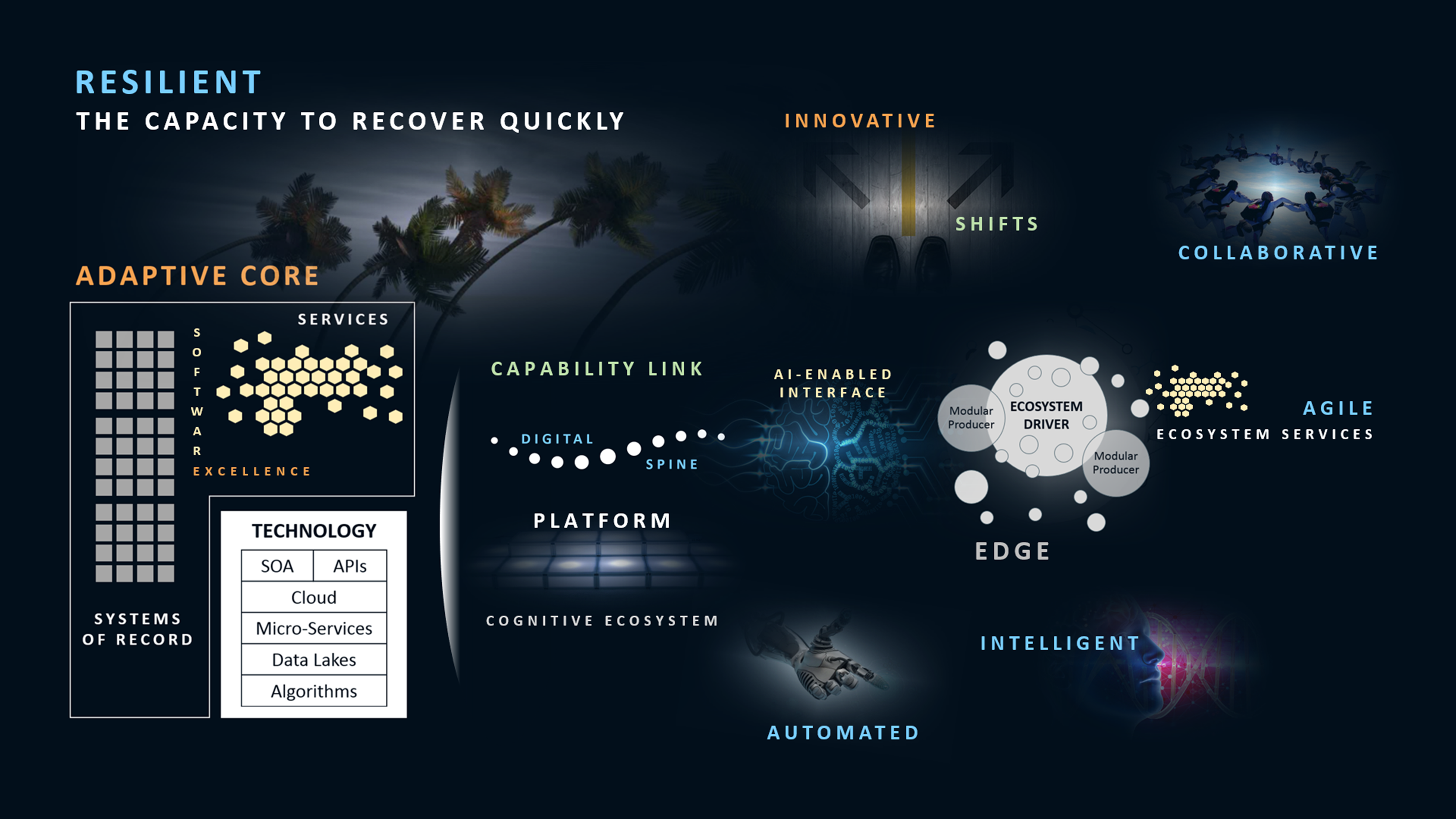
In my last post, I explored the evolution of business in the industrial age. This Fourth Iteration of Business establishes resilience on a foundation of automation and intelligence. Resilience may be more important than the productivity gains that are sure to be realized as we progress towards Business 4.0, providing the capacity to recover quickly as the pace of shifts accelerates. This visual represents a strategic foundation for Business 4.0.

The Strategic Foundation

Continue reading

The Automation of Everything

In a Post from 2014, I explored the path of automation and a possible economic impact between $14 and $30 trillion. Almost four years later, my focus has shifted from economic to societal impact. How far will we take automation? Will automation augment us, freeing us from mundane and redundant tasks, or will it replace us? Is automation limited to those characteristics we typically associate with our left brain – or will it encroach upon our right brain characteristics?

These questions currently have no answer – just speculation. How far the slider in the visual below goes, drives a profound difference in the ultimate implications to society. The obvious area of impact is the future of work – if we do indeed realize decentralized autonomous organizations. Do our right brain characteristics become much more important in this future world, and do they represent a safe haven? I show three very impactful examples in presentations that would have us question whether or not machines can be creative, compassionate, and eventual companions.

Continue reading

Artificial Intelligence and Jobs

This very good opinion piece addresses a subject that is gaining more attention and driving more dialog. Will artificial intelligence destroy jobs? Author Kai-Fu Lee has an opinion:

“It will soon be obvious that half of our job tasks can be done better at almost no cost by AI and robots. This will be the fastest transition humankind has experienced, and we’re not ready for it”

Continue reading

Tipping Points in Human History

I’ve been talking lately about the two main tipping points in human history: from hunter-gatherer to agriculture, and agriculture to our industrial society. That second tipping point beginning about 1760 ushered in three revolutions. The First Industrial Revolution  saw the rise of iron and textile industries and the mechanization of production through the use of water and the steam engine. This second tipping point saw a reduction in physical labor and a shift in where new forms of labor were required. The Second Industrial Revolution started in 1870,  riding advances such as electricity, telephone and the internal combustion engine to drive rapid industrialization and globalization. A massive disruption followed, as established sectors were eliminated and new ones emerged.

Continue reading

Will a Robot Take your Job?

In a recent article, Kevin Drum makes a compelling argument that You Will Lose Your Job to a Robot—and Sooner Than You Think. The piece is a little long, but this is a must read for everyone. At the heart of his argument lies the exponential progression of artificial intelligence (AI). Using the human brain as a barometer, AI will reach one tenth the power of the human brain by 2035. By 2045, we will have full human level AI.

Continue reading

Is Creativity the Sole Domain of Humans?

The transition from our current industrial/information age to an augmented and then ultimately an automated society is underway. The role of humans in that society is an often discussed topic, where our right brain characteristics are likely to play a more dominant role. But are those characteristics the sole domain of humans?

Meet an Artificial Intelligence Virtual Artist called AIVA that was taught to compose classical music – an emotional art which is usually considered to be a uniquely human quality. Musical pieces composed by this AI are used as soundtracks for film directors, advertising agencies, and even game studios. Oh, and it released its first album called Genesis.

8 Billion Acts of Innovation

I had the pleasure of talking to Taimour Zaman of 8 Billion Acts of Innovation today. They have a TV show focused on Artificial Intelligence, with some incredible stories about current innovation in the field.

The 8 Billion Acts of Innovation venture capital TV show is focused exclusively on artificial intelligence. Recently introduced in Toronto, Canada by investment visionaries Sai Mohammed and Taimour Zaman, AI companies present their business cases and compete for venture capital financing. It’s the only show of its kind in the world, now being viewed by over 3 million people.

$20+ Million of Funding per Show

The show’s panel of investors are senior ‘C-level’ executives whose job is to assess AI companies’ business and financial potential. The funds are put up by Curah Capital, a Toronto-based private venture capital firm involved in real estate and technology.

Mr. Mohammed and Mr. Zaman’s objectives for their show:

1) Worldwide popularity via expanded TV coverage
2) Attract top AI companies from across the world
3) Award ever-larger funding amounts, and
4) Develop financed-firms into celebrated successes

We covered a wide variety of topics in this short video.

Next Generation Education

The World Economic Forum estimates 65 per cent of children today will end up in careers that don’t even exist yet.

“Individuals and companies that succeed in the future will be those who adopt the philosophy of lifelong learning,” says Nigel Heap, managing director of Hays UK and Ireland. “Businesses that facilitate the resources, tools and time to support learning will not only have employees who are more engaged, but their business will be better placed to face challenges and remain innovative.”

From the Future of Learning


I’ve attempted to link innovation and our well-being via a visual that I’ve shared previously in this forum. It allows us to envision our emerging future and leverage story telling techniques to describe it in ways that become actionable. One of the most critical aspects of this emerging future in my humble opinion is the future of learning and education.

Reimagining Education

Our education system must prepare individuals for the world that is, not the one that was. It must ensure that those educated embody the qualities and competencies essential to life in a society very different than our industrial past. Among them are: creativity, critical thinking, innovative thinking, curiosity, social intelligence, a collaborative spirit, adaptability, entrepreneurial spirit, connecting dots, and knowing how to ask the right questions. Our need for life-long learning and unlearning drives us to reimagine education and transform through combinatorial innovations that leverage AI, Mobile, Cloud, Virtual Reality, Augmented Reality, Big Data, and more. Some of the facets of next generation education include:

Continue reading

The Singularity: Connecting Dots

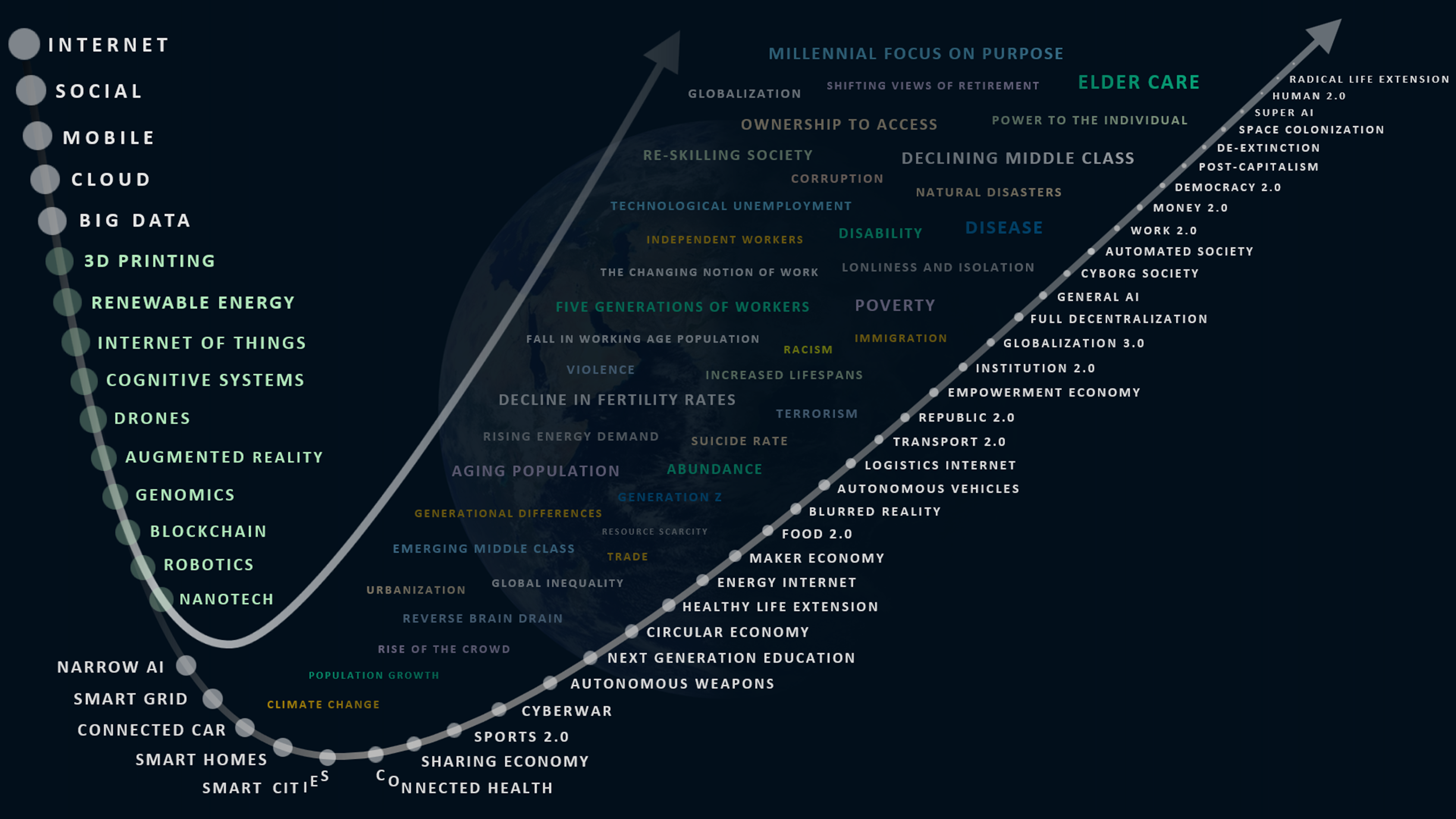
I have found that the metaphor “Connecting the Dots” is a good way to think about the emerging future. With the sheer number of dots emerging, and the pace at which they advance, we are challenged both by the number of dots, and the speed at which they emerge and Intersect. These dots are combining to form virtuous cycles; complex chains of events that reinforce themselves through feedback loops. Visualizing both the connections and the cycles is one approach to finding the signal through the noise.

Continue reading

The Timing of Future Scenarios

Timing. It’s one of the most difficult facets to consider when thinking about the future. We know that convergence across societal, political, economic, science and technological forces is creating many future scenarios. We also know that enablement is happening at an exponential pace. Some believe (present company included) that the coming macro-level tipping point is likely to impact humanity on a scale only experienced twice in human history (hunter-gatherer to agriculture and agriculture to industrial). There will be many micro-level tipping points on the journey towards an automated society – and the timing of those tipping points is impossible to predict.

Continue reading

Future Sports: Connecting the Dots

Last week, I presented on the future of sports at a fund raiser for the Rutgers University Women’s Soccer team. A local Article on the topic captured the high-level themes, but for those interested, here is the full presentation along with two very good reports I tapped into from Delaware North on the future of sports: The Future of Sports 2016 Report and The Future of Sports 2015 Report.

Continue reading

How will we Interact in the Future?

In recent post on the transformation of interaction, I talked about the changing ways in which we interact with our machines and each other. These changes combine with the emergence of ecosystems to complicate the experience journey. Well, if you saw my last post on our possible future, that journey could get very complicated. I’ve expanded my original visual to incorporate three additional categories of interaction, and some of what science and technology have in store (potentially) for our interaction paradigms. Continue reading

A Glimpse into a Possible Future

I saw a glimpse into a possible future in a book titled Homo Deus, written by Yuval Noah Harari in 2016. Before his journey forward, the author explores the past. His conclusions challenged my core belief system in a very uncomfortable way. His arguments were logical and thoughtful (whether I agree with them or not), and based on a foundation of life science, algorithms, and biotechnology.  This look forward once again raises the question of Ethics. The author himself makes this point when he says:

“The rise of AI and biotechnology will certainly transform the world, but it does not mandate a single deterministic outcome. All the scenarios outlined in this book should be understood as possibilities rather than prophecies. If you don’t like some of these possibilities you are welcome to think and behave in new ways that will prevent these particular possibilities from materializing.”

I’ve given the main themes of this possible future a label and provide a quick look using excerpts directly from the book. You decide for yourself if this future represents an enhanced or diminished humanity.

Continue reading

AI and the Conversational Era

On January 17, I had the pleasure of participating in another Game Changers show Presented by SAP focused on partnerships: Changing the Game for Digital Transformation. I was joined by Robin Kearon, SVP Channels and Alliances, Kore Inc. The show was once again expertly moderated by Bonnie D. Graham. You can listen on demand at your convenience.

TOPIC / EPISODE TITLE

Connecting People to Technology: AI and the Conversational Era

Continue reading