
I recently partnered with colleagues Bill Quinn, Kevin Mulcahy, and Rose Castellon-Rodriguez on an article for TCS Perspectives. You can Download the Article or view it Here.
The Augmented Age
Maurice Conti is the Chief Innovation Officer at Alpha focused on what he calls the Augmented Age. He talks about it this way: We’re heading for a future where our natural human capabilities are going to be radically augmented in three ways: Computational systems will help us think. Robotic systems will help us make. And a digital nervous system will connect us to the world far beyond what our natural nervous system can offer.
The Short Term Impact of AI is Very real
I recently ran into a TCS colleague at a forum in which I presented. Ryan Metz is a Data Scientist working at our Cornell Innovation Lab. Ryan mentioned an Article he had written about the short term impact of AI – versus the long term concerns voiced by the likes of Elon Musk and Stephen Hawking. As he states in the article, the long term concern is that we will produce machines so intelligent that we lose control over them. They will become a new form of life that rules over us as we do the the animal kingdom.
Rehearsing the Future
 I had the pleasure of participating on a radio show titled Geeks, Geezers, and Googlization. Hosts Ira Wolfe and Keith Campagna did a great job of facilitating our discussion about the future. Check out their Summary of our conversation, and/or listen to our conversation via this rebroadcast.
Looking Back to See Ahead
The further Backward you Look, the Further Forward you can See – Winston Churchill
I really like this quote from Winston Churchill. In a previous post on Learning from History, I was trying to say the same thing. One of the key learnings in looking back at our most transformative period (late nineteenth, early twentieth century), was the Convergence that occurred across multiple domains. I had developed a visual to capture a convergence phenomenon that took place over a one hundred year period – some have called this a Special Century. I updated the visual with new content (click the visual to expand). The color scheme shows the convergence that occurred across the business, science, technology, political, societal and economic domains. The red boxes represent the Catalysts that drove this convergence.
Embracing the Collaborative Nature of Ecosystems
Thoughts I shared at this years TCS Innovation Forum in New York City.
Possible Futures: Exploring Deepfake and Neuralink
Two recent articles highlight the dilemma faced in this era of rapid innovation: the potential to enhance humanity, and the opportunity to diminish it. This article on DeepFakes describes the challenge that society will face as Deepfake video and audio make it impossible to tell the difference between reality and fiction. Audio attacks using convincing forgeries can send stocks plummeting or soaring. How about mimicking a CEO’s voice to request a senior financial officer to transfer money? These are real examples provided by Symantec. This short Video describes the money transfer scenario.
More Societal Factors Added to Visual
As I periodically do, I have updated my anchor emerging future visual. The focus for this iteration was The middle portion of the visual: societal factors. The following factors were added, with some descriptions provided by the Future Today Institute (FTI) 2019 Trends Study:

The Shifting Winds of Education and Artificial Intelligence
Nick Burnett, Futurist and Education and learning entrepreneur, recently published an Article on education and artificial intelligence. The article launches a series that explores exponential technologies and their impact on learning and teaching. The post was co-authored with Nick Kairinos and the Fountech team. A focus on learners, teachers and leaders is critical, as education is the key to success in the 21st Century. I recommend the article.
The Story of Our Emerging Future
Story telling is the most effective way to communicate – and in times of complexity, uncertainty, and rapid pace, it becomes even more critical. Telling stories about the future requires a broad view of an increasing number of building blocks. The visual I use attempts to look at these building blocks and the various ways they combine to enable future scenarios. The scenarios themselves are combinatorial – converging on one and other in ways that transform how we think about the future. A deeper explanation of the visual can be found Here.
The Convergence of Science and Technology
In looking at transformative periods throughout history, it is apparent that Convergence was a critical driver of change. While I am still hopeful of the ultimate convergence across societal, political, environmental, philosophic, economic, and business domains, it is clear that convergence is already occurring in the science and technology domains. This synergistic relationship where advances in one domain fuels rapid advances in the other is the force behind our rapid pace. As we saw in the Poll that looked at the catalysts that drive convergence, it is this rapid pace of innovation that many believe will ultimately drive it. This initial convergence is altering long-held Beliefs and Intuitions – eventually forcing convergence across the other domains.
The Future of Cars: An Infographic
I recently came across a very good Infographic that describes the future of cars. Here is the abstract from the Carsurance website:
The future of cars undoubtedly seems exciting. Up to this point, cars were viewed primarily as a convenient method of transportation. The main advancements were made in reliability, safety, performance, and overall comfort. However, the advent of the internet and artificial intelligence unlocked a whole new field of progress in the auto industry.
Continue readingEcosystems in the Context of Digital Transformation
I recently authored an article on ecosystems and digital transformation along with leading platform strategist Simon Torrance. Here is a brief abstract of the article. You can read it Here on the TCS website – along with other perspectives on digital transformation.
ABSTRACT
As Frank Diana and Simon Torrance explain in “Defining Your Digital Ecosystem: The First Step in a Machine First™ Transformation,” many leaders are no longer looking at strategy and industry structure in the ways of a non-digital world. Instead, they’re analyzing how emerging ecosystems—networks of stakeholders, including business partners, suppliers, customers, and competitors that interact digitally to create value are supplanting traditional industries as the organizing construct. For example, in a mobility ecosystem, automakers no longer just make cars; they must redefine the very notion of automobile ownership and how people get around.
Bias and Diversity in Computing
In the past several weeks, the topic of Digital Ethics has come up several times. A critical piece of this discussion involves the bias that is and will be built into the applications of artificial intelligence. Amy Webb is a Quantified Futurist, Professor, Strategic Foresight at NYU, and the Founder and CEO of The Future Today Institute. In March of this Year, Amy published a book titled The Big Nine.
In her book, she tackles the issues associated with bias; specifically, the lack of diversity in computing. In this recent Article, Amy discusses the consequences of computer systems that don’t anticipate all the types of people who might use them. For example, Computers have started issuing prison sentences. A quick look at one of the largest technology companies underscores the severity of the issue: At Google, more than 95 percent of technical workers are white or Asian.
In reacting to the big focus on STEM, AMY had this to say: “If everyone is focused on the nuts and bolts of making software quickly at scale, where will they learn to design it with equity and care? Critical thinking is what the computers won’t be able to do,”. I recommend both the book and the article as a means of education and awareness regarding this critical issue of bias.
Brave New World of Digital Ethics: Who’s Deciding Our Technology Rules?
On June 19th, I participated in a VoiceAmerica Talk Radio program focused on digital ethics. VoiceAmerica is the leading producer, distributor, and online broadcaster of original live and on demand talk radio programming worldwide. Joining me on the program were Gray Scott, Jack Shannon, and Dan Wellers. The show was hosted by Bonnie D. Graham.
Issues like digital ethics must come to the forefront – and awareness is key to achieving that. Shows like this are a great vehicle for driving awareness. You can listen to the rebroadcast Here. A description of the episode follows.
Will Astounding Innovation Elevate Global Well-Being?
The center-piece of my work is the early signs of a Shift to Purpose and Well-being. I first developed this Innovation Wheel (click to view in a separate window) 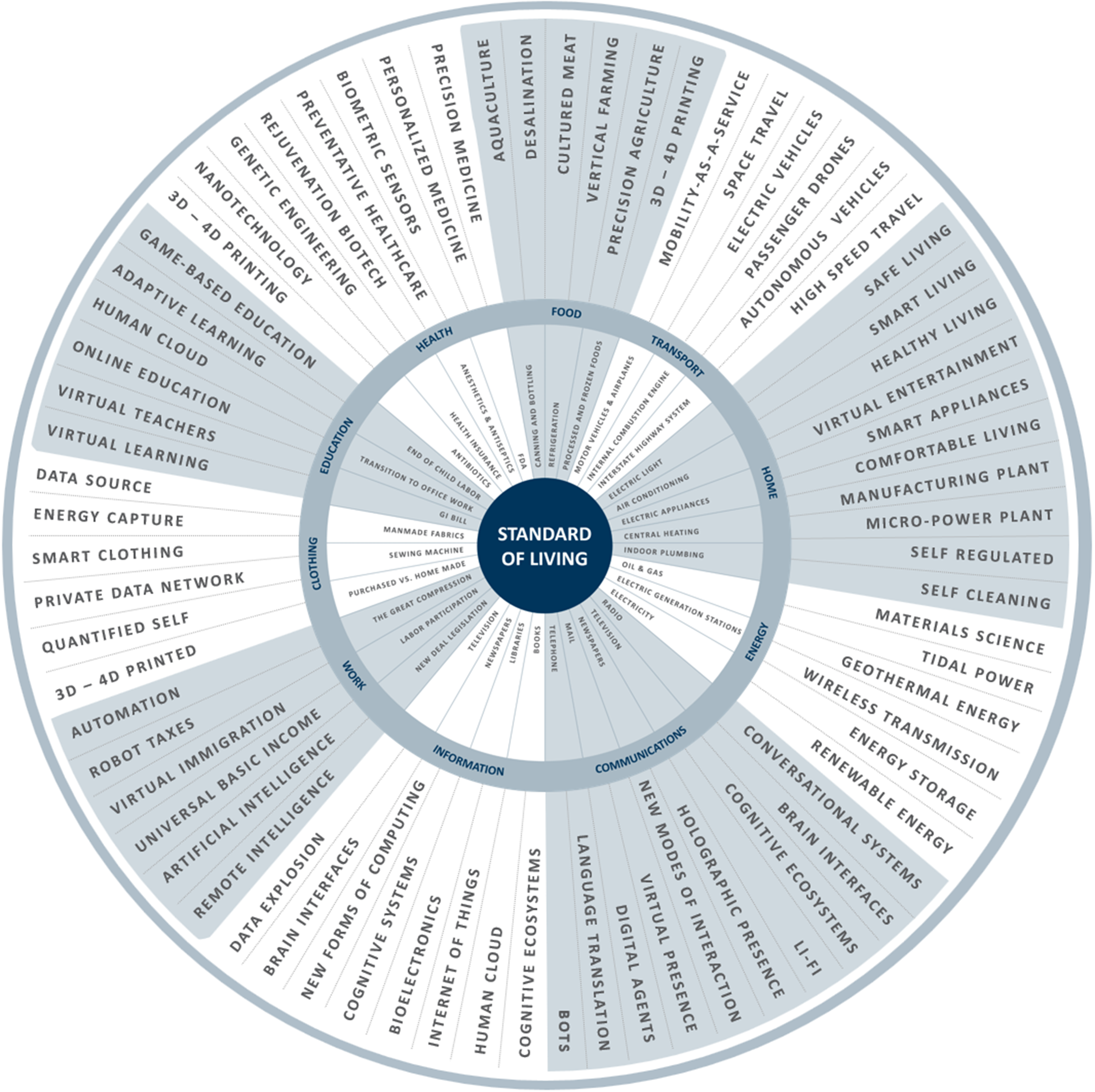 when analyzing the impact of second industrial revolution innovation on well-being in the Western world. The Possibilities are boundless – but society must Map the Path of Future Innovation. I walk around this innovation wheel when describing it to an audience, investing time in describing the possibilities across the various areas of well-being. This short video clip replicates that walk around the innovation wheel. The possibilities are indeed boundless.
Food Abundance and Unintended Consequences
Two major forces are likely to converge in very unpredictable ways. The road to Abundance, as described by Peter Diamandis, promises to advance our human development in ways we never could have imagined. At the same time, the journey will drive a number of unintended consequences. The intersection of these two forces underscores the importance of focusing on emerging scenarios now, while we have the opportunity to realize the advancements and mitigate the impact of unintended consequences. Let’s use the journey towards food abundance as an example.
The Ready Room
I had the recent pleasure of talking with Richard Frederick about a number of topics regarding the future. Richard runs a Podcast called The Ready Room; an idea driven by his concern over the decline of civil discourse and the ideological barricades with which so many have surrounded themselves. In his words: “If only we could come out from behind our political fortresses and talk openly with one another and truly seek to open our minds to change, we could regain a shared civic trust.”
The Ready Room is Richard’s way of reaching out to others to begin this discourse. I was happy to be included in this process. You can listen to our discussion below.
Perceptual Computing and Emotional AI: A Discussion
As mentioned in my last Post, a fascinating exchange happened between Gray Scott and Anthony Scriffignano, as we discussed the need to prepare for the future at the TCS Innovation Forum in New York City. I’ve captured that dialog in this post. As a backdrop, Anthony was reacting to the topics that Gray covered, namely; Perceptual Computing and Emotional AI. Here is their exchange:
Preparing for the Future: Part Two
As mentioned in my previous post, I had the pleasure of hosting two sessions recently at the TCS Innovation Forums in London and New York City. The sessions, which explored the need to prepare for the future, involved thought leaders, futurists, and various leaders across multiple domains. They were structured with several five-minute descriptions of forward-looking themes, and once context was set, a discussion with the broader leadership group was moderated. The sessions focused on education and awareness, rooted in a strong belief that leaders must prepare for and shape our emerging future.
This post will summarize the New York Session, which differed slightly from the one in London. While the London session painted a wide array of evocative future scenarios, the New York session explored several of the key technologies and enablers that will fundamentally shape and impact emerging scenarios. It wasn’t however a technology discussion. This engaging group of thought leaders provided eye-opening facts and focused on implications, both positive and negative. As in London, I opened the session with three key themes from my Expectation post: Acceleration, Possibilities, and Convergence; Here is a look at the insights that followed.
 Reimagining the Future